
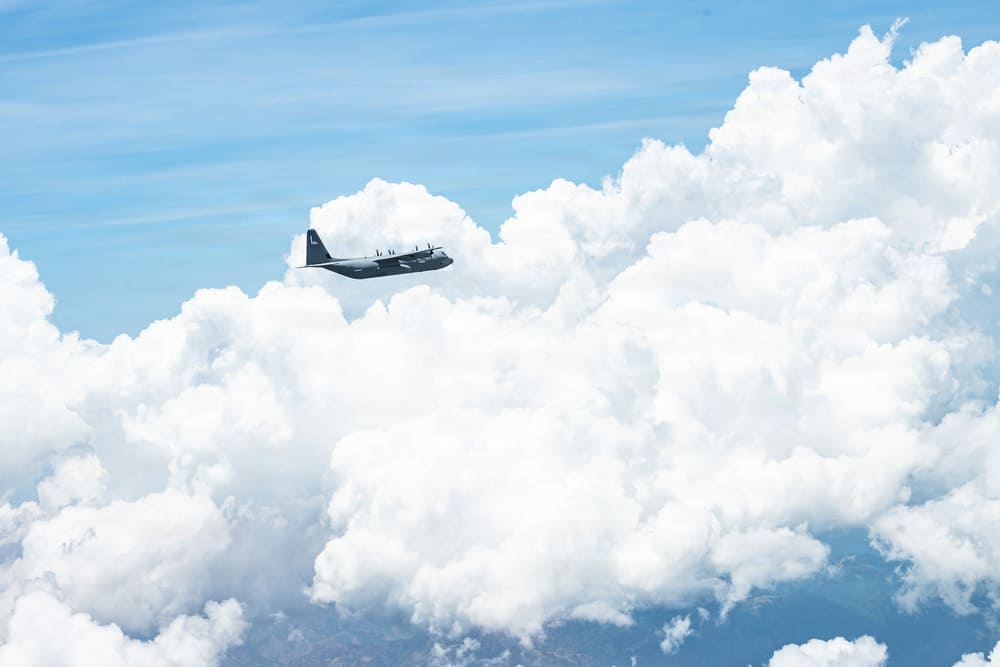
Footage circulating on Dec. 16, 2025 shows a new Chinese four turboprop transport aircraft in flight testing. The designation stays unofficial, with Y-30 and Y-15 both in use among watchers. The airlifter appears sized between the Y-9 and the larger Y-20, with features aimed at tactical lift and rough field work.
China Y-30 tactical transport aircraft flight test footage and first sighting details
The first clear sign came from low quality video shot from the ground. The aircraft passes overhead at low altitude, with the camera tracking it through a short segment. Still images then followed, showing more of the planform and tail. The material spread fast across Chinese social platforms, then into wider defense circles.
A long air data boom stands out on the nose in the imagery. That feature points to early envelope work, with test points that gather airflow and pressure data. The airframe also appears clean, with little sign of the antennas and fairings that tend to multiply later in a program. The footage does not settle the question of refueling equipment, since angles stay limited.
The location remains unconfirmed in official channels. Several trackers tie the flight to an airfield in the Xi’an area, where large transports and special mission aircraft have appeared in the past. Some reports connect the program to the Shaanxi transport line, with corporate boundaries that shift over time inside the same state aviation ecosystem.
The airlifter had a public trail before this week. A scale model displayed at the Zhuhai show in 2014 carried the Y-30 label and the description new type medium transport aircraft. That model sat inside the state aviation group’s exhibit space. The decade long quiet that followed fits China’s pattern for transport and support aircraft programs.
Formal acknowledgement still has not arrived. No service statement has confirmed a designation, a manufacturer, or a schedule. That silence leaves room for the usual churn of claimed specifications and edited imagery. The most responsible read stays narrow and sticks to what the photos show.
Y-30 design features compared with Airbus A400M, Y-9, and C-130J class airlifters
The aircraft looks like a shoulder wing transport with a rear cargo ramp. A T tail sits above the fuselage, with a tall vertical fin and a high mounted horizontal tailplane. The overall layout matches a modern tactical airlifter more than a commercial derivative.
Winglets appear on the wingtips, with a blended look in several photos. The main wing itself looks straight, without the sweep seen on some comparable Western designs. Four nacelles sit along the wing, each driving a propeller. In the clearest images, the props show six blades.
Several observers have compared the silhouette to the Airbus A400M. The comparison comes from the T tail, high wing, winglets, and ramp. Size cues point to something smaller than A400M, though exact dimensions remain unknown. It also reads as larger than the Y-9 in fuselage cross section, at least from the angles available.
Heavy duty landing gear shows in the side views, with a stance that suggests short field intent. The gear appears built for repeated cycles on less prepared strips, not just smooth concrete. The combination of a ramp and rugged gear points to pallet work, light vehicles, and airdrop loads.
The transport sits in a space that many air forces treat as core capacity. The C-130J remains the reference point for that mission set, and China has relied on older Y-8 variants plus the newer Y-9 for years. A new airframe in this bracket offers better payload options and better efficiency, if production follows.
WJ-10 and WJ-16 turboprop engines, propellers, and estimated payload range
Engine identity remains the biggest unknown. Public discussion points to a new turboprop, often described as WJ-10, with other references pointing to WJ-16. Some reporting ties the likely powerplant lineage to the AEP500 series developed for China’s MA700 turboprop airliner. None of this has official confirmation today.
Power estimates vary and should stay treated as provisional. Figures in circulation range from roughly five thousand to nearly seven thousand horsepower per engine, depending on which engine label an analyst uses. Even the low end would support a payload class above older medium transports. The high end would push it closer to the upper part of the tactical bracket.
The propellers look conventional in planform, at least from the photos released so far. The A400M uses distinctive scimitar blades, yet this airframe shows a more standard blade profile and a six blade count. That choice can reflect development stage, vendor path, and certification needs. It also can change between prototypes and production aircraft.
Payload claims center on a 25 to 30 metric ton bracket. That estimate appears in several reports that treat the aircraft as a bridge between the Y-9 class and the heavier jet powered Y-20. A 30 ton class would align with a wider fuselage and higher floor strength than the Y-9, while staying well below the strategic lift tier.
A wider fuselage matters as much as raw tons. Internal volume drives what a unit can load without disassembly and special handling. The ramp also matters for fast turnarounds, since it supports roll on cargo and low profile vehicles. Door placement in the rear fuselage, if confirmed, can support paratroop exits and rapid offload drills.
According to industry sources, a major goal here is a transport that can run regular lift cycles from dispersed strips, then feed larger hubs and strategic aircraft. That concept matches the mix of engines and the likely runway performance target. It also matches how other air forces use C-130 class fleets alongside heavier jet transports.
PLAAF airlift modernization, Y-20 fleet growth, and future special mission variants
China’s airlift fleet has expanded fast over the past decade, with the Y-20 leading the strategic end. The tactical end still leans on the Y-8 family and the newer Y-9, plus a smaller number of imported Il-76 transports in earlier years. Public estimates put the Y-9 transport fleet far below what a large military would want for sustained high tempo lift.
Training trends point to why tactical lift stays important. A recent U.S. defense report said PLA training events refined logistics coordination, long distance transport, and rapid loading and offloading of amphibious equipment. Those lines describe basic mechanics that depend on reliable airlift, not only combat aircraft.
A medium turboprop also opens options for missions that the Y-8 and Y-9 have carried in large numbers. China has built many special mission variants on those airframes, including maritime patrol, electronic warfare, and airborne early warning aircraft. A new base airframe can take some of that load over time, though older lines can also stay open for niche builds.
Export potential stays part of the story, even if this prototype never leaves China. State firms have marketed Chinese platforms as alternatives for countries that face restrictions on Western aircraft buys. A transport that sits near the C-130 class would attract interest in regions that run mixed fleets and operate from short runways. The final export path depends on production rate and support capacity, not only performance.
Questions remain basic and unavoidable. How many prototypes exist. What engine ends up on the production version. What the real payload and range values are with hot weather and short strips. The first flight imagery gives a foundation, yet the program now needs repeat sightings across months, not days.
Our analysis shows the Y-30 concept fits a visible gap in China’s transport ladder, between the Y-9 fleet and the Y-20 strategic airlifter. A successful program would add more than another new airframe. It would add daily lift capacity that supports deployment, sustainment, and training cycles across a wide map.
REFERENCE SOURCES
- https://www.janes.com/osint-insights/defence-news/defence/update-new-chinese-transport-aircraft-appears-in-video-footage
- https://www.flightglobal.com/fixed-wing/new-four-engined-chinese-tactical-transport-spotted-in-flight/165723.article
- https://www.scmp.com/news/china/military/article/3336791/are-these-first-pictures-chinas-new-military-transport-plane-taking-skies
- https://www.globaltimes.cn/page/202512/1350803.shtml
- https://theaviationist.com/2025/12/16/chinas-new-medium-airlifter-has-flown/
- https://www.aerotime.aero/articles/china-y-30-turboprop-transport-first-flight
- https://aerospaceglobalnews.com/news/china-y-30-transport-maiden-flight/
- https://media.defense.gov/2025/Dec/23/2003849070/-1/-1/1/ANNUAL-REPORT-TO-CONGRESS-MILITARY-AND-SECURITY-DEVELOPMENTS-INVOLVING-THE-PEOPLES-REPUBLIC-OF-CHINA-2025.PDF