Col. Guy Yelverton, who leads the Army’s counter-drone product office, told an AUSA audience the service will run industry competitions “at least at an every two-year cycle” to match fast-changing threats and reduce delays between demonstrations and fielding. “We need to ensure that we continuously outpace the threat,” he said. He also described an ongoing evaluation with “about 12 vendors” for soldier common equipment and left room for multiple winners. “And if they’re all good, we’ll select all 12, because we need a lot of capability in the counter UAS environment.”
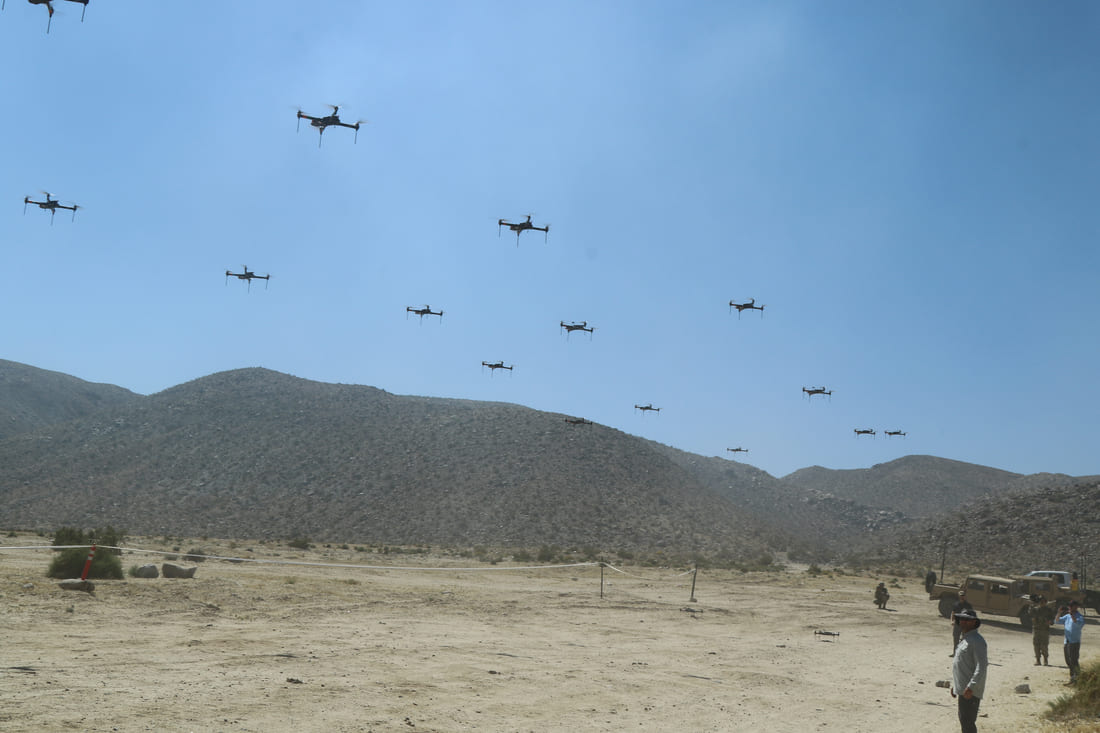
The schedule follows three years of urgent counter-UAS buys, rapid prototypes, and joint experiments with mass use of small, inexpensive drones operated by distributed teams. Officials stressed faster cycles of test, select, field, and update to match contact pace.
Soldier and Unit Equipment Requirements
Program officials targeted two areas. First, individual soldier-carried or wearable counter-UAS gear that can detect, identify, and defeat Group 1 and Group 2 drones without fixing troops in place. Second, unit common equipment mounted on vehicles to provide shared sensing and fire control across platoons and companies. Officials confirm larger Group 4 and Group 5 systems remain under traditional air defense.
Early entries for soldier equipment include handheld or rail-mounted sensors, lightweight electronic-warfare emitters, optic add-ons that cue shooters to aerial targets, and software interfaces over dismounted radios. According to industry sources, some kits overlay digital target markers in a shooter’s sight picture and hand off to jammers or kinetic options if a drone persists. Several vendors highlighted radio-delivered software updates to improve algorithms without hardware swaps.
Unit equipment on display drew from modular sensor masts, passive RF detection, compact radars, and electronic-support packages moving with maneuver formations. Companies showed fused tracks from acoustic, RF, and radar sources feeding a simple fire-control picture to platoon level. Officials confirm the Army intends to buy multiple variants to avoid single-point failure and align offered recurring competition.
The Army also briefed ongoing fire-control trials tied to counter-UAS. Those trials test which systems can ingest several sensor feeds, classify tracks, and pass target-quality data to effectors without heavy crew workload. Briefers linked the effort to an FY26 slate soliciting unit common equipment, additional sensors, and electronic-warfare modules.
Microwave Interceptors and Layered Defense
Maj. Gen. David Stewart called Group 3 aircraft “a vexing middle ground,” citing speed, maneuver, and endurance that complicate kills for short-range systems. Swarms of Group 1 and Group 2 drones deliver similar effects at much lower cost. Col. Marc Pelini pointed to high-power microwave weapons as a cost-effective answer to swarms if the systems can hit targets “at least a kilometer or two” away. “I think that’s probably the most economical and combat-effective approach,” he said, stressing standoff. Pelini warned against seeking a single solution. “I don’t think there’s a silver bullet that can address the full range of threats. You need a Swiss Army Knife of effectors to completely protect yourself from an engagement perspective.”
Recent demonstrations offered fresh data. A high-power microwave system recorded 61 defeats out of 61 drones across five scenarios in August and finished one-pulse against a 49-drone swarm. The event followed Army deliveries of prototype HPM systems under an accelerated program and pointed to standoff effects against dense raids without expending interceptors.
Industry teams paired HPM payloads on robotic carriers and tracked UGVs to keep emitters moving. One prototype integrated a microwave payload on a 10-ton unmanned ground vehicle to escort formations and protect mobile command posts. Exhibitors emphasized power management, beam steering, and rapid re-attack.
Kinetic interceptors remain in the mix. The Army last year selected BlueHalo to advance a Next-Generation C-UAS Missile through a consortium effort for extended range and modularity against Group 3 drones. Officials cited that award while describing how recurring competitions will keep lanes open for both kinetic and non-kinetic systems.
Layered defense drew attention beyond microwave and missiles. Units experimenting under V Corps’ Project Flytrap in Europe reported tactics pairing RF sensing, shooters, and allied systems. The series brought together U.S. and U.K. formations, NATO partners to test counter-drone devices and adjust tactics. Results will inform requirements and future competitive events.
The Army’s new joint interagency task force for small-UAS also featured during AUSA discussions. Leaders described a faster loop for bringing allied lessons and commercial tech into U.S. units, iterating hardware and software at operational tempo. Officials said the approach matches competition cadence and encourages broader vendor participation.
FY26 Solicitations and Multi-Award Approach
The service is closing a fire-control competition during soldier-equipment down-select runs in parallel. The FY26 pipeline includes solicitations for unit common equipment, sensors, and electronic-warfare payloads. Program teams asked for open architectures accepting rapid updates and user interfaces cutting false tracks and cognitive load. Yelverton’s office expects to structure events so more than one firm wins when gear meets performance thresholds in trials.
Acquisition officials linked the recurring model to practical goals: comparable performance data across regular test events, space for vendors to return during two years later, and resilience from a deeper pool of qualified systems if a supplier faces constraints.
The two-year cycle also supports quicker fielding. Soldier feedback from National Training Center rotations, Project Flytrap, and deployments feeds the next call for proposals. Industry responded in kind. Companies showed plug-in microwave arrays, compact radars sized for JLTV racks, passive RF sensors that geolocate emitters without exposing friendly positions, and interceptors reusing common launchers. Several firms pitched software-first designs accepting waveform libraries from government sources, offering the government interface control. According to industry sources, multiple teams left AUSA preparing for FY26 requests built around open-mission profiles.
Operational users pressed for clarity and consistency. Platoon leaders asked for clean symbology, simpler aids for rules of engagement, and automation lowering friendly-UAS fratricide risk. Trials in heavy EW clutter highlighted why classification quality matters as much as detection. Fusion stacks combining radar micro-Doppler signatures from RF and optical confirmation performed better against decoys and birds.
Training units argued for common ergonomics. A shooter moving from one handheld jammer to another during rotation should find the same trigger logic, battery-status layout, and aiming aids. Program teams said they will score this during soldier touchpoints and push findings into down-selects.
Test officers stressed kill-chain integrity. A strong sensor fails if fire-control nodes drop tracks during network congestion. Competing systems must preserve track continuity and pass target-quality data retaining intact timestamps. Vendors showed local-mesh fallback to keep short-range tracks alive when backhaul links saturate.
Power-dominated design tradeoffs. HPM payloads demand energy and thermal control, especially on small robotic carriers. Demonstrators used hybrid generators and swappable battery packs keeping emitters available for long missions. Kinetic systems faced reload times and launcher limits. Units during tight vehicle space pushed for common canisters or rails.
Range claims faced careful questions. Pelini’s one- to two-kilometer requirement reflects the need to engage swarms before they saturate a position. Demonstrations raised confidence, though operational testing must prove effects in wind and rain and against mixed-material airframes. Program managers said they will require repeatable performance in varied environments, not instrumented ranges only.
Electronic protection remained a focus. Adversaries shift waveforms and links quickly. The Army wants emitters and decoders updating on short intervals without full hardware swaps, moving more work into software and field service kits. According to officials, competitions will score how fast firms deliver validated updates after a new threat appears.
Our analysis shows the two-year competition cycle shortens delays between new adversary tactics and counters inside U.S. formations, especially when software-heavy EW and detection payloads lead changes. Procurement language steered away from single-vendor pathways. Leaders signaled preference for multiple awards within categories and continuous shoot-offs in the next cycle to sustain performance pressure.
REFERENCE SOURCES
- https://breakingdefense.com/2025/10/army-to-execute-recurring-competitions-for-counter-drone-tech/
- https://cuashub.com/en/content/us-army-to-hold-recurring-competitions-to-fielding-counter-drone-tech/
- https://www.ausa.org/2025-annual-meeting-news
- https://meetings.ausa.org/annual/2025/
- https://bluehalo.com/bluehalo-selected-for-u-s-army-next-generation-c-uas-missile/
- https://www.epirusinc.com/press-releases/epirus-leonidas-high-power-microwave-defeats-49-drone-swarm-100-of-drones-flown-at-live-fire-demonstration
- https://www.army.mil/article/287453/v_corps_leaders_share_lessons_learned_on_counter_uas_training_from_project_flytrap
- https://extra.ausa.org/05-08-2025/docs/AUSAExtra_May-8.pdf