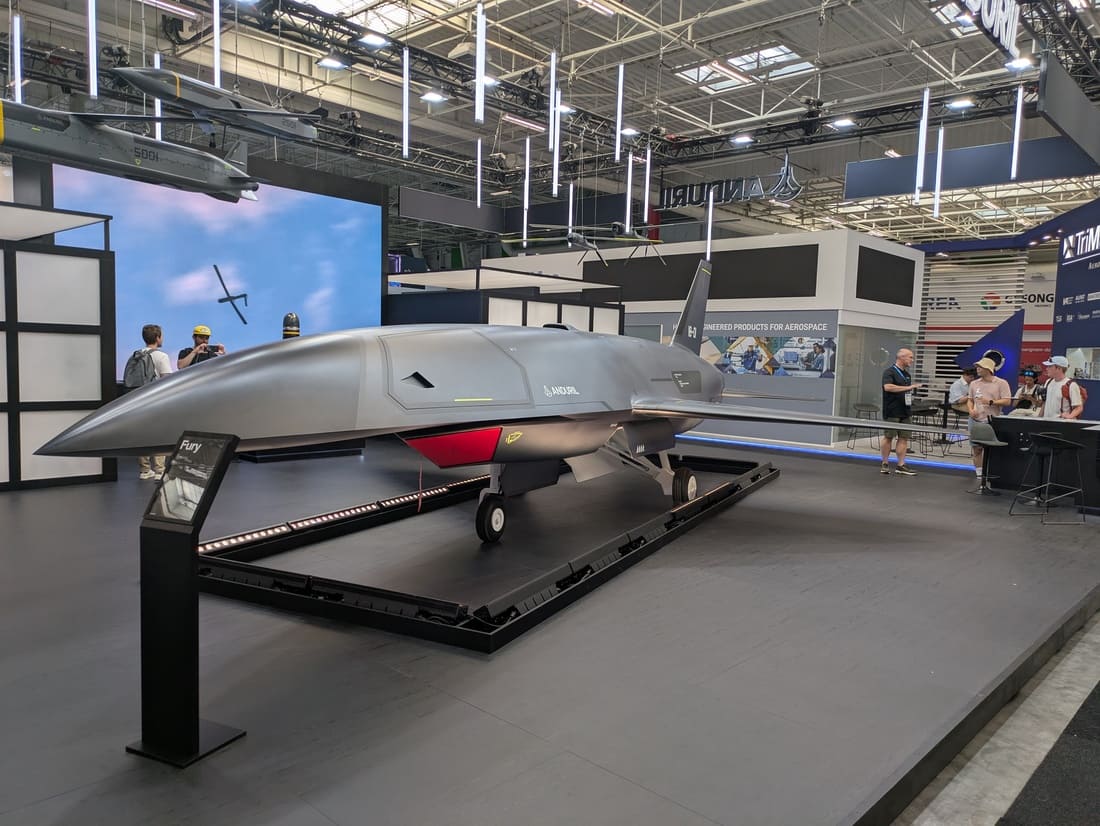
Palmer Luckey warned reporters in mid-October that the government shutdown would “certainly” set back the first flight of Anduril’s Collaborative Combat Aircraft prototype. “I can’t fund the government,” he said, pointing to approvals and support functions that pause when agencies close. The Air Force has now confirmed the maiden flight of Anduril’s YFQ-44A on October 31 at a California test site, flown in a semi-autonomous mode. The shutdown slowed coordination, yet the event went ahead once the service cleared the remaining steps.
General Atomics’ competing prototype, designated YFQ-42A, entered flight testing on August 27. That earlier start created a brief gap between the two efforts inside Increment 1 of the Air Force CCA program. Both prototypes are now in test.
The October 31 sortie highlighted the concept Anduril has described since September. Company leaders said they aimed for a push-button takeoff and landing on day one, without a human on a stick-and-throttle controlling the aircraft in real time. That approach demanded more software readiness before first flight, which the firm argued would pay back later during envelope expansion. The Air Force’s statement on Friday underscored the semi-autonomous profile, and an official added that competition is driving faster delivery.
Government Shutdown Effects on Flight Test Approvals
A shutdown that began on October 1 kept large parts of the civil service at home and forced many others to work without pay. Budget analysts have put the running economic drag in the multibillion range as the stoppage pushed past four weeks. For flight test, furloughs hit the schedulers, contracting officers, safety reviewers and range coordinators who stitch together a maiden flight. Industry teams can prepare vehicles and crews, but government acceptance steps move slower during fewer people on duty. Luckey captured that bottleneck on October 13 when he said the shutdown would “certainly” cause delay because “a lot of stuff stops moving.”
Defense officials confirm essential test activity can proceed under excepted status when safety or national security demands it, though support is thinner and sequencing grows harder. According to industry sources, some test windows in October slid to the right as government checkpoints stacked up, even as contractors kept vehicles fueled and crews current.
Even after the first flight completed, the lingering funding lapse still touches the program. Travel, non-urgent reviews and paperwork routing do not recover instantly. The service has not published a detailed schedule for the next sorties during the shutdown continues, and no one in government has offered a public estimate for when full staffing returns. The Air Force has kept messaging focused on competition and test progress, avoiding any suggestion that Increment 1 slips out of its planned decision window.
YFQ-44A Semi-Autonomy Approach and Shield AI Integration
Anduril handed the aircraft to the Air Force over the summer and ran fuel, taxi and systems checks under government observation. Company leaders repeatedly previewed a first flight that would start using automation, not manual piloting, to accelerate later tasks. Diem Salmon described the goal in September: takeoff and landing “at the push of a button” without no stick and throttle, execute a preplanned profile using vehicle autonomy. That choice pushed software work to the front of the queue, which the company said would shorten later phases. Friday’s semi-autonomous flight matches those claims.
The firm’s engineering lead, Jason Levin, has emphasized in public forums that fight-autonomy software lives onboard, during a human supervising but not issuing continuous control inputs. Air Force reporting on the October 31 event described the aircraft managing its own throttle and flight controls and returning to land automatically.
Pairing on autonomy matters for Increment 1. According to program reporting in late September, Shield AI’s Hivemind software is slated to provide the autonomy “pilot” for Anduril’s platform, during RTX supports General Atomics on its model. The government has not released contract values for the autonomy packages, but the selection indicates the Air Force wants at least two independent stacks maturing in parallel during the airframes.
Weapons carriage, survivability features and bandwidth management remain largely undisclosed. Ground photos show a compact, jet-powered planform offering inlets sized for a small turbofan, consistent during the Air Force’s desire for speed and range that match fighter employment. The service has not listed payloads, though earlier CCA concept work pointed to air-to-air roles and escort sensing as the first mission set. Test cards in the near term focus on handling qualities, basic systems reliability and safe separation from chase.
General Atomics YFQ-42A and Competition Structure
General Atomics announced the first YFQ-42A flight on August 27, moving immediately into a coordinated test campaign during the Air Force. The company’s public statements highlighted a modular line that traces to the XQ-67A and previous off-board sensing projects. That early August start gave GA-ASI more time in the air before October, during Anduril finished software gates. Both vehicles are now airborne, so the service can compare real data on flying qualities, maintainability and autonomy behavior.
Competition at this stage remains head-to-head. Increment 1 calls for at least two production-representative prototypes and a down-select decision afterward. The Air Force has kept the door open to multiple vendors entering production, though it has also suggested one could dominate if it clears readiness thresholds earlier. The government’s focus, based on its messaging across the fall, centers on speed to an initial fielded capability rather than long, serial development.
Autonomy teaming outlines grew clearer in late September. Reporting then indicated RTX on the YFQ-42A stack and Shield AI on the YFQ-44A. Government officials have not committed to a single autonomy baseline for Increment 1, and industry expects hot-swap options to persist as algorithms harden through test.
The wider market is not standing still. Shield AI disclosed a separate jet project, X-BAT, outside the Air Force prototype program, signaling the spread of autonomy work beyond the two Increment 1 primes. Naval efforts are also underway to define a carrier-capable unmanned aircraft offering overlapping technologies, and several vendors from the Air Force effort have signaled interest.
Independent Squadron Structure and Production Schedule
Gen. Kenneth Wilsbach, now confirmed as Chief of Staff, told lawmakers on October 9 that CCA units will likely stand as independent squadrons rather than embed inside fighter squadrons. “We’re thinking that they’re not going to be embedded in current fighter squadrons, but rather they’re going to be their own squadrons, and they’ll be dispersed,” he said during his confirmation hearing. Separate units give the service a cleaner way to assign commanders, set maintenance structures and write training syllabi without rewriting fighter squadron tables. The concept also fits an aircraft that can fly alongside multiple host platforms across a wing.
Production timing remains the question inside the program office. Public statements around the Anduril first flight reiterated a production decision target in fiscal 2026. The service has not detailed quantities for an initial tranche under Increment 1, and it has not named a preferred basing sequence. Any decision to push quantities will depend on flight hours, availability rates and the rate at which autonomy proves trustworthy across basic tasks. Friday’s event clears the fundamental bar of controlled flight in the program’s second airframe.
Defense officials confirm the shutdown has not changed the Air Force’s intent to keep Increment 1 moving, even if administrative steps take longer under reduced staffing. A sustained lapse in appropriations can slow contracting awards, acceptance of test reports and travel for integrated test teams. According to industry sources, teams continue to work affordability levers in parallel, including engine and mission-system options that hold down sustainment costs once production starts.
Two flying airframes give test pilots and autonomy engineers a real venue to study how a crewed aircraft supervises a wingman at range without constant radio calls. Range time now goes toward proving basic behaviors-rejoin, station-keeping, route execution, return-to-base logic-and collecting data on how often the autonomy hands back authority under edge cases. That work will inform whether independent squadrons need a common “coach” aircraft in the pattern or whether squadron-owned ground stations carry most of the load.
Quotes from both sides show a cautious confidence. Luckey’s “Certainly … a lot of stuff stops moving” remark captured what test organizations saw across the month. In contrast, the Air Force’s message on Friday stressed momentum. “This milestone demonstrates how competition drives innovation and accelerates delivery,” an official said in the service’s announcement. Those notes do not conflict. The first speaks to staffing and process; the second to the outcome once the pieces came together.
General Atomics’ head start still matters. More weeks in the air normally translate into more sorted bugs, better maintenance planning and smoother checkouts for new software builds. Anduril’s choice to start during semi-autonomy changes that math. The company front-loaded the heavy software lift, then crossed first flight during the autonomy stack already doing real work.
Wilsbach’s comments about independent squadrons deserve attention from state and local planners. Separate units spread across multiple bases create more places to store spares and train maintainers. The service has not said whether active-duty, Air National Guard and Air Force Reserve units will share the load at the start, though Wilsbach left the door open in his testimony.
Autonomy suppliers stand on their own test agendas as well. Shield AI’s work on Hivemind runs across multiple aircraft, and RTX continues to integrate mission-level autonomy for the GA-ASI entry. Those teams feed new behaviors to the airframes, which in turn feed test data back into the autonomy stacks.
Our analysis shows the gap between the two competitors may narrow faster than calendar days suggest if semi-autonomous behaviors hold up under broader conditions. The program’s next visible markers are inside test reporting rather than big public events. Engineers will watch aircraft availability, post-flight write-ups and the tempo of software updates. Safety boards will pay attention to how often the autonomy disengages and why. Maintenance chiefs will push data on line replaceable units that fail most often in desert heat or high-density altitude. None of those items require public ceremonies, and none of them benefit from a lingering shutdown.
REFERENCE SOURCES
- https://breakingdefense.com/2025/10/shutdown-will-delay-air-force-drone-wingmans-first-flight-anduril-executive-says/
- https://www.reuters.com/business/aerospace-defense/us-defense-company-anduril-flies-its-uncrewed-jet-drone-first-time-2025-10-31/
- https://breakingdefense.com/2025/10/anduril-drone-wingman-prototype-makes-first-flight-air-force-says/
- https://www.defensenews.com/air/2025/10/31/andurils-drone-wingman-begins-flight-tests/
- https://www.ga-asi.com/ga-asi-marks-another-aviation-first-with-yfq-42a-cca-flight-testing
- https://defensescoop.com/2025/10/09/air-force-cca-drones-independent-squadrons-wilsbach/
- https://www.airandspaceforces.com/anduril-cca-first-flight/
- https://www.theguardian.com/us-news/2025/oct/29/economic-loss-government-shutdown-2025
- https://www.reuters.com/sustainability/sustainable-finance-reporting/federal-shutdown-could-cost-us-economy-up-14-billion-2025-10-29/
- https://breakingdefense.com/2025/09/rtx-shield-ai-picked-to-give-collaborative-combat-aircraft-autonomous-capabilities/
- https://breakingdefense.com/2025/09/first-flight-of-anduril-cca-likely-in-mid-october-air-force-secretary/