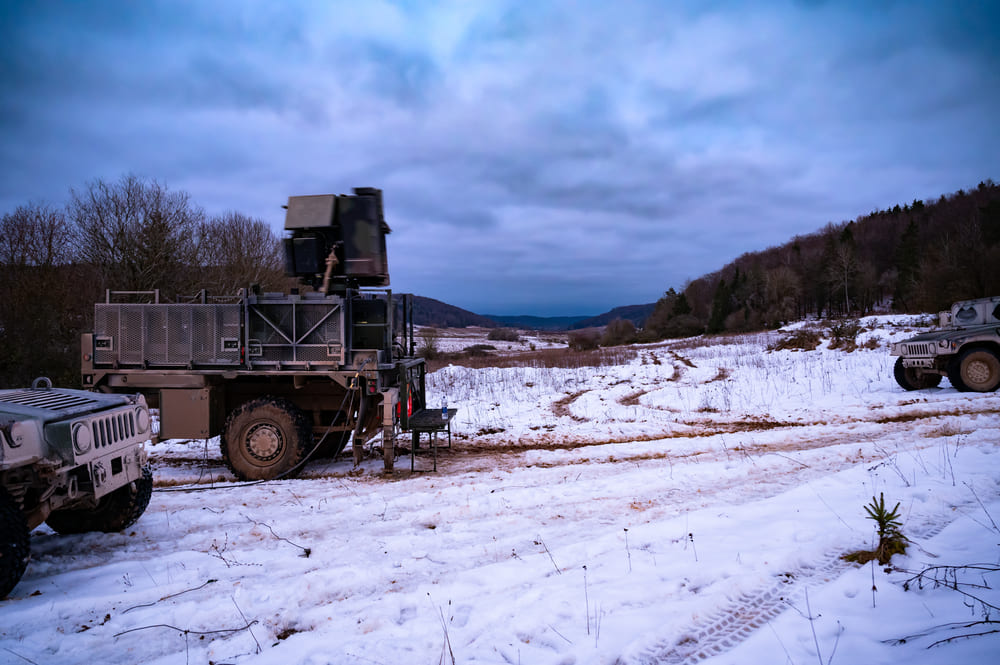
Defense officials confirm the Army will field its first full Sentinel A4 deployment around Washington, D.C. The radar is the AN/MPQ-64A4 variant. It targets low-altitude threats, with emphasis on cruise missiles and drones. The plan surfaced during a Redstone Arsenal event near Huntsville, Alabama, during Secretary Pete Hegseth’s visit. An Army officer described the production schedule, then tied the first fielding to the National Capital Region.
National Capital Region air defense will get first Sentinel A4 radar fielding in FY2026
“The plan is to be in full-rate production [of the Sentinel A4] at the end of FY 26 [Fiscal Year 2026], sir, and our first fielding will be actually in the National Capital Region,” the officer told Hegseth. “In January, we’re sending a Sentinel A4 to the National Capital Region to start that immigration process earlier, so that when it is fielded late next year, we’re ready to go.” Defense officials did not describe the receiving unit or site count. The statement points to an early arrival for integration work.
A Sentinel A4 radar has already deployed to South Korea under an early operational effort, according to the same Army briefing. Program staff have treated that deployment as a feedback source for a larger roll-out. A program director also said prototype air defense equipment has reached Guam and South Korea for soldier use and assessment. That package includes the Indirect Fire Protection Capability launcher, Sentinel A4, and other sensors tied to the Army’s integrated air and missile defense network.
Jeannie Sommer, a program director with the Army’s missile and space acquisition enterprise, described the intent at a Guam defense forum. “These prototypes really under traditional acquisition would be sitting at White Sands Missile Range undergoing continuous testing there, but we’re getting them into the hands of soldiers early,” she said. She tied the change to faster design feedback. “Learning in an operationally relevant environment versus a controlled test environment is paying enormous dividends already, even though the capability’s only been there a few months,” Sommer said.
Sentinel A4 AN MPQ 64A4 AESA radar increases detection range and target tracking
The Army described Sentinel A4 as a 360-degree air surveillance radar built for harsh weather and day-night operation. The target set spans cruise missiles, uncrewed aircraft systems, rotary-wing aircraft, and fixed-wing aircraft. The radar can also track artillery rockets, shells, and mortar rounds. The Army did not release detailed performance figures beyond what was shared at the Redstone event.
“what this radar does is provide 360-degree air surveillance, day or night, [in] adverse weather conditions and the most harsh environments, … [to] identify, track and classify cruise missiles, rotary-wing [aircraft], fixed-wing [aircraft], [and] UAS [uncrewed aerial systems],” the officer said. The officer added that specific details remain classified. Still, the Army did state a clear baseline improvement over the older AN/MPQ-64A3 version. The same briefing cited a 75 percent increase in detection range and higher simultaneous track counts.
Much of that gain comes from the move to an active electronically scanned array. An AESA steers beams with software rather than a rotating antenna. That allows more flexible search patterns and tighter track updates, especially against small or terrain-masked objects. The officer also pointed to growth capacity in the array. “The Sentinel A4 ‘does have growth potential,’ the Army officer highlighted to Secretary Hegseth during the event. “The current array that you see here is 60 percent populated, but we do have the ability to increase how much is in the array, which allows us to meet future threats.”
Washington DC layered air defense uses NASAMS and Avenger with Sentinel radar cueing
The National Capital Region already operates a dense air defense architecture built for a mix of threats and airspace control. Public program descriptions tie the area mission to National Advanced Surface-to-Air Missile Systems and Avenger short-range air defense, plus a broader set of surveillance and command-and-control assets. NASAMS has long been linked to the Washington-area mission set, with system makers noting integration into the region’s air defense since 2005.
Sentinel radars already support Army short-range air defense units, and they have been paired with NASAMS and Avenger in other fielded configurations. The Sentinel A4 brings a newer sensor into that model. Defense officials have not described how many A4 radars will be assigned, or where they will sit inside the region’s existing sensor grid. They have not discussed changes to alert procedures, engagement authorities, or the broader command chain tied to air defense of the capital.
False alarms have occurred in the region in past years, often tied to aircraft deviations and reporting issues rather than hostile activity. Better target discrimination helps in that environment. More stable tracks support faster identification steps and cleaner handoffs between sensors and weapons. The A4 deployment also fits a broader pattern that uses modern radars to tighten coverage against low-flying threats, where terrain, buildings, and clutter complicate detection.
Sentinel A4 supports Army integrated air and missile defense and Enduring Shield demand relief
Army leaders have framed Sentinel A4 as part of a larger modernization effort that links new sensors to integrated command-and-control and layered interceptors. Army professional writing on air defense modernization has stressed the need for integrated battle management and mixed formations, with systems such as IBCS, IFPC, and newer radar sensors in the same network. In that structure, Sentinel A4 supports both homeland defense needs and forward posture requirements, since the same sensor logic can support base defense and maneuver protection.
The IFPC launcher, often discussed under the Enduring Shield configuration, uses ground-launched AIM-9X today and has a second interceptor effort under development. Army officials have described prototype deployments to Guam and South Korea that place IFPC, Sentinel A4, and other systems in soldier hands earlier than older acquisition models would allow. That work matters because demand for higher-end air defense systems remains heavy, with Patriot units still tasked across multiple regions.
Sustainment infrastructure is also moving in parallel. At Letterkenny Army Depot, leaders tied new test capacity to modern air defense equipment. “Today, we are celebrating more than just new construction,” said Col. Caleb Lewis, the depot commander. “We are celebrating a powerful commitment to you – the talented and dedicated people who make our mission possible.” The depot also cited near-field testing support tied to Sentinel A4. “This new facility will continue to support LEAD’s capability to provide efficient maintenance and overhaul operations for mission-critical systems,” Lt. Col. Mark Pollak said. Our analysis shows the first full National Capital Region fielding fits a broader push for faster deployment, tighter sensor integration, and stronger sustainment depth for modern air defense.
REFERENCE SOURCES
- https://www.twz.com/land/armys-new-sentinel-a4-radars-first-full-deployment-will-be-defending-nations-capital
- https://www.stripes.com/branches/army/2025-11-13/army-tests-guam-missile-defense-19751181.html
- https://www.letterkenny.army.mil/News/Article/4365974/lead-breaks-ground-on-new-anechoic-chamber-and-access-control-point/
- https://www.war.gov/News/News-Stories/Article/Article/4359288/hegseth-senior-leaders-attend-spacecom-relocation-ceremony/
- https://www.lineofdeparture.army.mil/Journals/Air-Defense-Artillery/ADA-Archive/2025-E-Edition/Future-of-Indo-Pacific-Air-Defense/
- https://www.dote.osd.mil/Portals/97/pub/reports/FY2024/army/2024sentinel-a4.pdf
- https://www.asafm.army.mil/Portals/72/Documents/BudgetMaterial/2026/Discretionary%20Budget/rdte/RDTE%20-%20Vol%203%20-%20Budget%20Activity%205C.pdf
- https://www.raytheonemirates.com/en/what-we-do/iamd/medium-range/nasams
- https://www.kongsberg.com/newsroom/stories/2021/5/raytheon-missiles–defense-kongsberg-complete-first-amraam-er-missile-live-fire-test/
- https://www.euro-sd.com/wp-content/uploads/2025/10/ESD_10_2025_WEB.pdf