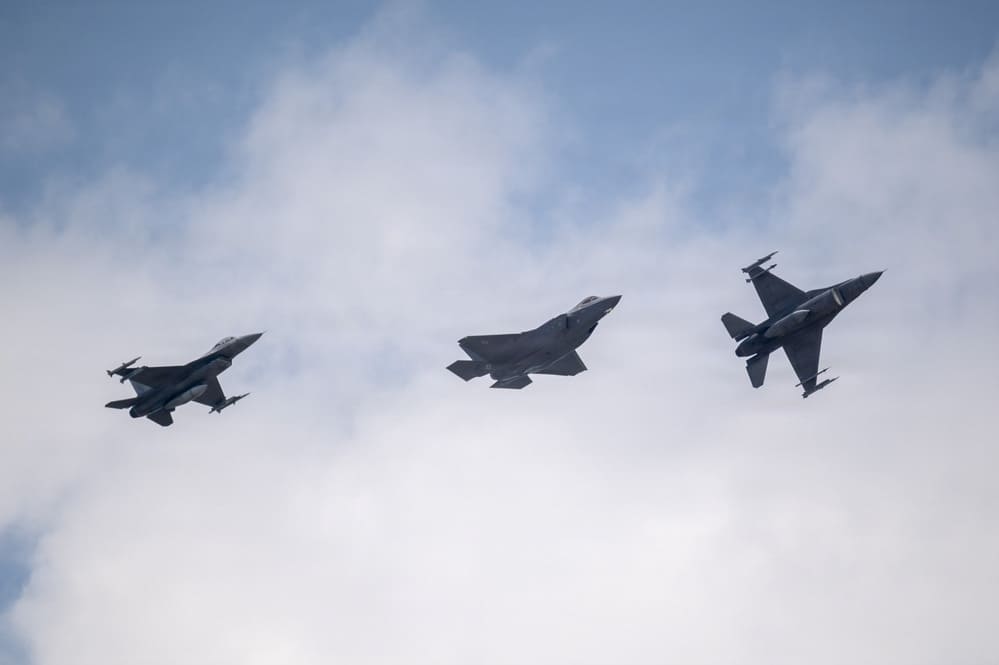
Defense officials confirm Canada’s senior operational air commander for NORAD integration continues detailed planning for the arrival of F-35A fighters, even as Ottawa reviews the broader fighter buy. Maj. Gen. Chris McKenna said the first tranche of aircraft is already paid for. He also said the larger infrastructure and personnel plan cannot pause, since basing work, training pipelines, and sustainment capacity take years.
Canada F-35A procurement review and NORAD overmatch requirement under Maj. Gen. Chris McKenna
Maj. Gen. Chris McKenna holds three jobs that converge on the same problem set. He commands 1 Canadian Air Division. He serves as operational commander for the Canadian NORAD Region. He also acts as the Canadian Joint Forces Air Component Commander. Those roles put him at the center of how Canada will employ fifth-generation fighters inside a bi-national air defense command.
Canada’s fighter decision sits inside a wider recapitalization effort across the air force. McKenna described it as the largest reset since World War II. He linked the fighter program to a parallel set of buys that expand how Canada senses and responds across the Arctic and maritime approaches. He listed tankers, remotely piloted aircraft, and new maritime patrol aircraft on the same track.
The fighter purchase remains under government review, but McKenna said he cannot wait for a final political call. Planning runs on fixed timelines that do not care about headlines. Real estate, runway work, secure networks, weapons storage, and qualified maintainers take long lead time. The first aircraft also arrive into a training system that has its own throughput limits.
Canada has committed money to an initial tranche of F-35s, McKenna said. “Canada has committed to 16 F-35s. We paid for them. The government placed the program under review, so we’re under review now.” He framed the final decision as sovereign and outside the air force chain.
McKenna kept his own requirement clear and narrow. “I have a fifth-generation threat that I need to defeat. And so that’s the challenge right now. I need to be able to defeat the adversary, and I need to have overmatch.” He said he needs that overmatch for both NORAD and broader national tasks.
McKenna said he remains confident the F-35 can meet the NORAD mission. “I have very high confidence that it’ll be able to achieve the NORAD mission set. Absolutely.” He linked that view to sensors, weapons options, and interoperability with the United States.
He also framed interoperability as a baseline requirement, not a bonus feature. NORAD uses integrated warning, shared tracks, and cross-border procedures that assume aircraft and networks can operate together at speed. That reality drives everything from radios to cryptographic handling, from data links to mission planning tools.
The broader question now sits around the size and mix of a future fleet. Canada’s program of record is 88 fighters. McKenna said the 88 figure came from operational research and a worst-case NORAD demand model, plus readiness generation and NATO needs. He said the world has changed, but he has not seen intent to go beyond 88.
He described the value of fifth-generation sensing as much as stealth. “Well, it has a great sensor package on it, and it has all the armaments you would need, obviously, to defeat a high-end threat.” He said the aircraft’s ability to work with the closest ally also matters in force development choices.
McKenna did not push alternative aircraft in the interview. He referenced the completed competition and said the government will decide whether it wants to pursue changes. “The competition is complete, right. We made an acquisition decision in 2023, and there’s a review ongoing. I’ll just leave it at that.” He did not engage the mixed-fleet argument beyond that.
The risk he highlighted sits in simple arithmetic and aircraft loading, not slogans. He described a mass cruise missile scenario and pointed to finite weapons on a single fighter. “If you have 16 to 20 cruise missiles coming off a platform, coming out of a submarine, you think about what your weapons load is. On the F-35 or an F-18, you have less than 10 weapons on that aircraft, depending on the configuration.” He described volume as the constraint.
That view pushes toward layered defense as a concept, not a procurement talking point. McKenna said the fighter must be forward, taking risk and pushing toward launch platforms. He then described defenses that sit behind that forward screen, closer to protected sites. “You have to approach integrated air missile defense from a layers point of view.”
Gen. Gregory Guillot’s framing came up in that context. McKenna said NORAD’s commander describes layers as a series of domes. “You can’t rely on a single effector or a single sensor. You have to have layers in every one of those aspects.” He said that applies from domain awareness through engagement.
F-35 sustainment often drives public debate, but McKenna kept his answer centered on what he saw during site visits. He cited discussions with U.S. units in Alaska and described Arctic procedures built through day-to-day operations. He said he did not see availability issues at the operational level during his visit, though he acknowledged what watchdog reporting and public debate say.
A U.S. watchdog report released this fall described F-35 program delays and readiness pressures. Public reporting tied mission capable rates to a wide spread across years and cited sustainment cost growth. That context matters for Canada since the fleet will operate far from dense supply nodes, with weather constraints and limited local surge capacity.
RCAF F-35 infrastructure at Cold Lake and Bagotville plus Arctic Forward Operating Locations
McKenna described the north as a response-time problem as much as a sensor problem. Canada has four Forward Operating Locations across the Arctic arc. He listed Inuvik near the Alaska border, Yellowknife farther east, and Iqaluit on Baffin Island. He also described Goose Bay, Labrador, as a larger deployed operating base.
Those sites allow dispersal and shorten the distance to likely intercept lines. They also create options during periods when main bases face weather or maintenance surges. McKenna framed them as the places he would push fighters to, with the goal of faster response to inbound tracks.
Runway length was the hard limiter he highlighted first. Inuvik’s runway sits around 6,000 feet today, with arresting gear. He said the RCAF could treat it like a carrier deck for Hornets over the years. The F-35 variant Canada expects includes a drag chute and a hook, similar to Norway’s configuration, but runway length still matters for margins.
McKenna described the runway extension work as slow and difficult. He pointed to permafrost and compared it to building over a bog. Public territorial documents describe the Inuvik runway extension as a 3,000-foot project that targets a 9,000-foot total length, with lighting and navigation upgrades. Reporting this fall also described schedule pressure tied to permafrost conditions and paving challenges.
He tied runway length to more than fighters. Tankers need more runway, stronger pavement, and larger turn radii. Inuvik also sits on the list for broader northern basing work under NORAD modernization plans. Public government timelines describe upgrades for the four FOLs, with work spread across this decade.
McKenna described the rest of what a forward site needs after concrete and asphalt. He named accommodations, weapons storage, fuel storage, and operational spaces. He described those items as a major share of where modernization money goes, since they decide whether aircraft can generate sorties at pace.
He also underlined that dispersal is not only an Arctic problem. He listed southern bases that can take fighter aircraft today, and he described recapitalization work to host the F-35 across the country. He listed Comox, Winnipeg, Trenton, and Greenwood as places that can take fighters in the current posture.
Cold Lake and Bagotville remain the center of gravity for the fighter force. McKenna said both wings are in a full recap. “We’ve knocked down the old stuff and we’re building up brand new infrastructure.” He described a large build effort that started after the 2023 contract award.
He offered an occupancy timeline for main fighter infrastructure around 2030 or 2031. That schedule reflects the scale of the construction, the security requirements, and the sequencing of temporary facilities. He described temporary housing and concurrent builds so the first aircraft can operate while the main complex finishes.
The delivery and training pipeline he laid out starts outside Canada. He said the first Canadian-owned F-35s will arrive at Luke Air Force Base in 2026. He said Canada would take possession of the first four to eight aircraft there. He also said the first 10 pilots deploy to Arizona in summer 2026 for training.
He described the intent to bring the first aircraft to Canada by late 2028. That date lines up with the need to stand up early units and begin domestic conversion training. It also fits with the temporary facilities approach he described, since main hangars and support shops may still be under construction.
McKenna described reliance on Greenland as a real operational factor. He said he uses Pituffik Space Force Base and often resupplies there during alert posture, with fuel and goods. That dependence gives Canada an additional node for northern operations, but it also requires planning for diplomatic access, weather windows, and lift.
Northern basing also ties into a broader concept of operational support hubs. Canada’s defense department has described future hubs in Iqaluit, Inuvik, and Yellowknife, with more locations under study. The hub concept adds sustainment depth and opens options for more persistent northern activity without building full bases everywhere.
The infrastructure burden also shows up in runway strength and taxiway geometry at main bases. Heavy transport and tanker aircraft need larger pavement loads and wider turns. Fighter bases hosting the F-35 also need secure networks, controlled spaces for mission data, and specialized maintenance facilities.
McKenna repeatedly returned to timing pressure. Hardware arrives on its own schedule. Construction requires seasonal work windows in the north. Personnel training pipelines have fixed throughput. That combination forces planning to move even when procurement headlines shift.
CF-18 Hornet extension upgrades, new AESA radar, AIM-9X and AIM-120D3 weapons, counter-drone options
Canada plans to fly the CF-18 until 2032, McKenna said. That timeline creates a long overlap between legacy fighters and the incoming fleet. It also creates a need to keep the Hornet relevant against cruise missile and small target sets, at least for a limited period.
McKenna said Canada completed a major Hornet upgrade in recent years that did not get much public attention. He said Canada installed a Super Hornet family radar in the CF-18. He described it as the AN/APG-79 variant and said the work was done with the U.S. Marine Corps, with shared software and shared development costs.
Public reporting and official program descriptions have described the APG-79(V)4 AESA radar as the planned combat capability upgrade for 36 Hornets under the Hornet Extension Project. The upgrade aims to replace the older APG-73 mechanically scanned radar. It also supports interoperability and allows continued access to civilian airspace under updated rules.
McKenna said the upgraded radar performs well against small targets. “The AESA radar is very, very good and we are earning a ton, to be honest, with that radar.” He described it as part of a cruise missile defense type role and linked it to the broader need to track very small targets.
Weapons upgrades are part of that same bridge strategy. McKenna said Canada has onboarded the AIM-9X and AIM-120D3. He said the RCAF already flies live with the AIM-9X on the Hornet, along with the new radar. He said live flying with the D3 is close, with testing underway.
That combination matters for NORAD alert posture. A radar that can hold stable tracks on small targets and missiles that can prosecute at range support the basic alert mission. It does not fix fleet size limits, but it raises effectiveness for each aircraft on the line.
Counter-drone work came up as a cost problem rather than a technology mystery. McKenna described interest in the Advanced Precision Kill Weapon System rockets, known as APKWS. He said the discussion is active, but he said no contract exists and he has not taken advice to government on it.
He framed the issue as what can go on an aircraft quickly, and what stays below a cost curve. That matters because air-to-air missiles can be expensive against cheap drones, and a dense drone attack can drain stocks fast. His answer stayed focused on economics and integration speed.
He did not commit the F-35 to a specific counter-drone rocket fit. “So F-35s, I don’t know yet.” He kept the discussion centered on the Hornet since it remains the main platform through the transition window.
McKenna’s volume-of-fire comments also tied to the counter-drone theme. An aircraft has a limited number of weapons, and reload cycles take time. A large raid forces choices around what the fighter engages and what other layers must handle.
The Hornet bridge also buys time for the broader ecosystem that the F-35 needs. Sustainment technicians must train. Security-cleared staff must fill mission data and network roles. Weapons storage and handling must scale. Those efforts do not depend on which aircraft wins a debate, but they depend on aircraft arriving on schedule.
McKenna also described manning as the lever he believes addresses readiness more than any single software patch. He said maintenance teams must be right-sized, properly trained, and multi-qualified. He also tied readiness to a domestic industrial base able to support the demand signal of a modern fighter fleet.
That view aligns with the size of Canada’s construction program on its fighter bases. It also aligns with effort to build sustainment capacity inside Canada rather than rely fully on distant depots. Northern operations multiply that need, since weather and distance limit rapid parts movement.
McKenna’s tone stayed operational, even when he addressed public watchdog reporting on availability. He did not dismiss the reporting, but he emphasized what he heard from U.S. units operating in cold weather. He described Wisconsin and Alaska procedures as useful reference points for Canada’s own approach.
The Hornet upgrade and weapons loadout also influence training. Radar and missile changes require updated tactics, simulator updates, and range work. That training load lands on units already stretched by alert duties, exercises, and transition planning. It adds friction at a time when the fighter community is already moving at speed.
NORAD modernization sensors, CC-330 tanker force, P-8 Poseidon, MQ-9 RPAS, and Canadian ground-based air defense integration
McKenna described tanker recapitalization as a major jump. “There’s been an 800% increase in our tanker procurement.” He said Canada is getting nine multi-role tankers. He said eight will act as tankers and one will serve as a dedicated VIP aircraft.
Canada’s defense department has described the program as the CC-330 Husky fleet, based on A330 aircraft. Public program pages describe nine aircraft, with a mix of new and used airframes. The mission set includes refueling, strategic transport, medical evacuation, and support to government travel.
McKenna described the delivery flow as a steady drumbeat after 2027. He said the first aircraft off the line will be a tanker with boom and drogue refueling. He said the second will be the VIP aircraft. He described follow-on deliveries every two or three months.
He described the refueling boom as a missing piece for Canada. He said Canada has never been able to refuel U.S. Air Force aircraft with a boom in Canadian service. He tied that to NORAD problems since U.S. tanking support often had to come from U.S. bases.
He described the current tanker fleet as probe-and-drogue only, good for aircraft like the F-18 but not for the F-35A. He said Canada needs boom capability for the future fighter and for allied support. That requirement flows directly from the fact that the F-35A uses boom refueling.
McKenna described a base plan for east and west tanker operations. He described Trenton as the eastern mobility base. He said runway work is underway to handle the 330’s weight and taxiway geometry. He said Canada will also build a western main operating base.
He described the need for shelters at tanker bases due to weather. He said aircraft must sit inside a shelter so crews can tow and launch on short notice. He described hangar plans as a three-bay hangar in Trenton and a two-bay hangar in Edmonton.
His golf course anecdote was not a joke in context. He described it as a fuel logistics issue. He said a rail spur must be built to bring fuel into the northern ramp area at Trenton, to feed the tanker fleet at the required density. He said the golf course closure makes him unpopular, but he framed it as a support requirement.
McKenna also listed new maritime patrol aircraft on order. He said P-8 aircraft are on order, with 14 to 16 showing up in 2027. Canada’s public statements have described the P-8A Poseidon buy as 14 aircraft with an option for two more, with deliveries starting in 2026 and a goal of full operational capability later in the decade. The program replaces the CP-140 Aurora fleet.
He also listed remotely piloted aircraft. He said MQ-9 systems are showing up in 2027. Canada’s RPAS project has been described in official program pages as an acquisition of 11 armed long-range aircraft with ground control stations and sustainment, with work and deliveries later in the decade. Timelines in public documents have shifted across years, but the direction remains the same, with focus on maritime and northern tasks.
Those aircraft programs tie into the sensing problem that underpins NORAD modernization. Fighters do not create tracks by themselves. They need warning, cueing, and persistent coverage. That coverage comes from radars, satellites, maritime patrol aircraft, and data fusion across domains.
NORAD modernization plans published by Canada describe upgrades at forward operating locations and fighter bases. They also describe investments in domain awareness, including Arctic and maritime sensors and modern command-and-control. The program aims to modernize warning and response across air and maritime approaches.
McKenna described integrated air and missile defense as a shared Army and Air Force effort. He said Canada announced plans to procure ground-based air defenses. He said the Army retooled its plan toward more robust point defense. He also said the Air Force posted officers into the Army to help ensure integration into the NORAD mission.
He described the Army’s recent re-entry into air defense after years with limited focus. He pointed to a short-range system in service with deployed troops. He described a Saab RBS 70 system used by Canadian troops in Latvia, tied to the enhanced forward presence brigade.
He listed a range of ground-based air defense options that often come up in public debate. He named Patriot, IRIS-T, and SAMP T. He said the options analysis belongs to the Army, not the Air Force. He emphasized integration as the key requirement, not brand names.
His core point returned to layers and integration. Fighters, sensors, ground-based systems, and command networks must connect. That linkage is harder than buying a launcher. It requires common data standards, shared track management, and clear fire control procedures, plus training that spans services.
According to industry sources, the integration burden drives cost and schedule as much as the launcher itself. A mixed sensor and effector design can work, but only with sustained engineering effort and repeatable training, especially in remote basing where connectivity can degrade.
McKenna also framed the transition as a manpower and sequencing problem across multiple fleets at once. Tankers, fighters, drones, and maritime patrol aircraft all arrive within the same general window. Each platform requires instructors, maintainers, and planners. The same people often fill multiple roles early on.
He also spoke about sensing beyond the aircraft layer, including radars and space-based platforms. That theme aligns with Canada’s NORAD modernization program, which has emphasized domain awareness in the north. It also aligns with broader allied focus on cruise missiles and long-range strike threats that stress warning time.
The interview made clear that the F-35 is not a single program inside his portfolio. It is one part of a national air defense architecture that spans airfields, fuel, sensors, weapons, and networks. The Defense-Aerospace editorial team reviewed the interview and related public program documents. Our analysis shows McKenna’s central concern sits in readiness timing, since construction, training, and integration will set what Canada can field in the early years of F-35 operations.
REFERENCE SOURCES
- https://www.twz.com/air/canadian-norad-commanders-view-on-future-f-35-fighter-force
- https://www.canada.ca/en/department-national-defence/services/procurement/fighter-jets/future-fighter-capability-project.html
- https://www.canada.ca/en/department-national-defence/services/procurement/strategic-tanker-transport-capability-project.html
- https://www.canada.ca/en/department-national-defence/services/procurement/remotely-piloted-aircraft-system.html
- https://www.canada.ca/en/department-national-defence/services/operations/allies-partners/norad/norad-modernization-project-timelines.html
- https://www.inf.gov.nt.ca/en/projects/inuvik-airport-runway-improvement
- https://www.wingsmagazine.com/inuvik-airport-paving-faces-delays-due-to-permafrost-conditions/
- https://www.canada.ca/en/department-national-defence/news/2023/11/canada-purchasing-up-to-16-p-8a-poseidon-multi-mission-aircraft-for-the-royal-canadian-air-force.html
- https://www.gao.gov/assets/gao-25-107632.pdf
- https://www.theaviationist.com/2025/10/09/canada-will-get-16-paid-for-f-35s/