Dec. 20, 2025 marks 36 years since the F-117 Nighthawk’s first combat use during Operation Just Cause in Panama. The sortie stayed quiet at the time, yet it set a pattern that followed the jet into later wars. Central America also sits back in U.S. planners’ field of view this month, with U.S. Southern Command focused on maritime counterdrug strikes and a larger regional posture.
Operation Just Cause and the F-117 Nighthawk’s combat debut over Rio Hato
A Panamanian checkpoint shooting on Dec. 16, 1989 helped push a long crisis into open conflict. Within days, the White House approved the execution order for an invasion plan that had already been built and revised for months. A Joint Chiefs history puts the opening blows shortly before 1 a.m. on Dec. 20, with special operations forces hitting key sites first, then conventional task forces rolling into Panama City.
U.S. planners aimed to seize airfields, block movement, and prevent an escape. Rio Hato mattered for those reasons, since it combined a large garrison, an airstrip, and proximity to one of Noriega’s residences. The same Joint Chiefs account describes early objectives that ranged from the Panama Defense Forces headquarters at La Comandancia to approaches into the capital, with the intent to break centralized control fast.
Two stealth fighters entered that opening window. A 2009 Air Force-focused account describes them sweeping down on Rio Hato just before Rangers jumped in, with each jet releasing a 2,000-pound laser-guided GBU-27 at 1:01 a.m. The bombs were not meant to strike the barracks. Commanders wanted shock and disorientation before troops hit the ground.
The operation around Rio Hato moved fast after the explosions. Rangers exited C-130s after a long flight from the United States and pressed toward the base area, with the fight running for hours before the defenders gave way. Elsewhere that same night, airborne troops landed on Tocumen airfield and U.S. forces moved on other preplanned targets across the capital region.
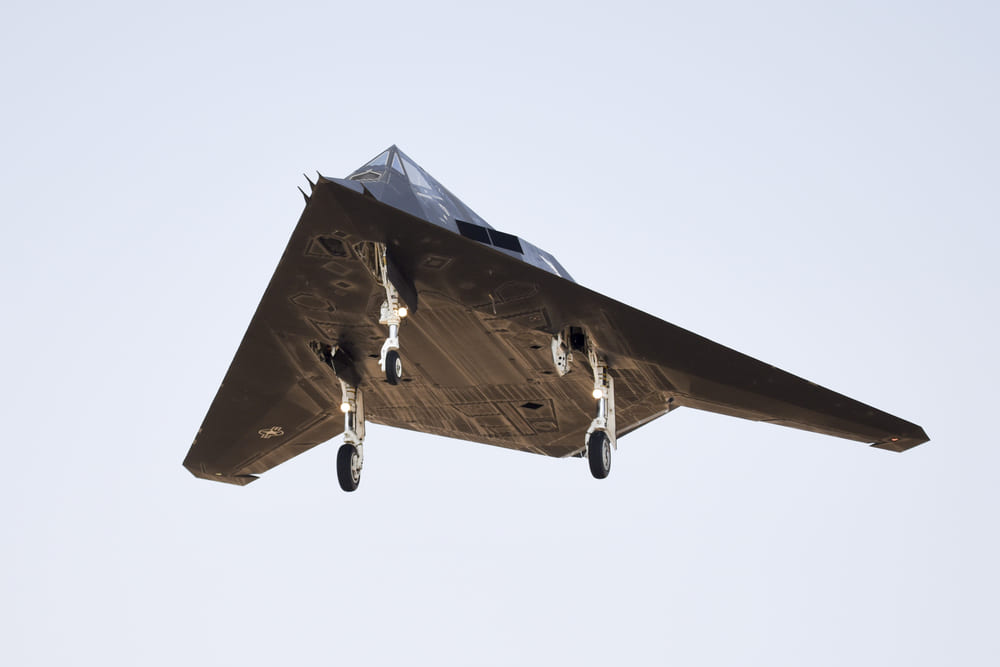
The F-117’s Panama use also carried the weight of secrecy. Public acknowledgment of the jet came only a year earlier, and the service still treated the unit as a low-visibility tool. The aircraft itself had been designed for a narrow job, high-value targets with reduced radar detection, and it carried weapons internally rather than on external pylons.
Tonopah preparations, time over target drills, and KC-10 refueling plan
A mission like Panama demanded more than stealth. It needed timing tight enough to support ground forces without putting them under friendly bombs. Capt. Greg “Beest” Feest later described a rehearsal that tested whether the jet could meet a last-minute time-over-target window and still hit a small aim point. “Several of the special ops planners came to Tonopah one night. They gave me a photo of a small target, highlighted by a triangle, which was located on one of the Nellis AFB ranges.”
He said the planners withheld the exact time until just before takeoff. “They said they would be on the range and that I needed to demonstrate how I could hit the target at a precise time. They would give me my time-over-target (TOT) right before I took off.” He also described how a cockpit video record became part of the proof. “We had the ability to videotape all our target runs in the F-117A so, when I returned to the squadron after flying my mission, they asked for my tape.”
The distance to Panama turned tanker support into a central piece of the plan. The same 2009 account says the two F-117s came from the Tonopah Test Range in Nevada and refueled four times on the way in. That arrangement points to a carefully staged track system, with KC-10 support enabling a strike aircraft built for precision to reach a target far outside its home basin.
The weapon load also fit the mission design. The F-117 commonly carried two 2,000-pound-class laser-guided weapons internally, and the aircraft’s early reputation came from consistent delivery of those weapons onto fixed targets. Air Force historical material also credits the jet’s stable bombing platform and its ability to carry meaningful internal stores for its era.
Tonopah itself had been chosen decades earlier to keep the program out of sight. The site supported covert operations in the 1980s and became the operating base for the first F-117 units, separate from the test environment at Groom Lake. That posture let crews train at night, fly long sorties, and keep the program’s rhythms away from routine base traffic.
GBU-27 drops at Rio Hato and debates over accuracy
The Rio Hato target was unusual for a stealth strike. The plan did not call for a direct hit on buildings. It called for timed detonations close enough to stun a garrison, with Rangers arriving seconds later. A detailed 2009 reconstruction says the original idea placed impacts very close, then senior leaders increased the offset to hundreds of yards. The result was a concept closer to a battlefield “stun” effect than a classic precision strike against infrastructure.
Accounts diverge on why the second bomb landed farther away than intended. One thread points to a late change in aim points driven by wind and the desire to avoid smoke interference with laser designation. A second thread points to cockpit workload, offsets, and the difficulty of night navigation under strict timing. The 2009 narrative describes a sequence where one pilot hit his original point, then the wingman keyed his drop off the first detonation, which pushed the second impact wide.
Feest’s own description stayed focused on intent and timing. “As the lead pilot, I was aiming for a field just short of two of the Panamanian Defense Forces’ barracks. There was no intention to kill anyone, just to disorientate, and my 2,000-pound laser-guided GBU-27 bomb hit the field at the exact TOT.” He wrote that he then safed the system, returned to the tanker, and started home.
A separate explanation tied conditions on the ground to sensor performance. A later account attributes this line to then–House Armed Services Committee chairman Les Aspin, who said the F-117’s Infrared Acquisition and Designation System struggled in Panama because “the humid, varied, vegetation lowered the contrast and gave the system problems.” That assessment fits the setting, with heavy humidity and terrain clutter compared with desert ranges.
The short-term battlefield effect remains hard to quantify from public material. Rangers still took the objective after hours of fighting, with AC-130 gunships and attack helicopters providing fire support elsewhere during the opening. The broader operation moved through its initial target set quickly, with U.S. forces capturing La Comandancia after a fight and breaking centralized PDF control early in the campaign.
Debate over the F-117 in Panama grew larger than the target itself. The 2009 account notes press coverage that framed the miss distance as a referendum on stealth, even though later combat results would show the platform’s accuracy in a different environment. That episode still sits inside the program’s story because it shows how a small event can drive lasting narrative.
F-117 Nighthawk still flying in 2025 and what it signals for stealth training
A surprising detail sits behind this anniversary. The F-117 did not vanish after its 2008 retirement ceremonies. Air Force and museum material still describes the aircraft as the first operational stealth platform, with a design that forced adversary air defenses to re-think detection and engagement, even when the jet carried only a modest two-weapon internal load.
According to industry sources, the Air Force has kept a small number of Nighthawks in flyable condition for test support and training events, rather than combat tasking. Reporting over the last year has also tracked sightings that pushed the service into limited confirmation that retired aircraft still fly for training purposes.
Another reason the jet still appears is the role it can play against modern sensors. A low-observable aircraft with older-era avionics can still stress radars, cue fighters, and help crews practice detection timelines without exposing newer stealth designs. The Air Force has used similar approaches for decades, and the Nighthawk’s unique radar signature gives planners another tool for that niche.
The other parallel sits in geography. Central America and the southern Caribbean returned to daily briefings in late 2025, driven by maritime interdiction and a wider counterdrug push. A U.S. Southern Command news release on Nov. 21 describes at-sea strikes against what it called “intelligence-confirmed narco-terrorists” since September, and it framed the effort as Operation Southern Spear. The same release also said the department would not discuss any plans involving land action in Venezuela.
Those two threads meet in a narrow way. Panama in 1989 was a case where U.S. forces relied on speed, air mobility, and tight control of airfields to lock down a small theater. The F-117’s debut fit into that model, even if the bombs were meant to startle rather than destroy. Our analysis shows the anniversary resonates now because the region again hosts U.S. forces, the mission set again leans on timing and reach, and a “retired” stealth jet still supports real training demand.
REFERENCE SOURCES
- https://www.jcs.mil/Portals/36/Documents/History/Monographs/Just_Cause.pdf
- https://www.southcom.mil/MEDIA/NEWS-ARTICLES/Article/4340031/hegseth-says-designating-venezuelan-cartel-as-terrorist-org-will-bring-new-opti/
- https://www.twz.com/air/the-legendary-f-117-nighthawk-first-went-to-war-36-years-ago-today
- https://www.airandspaceforces.com/article/1209panama/
- https://www.nationalmuseum.af.mil/Visit/Museum-Exhibits/Fact-Sheets/Display/Article/198056/lockheed-f-117a-nighthawk/
- https://www.af.mil/News/Article-Display/Article/1499939/remembering-the-f-117-nighthawk/
- https://www.airmanmagazine.af.mil/Features/Display/Article/2604078/airframe-the-f-117-nighthawk/
- https://theaviationist.com/2025/09/05/the-breakthrough-performance-of-stealth-and-the-f-117/
- https://theaviationist.com/2023/01/10/f-117s-will-keep-flying-at-least-until-2034/
- https://www.f-117a.com/Panama.html