The U.S. Navy confirmed it will pursue a new frigate class, FF(X), built around the Coast Guard’s Legend-class National Security Cutter hull. Navy leaders say the first ship will launch in 2028, with Ingalls Shipbuilding set as the lead builder. The move follows last month’s decision to end most of the Constellation-class frigate effort after years of redesign and schedule delay.
Navy FF(X) frigate announcement based on the Legend-class National Security Cutter design
Navy Secretary John C. Phelan said the service will shift to a cutter-derived frigate that can reach the fleet faster than the program it replaces. “To deliver its speed and scale, I have directed the acquisition of a new frigate class based on HII’s Legend-class National Security Cutter design, a proven American-built ship that has been protecting U.S. interests at home and abroad.”
The Navy’s public language keeps the program framed as a small surface combatant, not a direct replacement for the guided missile frigate that came before. In its release, the service calls FF(X) “a smaller, more agile surface combatant” intended to complement larger multi-mission warships and widen day-to-day options for commanders. The Navy also says the ship will focus on surface warfare first. The same release cites modular payloads and the ability to command unmanned systems.
Defense officials confirm the early plan aims at a fast start, not a long design phase. The Navy is leaning on a hull that has already done long deployments and heavy weather work, with a production record in the same industrial base the Navy already uses. A cutter hull also avoids the most disruptive part of the canceled frigate effort, the steady stream of design changes after construction work had already begun.
The shipyard choice was not a surprise inside the industry. Recent reporting in the defense trade press had pointed to a Coast Guard cutter derivative as the leading option, with Ingalls in position to move quickly. The Navy now has its public decision, but it still holds back the full configuration. The service has not released a formal weapons and sensors list. A planned ship count is also absent.
Ingalls and its parent company, Huntington Ingalls Industries, moved quickly to stress producibility and schedule. “We look forward to supporting the Navy on this critical program,” HII president and CEO Chris Kastner said. “Speed matters, and the NSC ship design is stable and produceable and will lead to predictable schedules. I have great confidence in the Ingalls team to execute this program, and in our ongoing efforts with our partners to successfully expand the U.S. shipbuilding industrial base to meet the Navy’s needs.”
Navy leaders are also tying FF(X) to a broader push for domestic production. Phelan linked the program to the administration’s “Golden Fleet” message, and he said the design will stay rooted in American yards and suppliers. The Navy also signaled it wants more than one yard involved after the first ships, which would spread the workload and create a backup plan if one builder hits a bottleneck.
The naming itself raises a question. The Navy is calling the ship FF(X), not FFG(X). The label does not decide combat systems, but it signals a deliberate reset. In past Navy ship programs, the letter mix helped set expectations across Congress, industry, and allied navies. The Navy has yet to explain the naming choice in detail. Navy officials have not linked it to any decision on missile cells or radar class.
Constellation-class frigate cancellation and the new small surface combatant requirement
The FF(X) announcement lands less than a month after Phelan ended the Navy’s plan to buy most of the Constellation-class guided missile frigates. “We are reshaping how the Navy builds its fleet. Today, I can announce the first public action is a strategic shift away from the Constellation-class frigate program,” Phelan said in a statement released Nov. 25. “The Navy and our industry partners have reached a comprehensive framework that terminates, for the Navy’s convenience, the last four ships of the class, which have not begun construction.”
Navy fact files list two ships still moving forward under that arrangement, Constellation and Congress. The same Navy document says the 2020 detail design and construction award covered 10 ships as a base year ship plus options, and it notes the Nov. 25 shift canceled additional hulls that were already on contract. The Wisconsin yard remains in play, but the Navy is no longer betting its small combatant future on the Constellation design.
The Constellation program started with a clear pitch. The ship would be based on a mature European frigate family, with limited changes, and it would reach the fleet on a tighter schedule than a clean sheet design. Requirements growth overtook that plan. According to industry sources, the Navy’s demand set kept expanding, and the ship moved far from its parent design.
Public reporting has put the commonality with the European baseline at roughly 15 percent, a figure that captures how deeply the American variant diverged after the award. The Navy had expected delivery of the first ship in 2026 when it announced the award, but Navy briefings and reporting since then have pushed the earliest delivery to 2029. Program offices also faced the hard truth that major redesign on the front end creates rework on the back end, even when the hull is already in fabrication.
Constellation was also built around a higher-end combat system stack than any cutter. Navy fact sheets list the Enterprise Air Surveillance Radar, the Baseline Ten Aegis Combat System, and an Mk 41 Vertical Launch System among the features tied to the class. The ship was meant to support air defense, anti-submarine warfare, and surface warfare in the same hull, with room for future growth. The package carries weight in electrical load, cooling, and top-side volume. It also drives integration risk when the design continues to change.
The Navy is careful in its public statements about why Constellation ended. The service cites speed and fleet growth as drivers, while outside observers have focused on the cost and timeline impacts of the redesign cycle. A company statement from the shipbuilder describes the Nov. 25 agreement as a reshaping of the program and a path to keep two frigates in work, with other future ship orders expected in different segments.
Fincantieri Marine Group CEO George Moutafis described the deal in those terms. “The agreement reached with the U.S. Navy marks a new chapter in our strategic partnership, built on mutual trust, a shared vision and commitment to excellence.” The shipbuilder also pointed to prior investment and workforce levels, and it said the arrangement provides continuity for its yards and suppliers.
FF(X) is also a response to a separate shortfall that has been building for years, the Navy’s small surface combatant inventory. The Littoral Combat Ship program delivered hulls, but it struggled to deliver the modular mission model that was sold as a way to cover more jobs with fewer ships. Many LCS deployments now rely on fixed sets of systems, not rapid swaps. As older cruisers and some early LCS hulls head for retirement, the Navy has fewer small combatants than it planned.
FF(X) frigate weapons and sensors questions, including VLS, radar, and modular payloads
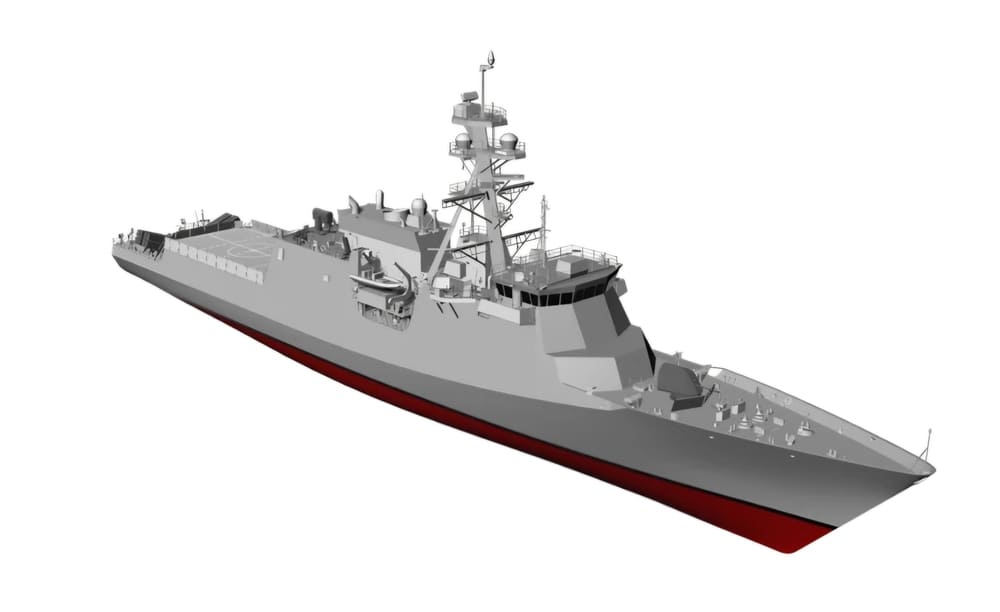
The Navy has released renderings of FF(X), and they provide hints without answering the core armament question. The hull and overall silhouette track closely to the National Security Cutter, with a long foredeck, a single forward gun, and a flight deck and hangar aft. The forward superstructure in the Navy images carries a new lower extension that juts ahead of the main face, a feature not present on the cutters.
No vertical launch system array is visible on the bow in the imagery the Navy has shared so far. For a Navy frigate, that absence draws attention. A VLS battery is the normal path to field area air defense missiles, anti-submarine rockets, and strike weapons in a compact deck footprint. The Navy has offered no detail on whether FF(X) will carry an embedded VLS. It has also not described any alternative approach.
Two missile launcher clusters are visible on the aft deck area in the images. Their layout matches the angled canister style used for over the horizon anti ship missiles on several Navy platforms. The Navy has already deployed the Naval Strike Missile on some Littoral Combat Ships, and it has moved to place that weapon on other surface combatants. A cutter-based frigate with canister launchers would fit that trend, even if the specific weapon set remains unconfirmed.
Close in defense also appears in the renderings. The images show a launcher consistent with the Rolling Airframe Missile system, a point defense weapon that the Navy uses across several ship classes. The forward gun appears similar in size and placement to the 57mm weapon mounted on the Coast Guard cutters, though the Navy has given no confirmation on the exact mount in the FF(X) package.
Modular payloads are the second big clue, and it may tie to a new approach for missiles and sensors. Navy language about modular payloads can point to containerized systems that can sit on open deck space, rather than internal modules that require major ship alteration. The Navy has already tested a containerized launcher derived from the Mk 41 family on a Littoral Combat Ship, and Navy leaders have shown interest in repeating that idea on other platforms.
The open questions cluster around integration choices the Navy has kept private:
- A built-in VLS and its location, or a container based alternative
- The primary air and surface search radar and combat system interface
- The mix between long-range anti-ship missiles and air defense weapons
- Space, weight, and power margins for later upgrades
If the Navy stays close to the cutter baseline, the ship will inherit a long range and an endurance set intended for patrol and presence work. The Coast Guard lists the cutter at 418 feet long with a 54 foot beam, a 12,000 nautical mile range, and crew capacity up to 148. The baseline supports steady forward operations, but combat system growth can change crew needs and internal volume quickly.
A cutter hull can also limit how far the Navy can push the sensor fit without major redesign. Constellation’s published feature list includes a SPY 6 family radar and the Aegis Baseline Ten combat system. Those systems can bring heavier topside weight and higher power demand than the cutter’s default fit. The Navy has offered no Aegis tie for FF(X) in public material. A radar choice is also absent.
The Navy’s own language suggests a different concept of use than Constellation. The service describes FF(X) as a surface warfare-focused ship that can carry add on payloads and control unmanned systems. The same concept suggests a ship that can command unmanned surface vessels in lower-threat areas. Self-defense weapons and limited combat loads are still expected.
Unmanned system control can take several forms, from data links and mission planning spaces to flight deck routines for vertical takeoff drones. The cutter hull already supports aviation, and the Navy can draw on lessons from destroyers and amphibs that have integrated drones and unmanned surface craft on deployments. The Navy has not said which unmanned systems it wants FF(X) to run. Command spaces remain undescribed in the design material.
The new forward shelf like extension on the superstructure may tie to these integration choices. It could offer a location for sensors or launchers above deck. The change could keep below deck changes smaller. It could also create a mounting surface for point defense systems that need clear arcs. Until the Navy releases a configuration baseline, the feature stays an indicator, not an answer.
FF(X) acquisition strategy, Ingalls Shipbuilding lead yard plan, and shipbuilding capacity
The Navy’s acquisition language is almost as important as the rendering. Phelan said the service will use a lead yard, then run a competitive follow on plan aimed at multi-yard construction. The Navy is trying to build enough ships to maintain fleet size while also funding submarines, destroyers, and amphibious ships. A cutter-derived frigate fits an approach that uses existing tooling and known build sequences.
Ingalls is already running multiple ship lines, and it has built the full set of Coast Guard National Security Cutters. HII says the yard delivered its final cutter in October 2023. The cutter build work left a trained workforce with recent experience on the hull form the Navy now wants to adapt. It also leaves vendors and equipment makers with an active trail of prior buys, which can shorten long lead items.
A multi-yard follow-on plan can also protect the Navy from a single point failure, but it brings its own coordination load. The service will need a tight technical data package, clean configuration control, and a way to manage quality across more than one builder. The Navy’s statement on Constellation points at this as a lesson learned. The service wants stable requirements before steel cutting, not a cascade of change orders after work starts.
Chief of Naval Operations Adm. Daryl Caudle made the same point in the Navy’s announcement. “We know this Frigate design works, we know it operates with the Fleet, and most importantly, we know how to build it now.”
Congress is likely to push hard on the details. The Navy will need to explain how it will avoid a repeat of a program that started with a mature parent design, then drifted as requirements expanded. Lawmakers will also ask how the Navy plans to fund FF(X) without squeezing other priorities, and how it will handle the two Constellation hulls still in work.
The shipbuilder at Marinette has said the Nov. 25 agreement provides continuity and workload visibility, and it expects other Navy work in different ship segments. The position affects yard planning, since the Navy still needs more than one shipyard for a long-term surface combatant plan. The Navy will also weigh how much of the Constellation design work can carry over to other programs, even if the hull line is ending.
Navy leaders have also signaled they will hold firm against late design changes. They have described a build-to-print approach, and they have pointed to other ship programs where the Navy stayed closer to an existing baseline. A cutter-derived frigate can fit that model. It can also fail if the Navy tries to force a destroyer-like combat system into a hull that was never built for that weight and power demand.
Industry contacts say the near-term question is how much combat power the Navy accepts in the first ships. A smaller launcher count or a lighter radar can keep schedule risk down, but it can also affect how the ship fits into escort roles in higher threat areas. Navy officials have not given a public answer. More detail may arrive with budget documents and contract language.
Our analysis shows the Navy is choosing delivery speed and production scale first. It will then decide how much capability to buy inside that frame.
The Navy expects a cutter hull can host enough weapons and sensors for modern escort work, without reopening the kind of redesign cycle that ended Constellation. If the service keeps FF(X) close to the existing build plan, the first ship in 2028 becomes more plausible. If requirements creep returns, the calendar will slip again, and the small combatant shortage will deepen.
REFERENCE SOURCES
- https://www.navy.mil/Press-Office/Press-Releases/display-pressreleases/Article/4364538/navy-announces-new-small-surface-combatant/
- https://hii.com/news/hii-to-build-small-surface-combatants-for-us-navy/
- https://www.navy.mil/Resources/Fact-Files/Display-FactFiles/Article/2633250/constellation-class-ffg/
- https://news.usni.org/2025/12/19/secnav-new-frigate-will-be-based-on-national-security-cutter-first-ffx-to-be-built-at-ingalls
- https://news.usni.org/2025/11/25/navy-cancels-constellation-class-frigate-program-considering-new-small-surface-combatants
- https://www.fincantieri.com/en/newsroom/press-releases/2025/Fincantieri-Marine-Group-to-reshape-the-Constellation-Class-program-to-better-support-evolving-needs-of-the-US-Navy-strengthening-strategic-partnership
- https://www.dcms.uscg.mil/Our-Organization/Assistant-Commandant-for-Acquisitions-CG-9/Programs/Surface-Programs/National-Security-Cutter/
- https://www.twz.com/sea/this-will-be-the-navys-new-ffx-frigate
- https://www.twz.com/sea/navy-sinks-the-constellation-class-frigate-program