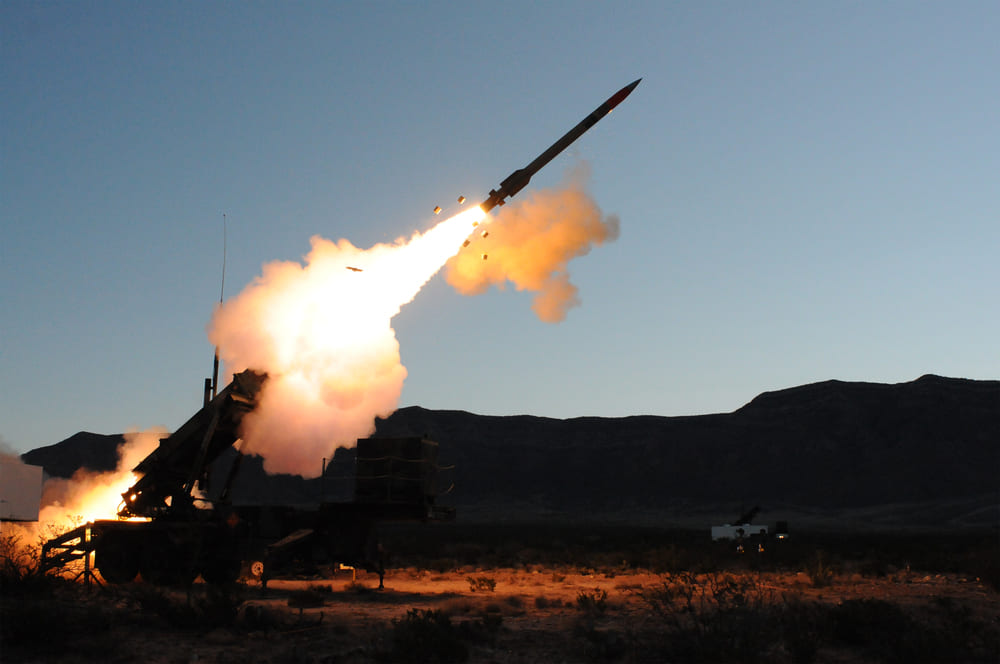
The U.S. Army is tying a new Patriot interceptor effort to a launcher shift toward a more vertical firing profile. The stated goal is an “over-the-shoulder” shot, where a battery can engage a threat that already crossed overhead. Senior leaders heard the update during a visit at Redstone Arsenal in Alabama, set against a wider push for air and missile defense capacity and faster acquisition cycles.
Patriot Over-The-Shoulder Shot And The New Lower-Tier Interceptor Program
Army Lt. Col. Steven Moebes spoke in front of a Patriot launcher during the Redstone visit. He described how today’s launcher traverses but still depends on where the battery points its launchers at setup time. “So, the current [M903] launcher will slew,” Moebes said. “I will put in a plug that this year we’re starting a new interceptor program that will have longer range [and] higher altitudes.” He did not name the program during the exchange, but the Army has signaled interest in restarting work tied to a next interceptor tier for Patriot.
Moebes linked the new missile to a rear-arc engagement geometry that current Patriot batteries do not execute through their existing software logic. “All of our digital simulations are showing that with that new interceptor, we will have the ability for what we call [an] over-the-shoulder shot,” he said. “So, it will have the kinematic power to be able to launch and actually engage behind us.” The detail matters for a battery that faces a target stream from more than one direction, or faces a threat that slips past the radar’s strongest sector and keeps moving.
The “over-the-shoulder” concept carries tradeoffs. Brig. Gen. Patrick Costello, who leads the Fires Center of Excellence at Fort Sill, framed the issue as a software gate today and an energy problem in physics tomorrow. “It’s a software problem. On this system right now, the software does not allow us to fire behind,” Costello said. “The Common Autonomous Multi-Domain Launcher [CAML] that we’re developing … is going to be more vertical [in terms of launch profile], too.” He also warned about the kinematic penalty when a missile spends energy on a turn. “Even if we’re doing over-the-shoulder launches, we lose some probability [of kill], we lose some lethality … [when the] missile’s wasting energy going forward and turning around,” Costello said.
Vertical Launch Patriot Launcher Changes And The CAML Autonomous Launcher Family
Patriot’s basic battery layout still reflects a forward-oriented posture. A typical U.S. Army battery fields eight trailer-mounted M903 launchers, a multifunction phased-array radar, and the fire control and comms vehicles that tie the set together. The launchers can slew, but the battery largely fights in the direction it faces, with limits set by radar coverage and engagement logic. A more vertical firing profile changes the opening move of an engagement. The missile can leave the canister without a hard dependency on launcher azimuth, then turn in flight under guidance. A battery still needs tracking and timing, but the launcher no longer has to do as much physical work.
CAML sits in the middle of that launcher discussion because the Army wants a launcher family that can fire both defensive and offensive munitions from a common approach. Defense officials confirm that the Army issued a series of requests to industry in early December for CAML work, with emphasis on autonomy and rapid prototyping. The public documents describe multiple autonomy modes, a convoy leader concept, and a vehicle autonomy command-and-control element, with an aggressive delivery window. The same set of requests also calls for autonomous load and unload of palletized payloads, with a weight band that points to large missiles and heavy launcher modules.
According to industry sources, CAML’s heavy tier has drawn attention since it aims to carry large missile loads on an uncrewed or optionally crewed chassis. Public Army language ties that tier to Tomahawk and Patriot PAC-3 MSE. For Patriot, a more vertical launch path fits the over-the-shoulder discussion, since it reduces the reliance on launcher pointing and may support faster engagement sequencing under high raid density. For CAML, autonomy and reload concepts sit beside the launcher angle topic, since the Army wants more launch capacity without the same manpower burden per launcher unit.
LTAMDS Radar 360-Degree Coverage And IBCS Networked Fire Control For Patriot
A rear-arc shot only matters if the battery can see, track, and hand off targets in time. That is where LTAMDS and IBCS move from upgrade lines to core enablers. LTAMDS is the Army’s next radar for Patriot, with full-sector sensing as the headline feature. In late September, the radar program received a new contract award that covers radars for the U.S. Army and Poland, plus support, spares, and engineering services. The contract language also reinforces the intent to field at scale, not just in test units, which fits the wider demand for 360-degree coverage against missiles, cruise profiles, and low observable tracks.
IBCS matters for the same reason, but from the command-and-control side. In early October, the Army described a missile flight test that used IBCS to run a full kill chain against maneuvering cruise missile surrogates. Soldiers from 3rd Battalion, 43rd Air Defense Artillery tracked and identified the threats through the network, then engaged through the integrated architecture. The event tied into follow-on operational test work, and it aligned with the Army’s stated goal for a sensor-agnostic, best-effector approach that can survive a contested environment.
The combination of a 360-degree radar and a networked fire control layer changes what “behind” even means for a Patriot unit. A battery no longer depends on one forward radar face as the single gate for engagement. The system can fuse tracks, accept remote sensor inputs, and distribute engagement logic across a wider set of nodes. A more vertical launcher and an interceptor with the energy to turn into a rear-sector engagement fits that model. It allows the battery to keep fighting even when threats arrive from multiple axes, or when the first engagement window closes fast and the target continues through.
LTFI Revival Signals, Patriot Capacity Pressure, And Where The Program May Go Next
The Army’s comments at Redstone fit a wider arc of work around the lower-tier interceptor gap. Maj. Gen. Frank Lozano spoke in October about the path back to a next-generation Patriot interceptor. “There are some aspects of the LTFI program that are still somewhat pre-decisional, but I believe that we will get support for the program, and I may be in a position this time next year to begin program-of-record execution,” he said. He framed the internal view as cautiously positive. “I think right now the glass is probably half full that we’ll get to run that program, and so we’re really in the planning process in figuring out what that’s going to look like moving forward.” Lozano also led the Redstone tour where the over-the-shoulder concept came up.
Patriot demand keeps rising across theaters, and the system has absorbed hard lessons under sustained missile attack conditions. Recent reporting and official statements point to adversaries that adjust flight behavior in terminal phases, which compresses engagement timelines and stresses radar coverage and shot doctrine. A rear-arc option does not replace 360-degree sensing, and it does not solve inventory pressure on interceptors. It does address a specific geometry problem, where a battery can lose an engagement chance when the threat crosses overhead faster than the launcher posture can adapt.
Our analysis shows the Army is converging on a single idea across these lines. A next interceptor adds energy and altitude margin. A more vertical launcher reduces dependence on battery orientation. LTAMDS and IBCS widen the track and engagement picture to full sector. CAML adds mobility and launch capacity, with autonomy features that fit a manpower-tight force. That package targets the same failure mode from different angles, where a threat slips through a narrow engagement window and forces the unit to reposition before it can fire again.
REFERENCE SOURCES
- https://www.twz.com/land/new-patriot-interceptors-to-allow-for-over-the-shoulder-shots-at-passing-targets
- https://www.spacecom.mil/Newsroom/News/Article-Display/Article/4360816/hegseth-senior-leaders-attend-spacecom-relocation-ceremony/
- https://www.army.mil/article/289756/space_command_unveils_sign_at_future_redstone_home
- https://defensescoop.com/2025/12/01/army-caml-common-autonomous-multi-domain-launcher-rfis/
- https://sam.gov/workspace/contract/opp/5d88ee9d8dc64d91b2a0a0964252d16d/view
- https://breakingdefense.com/2025/10/glass-half-full-army-likely-to-reverse-course-go-for-next-gen-patriot-interceptor-after-all/
- https://www.rtx.com/news/2025/09/23/rtx-awarded-contract-for-ltamds
- https://www.army.mil/article/288885/u_s_army_conducts_missile_flight_test_with_integrated_battle_command_system
- https://news.northropgrumman.com/ibcs/integrated-battle-command-system-proves-performance-in-flight-test
- https://news.northropgrumman.com/ibcs/integrated-battle-command-system-intercepts-cruise-missiles-in-key-test
- https://oshkoshdefense.com/oshkosh-defense-introduces-the-family-of-multi-mission-autonomous-vehicles-fmav-at-ausa-2025/
- https://www.ft.com/content/078b8e70-a58c-47cc-b573-598850dd5685