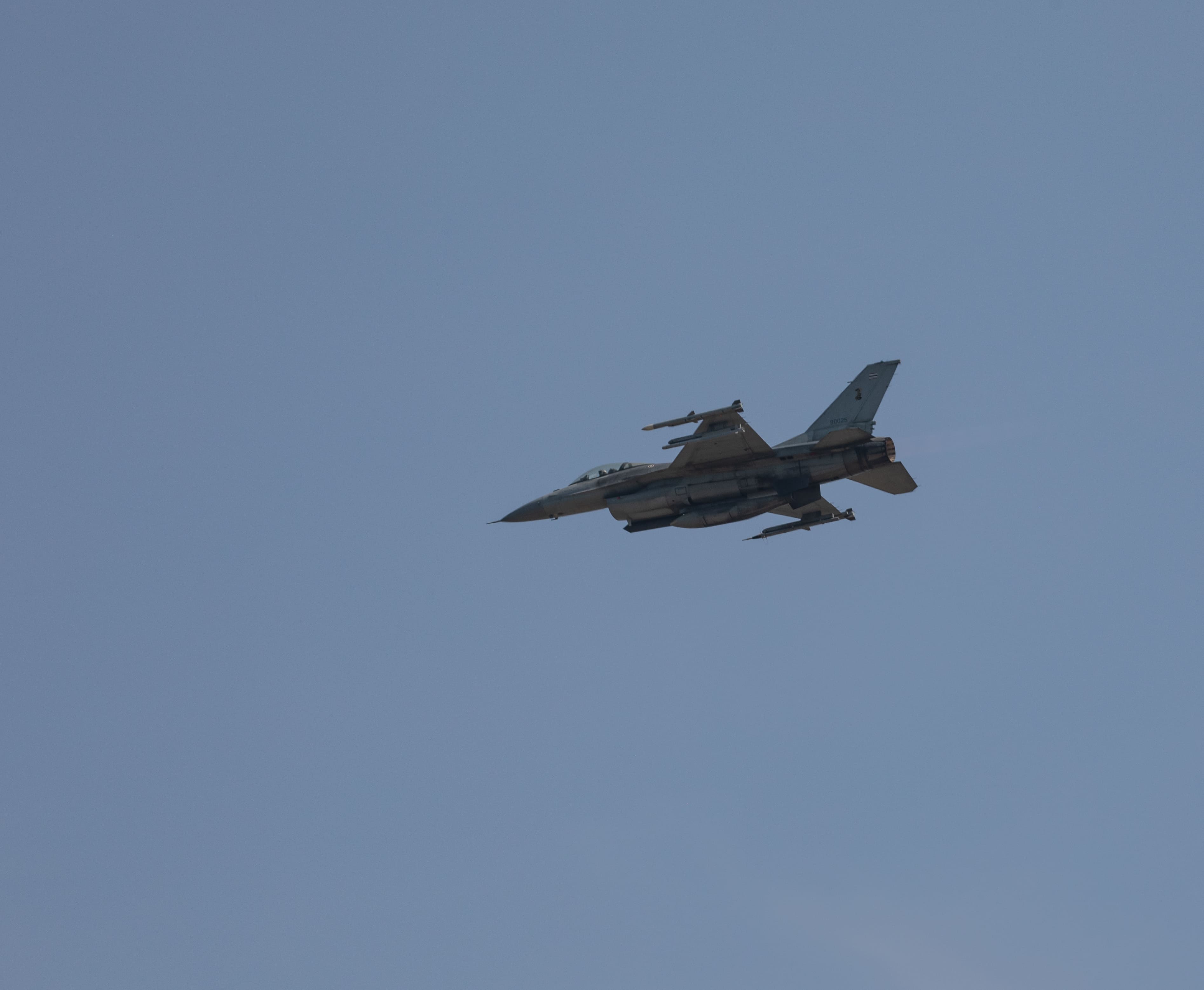
Following overnight clashes that resulted in the death of a Thai soldier and the injuries of others, Royal Thai Air Force F-16 fighters attacked what Bangkok described as Cambodian military targets along multiple points of the disputed frontier early on Monday. Thai and Cambodian officials each accused the other side of breaking a ceasefire reached about six weeks ago under U.S. President Donald Trump’s involvement.
The Royal Thai Air Force said the strikes hit “military targets” in many places along the 500-mile border. Thai officers said that long-range artillery positions and other related sites were also part of the target set. Defence officials say that the air operation came after ground fighting that got worse before dawn and spread to more than one sector. Both militaries reported small-arms fire and indirect fire in the morning.
Royal Thai Air Force F-16 Strikes on Cambodian Positions
According to Thai military spokespersons, the military used aircraft to deter attacks and lower the risk posed by heavy weapons deployed close to disputed border areas. In Thai briefings, commanders pointed to rockets and artillery they said could reach civilian locations. They named transportation routes and medical facilities among the sites they believed were at risk. Thai officials said these concerns drove the decision to carry out airstrikes.
Thai authorities did not publish details on the types of ordnance used. They also did not provide a verified battle-damage assessment for the targets cited in the first statements. The military released imagery it said showed impacts on a Cambodian position. Independent verification was still limited as of Monday afternoon.
According to industry sources, Thailand’s F-16 force consists of 36 single-seat F-16As and 14 two-seat F-16Bs, the remaining aircraft from earlier U.S. deliveries, plus seven additional F-16A/Bs later donated by Singapore. The fleet gives Thailand a mature strike and air-defense platform for border contingencies, although Bangkok has not disclosed what rules of engagement governed Monday’s sorties.
Thai ground operations continued while the airstrikes were underway. Reports circulated Monday that Thai Army units moved armored vehicles toward contested villages, including movement of M113-series armored personnel carriers captured on local video, and footage from the area showed a Scorpion light tank firing toward Cambodian positions. Thai authorities did not formally confirm the seizure of specific villages during the morning, and some claims remained unverified.
Public Thai statements did confirm the casualty trigger for the latest escalation. One Thai soldier died during the morning’s fighting, while official counts for the injured varied across statements issued during the day. Thailand’s foreign ministry later referred to eight wounded in its summary briefing, while other Thai accounts cited four wounded earlier in the day.
Washington had not issued a public statement on Thailand’s employment of U.S.-origin F-16s against Cambodia as of Monday. Thailand is a U.S. Major Non-NATO Ally, and Thai officials have described their actions as self-defense under international law.
PHL-03 and BM-21 Rocket Launchers Raised in Thai Briefings
Thai defense officials put unusual emphasis on rocket artillery in their explanation of the airstrikes. Thai statements highlighted what they described as Chinese-made PHL-03 multiple rocket launchers and Soviet-era BM-21 systems deployed on the Cambodian side, with Thai officials arguing those weapons increased the risk to civilians and critical infrastructure in nearby Thai provinces.
Thai Ministry of Defense spokesman Rear Admiral Surasant Kongsiri said Thailand had identified Chinese-made PHL-03 systems in the area and claimed only six of the launchers were believed to be in Cambodian service. Thai briefings tied those systems to potential threat envelopes that include a provincial airport and a state-run district hospital, and Surasant added: “Based on our intelligence as well, there have been attempts … to lock on the coordinates of these facilities,” without presenting public evidence for how that assessment was made.
The PHL-03 is a 300mm, 12-tube multiple rocket launcher broadly modeled on the BM-30 Smerch configuration, with maximum range depending on rocket type. Open technical references describe ranges extending into the 70–130 km class for standard rockets, which places deep areas of border provinces at theoretical risk if systems are positioned close to the frontier.
BM-21 systems use 122mm rockets and can fire salvos quickly, with common rocket types reaching into the tens of kilometers, again depending on munition and variant.
Cambodian officials rejected Bangkok’s account of heavy-weapons deployments. A statement attributed to the Cambodian Ministry of National Defence spokeswoman, Lt. Gen. Maly Socheata, said Thai channels circulated “false information” about Cambodia moving “heavy and destructive weapons and equipment” to border positions. The statement said Cambodian forces had not violated the ceasefire or the joint peace declaration.
Thai officials presented the air operation as a response to an imminent risk, not a punitive strike. Thai accounts said the targets included sites believed to hold rocket-related equipment and storage facilities. Independent confirmation of those claims remained difficult as of Monday.
Trump Brokered Ceasefire and Heavy Weapons Withdrawal Plan
The renewed fighting added pressure to an agreement that was already under strain. Officials signed a reinforced ceasefire framework in Kuala Lumpur in late October. They then implemented it through measures taken in November. The plan included phased heavy-weapon withdrawals and demining work by both sides. Thailand said the withdrawal process began with rocket systems. It said the next phases would cover artillery, tanks, and other armored vehicles, with an end-of-year target for completion.
Thailand linked Monday’s escalation to landmine allegations that had already pushed the ceasefire toward collapse. Bangkok said it halted implementation of the deal in mid-November after a landmine blast seriously injured a Thai soldier, arguing the mines were newly laid, while Phnom Penh denied the charge and said unexploded ordnance in the region dates back decades.
Thailand’s defense minister, Gen. Nattaphon Narkphanit, referenced the Ottawa Convention meeting in Geneva and said Thailand had presented evidence of anti-personnel landmine use shortly before the latest clashes. His statement said Cambodia attacked on the morning of Dec. 8 after Thailand raised the landmine issue, and it asserted Thailand would “fully exercise its right of self-defense under international law.”
The ceasefire followed a wider run of conflict earlier in 2025. In late July, fighting escalated into a five-day conflict. Border provinces saw widespread displacement, and both sides reported deaths. President Trump’s administration intervened, alongside regional mediation efforts. Those steps helped produce an initial ceasefire and later a reinforced deal in Kuala Lumpur, and both governments pointed to international pressure as a reason talks resumed.
Recent reporting published a chronology of the crisis. It describes recurring rounds of localised clashes, diplomatic retaliation, and fresh negotiations. Heavy weapons and landmines appeared again and again as points of dispute. The reporting also said Thailand connected border stability to trade talks with Washington, while Cambodian officials highlighted sovereignty and rejected claims of new mine-laying.
Evacuations and Official Statements from Bangkok, Phnom Penh, and Kuala Lumpur
Civilians again carried the immediate cost. Cambodian officials reported four civilian deaths in Oddar Meanchey and Preah Vihear provinces, and Thai and Cambodian accounts described additional injuries on the Cambodian side. Tens of thousands of residents left border villages, and Thai authorities issued evacuation orders across several provinces.
Thailand’s government said more than 385,000 civilians were ordered to leave border areas across four provinces, and it reported registration figures at shelters that rose through the morning. Cambodian information officials said at least 1,157 families were evacuated to safer areas on the Cambodian side.
Thailand’s prime minister, Anutin Charnvirakul, rejected claims that Bangkok initiated the latest violence and said Thailand did not want renewed fighting. He added: “However, Thailand will not tolerate any violation of its sovereignty,” and he said security agencies had been instructed to protect civilians and support those in temporary shelters.
Hun Sen, Cambodia’s former prime minister and still a central political figure, urged restraint but placed responsibility on Thailand. Malaysian Prime Minister Anwar Ibrahim, serving as Chair of ASEAN, urged both parties to be “as restrained as possible,” maintain lines of communication and utilize previous methods that assisted with the earlier defusing of tensions.
Both countries expressed concern that Malaysia’s previously negotiated peace agreement would not hold due to increased pressure at the border.
Thailand’s Ministry of Foreign Affairs said the recent actions were taken in self-defense. It also said landmine density in some areas limited ground movement near the border. Cambodian representatives rejected those claims. Cambodia has warned Thailand over what it calls misrepresentations about weapon placements, and it said its military remains committed to the ceasefire agreement.
The airstrikes have made it harder to sustain the ceasefire. It is already affected by unresolved disagreements over landmines, prisoner issues, and the placement of long-range firepower systems close to populated areas. Both sides are still documenting their version of events through public statements.
REFERENCE SOURCES
- https://www.reuters.com/world/asia-pacific/thai-army-says-air-strikes-launched-along-disputed-border-area-with-cambodia-2025-12-08/
- https://www.reuters.com/world/asia-pacific/how-thailand-cambodia-conflict-went-trump-backed-ceasefire-airstrikes-2025-12-08/
- https://www.reuters.com/business/aerospace-defense/china-made-rocket-among-triggers-thai-airstrikes-into-cambodia-2025-12-08/
- https://www.aljazeera.com/news/2025/12/12/trump-says-thailand-cambodia-agree-to-renew-ceasefire-after-deadly-clashes
- https://www.twz.com/news-features/thai-f-16s-bomb-targets-along-disputed-cambodian-border