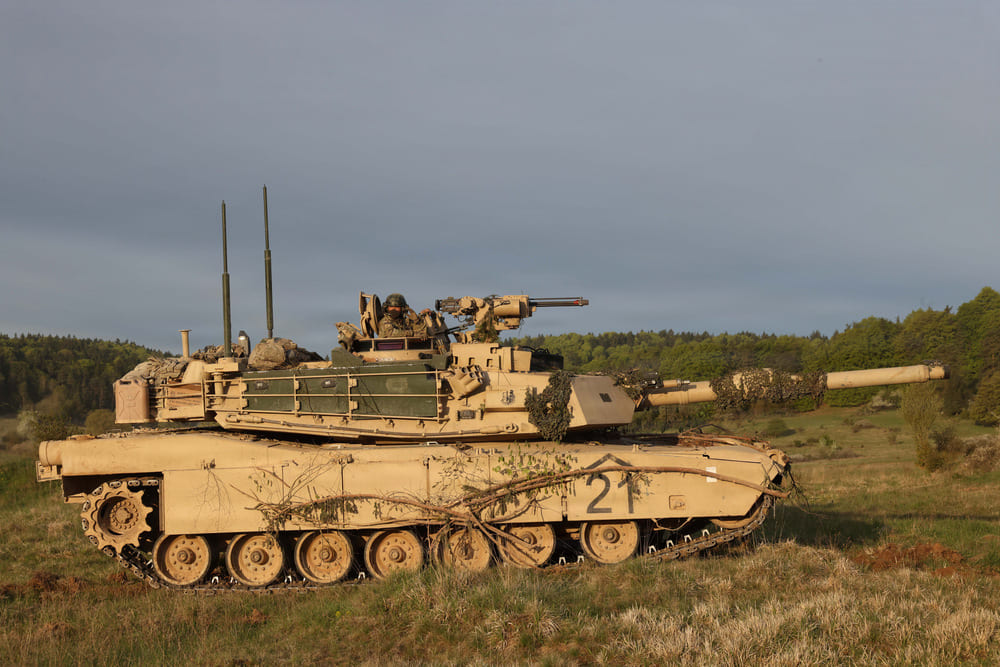
General Dynamics Land Systems and AeroVironment have tested a turret-mounted launcher that lets an M1A2 Abrams SEPv3 fire Switchblade loitering munitions during a U.S. Army demonstration in Texas. The companies said the kit, called Precision Effects and Reconnaissance Canister-Housed, launched a Switchblade 300 and a Switchblade 600 during a breaching scenario at the Army’s MARS event, held Oct. 26–30.
The PERCH hardware replaces the Abrams loader’s sponson box and bolts onto existing attachment points, with no welding or cutting, according to the company statement. A photo released by GDLS shows a pop-up canister mounted on the turret during a launch.
Scott Taylor, GDLS director of business development, said the PERCH prototype used a tablet for control during the October demonstration. He also described planned changes meant to make the launcher easier to reload.
PERCH launcher integrates Switchblade drones on M1A2 Abrams SEPv3
PERCH mounts outside the turret and takes the place of the standard loader sponson box on the SEPv3. The kit bolts onto existing points, and the companies describe it as a modular add-on for both Abrams and Stryker vehicles.
Janes reported PERCH can carry three Switchblade 300s and one Switchblade 600 at the same time. The same report said the initial design used a single actuator hinged off the back of the sponson area, and crews controlled launches through a tablet interface.
GDLS says later versions will run on the vehicle’s existing computer systems. That step matters for how crews manage sensor feeds, target handoff, and launch control under armor without adding another separate control stack in the turret.
Two company executives tied the effort to how armored crews look for targets they can’t see from the gunner’s optics. Jim Pasquarette, GDLS vice president for U.S. strategy and business development, said, “PERCH allows units to deploy Switchblade loitering munitions far forward on the battlefield while remaining covered and concealed themselves.”
Brian Young, AeroVironment senior vice president for loitering munitions systems, said, “Integrating Switchblade 300 and 600 into General Dynamics Land Systems platforms through the PERCH modular kit delivers immediate operational advantages.”
MARS breach demonstration at Fort Hood used Abrams launched loitering munitions
The companies say the MARS event ran Oct. 26–30 at Fort Hood, and the PERCH team used Switchblade 300 and 600 launches during a complex obstacle breach. Their statement describes beyond-line-of-sight reconnaissance and over-the-horizon targeting used during the scenario.
A U.S. Army video tied to III Armored Corps described a combat breaching demonstration that used autonomous technology to reduce risk to soldiers. The video summary said the MARS program used the Defense Advanced Research Projects Agency RACER vehicle and other systems during the Fort Hood event window.
Army imagery from the same event described a live-fire breaching demonstration shown to senior leaders and industry partners, with the 36th Engineer Brigade and III Armored Corps listed as the units behind the program. That matters for PERCH because the breaching lane creates the kind of short-notice target set that drives demand for fast reconnaissance, then a precision strike option that doesn’t require the tank to crest terrain.
The PERCH launch itself stayed outside the armor package and used a canisterized round, so the crew did not need to open the hatch for the shot. The companies have not released a full after-action readout for the event, and they did not publish hit data or reliability rates from the demonstration.
Switchblade 300 Block 20 control range and payload roles for Abrams crews
AeroVironment’s current Switchblade 300 Block 20 listing shows a 30 km range with an extended range antenna and endurance of 20+ minutes. The same page lists a munition weight of 3.69 lb and describes a modular payload bay with fragmentation and EFP warhead options.
The Block 20 description also centers on operator control through a touchscreen fire control system, plus real-time video and cursor-on-target GPS coordinates. Those details line up with the tablet-controlled setup described for the early PERCH configuration, at least for demonstration use.
For an Abrams crew, the practical use case stays simple. The tank crew can launch a small munition to scout a route, check a trenchline, or confirm a firing point beyond the gun’s direct view, then commit to a strike if the rules of engagement allow it. The manufacturer’s “wave-off” language matters here because it supports aborting an engagement when the picture changes mid-flight.
PERCH also puts that munition on a platform that already carries stabilized optics, radios, and a crew trained to work inside a tight decision cycle. It does not replace the tank’s main gun or coax, but it gives the crew an organic option for targets in dead ground, or behind an obstacle that blocks line of sight.
Switchblade 600 and follow on Army testing discussions under Transformation in Contact
AeroVironment’s Switchblade 600 datasheet lists endurance of 40+ minutes and a demonstrated target standoff range of 37.2 miles (60+ km), with 56+ miles (90+ km) shown with a “Forward Pass.” The datasheet also lists a 33 lb munition weight and describes an anti-armor warhead, plus a tablet-based fire control unit with tap-to-target guidance and a built-in mission planner and trainer.
Those figures help explain why the PERCH loadout pairs a 300 with a 600. The smaller munition suits short-range reconnaissance and light target sets. The larger munition fits longer standoff and harder targets, at the cost of weight and reload burden on the vehicle.
According to industry sources familiar with the discussions, the Army is working through parameters for a potential contract to support additional PERCH experimentation under the Transformation in Contact effort. Janes reported GDLS plans to use internal research funding to modify the prototype while it waits on a possible Army award path.
Defense officials confirm the service has used Transformation in Contact to buy systems outside programs of record for field experimentation, and PERCH sits in that same lane if a deal comes together. Janes reported Taylor said an upgraded PERCH could support an evaluation with 1st Cavalry Division’s 2nd Armored Brigade Combat Team during the Pegasus Forge exercise in the latter part of 2026.
Our analysis shows the October demo linked an Abrams SEPv3, a bolt-on turret launcher, and two different loitering munitions inside a breaching-focused event run by armored and engineer units, then tied it to near-term Army experimentation planning.
REFERENCE SOURCES
- https://www.gdls.com/perch2025/
- https://www.avinc.com/resources/av-in-the-news/view/aerovironment-and-general-dynamics-land-systems-successfully-demonstrate-perch-loitering-munitions-launcher
- https://www.janes.com/osint-insights/defence-news/industry/us-army-weighs-tank-launched-loitering-munition-experiment
- https://www.dvidshub.net/video/987745/machine-assisted-rugged-soldier-trailer
- https://www.dvidshub.net/image/9400297/mars-project-demonstration
- https://www.avinc.com/lms/switchblade
- https://www.avinc.com/lms/switchblade-600-block2
- https://www.avinc.com/images/uploads/product_docs/Switchblade-600_Datasheet_v04.pdf
- https://thedefensepost.com/2025/12/08/general-dynamics-munition-launcher/
- https://www.twz.com/land/m1-abrams-tank-armed-with-switchblade-drones-tested-by-army