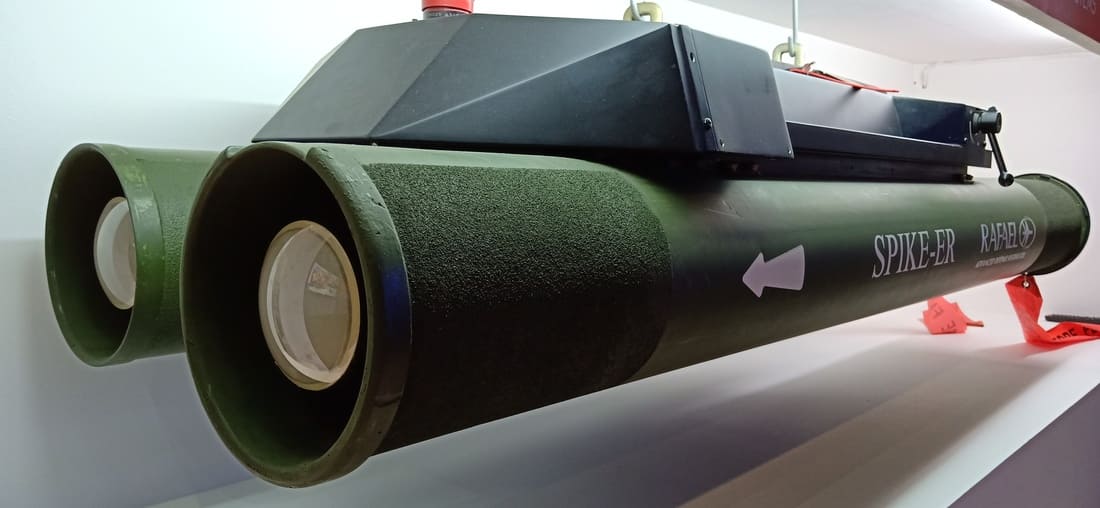
Rafael’s U.S. subsidiary introduced a rocket-powered loitering munition, the L-SPIKE 4X, during the Association of the United States Army exhibition in mid-October. The company presents it as a “Launched Effect” that complements the wider SPIKE family and uses legacy SPIKE launchers and adds loitering persistence. “With L-SPIKE 4X we bring SPIKE’s missile pedigree into a new dimension – combining the speed and precision of a missile with the persistence of a Launched Effect,” said Yoav Tourgeman, CEO and President of Rafael. Company material also highlights “high-speed transit, seeker precision and mission persistence for contested operational environments.”
Concept and Role of L-SPIKE 4X
The round is a missile with loitering built in, not an air vehicle retrofitted with a warhead. It sprints to the target area, then can orbit while the operator searches or observes. Published figures list engagements to 40 km, about five minutes to reach that range, and up to 25 minutes of on-station time. The initial payload set includes a tandem HEAT option for armor and a multi-purpose warhead. The airframe uses a cruciform wing layout and a forward EO/IR seeker head.
Speed and Endurance Advantages Over Electric Loiterers
Five minutes to 40 km works out to roughly 480 km/h, far faster than common electric loiterers at similar distances. That pace narrows the gap between detection and strike for moving targets and reduces dependence on a separate overwatch platform to cue weapons. Rafael materials emphasize a dash-then-loiter profile.
Endurance reaches up to 25 minutes once on station. Some electric systems stay aloft longer, yet the trade favors quick ingress and survivability against point defenses. Company statements compare L-SPIKE 4X favorably against most electric loitering effects on time-to-target and retain enough dwell to wait for a target to reappear or clear masking. The operator receives seeker video, conducts identification, and authorizes the terminal dive.
Integration With Existing SPIKE NLOS Launchers
Units can fire L-SPIKE 4X from existing SPIKE NLOS canister launchers on ground vehicles, rotary-wing aircraft, and naval mounts. That lets users with SPIKE inventories add a loitering attack option without new heavy hardware. According to industry sources, compatibility with established fire-control interfaces and canister handling remains a central pitch to current SPIKE operators.
Show imagery points to a nose-mounted sensor window and folding cruciform wings, with four forward and four aft surfaces that deploy after launch. The forward body differs from legacy NLOS rounds even though the family resemblance is clear. The airframe keeps the canister form factor and the general handling envelope familiar to crews.
Operators can load mixed canisters and pick the effect per shot. A vehicle platoon or ship team that trains on SPIKE NLOS procedures keeps the same interface, then selects 4X when a fast dash plus short loiter is worth more than long endurance. According to industry officials, this is why the firm consistently calls 4X a missile rather than a drone.
Operator Control and Autonomous Support
Rafael describes a man-in-the-loop approach. The autonomy stack provides target recognition and image acquisition, and a human makes the release decision. One operator can supervise and coordinate up to four missiles in a single mission, assigning sectors and clearing the terminal attack. Company briefings stress interface aids, not fully autonomous strike.
The datalink and guidance suite target contested electromagnetic conditions and GPS-denied environments. Claims include hardened links and navigation schemes that do not rely on continuous GPS reception. Officials confirm that Launched Effects operate inside dense jamming and spoofing scenarios, so control must hold up when interference rises and bandwidth drops.
Sensors include day TV and IR, with EO/IR video to the operator during loiter. The feed supports positive identification, retargeting when an aimpoint is masked, and basic battle-damage assessment after impact. Operators can break off a run and reset the dive if the picture changes.
Program Status and Army Launched Effects Context
The public debut ran in Washington on October 13–15, 2025, with Rafael staff presenting L-SPIKE 4X alongside other loitering entries. According to industry officials at the show, the program sits near technology readiness level 5–6, with testing planned in 2026 and production targeted for late 2027 or early 2028. Company handouts reiterated the two warhead options and the EO/IR seeker architecture.
U.S. Army work on Launched Effects continued this summer at Joint Base Lewis-McChord, including a short-range special user demonstration in August and a service update issued on October 2. Defense officials confirm those events feed requirements and interface work across aviation and ground formations. The Army outlined short, medium, and long-range LE tiers and will study ultra-long-range payload carriers through 2026.
Black Hawk modernization tracks with LE integration. Program offices described early 2024 flight trials in the medium-range class and continued industry days, and rotary-wing upgrades focused on digital backbones that make payload carriage easier to clear. The message from those offices stayed steady-keep common interfaces, enable quick payload swaps, and avoid bespoke controls where possible.
Rafael’s smaller entry, SPIKE 1X derived from Firefly, now lists a five-kilometer range, ISR loiter up to 30 minutes, and a warhead around 2.2 kg. Israeli forces have used Firefly at squad level in urban fights. That places 1X as a backpack system for infantry, and L-SPIKE 4X as a vehicle, ship, or helicopter effect.
Our analysis shows the appeal rests on three points – very fast transit to 40 km, enough loiter to exploit brief exposure, and reuse of SPIKE launch gear many users already field. Company materials and independent show photos line up on the main claims – range, time-to-target, on-station time, payload options, and the human-in-the-loop control concept.
REFERENCE SOURCES
- https://breakingdefense.com/2025/10/rafael-unveils-new-high-speed-l-spike-4x-loitering-munition/
- https://www.defensenews.com/global/mideast-africa/2025/10/15/rafael-pitches-loitering-spike-variant-for-us-army-launched-effects/
- https://www.rafael.co.il/news/rafael-to-unveil-l-spike-4x-launched-effect-at-ausa-2025/
- https://www.rafael-usa.com/programs/l-spike-4x/
- https://euro-sd.com/2025/10/major-news/47261/rafael-unveils-l-spike-4x/
- https://www.army.mil/article/288835/advancing_army_innovation_special_user_demonstration_highlights_the_future_of_launched_effects_technology
- https://www.army.mil/article/288878/groundbreaking_launched_effects_demonstration_marks_key_step_in_u_s_army_modernization_strategy
- https://breakingdefense.com/2025/10/army-planning-26-demo-with-ultra-long-range-launched-effect-contenders/
- https://www.army-technology.com/news/ausa-2025-rafael-unveil-l-spike-4x-loitering-missile/
- https://www.rafael.co.il/system/l-spike-1x/
- https://en.wikipedia.org/wiki/Spike_Firefly
- https://www.calibredefence.co.uk/loitering-with-the-l-spike-4x-from-rafael/
- https://www.smgconferences.com/editors-corner/6262-news–rafael-usa-debuts-lspike-4x-loitering-munition-at-ausa-2025
- https://www.army.mil/peoaviation
- https://www.army.mil/article/272675/army_successfully_demonstrates_launched_effects_system
- https://www.army.mil/article/284204/u_s_army_taps_three_companies_for_cutting_edge_launched_effects_demonstration