
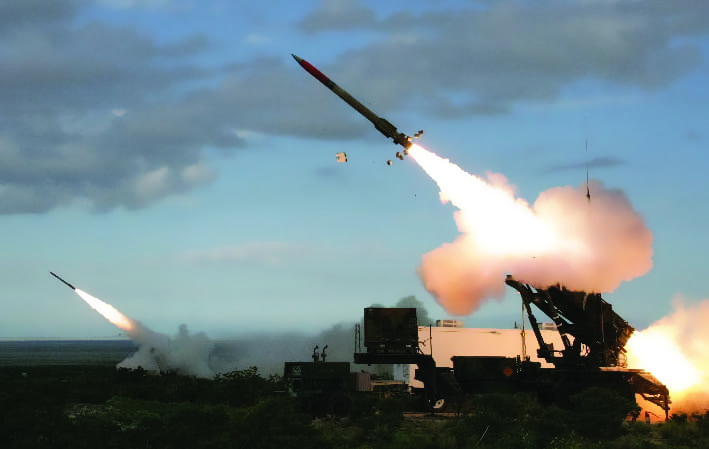
Lockheed Martin fired a Joint Air-to-Ground Missile from a new four-cell launcher built for vertical launch and shipboard counter-UAS missions, completing an initial ground test ahead of a planned intercept against a live drone.
Yuma Ground Test and Planned China Lake Intercept
On August 28 at Yuma Proving Ground, the JAGM Quad Launcher fired at 45 degrees and hit a stationary, decommissioned ground target. Test crews pulled ignition and flight telemetry from the shot to confirm canister pressures, plume temperature, thrust alignment, and structural margins. Officials confirm Army observers attended. Company engineers framed the event as a data-gathering step before a true vertical shot.
A second demonstration is slated this month at China Lake. The plan calls for a 90-degree launch against a target UAV to prove ship-style vertical egress, off-the-rail control, and clean seeker lock in the first seconds of flight. Briefers at AUSA said this run aims to close risk on exhaust flow handling and the initial turn away from the launcher. According to industry sources, the range team will record seeker handoff timing on a small aerial target and compare it to lab predictions.
Lockheed executives have labeled the canistered system the JAGM Quad Launcher, or JQL. The pack carries four rounds and mates to containerized or deck-edge mounts. Interfaces align with the company’s expeditionary launch family to reduce new kit. Program staff detailed control-software tweaks that support quick re-attack on multiple drones and use the baseline missile hardware. “JAGM [is] another arrow in the quiver for our customers… targeting naval defense, ship defense for counter-UAS,” said Casey Walsh, who oversees multi-domain missile systems. Launch systems director Edward Dobeck pointed to interest from navies that run smaller ships without room for large air-defense suites.
Vertical Launch Design and Exhaust Management
Ship decks and enclosed mounts need careful exhaust handling. A straight-down plume can scorch hardware or breach protective layers. The JQL prototype uses ablative liners, heat-resistant composite structure, and a routed gas channel that carries hot flow upward beside the missile during motor burn. The layout moves the exhaust column upward as the round climbs and shields the deck until the missile clears.
Manufacturing and integration draw on the same business unit that builds Mk 41 Vertical Launching System equipment and the Army’s Typhon launchers in Moorestown, New Jersey. Common tooling for canisters, handling fixtures, and acceptance testing enables faster iteration on the new quad pack. According to officials, that shared footprint also eases qualification of thermal shielding and over-pressure limits because the test rigs and measurement practice mirror existing vertical-launch hardware work.
The launcher is not ship-only. The canister pack can bolt to wheeled vehicles or expeditionary pallets in the same footprint used at sea. Recent concept displays showed containerized and chassis-mounted options that carry four vertically oriented JAGM rounds for point defense and surface targets. A European demonstrator paired vertical JAGM cells with an armored wheeled vehicle, signaling interest in land-based point defense and anti-armor fires from one mount. According to industry officials, operators studying convoy and fixed-site protection asked for one rack that can handle small drones, fast inshore boats, or armored vehicles without a swap.
Combat-system integration remains central for ships. A vertical canister adds engagement geometry, but the ship still needs reliable tracks and cueing. Officials confirm the JQL control unit accepts open-architecture inputs from combat systems and electro-optical directors. The China Lake run is expected to use a surrogate combat system and range sensors so engineers can measure latency from sensor track to missile launch and the seeker’s first solid lock.
JAGM Seekers and Counter-UAS Software Updates
The missile in these trials is the standard AGM-179 JAGM with dual seekers. One channel is semi-active laser for precise aimpoints. The other is millimeter-wave radar that enables fire-and-forget against movers and low-contrast targets. A medium-range evolution with a tri-mode seeker has flown in guided tests and adds an imaging channel suited to cluttered scenes and tougher discrimination.
Program managers outlined a software line focused on counter-UAS work. Items include aimpoint choice on small airframes, burst-height logic, and engagement gates tuned for low-altitude targets over water and near ship structures. Officials characterize the changes as seeker-and-autopilot updates rather than hardware swaps. The intent is to keep the same form-factor round for both surface and aerial targets. According to industry sources, the goal is to minimize changes to handling and storage and sharpen end-game performance against drones.
Price came up at AUSA in the discussion on magazine depth. Prior procurement figures place JAGM well below long-range area-defense interceptors. Executives argue navies need a stack of medium-cost shots that carry high single-round probability against one-way drones and smaller UAVs. They also want the option to hit armored vehicles or small surface craft. The same missile across roles keeps logistics simple for ships with limited volume.
Flight behavior after vertical egress stays inside the missile’s envelope. After clearing the canister, the round tips, turns, and either follows a midcourse update or flies to a laser spot if the ship designates. JAGM already executes lofted and crossing shots from aircraft. The novelty here lies in the very short first turn off the deck and the canister’s plume routing. Engineering teams intend to document thermal loads and structural margins across repeated cycles that mirror shipboard use, not only one-off range shots.
USV Integration and Ground Vehicle Concepts
Fleet commanders have asked for more magazine depth against drones at sea. Army helicopter trials in late summer showed AH-64E crews can detect, track, and defeat UAVs using several weapons, including JAGM, during an event in North Carolina. Those air-launched shots gave program staff data on seeker behavior against small aerial targets, fuze function, and clutter effects. Ship defenders seek a deck-launched option that delivers similar terminal results and keeps larger interceptors for other threats.
Uncrewed surface vessel work now intersects with JQL. A recent partnership announcement described plans to arm a roughly 72-foot surveyor-type unmanned hull. At-sea live-fire trials appear in a later phase. According to officials familiar with the project, the integration uses open interfaces so the launcher, sensors, and communications can evolve across hull variants. The use case focuses on near-coastal surveillance and interdiction where small drones and fast crewed craft appear in the same patrol window.
Ground-vehicle concepts follow the same idea. An industry demonstrator fitted an armored wheeled vehicle with vertical JAGM canisters in a compact array. Public descriptions list 24 cells on that vehicle. The aim is one launcher that can protect convoys or fixed sites from drones and light surface craft and then shift to anti-armor fires when required. According to industry sources, several armies have asked how quickly crews can reload and what deck or roof strengthening the mount needs.
Magazine depth matters on small ships. A four-cell pack helps only if reloads work at sea or if hulls can carry several packs. The expeditionary family’s rail-based horizontal reload method lets crews slide canisters on and off without heavy cranes. Early JQL material indicates a similar reload plan that suits containerized or deck-edge placements where topside cranes are not available. Officials confirm reload procedures will appear in follow-on trials after the China Lake window.
Program Status and Export Interest
There is no Army program of record for a vertical JAGM launcher. Company managers describe the current effort as internally funded risk reduction for launch, exhaust management, and seeker performance on ship and expeditionary mounts. Navy use cases drive the near-term work. Land options remain open through common canisters and control electronics. Independent coverage from AUSA matches these points and adds detail on the August shot and the planned November intercept.
Export inquiries have come in from allied navies that run small combatants in tight littorals, according to industry officials. Those operators often need to intercept unmanned boats, watch for quadcopters, and stop medium one-way drones in the same patrol period. A compact launcher paired to a dual-mode or tri-mode missile aligns to that mission and holds down per-shot cost compared with large area-defense interceptors.
Walsh positioned JQL as a way to put JAGM on ships without waiting for a bespoke interceptor program. Dobeck underlined the interest from operators of patrol vessels and auxiliaries who need compact gear. “Quite frankly, there has been a lot of interest in the international communities that have some of the smaller vessels,” he said. Our analysis shows the remaining hurdles fall in three places. Vertical egress heat and blast. First-turn control off the deck. Clean seeker lock on small, low-RCS drones in maritime clutter. The November range event is structured to capture that data with enough granularity to guide the next software drop and canister tweaks.
REFERENCE SOURCES
- https://breakingdefense.com/2025/10/lockheed-live-fires-new-vertical-launch-jagm-for-naval-counter-drone-role/
- https://www.lockheedmartin.com/en-us/news/features/2025/successful-first-time-jagm-quad-launcher-demo-showcases-mission-integration-capabilities.html
- https://www.navalnews.com/naval-news/2025/10/lockheed-martin-tests-jagm-quad-launch-canister-system/
- https://www.janes.com/osint-insights/defence-news/defence/ausa-2025-lockheed-martin-debuts-ground-launched-jagm
- https://www.shephardmedia.com/news/air-warfare/ausa-2025-lockheed-martin-conducts-first-ground-based-test-of-jagm-quad-launcher/
- https://insidedefense.com/insider/jagm-successfully-launches-canister-based-launcher
- https://www.navair.navy.mil/product/Joint-Air-Ground-Missile-JAGM
- https://news.lockheedmartin.com/2023-12-05-successful-jagm-mr-guided-flight-test-demonstrates-tri-mode-seeker
- https://www.reuters.com/business/aerospace-defense/tomahawk-missiles-planned-aboard-sea-drones-latest-lockheed-deal-2025-10-29/
- https://militaryembedded.com/unmanned/test/uncrewed-surface-vehicle-collaboration-announced-by-lockheed-martin-saildrone
- https://thedefensepost.com/2025/10/30/lockheed-saildrone-usv/
- https://www.overtdefense.com/2025/09/17/dsei-2025-rheinmetall-lockheed-martin-reveal-new-fuchs-jagm/
- https://www.army.mil/article/288216/army_demonstrates_apache_counter_uas_capabilities
- https://www.stripes.com/branches/army/2025-09-02/apache-helicopter-drone-threat-18951533.html
- https://navalnews.com/event-news/sea-air-space-2025/2025/04/export-interest-for-lockheed-martin-expeditionary-launchers-grows/