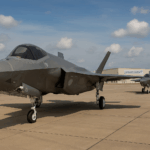
Romania now owns 18 former Royal Netherlands Air Force F-16AM/BM fighters that had already been flying from the 86th Air Base at Fetești as part of the European F-16 Training Center. The aircraft remain assigned to the training mission at Fetești, where Romanian and Ukrainian pilots transition onto the Viper under a multinational arrangement led by Romania, the Netherlands and industry partners.
The transfer converts what was an arrangement on loan into full Romanian ownership. The jets can now be counted in the inventory of the Romanian Air Force, raising the national F-16 fleet to roughly 67 aircraft when earlier Portuguese and Norwegian deliveries are included. This gives Bucharest one of the larger Western fighter fleets on NATO’s eastern flank at the same time as it prepares to introduce the F-35 in the next decade.
The aircraft are mid-life-upgraded F-16AM/BM airframes built between 1979 and 1992 and modernised under the MLU standard, with structural work and updated avionics that keep them relevant for training and air policing roles even though newer Block 70 variants now enter service elsewhere in Europe. Romanian officials present this purchase as a bridge between second-hand F-16s and a future all-F-35 force.
The aircraft stay at Fetești under the European F-16 Training Center framework, but legal control now rests in Bucharest. Defense officials confirm the jets are earmarked first for instruction yet can still be tasked for national air defense if NATO requirements or the regional situation demands.
Contract details and cost of the one euro F 16 transfer
The intergovernmental contract was signed at Romania’s Ministry of National Defence in Bucharest on 3 November 2025 by Brig. Gen. Ion-Cornel Pleșa, head of the General Directorate for Armaments, and Linda Ruseler from the Dutch Ministry of Finance, in the presence of Defense Minister Liviu-Ionuț Moșteanu and Dutch ambassador Willemijn van Haaften. The agreement finalised a decision first announced at the NATO summit in The Hague in June 2025, when Romania and the Netherlands extended the training-center arrangement at Fetești.
The line in the contract for the aircraft themselves lists a nominal price of one euro. Romanian authorities, however, calculate value-added tax on the declared worth of the aircraft, spares and support package, which public documents place close to 100 million euro. The VAT bill of 21 million euro flows into Romania’s own budget rather than to the Dutch side, so the transaction between the two governments stays symbolic even though the underlying hardware obviously does not come for free.
Dutch notifications to their parliament describe the package as including the 18 airframes, associated spare parts and simulators, with a valuation around 65 million euro for that portion alone. The gap between different public figures reflects the way governments record support equipment, refurbishment work and services rather than any hidden discount. Accounting-wise the jets themselves are fully amortised in Dutch books after several decades of service, which makes a token sale price a normal tool for transfers inside an alliance.
The legal structure resembles the 2002 deal in which Germany passed 22 surplus MiG-29 fighters to Poland for one euro each, with Warsaw taking on the cost of overhaul and operation. In the current case the Royal Netherlands Air Force had already retired the F-16 from its own order of battle after the F-35A took over, including the former nuclear-strike mission, so the aircraft were available for either disposal or onward transfer.
Several of the jets in this batch previously supported Dutch training in the United States and later sat in storage before being ferried to Gosselies in Belgium for overhaul and upgrade work ahead of their move to Romania. According to industry sources companies contracted by the original manufacturer carried out structural checks, systems updates and repainting so the aircraft entered Romanian service with standardised configuration suitable for training both national and Ukrainian aircrews.
European F 16 Training Center role in Romanian and Ukrainian training
The European F-16 Training Center operates at Baza 86 Aeriană “Locotenent aviator Gheorghe Mociorniță” in Fetești in southeast Romania. Romania provides the air base, infrastructure, ground support and host-nation services, while the Netherlands originally supplied the F-16s for training and the prime contractor delivers simulators, instructors and maintenance support through a network of subcontractors.
The center grew out of the wider F-16 Training Coalition formed at the Vilnius NATO summit in July 2023 to coordinate instruction for Ukrainian pilots and ground crews. Coalition plans put Romania in charge of the regional hub, with the base at Fetești chosen because the country already operated F-16s and could absorb more airframes without major infrastructure changes. The first five Dutch jets for the center landed there in November 2023, ahead of any Ukrainian F-16 deliveries.
Initial activity focused on refresher courses for experienced F-16 instructors recruited into the program, giving them time on the specific configuration and local procedures before new student intakes arrived. The syllabus now covers basic conversion, instrument flying, formation work, air-to-air employment and tactical training up to combat-ready level, with sorties flown entirely in NATO airspace.
Romanian pilots entered the pipeline first, followed by Ukrainian crews as aircraft became available for Kyiv. Officials in Bucharest state the 18 newly transferred jets will be used “exclusively for pilot training, with part of the slots dedicated to Ukrainian pilots.”A letter from the Dutch side to its parliament commits Romania to reserve roughly half of the EFTC’s training capacity for Ukrainian pilots for eight years, formalising Fetești’s role as a long-term training site for Ukraine’s F-16 force.
Defense officials confirm that the center is run under common standards agreed within NATO’s F-16 community, so instructors and students from different member states can rotate through the same syllabus without major adjustment. According to industry sources, subcontractors such as Draken International and GFD support the training system under contracts linked to the main industrial partner, supplying instructor pilots, maintenance personnel and training support tools that Romania alone would struggle to field at this scale.
Dutch Defence Minister Ruben Brekelmans summed up the government view by saying the training center is “a textbook example of successful cooperation” and that Ukrainian pilots trained there already contribute significantly to the defence of their country. Liviu-Ionuț Moșteanu, his Romanian counterpart, called the November contract “the completion of a significant stage” in the development of the center and described Fetești as a European hub for all states that operate or plan to operate the F-16.
Romanian F 16 fleet growth and NATO air defense tasks
Romania’s F-16 fleet has grown through three separate “Peace Carpathian” tranches plus the Dutch transfer. The air force first took 12 F-16AM/BM from Portuguese stocks, followed by another five aircraft from the same source. A later contract with Norway added 32 F-16s, delivered across 2023 and 2024 as the Romanian Air Force retired its MiG-21 LanceR fleet. The 18 ex-Dutch aircraft now absorbed into the inventory push total F-16 numbers to about 67 airframes, although not all are simultaneously available for operations because some support training or deep maintenance.
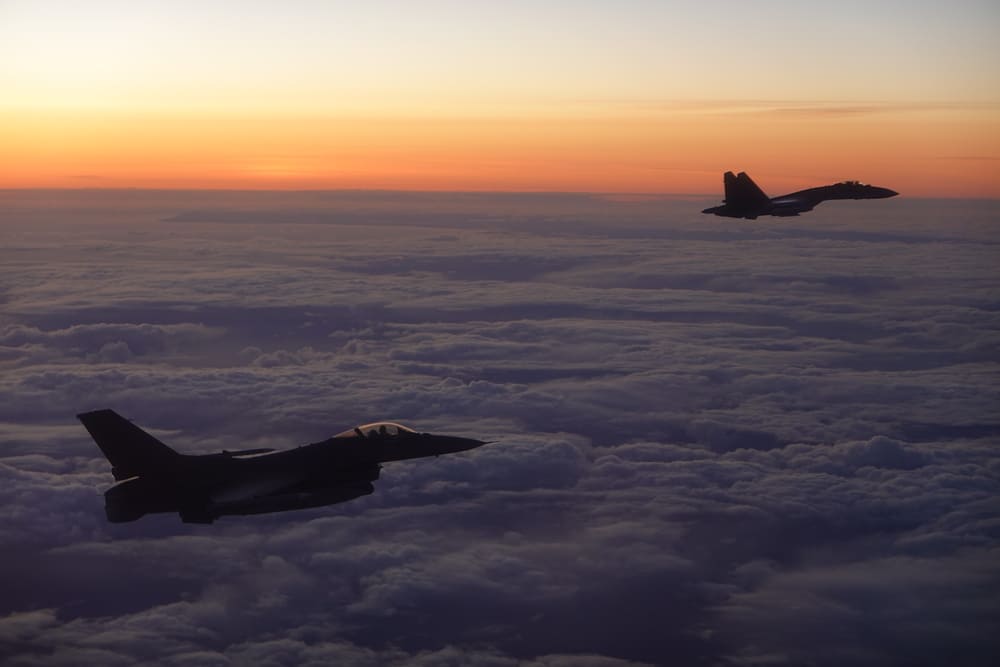
This rapid expansion has allowed Romania to sustain quick-reaction alert at home and contribute fighters to NATO air-policing missions over the Baltic and Black Sea regions. F-16s from the “Carpathian Viper” units have already rotated through deployments at Šiauliai in Lithuania, intercepting Russian aircraft on alliance taskings alongside Portuguese and Polish detachments. In parallel, Romanian jets regularly patrol national airspace along the Black Sea coast, where NATO air activity has increased since Russia’s full-scale invasion of Ukraine.
The mix of aircraft dedicated to EFTC and those focused on operations gives Romania more flexibility than the small MiG-21 force it retired in 2023. Some of the Dutch jets at Fetești are wired and cleared for live weapons and can be switched to operational roles if alliance commanders request additional fighters in theatre.Defense officials confirm that national plans treat the F-16 fleet as a single pool with training and operational squadrons, which simplifies logistics and pilot management even while the training center carries an international label.
Fact-checking work published in the region notes that the Dutch airframes Romania now owns are older but upgraded jets, and stresses they cannot be compared directly with new-build F-16 Block 70 aircraft ordered by states such as Bulgaria and Slovakia. The Romanian choice reflects both budget realities and the need to field a larger number of airframes quickly enough to cover national and NATO missions, rather than pursue a smaller fleet of brand-new fighters.
Impact on Ukraine fighter plans and Romania F 35 transition
The F-16 Training Center at Fetești now sits inside a wider program that brings Western fighters into Ukrainian service. After Washington approved re-export, four European donors pledged a combined total of 87 F-16s to Kyiv:
- 24 aircraft from the Netherlands
- 30 aircraft from Belgium
- 19 aircraft from Denmark
- 14 aircraft from Norway
Deliveries from Dutch and Danish stocks began in the second half of 2024, and by mid-2025 Ukrainian F-16s were flying combat missions against Russian cruise-missile and drone attacks as well as ground targets. Several Ukrainian pilots have spoken publicly about shooting down multiple incoming missiles in a single sortie while flying the new jets.
Combat losses underline the demands placed on Ukraine’s small F-16 force. By mid-2025 open sources recorded at least four F-16s destroyed in accidents or combat, with three pilots killed and one surviving ejection, figures that match public statements from Ukrainian and Western outlets tracking the air war. Those losses come on top of attrition in Ukraine’s remaining Soviet-type fighters, which the F-16 is gradually replacing.
Pilot pipelines therefore matter as much as raw aircraft numbers. A portion of Ukrainian pilots and ground crews train in the United States with the Arizona Air National Guard’s 162nd Wing, while others go through F-16 conversion in Denmark and other coalition locations. The Romanian center adds another stream that can be scaled as more instructors and simulators come on line, and it operates closer to Ukraine than US bases, with shorter travel times and easier coordination with Kyiv.
Ukraine has also received Mirage 2000-5 fighters from France and is discussing future acquisition of Saab Gripen aircraft from Sweden, which would diversify its Western fighter fleet. Each additional type brings new training and logistics demands, yet all of them rely on a core cadre of pilots who have already transitioned to Western cockpits, many of whom passed through coalition training hubs such as Fetești.
Romania’s own fighter roadmap now points toward the F-35. Bucharest approved a plan to buy 32 F-35A aircraft through a foreign military sales case with the United States, with an estimated package value around 6.5 billion dollars and first deliveries expected early in the 2030s. Romanian leaders have described the current F-16 fleet as an intermediate step on the way to a fifth-generation force, not an endpoint.
Our analysis shows the one-euro transfer of Dutch F-16s effectively secures a long-term role for Romania as a training and support hub for Western-standard fighters on NATO’s eastern flank, even after frontline European air forces move fully to the F-35. The aircraft now on the books in Bucharest keep the European F-16 Training Center supplied with hardware under Romanian control, while still serving a wider coalition effort to keep Ukrainian crews in the air with a sustainable flow of trained pilots and maintainers.
REFERENCE SOURCES
- https://english.news.cn/europe/20251104/4cd31ff6f5144660a75d377e0f954356/c.html
- https://www.twz.com/air/romania-just-bought-18-f-16s-for-one-euro
- https://theaviationist.com/2025/11/05/rnlaf-18-f-16s-transfer-romania/
- https://www.aerotime.aero/articles/netherlands-transfers-f-16-romania
- https://www.f-16.net/f-16-news-article5336.html
- https://nltimes.nl/2025/11/04/romania-buys-18-dutch-f-16-fighter-jets-eu1
- https://factcheck.bg/vyarno-e-che-rumaniya-poluchava-18-iztrebitelya-f-16-za-edno-evro/
- https://news.lockheedmartin.com/2023-08-31-Lockheed-Martin-Announces-European-F-16-Training-Center-in-Romania
- https://www.businessinsider.com/nato-military-got-more-f-16s-for-one-euro-2025-11
- https://en.wikipedia.org/wiki/F-16_training_coalition
- https://defensemirror.com/news/39771
- https://aerospaceglobalnews.com/news/romania-dutch-f16-one-euro-nato-ukraine-training/