A photo that began circulating online in early December shows a Ukrainian F-16AM carrying two seven-shot 70mm rocket pods that match the LAU-131 family, mounted under the wings. A targeting pod appears on the intake station on the right side. The weapons fit a load often used for air-defense patrols, with short-range air-to-air missiles visible alongside the pods. The photo does not show the rocket type at the front of each tube clearly enough to settle the question alone, but the combination of pods and a modern laser designator points toward a guided-rocket setup rather than unguided Hydra rounds.
A second image posted soon after appears to show the same general configuration from a different angle and distance, with the pod easier to pick out than the rockets. The pods look consistent with a 2.75-inch launcher and not a larger-caliber system, and the carriage points match what operators use on other aircraft when they fly 70mm precision rockets. The aircraft tail and unit identifiers are not fully legible in the available copies, yet several details line up with Ukrainian Air Force F-16AM imagery released in recent months.
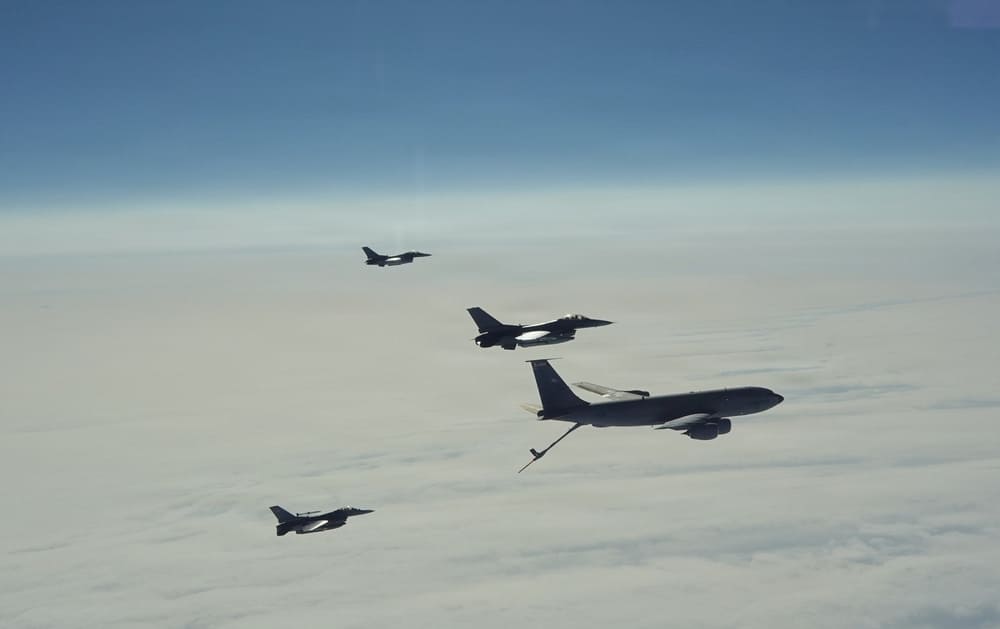
By early January, an official Ukrainian Air Force video on its F-16 program added another data point. The footage includes both single-seat and two-seat F-16s on the ramp and in flight, with visible air-to-air missile loadouts and a brief but clear look at the same intake-mounted targeting pod position seen in the December stills. The video does not show a rocket launch sequence, but it places the pod on Ukrainian F-16s in a way that supports the December photos. Public-release material of this sort rarely lingers on stores long enough for full confirmation, but it offers a closer view than most social media stills.
The likely pod in the images matches the AN/AAQ-33 Sniper family, a system that supports laser designation, laser spot tracking, and stabilized electro-optical and infrared video. Ukraine has not published a formal statement listing the pod type or its mission set. Still, the presence of an intake-mounted designator solves a practical problem for laser-guided rockets on the F-16, since the aircraft needs a stable, precise laser source and the right cockpit interfaces to work targets at the ranges where 70mm rockets make sense.
The December images also point to a specific idea about how Ukraine intends to use its limited F-16 fleet. Fighters have spent many nights intercepting long-range one-way attack drones and cruise missiles. Missiles like the AIM-120 and AIM-9 series remain the most visible tools in Ukrainian F-16 footage, but the number of missiles a jet can carry on a typical defensive patrol stays finite. A pair of seven-shot pods changes the arithmetic without forcing a major aircraft change, and the pictures suggest Ukraine reached the point where it can fly that configuration.
APKWS II laser-guided 70mm rockets and the cost math of counter-drone sorties
The weapon most often tied to this configuration is the Advanced Precision Kill Weapon System II, a laser-guided 70mm rocket built around a standard Hydra motor and warhead with a guidance and control section installed between them. The guided portion carries the unit cost. Public reporting in December placed the guidance section at roughly $15,000, and total round cost commonly cited in the $20,000 to $25,000 bracket, though exact figures vary by configuration and lot.
That price range matters because Ukraine has had to spend expensive air-to-air missiles against targets that often cost far less than the interceptor. Recent U.S. fighter operations in the Middle East pushed the same issue into the open, with combat aircraft tasked to knock down drones in volume and at odd hours. A laser-guided rocket does not replace a modern missile in an air-to-air fight, but it can fill a gap against slow, non-maneuvering drones and some subsonic cruise missiles when the engagement geometry stays favorable.
Magazine depth is the other draw. Ukrainian F-16 footage and stills have shown patrol loads that typically carry four to six air-to-air missiles. Two seven-shot pods add up to 14 rockets if both pods are fully loaded, though pilots may not always fill every tube. Even at a partial load, a fighter gets far more trigger pulls for the same external station count than it would with missiles alone. The pods can also free the jet from an all-or-nothing choice between using a missile or saving it for a later threat, which has been a constant problem for operators who face waves of drones.
Ukraine already has experience with guided 70mm rockets from the ground. Ukrainian Air Force and air defense units have used systems that fire laser-guided Hydra rockets as a counter-drone method, including the VAMPIRE launcher supplied by L3Harris Technologies. That ground record does not guarantee the same success from a fast jet, but it reduces the novelty on the logistics and training side. The shift from a vehicle launcher to an aircraft pylon introduces new flight envelopes and fire-control work, yet it stays inside an already familiar family of rockets, warheads, and laser guidance concepts.
There is also a version optimized for aerial targets. Reporting on U.S. development work has referred to an air-to-air tailored variant as AGR-20F, and it has been linked with proximity fuzing and modified guidance logic to raise the odds against small airborne targets. Whether Ukraine has received that particular configuration is not clear from public material. The photos only show pods, and the rocket nose details are too small to read. The more basic point still stands, a laser-guided 70mm rocket expands the set of feasible intercepts without requiring a large missile expenditure.
The setup does impose real constraints. The shooter needs a laser designation for the full engagement, which ties up the aircraft’s sensor focus and limits how quickly a single jet can prosecute multiple targets in different directions. A fighter that can fire a missile and immediately turn away does not have the same constraint, but it also pays a far higher price per shot. For Ukraine’s nightly drone problem, the guided rocket sits in a middle lane, lower cost than a missile and more reach and flexibility than a gun in many scenarios.
Norway JUMPSTART funding and United States Navy production orders for APKWS guidance kits
A public Norwegian government announcement in mid-December added a strong procurement clue. Norway said it would provide roughly NOK 3.2 billion through the JUMPSTART mechanism for F-16 ammunition and air defense purchases, and it described an “advanced precision weapons system that converts low-cost missiles into precision-guided munitions for use by aircraft or ground-based air defence systems.” Defense officials confirm the package also includes financing for a precision system intended for F-16 use, with procurement routed through the U.S. Foreign Military Sales structure.
The language in the announcement does not name APKWS outright, but it describes the exact function of the guidance kit, and it appears in a package centered on F-16 weapons and air defense. Reporting that followed tied the Norwegian funding to a laser-guided 70mm rocket solution for counter-drone work. The same reporting also linked the purchase path to Norway’s use of JUMPSTART and Foreign Military Sales to move hardware quickly, which fits the timeline pressure implied by the December photos.
On the production side, a U.S. Navy contract announcement in December pointed to large-volume guidance kit demand. Public reporting described an indefinite-delivery contract with a ceiling of $1.7 billion and an initial order for 11,000 laser guidance kits. According to industry sources, the production line now has enough momentum to support tens of thousands of additional kits for U.S. services and foreign customers under the same contract vehicle. That matters because a counter-drone mission burns through shots fast, and stock depth becomes as important as raw performance.
An executive quote carried in the reporting captured the pitch in plain terms. “The award reinforces the value of proven and cost-efficient precision munitions,” said Neeta Jayaraman, identified as a director in BAE Systems precision guidance and sensing. The same statement described the kits as “combat proven” across multiple roles, a line that matches how operators talk about the system’s wide platform list.
The December procurement signals also align with what the photos imply about hardware availability. The rocket pods themselves are common in NATO inventories and have long been integrated on multiple aircraft types. The more sensitive piece is the targeting pod and the cockpit integration that supports laser designation and weapon cues. Ukraine’s F-16 fleet consists of earlier variants upgraded through mid-life programs, and the pod and wiring fit becomes a gating item for any laser-guided rocket plan. The official Ukrainian Air Force video showing the intake-mounted pod suggests that part of the equation is already solved.
For Ukraine’s air defense fight, the Norwegian and U.S. procurement signals do not prove which specific kits are on which specific jets. They do, however, show that allied funding and industrial supply have moved toward a high-volume precision-rocket lane for air defense work, right inside the window when Ukrainian F-16s began appearing with rocket pods in public imagery.
Laser designation limits, buddy lasing, and how F-16 sensors may support APKWS shots
A laser-guided rocket requires continuous designation through impact, so the aircraft has to keep the target inside a stable track for the full time of flight. That favors steady targets and predictable intercept geometry, and it discourages last-second maneuvering by the shooter. A counter-drone patrol over defended areas can support this kind of engagement, since the fighter can plan its run and maintain a track without the same threat picture it would face deep near the front.
The Sniper pod’s stabilized optics can hold a laser on a small target when the aircraft stays within a workable envelope. The pilot still has to manage closure, range, and background clutter, and those factors vary with weather and lighting. A one-way attack drone tends to fly a predictable path and speed, which is one reason operators keep returning to cheaper interceptors for that problem. A subsonic cruise missile presents a different challenge, since it can fly low and use terrain and clutter, but it still stays inside the performance band where a 70mm rocket can make sense under the right conditions.
Laser designation also opens the door to buddy lasing, where one aircraft provides the laser while another launches. Ukraine has used cooperative tactics with ground sensors and airborne interceptors for years, and the concept fits the way mixed patrols and ground-based air defense already work together. Public imagery has not shown buddy-lase setups directly, and Ukraine has not published a description of how it intends to employ the rocket pods. The method remains a logical option when a single jet has too many targets to service with its own pod alone.
The rocket itself also places limits on engagement tempo. Even if a jet carries 14 rockets, the pilot still has to designate each target and manage the aircraft between shots. A missile-heavy patrol trades fewer trigger pulls for faster handoff and less cockpit workload per engagement. The rocket-pod approach looks suited to high-volume nights where the target set includes many drones and where a fighter can work a sector with ground control support and predictable inbound lanes.
U.S. reporting has also described work on a dual-mode guidance concept that adds an imaging infrared seeker to reduce reliance on continuous laser designation. That concept has obvious appeal for counter-drone work, but it remains a development path rather than a fielded solution in the public record for Ukraine. The December photos point to the current, simpler method: a laser designator, a rocket pod, and disciplined engagement geometry.
A Ukrainian F-16 pilot described the pressure to adapt tactics to a threat mix dominated by drones and missiles, in language that fits this kind of incremental change. “We had to sit down and come up with tactics for how we would destroy cruise missiles and strike drones,” he said in an official video interview released in early January. The quote does not address rocket pods directly, but it reflects the same operational problem the APKWS configuration appears built to solve.
Our analysis shows the rocket-pod configuration offers Ukraine a way to stretch limited missile inventories on nights when drones dominate the target set, while keeping the F-16 inside the defensive mission lane seen in recent official footage.
REFERENCE SOURCES
- https://www.twz.com/air/ukrainian-f-16s-now-appear-to-be-armed-with-laser-guided-rockets
- https://www.janes.com/osint-insights/defence-news/defence/ukraine-conflict-norway-supplying-laser-guided-air-defence-weapons-for-ukrainian-f-16s
- https://www.airandspaceforces.com/apkws-base-laser-guided-rockets-pentagon-contract/
- https://www.zona-militar.com/en/2025/12/25/ukrainian-f-16-fighters-are-reportedly-already-equipped-with-apkws-ii-guided-rockets-to-shoot-down-russian-drones/
- https://euromaidanpress.com/2025/12/26/f-16-paveway-iv/
- https://united24media.com/latest-news/ukraines-f-16s-just-got-a-new-add-on-and-its-shredding-enemy-drones-14058
- https://en.wikipedia.org/wiki/Advanced_Precision_Kill_Weapon_System
- https://www.navalnews.com/event-news/sea-air-space-2025/2025/04/bae-systems-unveils-new-apkws-precision-guided-rocket-at-sea-air-space-2025/
- https://www.airandspaceforces.com/weapons/apkws/
- https://www.globalsecurity.org/military/world/war/russo-ukraine-2026-01-16.htm