
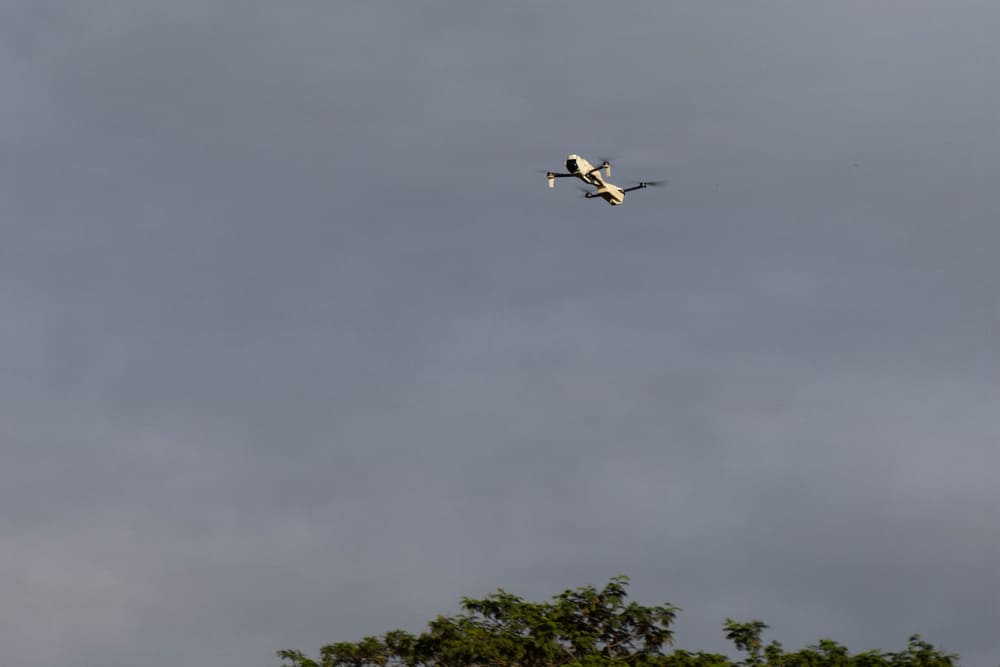
The U.S. Army plans to move from buying roughly tens of thousands of drones a year to acquiring at least one million in the next two to three years and then more than one million every year by 2028. Secretary of the Army Daniel Driscoll set that target during a recent visit to Picatinny Arsenal, where he said the service wants the United States able to “manufacture however many drones we would need” if a major war starts.
Driscoll told reporters the Army expects to purchase “at least a million drones within the next two to three years” and use those buys to prove a domestic supply chain can surge under wartime pressure. He noted that the Army currently buys only a fraction of that figure each year and called the jump to hundreds of thousands, then millions, “a big lift” for both the service and industry.
Officials confirm the million-drone effort links directly to earlier shortfalls in Pentagon drone programs, including the Replicator initiative that was supposed to field thousands of autonomous systems by August 2025 but did not meet that mark. That experience pushed Pentagon leaders toward shorter contracts, faster development cycles and closer tracking between real combat demand and what factories can actually deliver.
The Department of Government Efficiency, known as DOGE, now runs much of the wider drone effort and has support from Defense Secretary Pete Hegseth. DOGE staff are working across the department on new drone buys, while Hegseth uses public speeches and private meetings to push large contractors toward higher production rates instead of long custom programs.
Army Target Of One Million Drones And 2028 Production Goal
Army planning calls for at least one million drones of different types to be bought within two to three years and for annual procurement to grow to more than one million by 2028. Defense officials say the aim is not a one-off stockpile but a standing capacity to build and replace large numbers of drones every year if combat losses demand it.
According to industry sources, the Army has told suppliers it wants drones treated much closer to ammunition. Driscoll has said he wants them handled “more like expendable ammunition rather than an exquisite piece of equipment,” and internal planning documents compare future drone stocks to artillery shells or small arms cartridges.
The fleet mix under discussion covers several families of systems, from tiny quadcopters to larger tactical aircraft. Current documents and briefings point to four main groups:
- palm- and backpack-sized quadcopters for short-range reconnaissance and artillery adjustment
- first-person-view (FPV) drones configured as one-way attack munitions or to drop small explosive charges
- loitering munitions with longer endurance, in the Switchblade-600 class
- larger Group-3 drones for company and battalion surveillance and base defense
The Army wants the smallest drones issued at squad and platoon level, not just in battalions and brigades. Commanders have described an end state where quadcopters are as common as radios in infantry units, while loitering munitions and heavier platforms sit at company or battalion level to support long-range sensing and precision strike.
Counter-drone equipment is built into the same push. During his Picatinny visit, Driscoll watched trials of “net rounds” fired from launchers and electromagnetic systems fitted to existing weapons. Program documents list counter-UAS missiles, specialist ammunition and electronic-warfare tools as part of the planned spending, on the basis that any large U.S. drone fleet will face massed drones from opponents as well.
Lessons From Ukraine And China Drone Output
Combat in Ukraine sits in the middle of Army thinking on the new program. Ukrainian and Russian units use large numbers of FPV drones, small quadcopters and loitering munitions along the front, with dedicated teams hunting tanks, artillery, command posts and logistics nodes. Open sources put Ukraine’s drone production or assembly at around four million systems in 2024, with similar levels assessed for Russia.
Driscoll has pointed to those numbers and has warned in public that China stands on an even larger industrial base. He has said Chinese factories already supply most of the global commercial drone market and that Chinese output is probably “more than double” the Ukrainian and Russian figures combined. For Army planners, these comparisons show how quickly low-cost uncrewed systems can flood a battlefield once a country has the factories and electronics in place.
Senior commanders have begun to admit the gap in direct terms. Maj. Gen. James “Jay” Bartholomees, who commands the 25th Infantry Division, said at the Association of the U.S. Army meeting that the Army is “behind on long-range sensing and long-range launched-effect strike” and needs systems similar in concept to the Iranian-designed Shahed-136 that Russia uses in Ukraine. Lt. Gen. Charles Costanza, commander of V Corps, described the situation even more bluntly, saying “we’re behind” and “we aren’t moving fast enough” on both drones and counter-drone capabilities.
Ukrainian officials say a very high share of casualties now comes from drone attacks, and lawmakers in Washington who back the SkyFoundry Act use that data in public arguments for rapid expansion of U.S. drone output. North Carolina Congressman Pat Harrigan, who introduced the bill, has said the United States does not yet have the capacity to build drones at the needed scale and warns that opponents could out-produce it in “the class of weapons that decide wars.”
Chinese firms, meanwhile, offer one-way attack drones roughly comparable in size and role to the Shahed family, with advertised ranges beyond 1,000 kilometers and unit prices in the tens of thousands of dollars. Those systems give China and its partners a way to threaten ports, bases and fuel sites far from the front line. Army officers and DOGE staff now treat those catalogues as a standing reference when they judge what kinds of systems U.S. forces may face.
Industrial Base And Commercial Drone Suppliers
Driscoll has said his main industrial goal is to ensure the United States can build enough drones for a future war and to move motors, sensors, batteries and circuit boards away from supply chains controlled from China. According to officials, the Army wants domestic capacity not only for airframes but for the electronics and power systems that keep them flying.
One recent acquisition push under the Replicator banner selected Anduril’s Ghost-X and Performance Drone Works’ C-100 for company-level small UAS roles, while earlier tranches funded AeroVironment’s Switchblade-600 along with several uncrewed surface and counter-UAS systems. These buys were modest in volume but forced vendors to strengthen supply chains and prepare for larger orders built around common control software and networks.
On Capitol Hill, lawmakers have argued over whether drone production should center on a single national plant or remain distributed. One proposal would fund a government-backed factory in Texas able to turn out up to one million drones a year. People familiar with Driscoll’s position say he favors a spread of contracts across several companies instead of tying most production to one site.
DOGE’s drone task force, now led by former Marine and former Pentagon official Owen West, has collected detailed data on existing drone fleets from each service and from the Defense Innovation Unit. According to industry sources, the task force wants to steer near-term purchases of at least 30,000 drones and chart an expansion path that includes firms such as Red Cat, Skydio, Performance Drone Works and newer entrants like Neros.
Hegseth has used his speeches to press large defense primes to adapt to that direction. In one recent address he said major contractors “need to change, to focus on speed and volume and divest their own capital to get there,” signaling that the department expects co-investment and higher output in exchange for future work. Pentagon material linked to Replicator stresses commercial technology and “attritable” systems, backed so far by roughly one billion dollars spread across fiscal years 2024 and 2025.
Planning papers from the Army and DOGE call for domestic production of brushless motors, lithium batteries, inertial sensors and secure datalink modules. SkyFoundry, an internal pilot program, combines Army funding and factory space with private manufacturing lines to “churn out drones rapidly for battlefield use,” as one Army spokesperson put it. People involved in contract talks say SkyFoundry and related deals push common standards for control links and payload interfaces, so airframes, sensors and warheads can be mixed in different combinations without long redesign work.
Combat Use Of FPV Drones And Counter Systems
Many of the drones in current trials are built as weapons, not just scouts. Small FPV aircraft that carry anti-armor charges or modified grenades now feature in training events in Europe, where U.S. units practice attacks on vehicles, dug-in positions and low-flying helicopters with low-cost airframes. Loitering munitions in the Switchblade-600 class give company and battalion commanders an option to hit artillery, armor and infrastructure outside direct line of sight while operators remain under cover.
Commanders in Europe and the Pacific have also shown interest in drones with roles similar to the Shahed-136 and related designs. Those delta-wing one-way attack systems mix modest cost, long range and simple construction and are now produced in quantity inside Russia. Intelligence reporting and open imagery indicate that several countries, including China, are fielding comparable models and adapting them for swarming and strikes on fixed targets such as airfields and fuel depots.
Army units in Europe have begun to test integrated packages that link weaponized drones and counter-drone tools. Trial events combine quadcopters, FPV strike drones, loitering munitions and guided interceptors with electronic-warfare systems that jam or mislead incoming threats. Public information from these exercises shows progress, but it also shows how far U.S. units still trail Ukrainian brigades, which already run large drone teams with their own production, training and repair sections.
Some of the new systems backed under Replicator are meant to narrow that gap. Ghost-X and C-100 are designed as company-level surveillance drones that fit into rucksacks, can be assembled quickly in the field and fly under tablet-style control. Their payload capacity and endurance support both sensor and light-munition loads, and their software is built to tie into Army command networks rather than stand alone.
Our analysis shows the million-drone plan will only work as intended if three lines move together: unit training with real drones, industrial output of airframes and components inside the United States, and steady funding that keeps programs like Replicator, SkyFoundry and DOGE’s task force from sliding back into one-off experiments. For now, the one-million figure gives Congress, contractors and field commanders a clear reference point for how far the Army wants to move toward the kind of drone mass already seen in Ukraine, Russia and China.
REFERENCE SOURCES
- https://www.reuters.com/business/aerospace-defense/us-army-buy-1-million-drones-major-acquisition-ramp-up-2025-11-07/
- https://www.twz.com/air/army-sets-out-to-buy-a-million-drones-by-2028
- https://armyrecognition.com/news/army-news/2025/u-s-army-targets-one-million-expendable-drones-by-2028-citing-ukraine-lessons-and-chinese-scale
- https://www.defensenews.com/breaking-news/2025/11/07/army-aims-to-produce-1-million-drones-in-next-2-3-years/
- https://www.reuters.com/business/aerospace-defense/pentagons-doge-unit-revamp-military-drone-program-sources-say-2025-10-30/
- https://www.reuters.com/business/aerospace-defense/pentagon-buys-two-new-types-drones-under-replicator-initiative-2024-11-13/
- https://news.usni.org/2024/03/11/pentagon-will-spend-1b-on-first-round-of-replicator-drones
- https://www.reuters.com/world/us/us-pentagons-replicator-program-falls-short-goals-deploy-ai-weapons-wsj-reports-2025-09-27/