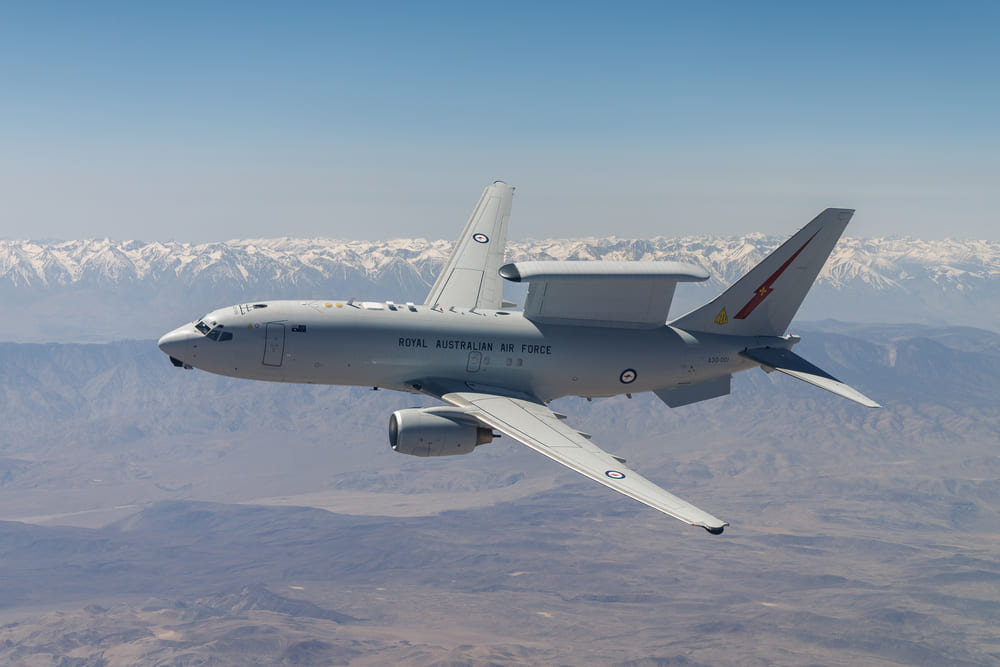
Draft language in the fiscal 2026 National Defense Authorization Act would block the Department of Defense from ending the Air Force’s E-7A Wedgetail effort during fiscal 2026. The same draft would also stop the Air Force from retiring any E-3 Sentry aircraft if the inventory drops below 16. Lawmakers paired those provisions with a higher authorization level for E-7 development and procurement. Final passage still requires votes in both chambers and a presidential signature.
FY 2026 NDAA language bars termination of E-7A Wedgetail contract and production line shutdown
The draft bill includes a specific prohibition tied to fiscal 2026 funding. It states that funds for fiscal 2026 may not be used “to terminate” the mid tier acquisition rapid prototype contract for the E-7A. The same section bars spending to “terminate the operations of, or to prepare to terminate the operations of” a production line for the E-7A aircraft.
The language targets two choke points that usually end programs fast. Contract termination stops near term work on the prototypes and mission systems. Production line shutdown planning matters too, since suppliers and conversion lines tend to disperse once a shutdown starts, then they rarely come back at the same cost or schedule.
Defense officials confirm the department’s fiscal 2026 budget submission described E-7 cancellation as a program decision, not a pause. In a budget briefing, a senior military official attributed the move to “cost increases from $588 million to $724 million per aircraft” and survivability concerns, and said the department would invest in alternate solutions that include space based capabilities and additional E-2D aircraft.
The Air Force selected the E-7 as its AWACS replacement path in 2022 and structured the U.S. buy around a rapid prototype approach first. The plan called for two production representative aircraft for test and evaluation, then a service specific production configuration. In public planning documents and earlier briefings, the service aimed for operational E-7 deliveries later in the decade, with the E-3 fleet carrying the mission load until then.
According to industry sources, the two U.S. rapid prototype aircraft would use an established conversion line in the United Kingdom, aligned with the same facility work that supports the Royal Air Force’s E-7 build. That approach lets the program lean on an existing labor pool and a mature modification process, rather than creating a fresh U.S. conversion line at the start.
NDAA provision keeps E-3 AWACS inventory at 16 unless Air Force submits plan or E-7 aircraft arrive
A separate section of the draft NDAA places a hard floor under the E-3 inventory for fiscal 2026. It blocks the Air Force from spending fiscal 2026 funds to “retire, prepare to retire, or place in storage or in backup aircraft inventory any E-3 aircraft” if those actions would reduce the total inventory below 16.
Two exceptions appear in the same section, and both require specific triggers. One exception starts 30 days after the Secretary of the Air Force submits a plan to congressional defense committees. The plan must address readiness and include assurance that mission capability will not lapse. The other exception begins after the Air Force procures enough E-7 aircraft to accomplish the required mission load, and after those aircraft are delivered.
That structure matters because the E-3 fleet now sits in a narrow corridor. The aircraft remain central to air battle management, airspace surveillance, and large force operations. They also support domestic air defense and theater needs, and they still serve as a familiar node for joint and allied command and control. The bill’s language does not create new aircraft, but it limits near term divestment options.
The E-3 airframe traces back to the Boeing 707 family, and fleet age has driven sustainment pressure for years. Crews and maintainers have managed that pressure through phased depot work, parts sourcing efforts, and selective modernization. Those steps keep aircraft in service, but the bill’s wording suggests Congress wants the Air Force to hold capacity steady while Wedgetail or another replacement arrives.
One senator’s earlier warning about the gap still circulates on Capitol Hill and in staff memos. Sen. Lisa Murkowski said, “We’re kind of limping along up north right now, which is unfortunate,” while arguing the E-3 force could not hold indefinitely if the replacement plan slipped.
The NDAA text also includes an important detail about storage language. It does not only block full retirements. It bars placing E-3s in storage or backup inventory if that action drops the counted inventory below 16. That closes an option sometimes used to bank aircraft for parts or future reactivation while still moving crews and maintenance capacity elsewhere.
Congress adds funding for E-7 Wedgetail as continuing resolution and authorization totals rise
The compromise NDAA draft includes a funding table that authorizes $846.7 million for continued development and procurement of the E-7. That figure stands far above the level associated with the Air Force’s earlier request posture for fiscal 2026, and it gives the authorizers a way to support the program while broader budget negotiations continue.
Authorizers still do not write the final spending check. Appropriations decide how much money actually flows and when. But authorization numbers shape negotiating leverage, and they often drive report language that guides execution once appropriations land.
Congress already inserted E-7 money into the short term funding deal that reopened the federal government after the fall shutdown. The continuing resolution included $199,676,000 for “continued rapid prototyping activities” tied to the E-7 effort. It also included authority to transfer up to $200,000,000 from prior year aircraft procurement funds into research, development, test, and evaluation for the same rapid prototyping line.
That structure matters because it kept prototype work funded without requiring a full year appropriations bill. It also helped preserve program cadence while Congress debated whether the Air Force should pivot to other aircraft or rely on space based alternatives.
The same continuing resolution language framed the money around sustaining schedule and supporting the transition to production. It did not describe termination activities. That detail aligned with the later NDAA approach, where lawmakers wrote a clear prohibition on using fiscal 2026 funds to end the rapid prototype contract or close the production line.
A separate pressure point comes from where Wedgetail sits in the broader special mission aircraft portfolio. The Air Force has multiple recapitalization demands at the same time, and it has limited margin inside training, basing, and manpower. Authorization and stopgap funding do not fix those constraints, but they do keep the E-7 line active long enough for Congress to force a clearer decision path.
Pentagon plan for E-2D Hawkeye buys and space sensor layer remains the alternative path
The department’s alternative plan, as described in budget briefings and supporting material, pairs two moves. One move adds E-2D Hawkeye aircraft as an interim airborne early warning option. The other move pushes a larger share of moving target sensing and warning tasks toward space based systems over time.
The E-2D can provide useful coverage, and it brings a modern radar and battle management suite. But it was designed around carrier operations, and it trades speed and altitude for carrier suitability. Using the E-2D for broad area coverage from land bases would require different basing concepts, different tanker support patterns, and careful matching between aircraft performance and threat envelopes.
The Wedgetail comparison looks different on basic geometry. A larger jet platform can generally stay higher and cover more area per sortie. It also carries more crew consoles and power margins, which helps mission system growth. Those are not abstract points. They show up in how many orbits you need, how many crews you burn through in a week, and how far you must push aircraft toward defended airspace to maintain track quality.
European NATO partners added a separate data point in November when they dropped their plan to buy six E-7 aircraft as the alliance’s next AWACS replacement. The Dutch Ministry of Defence cited the U.S. withdrawal from the replacement program as a factor. Dutch State Secretary for Defence Gijs Tuinman said, “The commitment remains to have other, quieter aircraft operational before 2035,” while pointing to a need to invest more in European industry.
That NATO decision does not dictate what the U.S. Air Force should do, but it does show how quickly the Wedgetail order book can shift when the U.S. position changes. It also complicates supplier expectations, since suppliers tend to invest when they see stable multi customer demand.
The United Kingdom has stayed with its Wedgetail plan, and it has positioned RAF aircraft to operate from RAF Lossiemouth. London also publicly welcomed U.S. prototype assembly work in the UK, framing it as a boost to the local industrial base and a sign of deeper defense aerospace ties. That UK line now matters more, since it represents the most visible active conversion capacity for the platform.
Congress now holds two levers at once, and it used both in the compromise NDAA. One lever blocks termination and production line shutdown actions during fiscal 2026. The other lever holds the E-3 inventory floor, with narrow off ramps tied to an Air Force plan submission or delivered replacement capacity. Our analysis shows lawmakers want a forced bridge across the AWACS gap, not another reset that pushes the problem into the next budget cycle.
REFERENCE SOURCES
- https://www.congress.gov/119/bills/s1071/BILLS-119s1071enr.htm
- https://www.defenseone.com/business/2025/11/funding-e-7-wedgetail-included-bipartisan-deal-end-41-day-government-shutdown/409453/
- https://www.congress.gov/bill/119th-congress/house-bill/5371/text
- https://breakingdefense.com/2025/12/compromise-ndaa-protects-wedgetail-greenlights-black-hawk-multiyear-buys/
- https://www.war.gov/News/Transcripts/Transcript/Article/4228828/background-briefing-on-fy-2026-defense-budget/
- https://www.aviationweek.com/defense/aircraft-propulsion/usaf-e-7-rapid-prototypes-be-assembled-uk
- https://www.gov.uk/government/news/jobs-boost-as-uk-set-to-build-military-aircraft-for-united-states-for-first-time-in-over-fifty-years
- https://www.defensenews.com/global/europe/2025/11/13/european-nato-countries-scrap-plan-to-buy-boeing-e-7-wedgetail-awacs/
- https://www.defensie.nl/actueel/nieuws/2025/11/13/awacs-partners-zoeken-alternatief-voor-vervanging-vloot
- https://www.boeing.com/defense/patrol-early-warning-and-battle-management/e-7-aewc