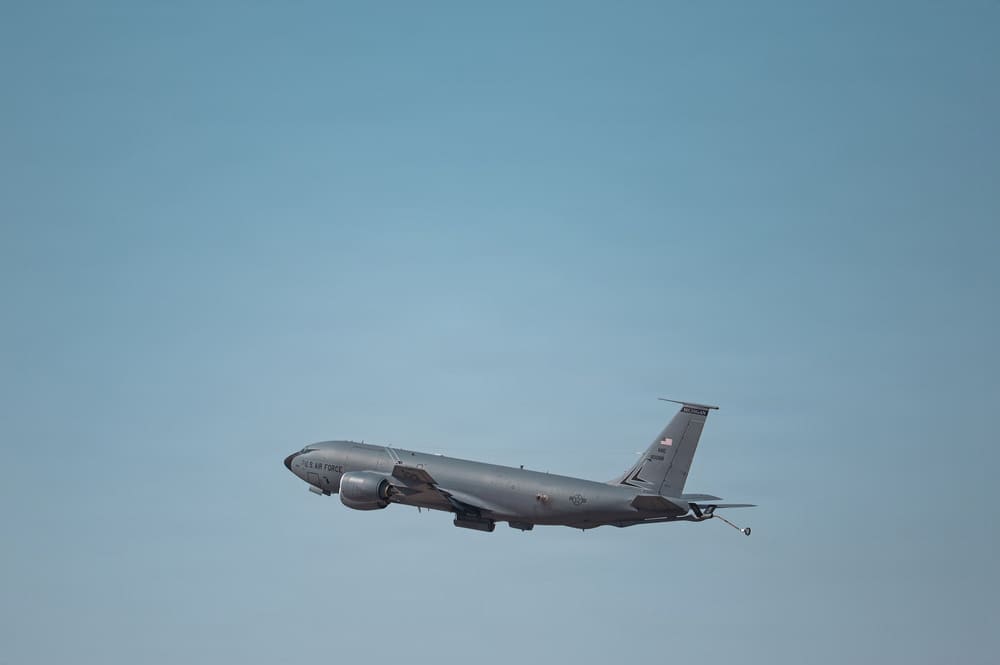
Photographs and flight-tracking posts over the past two days point to a larger U.S. Air Force KC-135 presence at Las Américas International Airport in the Dominican Republic. The tanker staging coincided with steady C-17 traffic into Puerto Rico and an additional cargo run into Ecuador tied to the same regional operation. A federal aviation security notice now warns crews to use caution across Venezuelan airspace. Washington also pushed economic pressure this week after U.S. forces seized a sanctioned crude tanker off Venezuela’s coast, while senior officials briefed lawmakers on a separate boat-strike controversy.
KC-135 Stratotanker Deployments At Las Américas International Airport In The Dominican Republic
A U.S. Air Force photo dated Dec. 7 showed a KC-135 parked on the airfield at Las Américas in support of Operation Southern Spear. The image credit ties the scene to the 621st Contingency Response Wing. It matches separate reporting that tanker operations began there earlier this month, with aircraft visible on restricted ramp space.
Local reporting from Santo Domingo described six KC-135 aircraft present at Las Américas as of Dec. 9. The same report laid out a daily pattern. The tankers take on fuel, depart in the morning, remain over the Caribbean for refueling tasks, then return to repeat the cycle. It also reported a temporary camp and support vehicles brought in with the detachment.
Open-source imagery and defense-focused social media accounts now suggest the visible count is higher. One post shared Dec. 16 claimed ten KC-135s deployed at Las Américas. Satellite and ground imagery can lag each other, so the exact number can shift day to day. The trend is clear. The parking footprint has grown since early December.
A contingency response unit at a civilian international airport changes the tempo. Ramp access has to work around commercial flows. Fuel delivery becomes a scheduling problem, not a simple request. Airfield security also tightens, since crews, equipment, and mission planning now sit closer to public infrastructure.
The KC-135 is not new, yet it remains the main fuel bridge for long sorties. A forward tanker line reduces the distance between receivers and their refueling track. It also shortens the time tankers spend in transit from the continental United States. Crews then spend more of the duty day on the refueling orbit, not on reposition legs.
A forward tanker pool also supports aircraft that need steady coverage over water. That includes maritime patrol aircraft, surveillance platforms, and aircraft that provide communications relay. Public reporting and flight tracks have repeatedly tied the broader Caribbean surge to airborne surveillance and interdiction support, with tanker coverage acting as the constant.
Defense officials have released few specifics on sortie schedules or refueling tracks, and that restraint is normal for active operations. Still, the basing logic is visible from the ground. Las Américas offers long runways, heavy fuel infrastructure, and a location that sits within easy reach of the wider basin.
The Dominican government has framed the activity as part of bilateral security cooperation. Local reporting described oversight by Dominican defense authorities and counterdrug services, with defined spaces at Las Américas and at San Isidro for technical work, temporary personnel, and support activity. That matters for day-to-day operations. Clear permissions keep the aircraft moving.
KC-46 Pegasus Tanker Sorties From The U.S. Virgin Islands And C-17 Airlift Into Puerto Rico And Ecuador
Flight activity from the U.S. Virgin Islands has added a second refueling node. Reporting described KC-46 Pegasus tankers flying from that area for months, with an uptick in recent weeks. The KC-46 brings a modern refueling suite and can cover a separate orbit while KC-135s work another sector. The result is more flexibility for planners, even with limited public detail.
The tanker mix also spreads demand across airfields. A single base does not have to handle every refuel sortie, every crew rest cycle, and every maintenance action. That matters in the Caribbean, where weather, ramp congestion, and diplomatic clearances can disrupt a plan fast.
Heavy airlift has been the other steady signal. A DVIDS image set tied to the same response wing showed C-17 operations at Las Américas on Dec. 6, a day before the KC-135 ramp photo. The sequence fits a typical pattern. Airlift arrives first, then ground support settles in, then sortie tempo increases.
Public flight-tracking posts also flagged a Dec. 16 C-17 flight into Ecuador. The account cited a MacDill-to-Manta route and described the cargo as coming from Erbil, Iraq. U.S. Central Command declined to comment, according to reporting that relayed the tracker’s claim. Ecuador has supported U.S. counterdrug cooperation for years, so airlift into its coastal facilities tends to draw attention when it appears tied to a named operation.
Separate tracking posts described repeated C-17 flights from Burlington, Vermont, into Puerto Rico, landing at Roosevelt Roads. The same tracker called the Dec. 15 sortie the ninth cargo flight in support of the 158th Fighter Wing’s upcoming deployment. The Vermont National Guard declined to provide details, based on the same reporting.
A fighter deployment needs ground gear first. Maintenance stands, spare parts, security equipment, and support personnel arrive well before jets. That shows up as airlift, not as a fighter radar return. The flight pattern into Roosevelt Roads looks consistent with that kind of staging, even without a public aircraft count.
The Navy side of the posture has been visible since late October. Defense Secretary Pete Hegseth tasked the USS Gerald R. Ford and its escorts to U.S. Southern Command, with a Pentagon spokesperson describing the goal as disrupting illicit actors and narcotics trafficking networks. Reporting at the time placed Ford in the Mediterranean, with a transit time measured in days, not hours.
That carrier order matters for air as well as sea. A carrier strike group brings its own surveillance, strike, and support aircraft. It also adds another demand for tanker coverage if land-based aircraft operate alongside carrier air. None of that requires guessing about intent. It is basic logistics, and the fuel chain is the limiter.
FAA Venezuela Airspace Security NOTAM And Heightened Civil Aviation Caution
A one-page FAA security advisory issued Nov. 21 warned operators to use caution in the Maiquetia Flight Information Region at all altitudes. The notice cited a “worsening security situation and heightened military activity in or around Venezuela.” It warned that threats could affect aircraft during overflight, arrival and departure phases, and on the ground.
That advisory landed as military air activity increased in the southern Caribbean. Civil aviation does not need a declared exclusion zone to face risk. Traffic density alone raises the chance of close passes. Crews can also see navigation issues when interference appears near borders and coastal corridors.
Aviation reporting tied the advisory to increased Global Navigation Satellite System interference reports in Venezuelan airspace, along with military drills that began in September. It also noted the requirement for U.S. operators to provide advance notice before flying through Venezuela, under the terms of the advisory.
Airline schedules reacted quickly. A Reuters report on Nov. 22 said several international carriers canceled flights departing Venezuela after the FAA warning, with some suspending service from Caracas. The report cited the advisory language and the broader risk picture tied to increased military activity.
The practical effect for the region is more rerouting, more avoidance, and more deconfliction planning. Crews that do transit near Venezuelan airspace tend to rely on published routes and controlled handoffs between flight information regions. When an advisory like this drops, those routines get tighter, and routing becomes less predictable for dispatchers.
None of this confirms a specific hazard type on a given day. The advisory is broad, and it is written that way on purpose. It signals that conditions have shifted enough for the FAA to formally warn operators, with the focus on caution rather than a blanket ban.
M T Skipper Oil Tanker Seizure And Operation Southern Spear Briefings As Forces Accumulate
President Donald Trump said Dec. 10 that the United States seized a sanctioned oil tanker off Venezuela’s coast. Asked what would happen with the oil, he replied, “We keep it, I guess.” Reuters reported that Attorney General Pam Bondi posted video of the boarding on social media and said federal agencies carried out a seizure warrant with military support.
Reuters later identified the vessel as the very large crude carrier Skipper, based on maritime risk reporting and government statements. Guyana’s maritime authority said the ship was falsely flying its flag, according to the same Reuters account. The report also said the United States had sanctioned the vessel over alleged involvement in Iranian oil trading under a prior name.
A separate Reuters report said Skipper departed Venezuela’s main oil port of Jose between Dec. 4 and Dec. 5 after loading about 1.8 million barrels of Merey heavy crude. That report said a judge-signed warrant issued Nov. 26 gave the administration until Dec. 10 to seize the vessel. It also cited an FBI statement tying the seizure to pressure on Venezuela and Iran.
Another Reuters dispatch reported the tanker was heading to Houston, citing sources. It described the seizure as part of a broader pressure strategy, and it placed the episode inside an expanding regional posture that now includes more visible aircraft movements and heightened maritime enforcement.
Trinidad and Tobago added a new piece to the logistics map on Dec. 15, when it approved transit of U.S. military aircraft through its airports in the coming weeks. Reuters cited a foreign ministry statement that described the movements as logistics-related and tied to regional security cooperation.
Operational updates also continued through official channels. A U.S. Southern Command press release dated Dec. 15 said Joint Task Force Southern Spear conducted strikes on three vessels in international waters, describing them as operated by designated terrorist organizations and engaged in narco-trafficking routes. The release said eight individuals were killed across the three strikes.
Earlier, a Pentagon update posted Dec. 2 said 21 kinetic strikes in U.S. Southern Command’s area had resulted in 82 deaths, citing remarks from Pentagon Press Secretary Kingsley Wilson. The same update framed the strikes as taken in defense of U.S. national interests and homeland protection.
Lawmakers pressed for more information this week after reporting on a Sept. 2 boat strike that became a political flashpoint in Washington. Reuters reported that Hegseth and Secretary of State Marco Rubio briefed every member of the Senate and House on Dec. 16. Hegseth said, “Of course we’re not going to release a top-secret full unedited video of that to the general public.” Reuters also reported Rubio called the mission “highly successful.”
The common thread across the air movements, maritime enforcement, and public advisories is the logistics spine that supports a sustained tempo. Tanker capacity, cargo throughput, and airfield access all show up in open sources first, often before any detailed official narrative. Our analysis shows the KC-135 increase at Las Américas fits that broader pattern of support assets arriving ahead of prolonged operational demand.
REFERENCE SOURCES
- https://www.twz.com/air/more-kc-135-tankers-deploy-to-the-caribbean
- https://www.dvidshub.net/image/9446821/921st-crs-airmen-conduct-operations-southcom
- https://www.diariolibre.com/actualidad/ciudad/2025/12/09/los-aviones-kc-135-de-ee-uu-ya-se-estan-en-republica-dominicana/3372079
- https://www.faa.gov/air_traffic/publications/us_restrictions/venezuela/KICZ-Advisory-NOTAM-A0012-25.pdf
- https://www.flightradar24.com/blog/aviation-news/us-issues-security-notam-for-venezuelan-airspace/
- https://www.reuters.com/world/americas/trump-administration-seizes-oil-tanker-off-venezuela-coast-us-officials-say-2025-12-10/
- https://www.reuters.com/business/energy/us-seized-tanker-near-venezuela-just-warrant-was-set-expire-court-document-shows-2025-12-13/
- https://www.reuters.com/business/energy/supertanker-skipper-seized-by-us-near-venezuela-is-heading-houston-sources-say-2025-12-12/
- https://www.reuters.com/world/americas/trinidad-tobago-approves-us-military-aircraft-transit-airports-2025-12-15/
- https://www.reuters.com/world/us/us-not-planning-release-unedited-boat-strike-video-public-hegseth-says-2025-12-16/
- https://www.southcom.mil/News/PressReleases/Article/4360972/lethal-kinetic-strikes-dec-15-2025/
- https://www.southcom.mil/MEDIA/NEWS-ARTICLES/Article/4346451/pentagon-provides-update-on-operation-southern-spear-reaffirms-socom-called-for/
- https://news.usni.org/2025/10/24/hegseth-orders-uss-gerald-r-ford-to-u-s-southern-command
- https://www.stripes.com/branches/navy/2025-10-24/aircraft-carrier-ford-deploy-latin-america-19531254.html