Draft language released this week for the fiscal 2026 defense policy bill would block the Navy from starting early contracting work for its first Modular Attack Surface Craft batch unless the service commits to vessels built from the start for unmanned operations. The clause targets “crew optional” designs that keep human support features, even if the plan calls for remote control most of the time.
FY 2026 NDAA Modular Attack Surface Craft Block 0 Restriction On Crew Optional Hulls
The House and Senate Armed Services Committees released the negotiated FY26 NDAA text on Dec. 8, after the House passed its bill on Sept. 10 and the Senate passed its version on Oct. 10. The public text gives the Navy new direction for several unmanned efforts, with one short provision written specifically for MASC.
The MASC clause bars the Navy secretary from entering a contract, or any agreement that includes priced or unpriced options, for construction work, advance procurement, or long-lead material for “Modular Attack Surface Craft Block 0” until the secretary certifies to Congress that the vessels will be “purpose-built unmanned.” The certification also requires they be engineered to operate without “human support systems” or operational requirements intended for crewed vessels.
That phrasing reaches beyond whether a boat can run with a crew on board. It goes after the design choices that come with the option, like crew spaces, life support, damage control layouts sized for people, and day-to-day habits that assume someone can walk down and fix a problem at sea.
The restriction ties directly to Block 0, the Navy’s first batch under MASC. It does not try to regulate every unmanned surface program in the fleet, but it sets a clear boundary at the point where the Navy would start committing money to hulls and long-lead items.
Congress used a certification gate rather than a ban on any single vendor. The mechanism still matters. It forces the Navy to lock in a definition of “unmanned” before the first production steps, not after selection.
The text does not tell the Navy what hull form it must buy. It does not set length or displacement limits, either. It draws the line at “purpose-built unmanned” and strips out the space where the Navy could buy a design that keeps crew accommodations as an insurance policy.
Navy Modular Attack Surface Craft Requirements For Containerized ISR And Strike Payloads
The Navy built MASC around modular payloads that can be swapped, rather than around one fixed combat system. Navy planning materials and recent industry briefings describe a family of larger unmanned surface craft that can carry containerized loads for surveillance and reconnaissance, strike, and other missions, with room for additional packages later.
One goal sits in plain view. The Navy wants an unmanned craft that can take on roles usually tied to larger warships, but without forcing every hull to look the same or carry the same permanent gear. Container payloads give the Navy a way to change mission sets without redesigning the ship each time.
The Navy also has talked about payloads meant to counter an opponent’s reconnaissance and targeting networks. It has not described those packages in detail in public, but the intent shows up in the way MASC gets briefed as more than a floating missile box.
Crew optional designs cut against that concept in a practical way. The moment a craft must safely host people, designers add systems and standards that do not help unmanned payload carriage. A crewed safety case tends to drive weight, wiring, ventilation, and layout decisions. It also changes how the Navy thinks about certification and rules for operation near other vessels.
Navy leaders have addressed that trade in blunt terms. “When you introduce that capability to operate with people on board, it creates a lot of other requirements and cost and complications,” Capt. Matt Lewis, the program manager for the Unmanned Maritime Systems program office at Naval Sea Systems Command, said in an August interview. He said the MASC solicitation was open, and the Navy wanted proposals “that don’t have people on board.”
Capt. Garrett Miller, commander of Surface Development Group One, put it even more directly at the same event. “We definitely want unmanned. Period. I mean, it’s that simple,” he said.
Defense officials confirm the Navy has leaned toward fully unmanned designs in its recent MASC work, even before Congress wrote the Block 0 language. The NDAA clause still raises the stakes by limiting what the Navy can accept as a starting point, not just what it prefers.
Ranger Mariner And The 720 Hour Reliability Standard For Medium And Large USVs
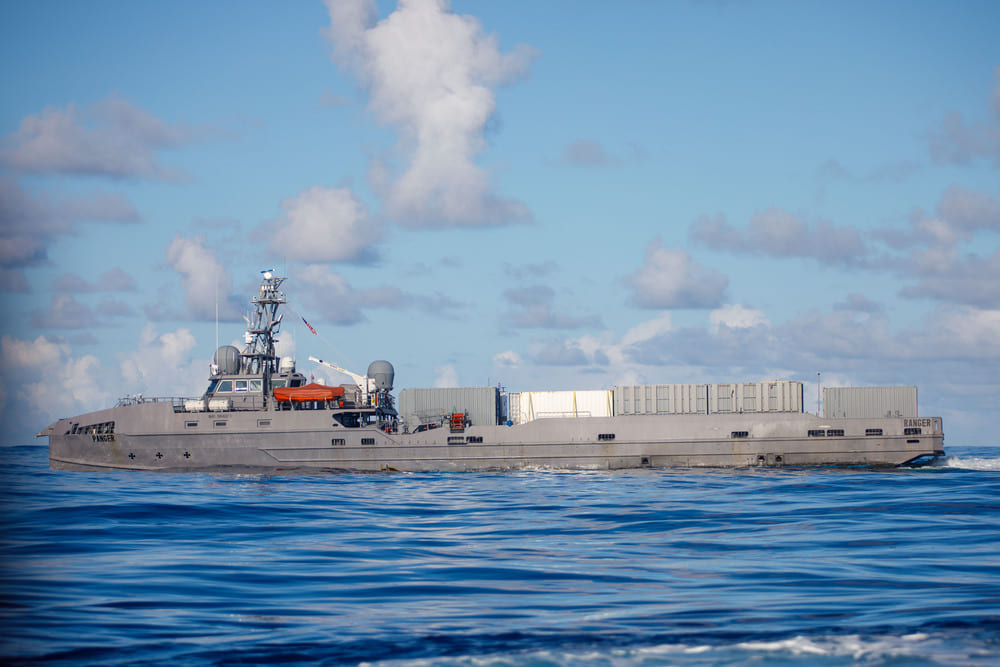
Optionally crewed vessels have carried much of the Navy’s surface autonomy testing load over the past several years. Ranger and Mariner, among others, gave the fleet a way to trial command-and-control links, autonomy stacks, and payload integration without waiting for a brand-new unmanned class to mature.
Those ships also helped the Navy learn what breaks first when nobody rides along. Remote systems can handle a lot, but sensors foul, fuel systems act up, and software needs attention. The Navy has pushed hard on that, but Congress now wants measurable proof before it accepts a new procurement path.
The FY26 NDAA draft includes a separate requirement aimed at medium and large unmanned surface vessel efforts. The provision would bar the Navy from awarding a detail design or construction contract, or obligating procurement funds, unless the contract requires an operational demonstration of “not less than 720 continuous hours” with no preventative maintenance, corrective maintenance, emergent repair, or any other repair or maintenance, across key systems. It would also block the Navy from accepting delivery of articles under that contract before the demonstration finishes successfully.
Seven hundred and twenty hours equals 30 straight days. The bill text does not treat that as a paperwork drill. It turns reliability into a hard threshold tied to contract award and delivery acceptance.
MASC and the medium and large USV lines overlap in the way industry sees them, even if program offices keep labels separate. If Congress forces unmanned craft to prove month-long operation without hands-on help, designers will treat “crew optional” as more liability than advantage. A crew option can hide reliability gaps for a while, but it does not solve them.
Surface Development Group One sits close to the center of this shift. The command oversees two unmanned surface vessel squadrons and runs major operational experimentation for the fleet’s unmanned push. It also oversees the two Zumwalt-class destroyers already in service, which keeps its focus tied to both new platforms and current fleet needs.
The NDAA language does not claim that unmanned craft are ready for every mission tomorrow. It does set a rule that forces the Navy and industry to show what the craft can do without a crew, for long stretches, before the Navy spends big procurement money.
DARPA NOMARS USX 1 Defiant And The Field Of MASC Industry Competitors
The Navy already has one recent example of a surface craft designed around the “nobody ever rides” assumption. The USX-1 Defiant, built under the Defense Advanced Research Projects Agency’s No Manning Required Ship effort, started open-ocean demonstration work this fall. A Defense Department video release in September showed Defiant arriving at Port Hueneme after a first open-ocean transit of more than 1,100 nautical miles in five days.
Program reporting around Defiant’s sea trial has highlighted autonomous operations and a refueling-at-sea demonstration that did not require personnel on the receiving vessel. The Navy has said it expects to take custody of Defiant after DARPA wraps its work, and Navy briefings have described it as a technology feeder for MASC-style concepts.
Industry has taken the hint, and several firms have moved to position designs around the container-payload approach that MASC favors. According to industry sources, companies now treat “no crew support systems” as a baseline requirement for early MASC bids, not a bonus feature.
Eureka Naval Craft has moved to expand production options for its Aircat Bengal-MC offering, signing agreements tied to U.S. shipbuilding capacity and marketing the design as a modular craft aligned with MASC. Public announcements around the effort describe work with Bordelon Marine Shipbuilders and emphasize a craft built around modular mission loads.
Huntington Ingalls Industries has pushed its ROMULUS family as another modular entrant. Reporting and company material from fall 2025 describe ROMULUS as an unmanned surface vessel line designed to carry ISO containers on a payload deck, with a lead vessel under construction and autonomy work that includes integration testing with outside software partners.
In November, Anduril announced a partnership with HD Hyundai Heavy Industries to develop Autonomous Surface Vessels, including a variant aimed at Navy requirements tied to MASC. Public reporting described an initial prototype build in Korea and follow-on production plans connected to U.S. shipyard capacity.
The bill language does not decide who wins. It does narrow what “counts” as an acceptable starting point for Block 0. If the Navy signs the required certification, it will have to explain to Congress why the chosen design does not carry human support systems and does not bake in crewed operating requirements.
Our analysis shows the Block 0 certification clause will push early MASC contracting toward designs that delete crew infrastructure completely, even if that forces tougher reliability proof and more conservative initial mission sets.
REFERENCE SOURCES
- https://armedservices.house.gov/news/documentsingle.aspx?DocumentID=6359
- https://www.govinfo.gov/content/pkg/BILLS-119s1071enr/html/BILLS-119s1071enr.htm
- https://www.twz.com/sea/crew-optional-designs-could-be-barred-by-law-from-navys-drone-ship-program
- https://www.dvidshub.net/video/977288/nomars-arrives-port-hueneme
- https://www.marinelog.com/news/eureka-naval-craft-in-shipbuilding-agreement-with-bordelon-marine-shipbuilders/
- https://seapowermagazine.org/eureka-naval-craft-strikes-new-shipbuilding-agreement-with-bordelon-marine-shipbuilders/
- https://www.navalnews.com/event-news/indo-pacific-2025/2025/11/hii-and-shield-ai-successfully-combine-proven-autonomy-in-usv-operations/
- https://www.naval-technology.com/news/hii-shield-ai-vessel/
- https://hii.com/news/hii-announces-major-milestone-for-romulus-usv-technology/
- https://breakingdefense.com/2025/11/anduril-hyundai-heavy-industries-set-sights-on-us-navys-unmanned-surface-vessel-program/
- https://www.defenseone.com/business/2025/11/anduril-build-autonomous-vessel-prototype-korea/409494/