
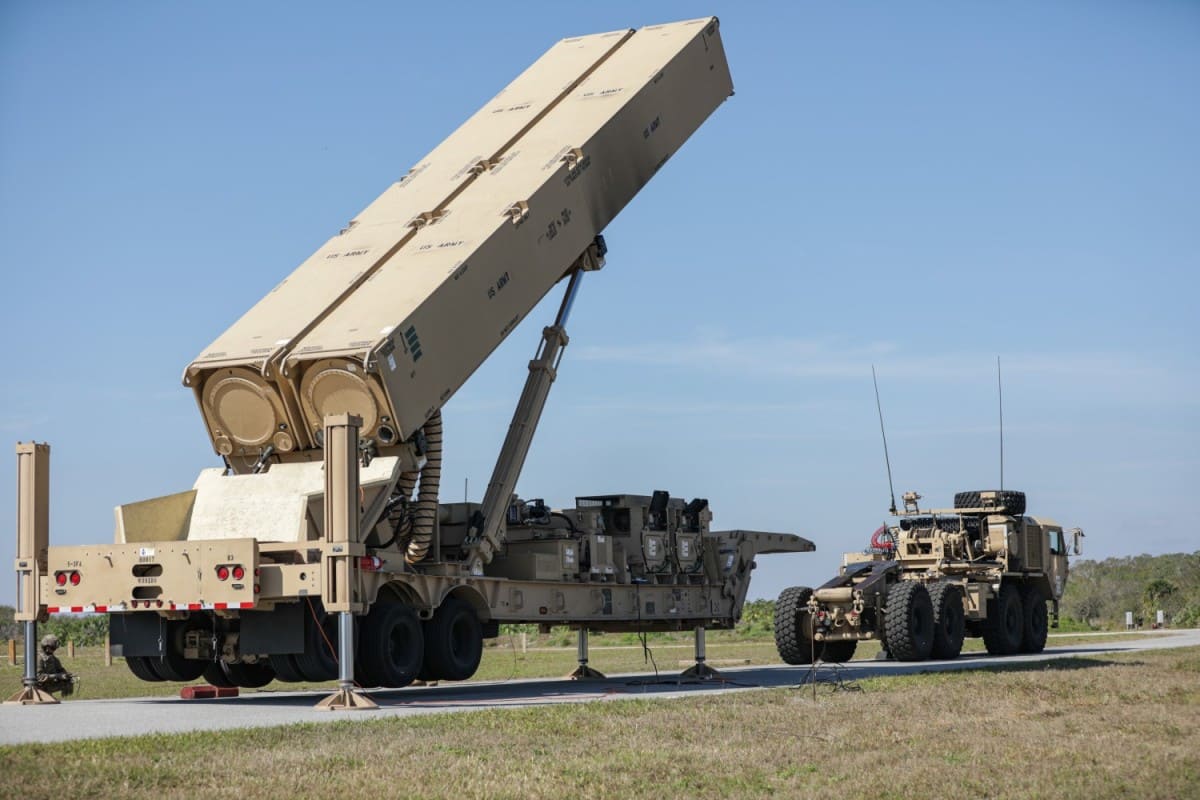
Video from Redstone Arsenal shows an Army hypersonics director telling Defense Secretary Pete Hegseth that the Dark Eagle weapon can reach about 3,500 kilometers. Another officer, filmed near the launcher, described its warhead as “under 30 pounds” and said the payload is meant to push “projectiles out” over a target area.
Redstone’s role in the Pentagon’s space and missile enterprise also shifted in the same trip, with the installation tied to the decision to base U.S. Space Command headquarters in Huntsville. The hypersonic briefing, though, drew more interest inside defense circles because it put unusually specific performance claims on the record.
Lt. Gen. Francisco Lozano, who oversees hypersonic and related rapid acquisition portfolios for the Army, used location examples to frame reach. He said Dark Eagle could hit “mainland China from Guam,” and he gave other geographic pairings to illustrate its strike envelope. Those lines, delivered in an open setting, go beyond prior unclassified descriptions that had kept official range figures tighter.
A second data point came from the warhead description. Under-30-pound explosive weight, if accurate, signals a design that leans on speed and impact energy, with a small explosive package shaping fragments and effects at the end. That matches what long-range boost-glide systems tend to prioritize: fast arrival, high terminal energy, and hard-to-predict flight paths in the upper atmosphere.
The travel time claim landed the same way. The officer said the weapon can cover its full range in less than 20 minutes. That kind of timeline compresses warning and response windows for fixed sites, mobile air defenses, and command nodes, especially when paired with a maneuvering glide vehicle.
3,500-kilometer Dark Eagle LRHW range and under-30-pound warhead disclosed at Redstone Arsenal
Lozano’s 3,500-kilometer figure sits above earlier public numbers that had circulated in U.S. reporting and congressional work, and it lands near the outer edge of what analysts have long inferred for the Army’s boost-glide weapon. According to industry sources, the new figure reflects confidence drawn from recent flight work and maturing guidance performance, rather than a paper estimate built around best-case conditions.
The range claim matters less as a headline number than as a basing and planning clue. A system that can cover that distance from a road-mobile launcher gives commanders more room to disperse and still hold targets at risk. Guam came up for that reason. It is a U.S. node with established logistics, runways, and fuel, and it sits within the arcs that planners use when they think about Pacific operations.
The small warhead description adds a second layer. The officer’s phrasing suggested a fragmentation approach, with “projectiles” doing work over a footprint. That aligns with a weapon intended to disable exposed equipment, damage radar faces, crater support areas, and break up air-defense batteries, rather than flatten hardened facilities with large blast weight.
Kinetic energy fills part of the gap. A boost-glide vehicle arrives at hypersonic speed, meaning above Mach 5, and it can carry substantial energy even if the explosive payload is limited. The hard part for defenders is not the explosive mass. It is the combination of speed, altitude changes, and maneuver options that complicate tracking and interceptor timing.
The same presentation included a production-rate exchange. The visiting party asked how many rounds are coming off the line. The response on camera described a current pace of roughly one per month and a goal of two per month. That output, if sustained, would still keep inventories tight for a system meant for high-end contingencies, even before training shots and test rounds are subtracted.
Dark Eagle LRHW common missile shared with Navy Conventional Prompt Strike system
Dark Eagle is the field name attached to the Army’s Long Range Hypersonic Weapon, a ground-launched system that fires a boost-glide vehicle from trailer-based equipment. The Navy is building a closely related capability around the same general missile architecture, aimed at ship and submarine launch, under its Conventional Prompt Strike program.
The shared design approach cuts both ways. It gives the services a chance to spread development cost across common hardware and testing. It also ties schedule risk together, since a propulsion, guidance, or warhead issue in one path can ripple into the other if the core “all-up round” stays shared.
Publicly released program material has described a two-stage booster that lofts an unpowered glide body, which then separates and flies the remaining distance by gliding at very high speed. Unlike a traditional ballistic missile reentry body that follows a more predictable arc, the boost-glide vehicle can adjust its path inside the atmosphere, which changes where and when it might appear on sensors.
That flexibility is one reason the Pentagon keeps circling back to hypersonics as a way to deal with modern integrated air defenses. Dark Eagle is not sold as a volume weapon. It is positioned as a tool for targets where timing, distance, and access matter more than warhead size.
Warhead performance has been a recurring theme in oversight reporting and testing commentary. Lethality is harder to validate for a system that is not meant to carry a large explosive package, and it depends on target type. A radar set, a missile transporter, and a buried command bunker do not fail the same way, and test shots that do not include representative targets create gaps in confidence.
Defense officials confirm that the services have pushed more warhead-related work into dedicated events, including non-flight testing, to close those gaps without burning scarce flight opportunities. Those test types do not replace flight shots, but they can answer narrower questions on fragmentation patterns, fuze timing, and effects against materials that mimic real systems.
The Navy angle matters because it broadens where the weapon can be brought to bear. A ship or submarine carrying a hypersonic weapon can patrol without the fixed signature of a land site. That complicates tracking for an adversary, but it also raises integration demands inside the fleet, including magazine space, maintenance, and training burdens.
Joint Base Lewis-McChord Dark Eagle battery activation and Indo-Pacific deployments
The Army has been building operational structure around Dark Eagle inside its Multi-Domain Task Force concept, which is focused on long-range fires, sensing, and networked effects. A battery-level unit offers the day-to-day mechanics that turn a developmental system into something that can train, certify, deploy, and sustain itself.
A recent Army announcement tied the first Long Range Hypersonic Weapon battery activation to Joint Base Lewis-McChord in Washington state. The same release linked the capability to Indo-Pacific needs and cited recent U.S. joint activity in Australia as an example of how these units are expected to operate across long distances with allies.
Adm. Samuel J. Paparo Jr., the commander of U.S. Indo-Pacific Command, framed that deployment in alliance terms, calling it “another demonstration of U.S. commitment to the defense of Australia … and … a safe and stable Indo-Pacific.” The line was aimed at reassurance, but it also underscored the practical reality: hypersonic systems make more sense when paired with access agreements, exercise ranges, and host-nation support.
The unit structure also hints at constraints. Trailer-launched hypersonic weapons are not single vehicles that vanish into the field and operate alone. They need command-and-control links, maintenance support, security, and a supply chain that can move sensitive components without delay. Those demands shape where a battery can go quickly, even before anyone talks about employment.
Training pace matters because the system brings new tasks to crews. Long-range targeting depends on sensors and networks beyond what a conventional artillery unit would handle. Launch crews need to understand safe handling, timing windows, and system checks that feel closer to strategic forces than field artillery. That training load will be a steady drag on readiness until the unit has time and repetitions.
The timeline pressure is real. The Army has said it wants Dark Eagle operational by the end of fiscal year 2025. Schedule slips have hit the program before, and the gap between a unit existing on paper and being ready to deploy tends to show up in support equipment, software maturity, and validated tactics, not in the launcher’s appearance.
Dark Eagle production rate, warhead lethality testing, and operational acceptance hurdles
The Redstone discussion put three separate concerns in the same frame: performance, effects, and inventory. Range and time-to-target describe performance. The “under 30 pounds” statement describes effects. Monthly production describes inventory. All three have to line up before the system is more than a limited demonstration.
Range alone does not settle survivability questions. A battery has to move, hide, communicate, and reload in a world full of satellites, drones, and electronic surveillance. A hypersonic weapon that arrives fast does not help if the launchers cannot survive long enough to launch more than once.
Effects are more sensitive than they sound. A small warhead can still defeat many systems, but the confidence comes from tests that replicate real spacing, real materials, and real operating states. A radar that is powered down is not the same target as one radiating at full output. A missile battery parked in storage is not the same target as one on alert with missiles loaded.
Inventory often drives real-world planning. One or two shots can matter for specific targets, but commanders still need enough rounds to train crews, support deployments, and keep a wartime reserve. The stated goal of two rounds per month would add up over time, yet it remains a thin stream compared with the scale of munitions demand seen in recent conflicts.
Our analysis shows the newly voiced range and warhead details fit a weapon designed for selective, time-sensitive strikes, not broad-area bombardment, and the near-term limiting factors remain testing confidence and production depth.
REFERENCE SOURCES
- https://defence-ua.com/news/dalnist_3700_km_i_bojova_chastina_30_funtiv_video_pidtverdilo_harakteristiki_dark_eagle_scho_kazhut_u_ssha-18664.html
- https://euro-sd.com/2025/10/articles/exclusive/44108/new-details-about-us-dark-eagle-hypersonic-missile-emerge/
- https://www.twz.com/air/new-dark-eagle-hypersonic-weapon-details-emerge
- https://www.dvidshub.net/news/494729/army-activates-first-long-range-hypersonic-weapon-battery
- https://apnews.com/article/trump-space-command-headquarters-alabama-colorado-0d80c0f4db3b03f632fdad488b67fa75
- https://www.axios.com/2025/09/02/trump-moves-space-command-headquarters-alabama-colorado
- https://crsreports.congress.gov/product/pdf/IF/IF11623
- https://news.usni.org/2025/06/12/gao-warns-shipbuilding-industrial-base-supply-chain-workforce-issues-could-hamper-efforts-to-deliver-u-s-navy-ship-construction-unmanned-programs