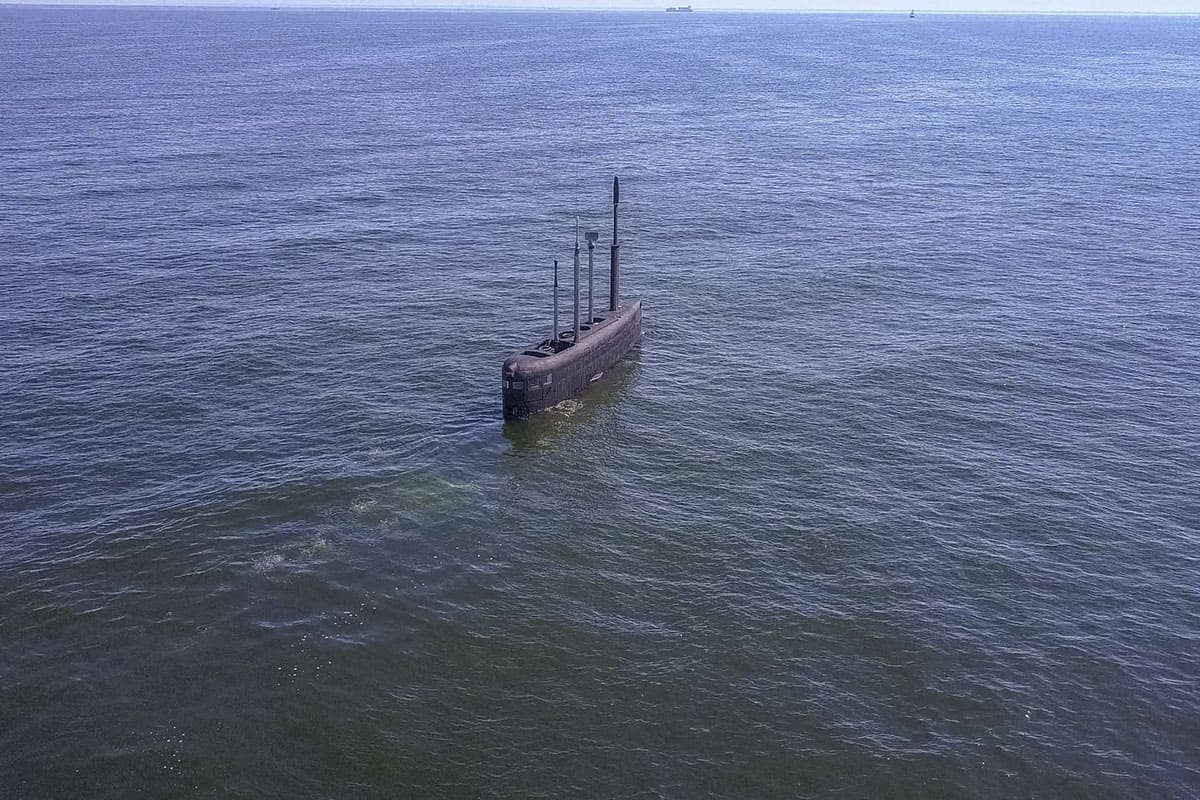
Commercial satellite images taken on Dec. 16, 2025 show blast damage to a pier inside Russia’s Novorossiysk naval port, close to a moored Project 636.3 submarine. Ukraine’s Security Service says an uncrewed underwater vehicle carried out the strike a day earlier. Russia’s defense ministry denies damage to any ship or crew.
Satellite imagery shows pier damage beside a Project 636.3 submarine in Novorossiysk
The clearest change in the post-strike imagery sits at the inner pier where the targeted submarine remained moored. A corner section of the quay shows fresh destruction, with broken concrete and a missing segment along the edge. The damage line sits close to the submarine’s stern position, based on the submarine’s orientation and the pier geometry.
A comparison image from Dec. 11, 2025 shows the same pier with a clean outline. The Dec. 16 frame shows a jagged break that cuts into the pier surface and the seawall edge. No secondary fires appear in the immediate scene. No obvious scorch trail shows along nearby deck surfaces, at least in the available resolution.
The submarine’s visible outline stays in the same berth. That fact matters for interpretation. A rapid tow-out would be expected after a confirmed hull breach that risks sinking at the pier, especially when other ships sit close nearby. The imagery does not show a submarine moved to an alternate berth within the port during the short window between the strike and the satellite pass.
Two other submarines that were near the blast zone before the strike appear to have shifted positions. One moved away from the inner pier cluster, while another no longer sat where it appeared in earlier imagery. Other surface ships remain in place, including vessels moored along the outer edge of the pier system.
Some observers have argued the targeted boat sits slightly lower at the aft end. The satellite angle and sea state make that a hard call. The stern also sits near the waterline in most overhead imagery. A change in trim could come from ballast changes, loading, or routine adjustments, not only damage. The images do not settle that question.
Damage below the waterline remains the central unknown. A detonation near the stern can affect the propeller, shaft line, rudder, and aft hull fittings. Those areas sit underwater and remain hidden in overhead imagery. Even a mission-kill result can leave few visible signs from space if the hull remains afloat and the crew controls flooding.
The scene also lacks clear indicators of emergency containment. The imagery does not show a visible oil sheen extending away from the berth. It does not show floating booms laid around the submarine. It also does not show cranes, barges, or salvage pontoons staged beside the pier. Those items can arrive later, yet their absence within roughly a day supports the view that officials did not treat the situation as an immediate sinking risk.
At the port entrance, floating barriers remain visible in multiple frames taken before and after the strike. The arrays appear set to restrict surface craft access through the channel. The post-strike imagery shows the barrier line still in place. According to industry sources, those defenses reflect a port posture built around fast surface drones, not a submerged vehicle that can pass under or around surface barriers.
SBU Sub Sea Baby underwater drone claim and what the strike video supports
Ukraine’s Security Service published a statement on Dec. 15, 2025 and tied it to video footage from the port. “Вперше в історії підводні дрони «Sub Sea Baby» підірвали російський підводний човен класу 636.3 «Варшавянка» (за класифікацією НАТО — Kilo),” the statement said. It added that “Унаслідок вибуху субмарина зазнала критичних пошкоджень і фактично виведена з ладу.”
The same statement linked the target to cruise-missile strike capacity. “На борту підводного човна розміщувалися чотири пускові установки крилатих ракет «Калібр», які ворог використовує для ударів по території України,” it said. The statement described a joint operation with the Ukrainian Navy and said the submarine class cost around $400 million.
The strike video shows a large explosion at the waterfront next to a moored submarine. The blast plume rises fast and spreads laterally across the pier edge. The clip does not show the underwater vehicle itself. The detonation timing and placement remain consistent with a submerged approach, since a surface craft often leaves a visible wake and a brief approach track on camera.
Daylight footage also narrows the defensive explanation. Port defenses tend to rely on layered sensors, patrol craft, fixed cameras, and physical barriers. A submerged craft reduces the value of many of those layers, especially when the port defense posture was built after repeated attacks from above the waterline.
The UUV label also carries technical implications for navigation. A drone that reaches a specific berth inside a crowded harbor needs reliable position holding and a route plan that avoids pier structures. It also needs control methods that work inside a port environment with reflections, clutter, and limited maneuver space.
The “Sub Sea Baby” name suggests lineage with Ukraine’s “Sea Baby” surface drone family, though the statement did not describe a technical relationship. Ukraine has disclosed other unmanned underwater concepts in the past, including publicly shown prototypes. None has been tied in official detail to the Novorossiysk strike.
A close detonation near a submarine in port can produce a range of outcomes. A direct hull breach can flood compartments and force an urgent response. A near-miss can still damage appendages and hull penetrations. Pier destruction in the imagery supports a detonation near the seawall, even if the charge did not contact the submarine’s pressure hull.
The strike also reinforces how Ukraine has prioritized port attacks against high-value naval targets. Russia moved key Black Sea Fleet assets away from Crimea after earlier attacks, with Novorossiysk treated as a more defensible hub. The new imagery shows the port remains within reach of maritime drones, even when surface barrier lines are visible.
Russian Defense Ministry denial and what imagery can and cannot confirm
Russia’s defense ministry released a denial through its official channel, quoting the head of the Black Sea Fleet press service. “The information disseminated by special services of Ukraine about the alleged ‘destruction’ of one of the Russian submarines in the bay of the Black Sea Fleet’s Novorossiysk naval base does not correspond to reality,” the statement said. It added, “Not a single ship or submarine as well as the crews of the Black Sea Fleet stationed in the bay of the Novorossiysk naval base were damaged as a result of the sabotage. The watercraft serve normally.”
The same statement described an attempted sabotage using an uncrewed surface vehicle. That description conflicts with Ukraine’s underwater-drone claim. The port imagery does not identify the attack vehicle. The physical results, at least on the pier, align with an explosion at the waterfront, which could occur from either a surface or submerged approach.
Russia also released video that it said showed the undamaged submarine. The clip does not provide a clear view of the stern area. The background appears heavily obscured in places. Concrete debris appears on the pier, even in the limited frames, which matches the pier damage visible in satellite imagery.
A key limitation remains the location of the blast relative to the submarine’s hull. Some analysts place the detonation near the pier corner rather than directly under the submarine. If that is correct, visible pier damage becomes the primary confirmed result. A near-stern underwater blast can still affect a submarine, but the degree depends on charge size, stand-off distance, and depth.
The satellite view also cannot show internal system damage. A submarine can lose propulsion and remain afloat at the pier. It can lose steering gear and remain afloat. It can suffer sonar dome damage and remain afloat. Those outcomes matter for combat use, yet they do not automatically change the appearance of the boat from overhead.
The scene also lacks signs of a rapid concealment effort. The port remains populated with other ships. The berth area remains visible in commercial imagery. Two nearby submarines moved, yet the attacked boat stayed in place. None of those points prove a damage level, but they help frame what a confirmed catastrophic result might have looked like in the first day.
The Russian denial also uses narrow language. It rejects “destruction” and claims no damage to vessels or crews. It does not address pier destruction in detail. It does not address whether repairs are underway. It does not identify the submarine hull number that was at the berth.
Ukraine’s statement also does not name the specific submarine. That gap matters because the Black Sea Fleet has operated multiple Project 636.3 boats. The imagery shows multiple submarines present in port. A confident hull identification needs closer imagery or official confirmation from a service.
Port defenses, UUV threat, and what other navies will watch next
The main confirmed lesson from the Dec. 16 imagery sits in access. A detonating charge reached a submarine berth inside a defended harbor, despite visible surface barriers at the entrance. The port defense system can evolve fast after that type of event, since barriers and patrol patterns often change when a new threat appears.
Underwater threats drive different countermeasures. Surface barriers stop or slow fast boats and force them into kill zones. A submerged drone pushes defenders toward sonar coverage, underwater nets, diver teams, and patrol craft tactics that focus on subsurface contacts near harbor approaches.
A harbor also has natural limits that help the attacker. Noise, clutter, and reflections complicate underwater detection. Traffic patterns add more clutter. Fixed objects create blind zones. A small unmanned craft can exploit those conditions, especially when it accepts one-way loss as part of the design.
The Novorossiysk strike also fits the broader pattern of unmanned system competition in this war. Ukraine adapted surface drones quickly. Russia adapted port defenses around that threat. Ukraine then claims an underwater variant that bypassed a defense layer meant for surface craft. That cycle has repeated across domains.
The attack has relevance beyond the Black Sea. Many navies have treated harbor defense as a mix of surface patrol and fixed barriers, with limited day-to-day investment in underwater detection at civilian-adjacent ports. UUV proliferation will pressure those assumptions, especially for bases that share waterways with commercial traffic.
The imagery also highlights target selection. A Project 636.3 submarine offers a high payoff target due to its cruise-missile role and its relative scarcity. Ukraine’s statement tied the target to Kalibr launchers. Russia uses those missiles in long-range strikes. Even a temporary loss of a single hull can matter for fleet tasking and missile sortie generation.
Our analysis shows the satellite evidence confirms a close detonation at the submarine pier and proves port penetration to the inner berth area. The imagery does not prove the submarine’s damage level. It also does not rule out underwater damage that keeps the boat alongside for repairs and inspection.
REFERENCE SOURCES
- https://ssu.gov.ua/novyny/sbu-vrazyla-pidvodnyi-choven-rf-u-novorosiisku-video
- https://t.me/s/mod_russia_en?before=24767
- https://www.businessinsider.com/images-show-russia-fortified-port-before-ukrainian-drone-attacked-submarine-2025-12
- https://www.pravda.com.ua/eng/news/2025/12/16/8012049/
- https://maritime-executive.com/article/satellite-imaging-shows-ukrainian-drone-hit-pier-not-russian-sub
- https://www.criticalthreats.org/analysis/russian-offensive-campaign-assessment-december-15-2025
- https://www.twz.com/news-features/aftermath-of-ukraines-underwater-drone-attack-on-russian-submarine-seen-in-satellite-imagery
- https://www.twz.com/sea/ukraine-claims-worlds-first-underwater-drone-attack-on-russian-submarine