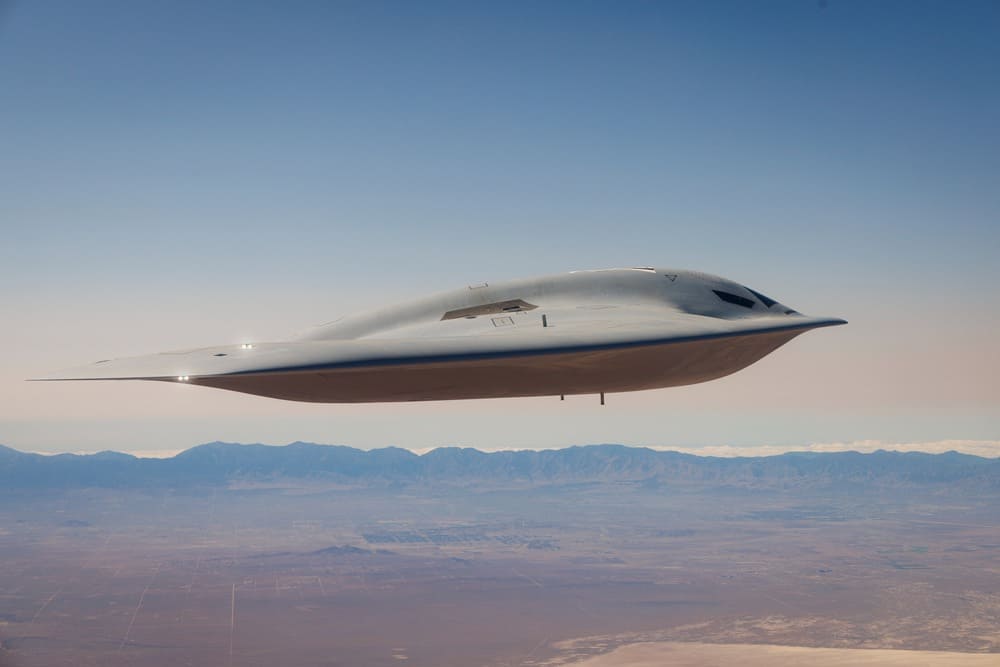
On 15 August, Gen. Thomas Bussiere, then commander of Air Force Global Strike Command, signed a memo that laid out his preferred B-21 crew mix. He argued that the Raider’s two-seat cockpit should usually carry one pilot and one weapon systems officer, not a pilot and co-pilot, so only a single pilot-rated officer would be on board for missions that can run well past 24 hours.
He sent the document to the Air Force secretary, the chief of staff and the head of U.S. Strategic Command. In the memo he wrote that “unleashing the Raider’s full potential demands a complex blend of skills: airmanship, weaponeering, electromagnetic spectrum operations, sensor management, real-time battle management and agile replanning in combat,” then concluded, “for this reason, the B-21 will be crewed by one pilot and one weapon systems officer.” Bussiere has since left his post; Gen. Kenneth Wilsbach became chief of staff on 30 October.
Lt. Gen. Scott Pleus, serving as acting vice chief when the memo surfaced, said Global Strike Command had passed its recommendation up the chain and called the document pre-decisional. No final decision on crew composition has been announced, and officials confirm there is no fixed timeline yet, even as B-21 flight test work expands at Edwards Air Force Base.
Current bomber practice leans heavily on multiple pilots. B-2 Spirits fly with two pilots. B-1B and B-52 crews include at least two pilots and several weapon systems officers, with pilots sharing basic flying duties on long missions and WSOs handling sensors, radios and weapons.
In June’s Operation Midnight Hammer, seven B-2s left Missouri to strike Iranian nuclear sites with 30,000-pound GBU-57 Massive Ordnance Penetrators, supported by more than 125 other aircraft across the joint force. Round-trip flight time reached about 37 hours per bomber with several aerial refuelings. Each jet had two pilots to share the work. Under the B-21 plan, one pilot would sit at the controls, supported by a WSO focused on mission systems rather than stick and throttle.
According to industry sources, the Raider’s WSO is expected to follow the model seen in aircraft like the F-15E. Weapon systems officers there learn enough flying to recover the jet if the pilot is incapacitated but spend most of their time running radar, targeting pods and weapons. The B-21 applies this to a stealth bomber expected to enter heavily defended airspace while coordinating with other aircraft and offboard sensors.
Today’s B-2 includes a fold-down bunk so one pilot can sleep while the other flies. Global Strike Command leaders have indicated the B-21 will offer some form of rest area as well, despite its smaller airframe. Even so, one primary pilot on very long missions carries more risk than a two-pilot crew. To keep that manageable, more of the flying and routine decisions have to shift into the aircraft’s own systems, with the crew setting intent and supervising.
Automation and AI in the B-21 design
Program material describes the B-21 as part of a long-range strike family that folds intelligence, surveillance and reconnaissance, electronic attack and communications into its nuclear and conventional strike role. The Air Force fact sheet states the bomber is “designed to accommodate manned or unmanned operations” and uses an open mission systems architecture to ease later upgrades.
That open approach follows guidance set during the Long Range Strike Bomber phase. A 2015 Department of Defense Inspector General report lists “capable of manned and unmanned operations” as a formal requirement, and an attached memo from the Office of the Secretary of Defense directed the service to procure “a survivable long range penetrating bomber capable of manned and unmanned operations where range, payload, and survivability are balanced with production cost.”
Northrop Grumman test pilots have noted how closely the first B-21 flight article matched its simulator models. One pilot reported that the aircraft’s behavior in flight lined up so well with the digital model that a small perceived difference during rotation was traced to his own extra input rather than to a flaw in the simulation. High-fidelity models give designers room to build advanced automation straight into flight-control and mission-system software instead of adding it as a later patch.
DARPA’s Aircrew Labor In-Cockpit Automation System, ALIAS, shows what that kind of automation can do for a crew. ALIAS is meant to provide a removable kit that can fly a mission from takeoff to landing while interacting with humans through screens and voice, cutting workload and improving safety by tracking aircraft state and calling up procedures.
A modified UH-60A Black Hawk, fitted with Sikorsky’s MATRIX autonomy core for ALIAS, flew in 2022 at Fort Campbell with no one on board, handling taxi, takeoff, route changes and landing under software control. Later trials had the helicopter fly logistics and sling-load missions, including external cargo hookups, with autonomous hover and navigation while soldiers issued commands from the ground.
Merlin Labs has built an “Autonomy Core” and Merlin Pilot package that can sit on existing aircraft and manage normal flight and emergencies. The Air Force picked Merlin’s system for work on the KC-135 tanker, aiming at autonomous contingency handling that keeps the aircraft safe in off-nominal events and prepares the ground for future uncrewed and collaborative systems.
Shield AI’s Hivemind software, already demonstrated on aircraft such as the MQ-20 Avenger and V-BAT, focuses on mission autonomy. It lets aircraft move through contested airspace, search for targets and react to threats without constant operator control and has been shown running formations of uncrewed aircraft alongside crewed fighters during exercises.
Engineers involved in mission-system work on the Raider, according to industry sources, expect the B-21 to field a decision-support agent closer to these autonomy systems than to a traditional flight director. Program officials in public remarks already emphasize the bomber’s ability to absorb data from external sensors, manage emissions and work with escorts and decoys. The software behind that has to fuse radar, electronic support, communications and intelligence feeds into a single picture and turn it into a short list of options the crew can act on quickly.
A cockpit with one pilot and one WSO only makes sense if those systems run much of the routine flying and mission management on their own, from complex pre-planned routes and terrain avoidance to radio and data-link housekeeping and basic sensor cueing. The same digital backbone that supports a possible future unmanned mode can provide that support on crewed sorties now.
Optionally manned missions, test force and training
Documents tied to the B-21 program have mentioned unmanned operations for more than a decade, but officials still speak of fully uncrewed Raider sorties as a later step, not an early standard. Before the public rollout in 2022, a source familiar with the effort said development was proceeding with the option to add pilotless capability later in the bomber’s life.
Operation Midnight Hammer highlights why planners want that option available. The seven-ship B-2 strike put fourteen GBU-57s on Fordow and Natanz while a U.S. guided-missile submarine fired Tomahawks toward Isfahan, and the air package pulled in over 125 aircraft including escorts, suppression platforms, tankers and ISR assets. Senior commanders later underlined that the B-2 portion was the second-longest operational sortie in the type’s history and would have triggered a complex search-and-rescue effort if any bomber had been lost. Combat search and rescue into central Iran, even with the B-2’s low observability and absence of Iranian fire on the night, was assessed as a major problem.
An optionally manned B-21 gives commanders another way to weigh risk. On some deep targets where crew recovery is judged unrealistic, an uncrewed Raider could be sent instead, accepting higher risk to hardware and sensitive technology to keep aircrew out of the engagement. On other sorties a crewed B-21 could lead a group of uncrewed Raiders or other long-range systems, with only the lead jet carrying humans. Program material on the Long Range Strike family expects the Raider to work closely with the AGM-181 Long-Range Standoff cruise missile and other, still-classified enablers.
The bomber’s stealth structure and mission computers remain highly sensitive, and losing a relatively intact aircraft over hostile territory would create serious counter-intelligence issues. Senior officers have acknowledged this and spoken of Raider autonomy as an option to be added carefully rather than a near-term operating mode.
Northrop Grumman has delivered two B-21 flight-test aircraft and two ground test articles to Edwards, with four more test jets in the pipeline. A second pre-production aircraft flew for the first time in September and joined the combined test force, where it supports envelope expansion and mission-systems work. Two low-rate production contracts are in place. Public budget material still points to at least 100 aircraft, and senior officers at U.S. Strategic Command and elsewhere have argued for more.
Ellsworth Air Force Base will be the first main operating base and training hub, with Whiteman and Dyess to follow. New facilities at Ellsworth cover hangars, maintenance and weapons support sized for the Raider and related long-range strike systems. Training units will convert experienced B-1, B-2 and B-52 crews into B-21 pilots and WSOs able to manage a much larger sensor and communications load.
Bussiere’s memo already hints at the curriculum for the right seat, listing “sensor management” and “real-time battle management” alongside weaponeering. That points to a WSO who not only drops weapons but runs data-sharing with fighters, tankers, stand-off weapons and uncrewed collaborators under strict emission-control plans. Safety training will likely draw on F-15E practice, where WSOs learn enough handling to recover the aircraft in emergencies and rehearse that in simulators and limited live sorties, now with more help from automated modes that can divert and land if a pilot goes down.
The Air Force has looked at reduced-crew concepts for tankers and transports in the past, often meeting pushback because older airframes lacked the automation needed to absorb extra workload. The B-21 comes in with autonomy and decision-support functions designed in from the start, and that changes the balance.
Collaborative combat aircraft now in development are being built around mission autonomy resembling systems like Hivemind, and recent demonstrations have shown crewed fighters using AI-based interfaces to control uncrewed wingmen. The Raider is expected to act as a forward node in that network, steering weapons and uncrewed platforms instead of flying alone into dense air defenses.
Our analysis shows the single-pilot proposal stems less from a wish to cut people and more from an assumption that AI-driven automation will take over work that previously demanded a second pilot, and the way the B-21 is being tested and fielded fits that view.
REFERENCE SOURCES
- https://www.af.mil/About-Us/Fact-Sheets/Display/Article/2682973/b-21-raider/
- https://aviationweek.com/defense/aircraft-propulsion/global-strike-chief-recommends-replacing-b-21-pilot-wso
- https://www.twz.com/air/single-pilot-b-21-raider-stealth-bomber-operations-hint-at-advanced-ai-capabilities
- https://media.defense.gov/2015/Aug/17/2001329760/-1/-1/1/DODIG-2015-170.PDF
- https://www.darpa.mil/research/programs/aircrew-labor-in-cockpit-automation-system
- https://www.darpa.mil/news/2022/alias-flight
- https://www.twz.com/air/b-21-ground-test-airframes-join-flying-pre-production-raider
- https://www.twz.com/air/b-2-strikes-on-iran-what-we-know-about-operation-midnight-hammer
- https://www.ainonline.com/aviation-news/defense/2025-10-23/merlin-usaf-team-autonomous-contingency-management
- https://merlinlabs.com/autonomycore/
- https://shield.ai/hivemind-solutions/
- https://shield.ai/shield-ai-looks-to-unleash-its-hivemind-autonomy-software-on-multiple-platforms/
- https://www.businessinsider.com/northrop-grumman-taking-financial-hit-b21-raider-stealth-bomber-us-2025-4