
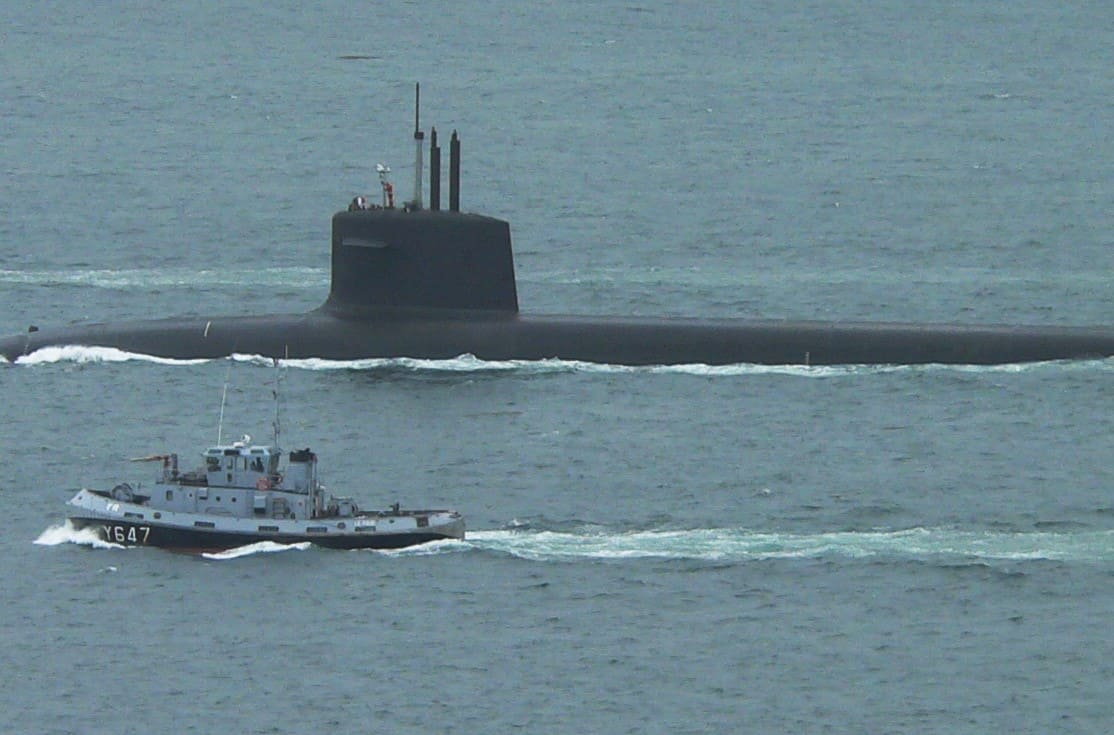
France has placed the M51.3 submarine-launched ballistic missile into operational service. Officials confirm the commissioning order was signed on Oct 24 and announced on Oct 28.
The Armed Forces Ministry said this week: “The M51.3 ensures the continued credibility of the ocean-based component in the face of evolving enemy missile defenses.” Armed Forces Minister Catherine Vautrin added when she signed the order: “This achievement embodies a major ambition of the 2024–2030 Military Programming Law: to accelerate the modernization of our capabilities and ensure the long-term credibility of our deterrence, the sovereign pillar of our security.”
The variant follows the M51.1 and M51.2 that entered service across the Le Triomphant-class fleet after 2010. A full qualification flight on Nov 18, 2023, from the DGA range near Biscarrosse cleared the route to entry in late October 2025. The DGA leads the program. ArianeGroup is prime for integration and propulsion. The warhead effort sits with the national nuclear authority, which fielded the TNO family and has delivered the updated TNO-2 package for M51.3.
Missile Performance and Technical Specifications
Paris has not published an official range figure. Independent estimates place M51.3 beyond 9,500 km, compared with more than 9,000 km for M51.2. Typical loadouts use multiple independently targetable reentry vehicles. Most estimates say four to six warheads per missile, each unit around 100 kilotons.
ArianeGroup’s public material outlines the flight profile in broad terms. The missile uses three solid stages and climbs above 2,000 km before reentry at about Mach 20. It measures roughly 12 meters and weighs more than 50 tons. The missile is hardened for cold launch from a submerged tube using a gas generator. Updated guidance, a refined post-boost vehicle, and decoys aim to raise survivability and accuracy as defenses improve.
Before service entry, the program conducted static firings and the 2023 qualification flight noted above. The DGA reviewed telemetry, debris-field data, and post-boost separation performance. Those results supported the commissioning order in October, officials confirm.
Warhead production remains classified. TNO-2 introduces hardened electronics, improved thermal protection, and a reentry body tailored for highly contested missile-defense environments. Safety features carried from the original TNO include insensitive high explosive and updated environmental monitoring. According to industry sources, France also refined warhead separation sequencing and the arming-fuzing chain to match the M51.3 bus timing.
The three-stage solid stack uses composite motor cases, submerged nozzles, and precision thrust vectoring. A powered post-boost vehicle deploys MIRVs and refines aimpoints. Defensive aids include decoys and other countermeasures. Guidance uses an astro-inertial core plus updates from modern navigation sources; details of terminal guidance remain classified.
Le Triomphant-Class Integration and SNLE 3G Program
Le Triomphant-class submarines will carry the new variant through the early 2030s. Each boat has 16 launchers. The navy keeps one hull on patrol during the others train or refit to manage availability and hull life. Launcher and fire-control updates have moved alongside the missile program, so the fleet can take M51.3 without major structural changes to the tubes.
Training and integration begin ashore. Crews work together during updated fire-control software at shore facilities, then complete boat-level checks. Safety teams verify tube seals, exhaust handling, and hydrogen management for launch gas generation. Harbor checks proceed to sea trials, where the navy checks timing under motion and pressure cycles. This sequence has matured since the M45 era and supports smooth variant swaps.
A successor class is in the pipeline. Naval Group cut first steel on March 20, 2024, for the SNLE 3G program at Cherbourg. The effort targets lower acoustic signatures, more energy margin, and a modern combat system that accounts for a future M51.4. Delivery of the first 3G boat is planned in the mid-2030s, and service expected into the late 2080s.
Patrol plans stay secret. Public doctrine describes permanent availability, one submarine on patrol, and a secure second-strike capability. Officials cite tougher missile defenses, wider radar coverage, and more capable space-based sensors as the threat picture evolves. A missile offering improved penetration aids, cleaner bus management, and higher accuracy supports that requirement.
M51.4 Development and International Context
France has also launched the next missile upgrade. The DGA awarded a combined development and production contract for M51.4 on August 28, 2025, and later published the action. Officials describe extended reach, better accuracy, and stronger penetration aids. Staggering major upgrades helps the navy avoid overlapping downtime during new submarines enter service.
Other nuclear powers have refreshed sea-based forces during the past decade. Russia fields new SSBNs and continues long-range missile upgrades. The United Kingdom is moving from Vanguard to Dreadnought during sustaining Trident. The United States is producing Columbia-class boats and extending Trident II. China has expanded SSBN basing and demonstrated longer-range JL-series shots. The French decision lands within this wider pattern.
The airborne component advances in parallel. ASN4G will replace ASMPA on Rafale, tied to the Rafale F5 standard and planned base upgrades. Government statements this spring kept initial operational capability in the 2035 window. The goal is to keep the air and sea legs moving in step across the next decade.
Policy coordination alongside London tightened in July under the Northwood framework. The two governments set up a senior-level steering group for nuclear dialogue and potential deconfliction. The arrangement does not merge command chains or patrol decisions. Paris keeps an independent decision line during improving shared assessments and communications during crises, according to officials.
Figures on yield and load rely on open sources. Independent tallies place France’s overall stockpile in the mid-hundreds and view the SLBM arm as the main delivery share. Estimated MIRV counts and yields for M51.3 fall within the ranges noted earlier. France relies on simulation and hydrodynamic facilities instead of nuclear testing to validate changes, including TNO-2 refinements.
Procurement responsibilities are stable. ArianeGroup leads the missile line and supports the test range. Naval Group builds and sustains the submarines. Missile assembly draws on composite and energetics plants that also support space projects. According to industry sources, production ramped in 2024 and 2025 to meet acceptance schedules and swap legacy stocks without disrupting patrol cycles. Officials have signaled deliberate pacing so retirements match M51.3 deliveries.
Oversight mechanisms remain in place. Parliament votes multi-year funding. The Court of Audit can review execution in non-sensitive form. The ministry issues program notes, and the DGA posts select test and contract notices. Those public documents let observers follow M51.3 from early studies to the 2023 qualification firing and the October 2025 service entry.
Research programs outside the missile line add perspective. Work on the V-MAX glide effort has pushed national expertise in high-speed aerothermodynamics and guidance under extreme heating. ArianeGroup’s space portfolio feeds materials, manufacturing techniques, and avionics that also appear in deterrent programs. Work on naval hardening has also informed space-launch safety and reliability.
Submarine crews cycle through tactical simulators and engineering trainers that mirror control rooms. The missile interface module links to synthetic ranges that emulate bus and reentry behavior without arming live systems. Evaluations include procedures for tube casualties, misfires, and gas-generator faults. Officials confirm the navy has not changed this approach for M51.3.
Public debate often centers on range and numbers. Program managers focus on reliability under stress and secure penetration against modern defenses. Our analysis shows the October order, paired together during M51.4 development, sustains assured second-strike capability through a small, survivable sea-based force during leaving doctrine and force size unchanged.
REFERENCE SOURCES
- https://www.defensenews.com/global/europe/2025/10/28/france-updates-submarine-launched-nuclear-missile-amid-arms-race/
- https://www.meretmarine.com/fr/defense/mise-en-service-du-missile-balistique-nucleaire-m513-equipant-les-snle-francais
- https://www.opex360.com/2025/10/28/dissuasion-le-missile-strategique-mer-sol-m51-3-a-officiellement-ete-mis-en-service/
- https://ariane.group/en/defence-systems/deterrence/
- https://thebulletin.org/premium/2025-07/french-nuclear-weapons-2025/
- https://www.navalnews.com/naval-news/2023/11/france-successfully-test-fires-new-m51-3-slbm/
- https://www.naval-group.com/en/naval-group-starts-construction-first-thirdgeneration-french-nuclear-powered-ballistic-missile
- https://www.lemonde.fr/en/international/article/2025/07/11/france-and-britain-reinforce-coordination-of-nuclear-forces-in-response-to-russian-threat_6743265_4.html
- https://www.defense.gouv.fr/sites/default/files/ministere-armees/20250912%20Press%20release_A_The%20DGA%20orders%20the%20development%20of%20the%20M51.4%20strategic%20ballistic%20missile%20to%20ArianeGroup%20vdef.pdf
- https://www.edrmagazine.eu/french-dga-orders-development-of-m51-4-strategic-ballistic-missile-from-arianegroup
- https://www.aerotime.aero/articles/france-awards-arianegroup-contract-for-new-m51-4-nuclear-ballistic-missile
- https://tf1info.fr/high-tech/armee-qu-est-ce-que-le-missile-mer-sol-francais-m51-3-qui-vient-d-entrer-en-service-operationnel-2403233.html