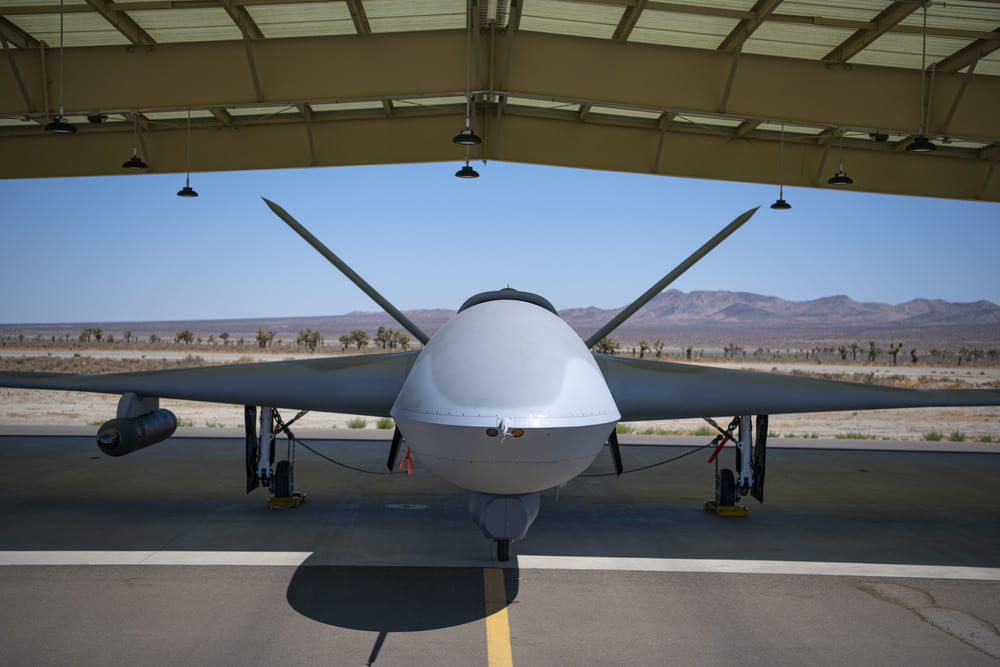
A concept video at AUSA 2025 showed an MQ-20 Avenger with a rotating nose section that projects a laser through a turreted aperture. General Atomics described it as a rendering rather than evidence of a fielded system, yet the configuration aligns with ongoing directed-energy work across its unmanned portfolio. Imagery indicates a redesigned forward fuselage with a lateral-rotating core and a separate spherical sensor at the tip, suggesting independent sighting and beam control functions.
Concept Render Shown at AUSA 2025 Exhibition
Expo attendees saw an animation of the jet-powered Avenger with its standard nose replaced by a cylindrical assembly that rotates to steer a high-energy beam. A separate multi-sensor ball appeared at the extreme nose, a position commonly used for electro-optical and infrared cameras plus rangefinding. The scene matched descriptions circulating among show visitors who captured still frames from the loop. The firm clarified the clip shows a concept rather than a current government program. “What visitors saw at AUSA was a conceptual render and short animation of an MQ-20 Avenger with a high-energy laser (HEL) system,” a company spokesperson said.
The spokesperson cautioned audiences not to treat the exact visuals as final. “I wouldn’t read too much into the actual visuals of the Avenger and laser depicted in that render,” he noted. He also said a mature installation could take other forms, including podded options on different aircraft families. The remarks align with the firm’s wider pitch that laser payloads can be built into an airframe or carried as removable stores.
Placing a turret at the aircraft’s forward axis can simplify boresight alignment between sensors and the beam director. It also minimizes obscuration from wings or stores during aggressive slews. The animation’s rotating inner barrel hints at a continuous azimuth field of regard, while the separate sensor ball at the tip would handle high-fidelity tracking and battle damage assessment.
General Atomics Laser Development Spans MQ-9B Pod and HELLADS Heritage
The same firm has shown a podded airborne laser sized for the MQ-9B family and pitched for fleet defense and counter-UAS tasks. A major naval exposition in April highlighted a distributed-gain design inside a wing pod that spreads thermal loads and eases size-weight-power demands on medium-altitude aircraft. Photographs from the floor revealed an intake and an underside aperture. Those features indicate active cooling and beam-emission hardware. Subsequent trade-press coverage described the concept in the 25-kilowatt class aimed at defeating one-way attack drones.
This effort builds on earlier high-energy laser work. The company’s electromagnetic systems arm reported lab validation of solid-state sources and beam-quality measurements across the last decade. DARPA’s HELLADS research explored compact, high-power packages sized for tactical platforms. Public records of beam evaluations date to 2015, and open literature on HELLADS described an aim to intercept rockets and mortar rounds using aircraft-class units. There is no public proof of an Avenger flight trial under that specific program.
The render also connects to the firm’s Gambit campaign. Gambit centers on a common core “chassis” married to mission-specific bodies, an approach meant to accelerate how sensors or effectors get fielded on autonomous jets. Company material and defense reporting point to Gambit feeding both internal R&D and U.S. service roadmaps for collaborative combat aircraft. In parallel, a company-owned Avenger has been used as a live test jet for autonomy stacks, including recent demonstrations that paired live and virtual aircraft and practiced air-to-air kill chains in a blended construct.
According to industry sources, a nose-integrated laser on an Avenger-class jet would serve more as a technology pathfinder than a mass-produced configuration. The spokesperson’s on-record remarks about alternate forms, such as podded systems on MQ-9B or a fully integrated weapon on Gambit, support that reading.
Technical Hurdles Include Power, Cooling, and Recent Program Cancellations
Defense officials confirm that two prominent U.S. airborne laser efforts hit hard limits in 2024. The Air Force abandoned plans to flight-test a laser on the AC-130J in March. The Self-Protect High-Energy Laser Demonstrator program concluded in May without a fighter flight trial. Official statements pointed to integration windows that slipped and to reliability work that remained on the ground. The record underlines how thermal management, vibration, and beam control impose tight margins on aircraft.
Open-source technical reviews describe the central challenges. Power generation at altitude must feed both the laser and the thermal management system. It still has to preserve range and payload. Aircraft motion and aero-induced jitter require advanced beam directors and fast steering mirrors. Atmospheric attenuation reduces effective range in humid or dusty air, so designers push toward higher power levels and robust adaptive optics. U.S. Air Force futures documents and independent analysis from research institutions highlight the same issues and warn against optimistic schedules.
Even so, the core technologies have matured. Solid-state and fiber architectures dominate current programs. Modeling and wind-tunnel work now inform turret faceting and window materials resistant to thermal bloom. Power-by-wire on unmanned jets avoids crew-safety limits and simplifies packaging. The April pod reveal underscored this shift by showing hardware scaled for medium-altitude unmanned missions rather than the large demonstrators of past decades.
Solid-state and fiber architectures dominate current programs. Modeling and wind-tunnel work now inform turret faceting and window materials that resist thermal bloom. Power-by-wire approaches on unmanned jets free designers from crew-safety constraints and simplify packaging. The April pod reveal underscored this shift, showing hardware scaled for medium-altitude unmanned missions rather than strategic demonstrators of past decades.
Counter-UAS and Escort Missions Fit Current Laser Power Levels
Near-term missions for an Avenger-class laser start with counter-UAS. A medium-power beam tied to precise tracking can disable small drones without fratricide risk from fragmenting munitions. Magazine depth depends on fuel and thermal capacity rather than missile stocks, which suits long-endurance patrols. The naval expo pitch framed the MQ-9B pod against one-way attack drones. The same logic applies to a nose-mounted laser on a high-subsonic jet like Avenger.
A second role covers self-protection and escort. A stabilized turret can threaten quadcopters, loitering munitions, or slow targets that close inside gun or missile minimums. The air vehicle’s autonomy stack already supports multi-ship cooperation. Company test releases this year described live-virtual events where an Avenger executed kill chains using government reference autonomy. An onboard laser would add a non-kinetic option to that flow.
Future collaborative combat aircraft offer further routes. Gambit-derived bodies promise reconfigurable noses and bays that ease routing for high-current cables, liquid cooling, and beam-director mounts. Recent disclosures on a Navy carrier-based uncrewed fighter competition open another route for laser payloads to enter fleet trials, even only as test articles in early spirals. Carrier duty would introduce deck operations, catapult loads, and corrosion control as additional design constraints for any directed-energy kit that aims for sea service.
Long-range missile defense is a different case. Think-tank papers and government lab notes call out the energy needed for boost-phase engagement and the geometry required to dwell a beam on hardened targets. High-altitude unmanned platforms remain useful for tracking and cueing rather than intercept after optimism cooled. That pivot keeps airborne lasers relevant for sensing and local defense, and pushes the heavier physics work back into research.
The MQ-20 has a distinctive role in this story. Public operators are scarce. The jet appears often as a testbed for autonomy and payload experiments. That suits an integrated nose turret because flight testing can focus on beam quality through maneuvers, aero-window heating, and handoffs between the nose sensor and the beam director. According to industry sources, the nose layout also offers a clean way to trial aimpoint maintenance at high off-boresight angles without reworking wing stores.
There is a logistics trade between a nose fit and a pod. Pods let units shift the laser between aircraft without deep maintenance and move the asset across fleets. An integrated nose lowers drag and clears wing stations, yet it binds the weapon to one airframe. The firm’s spokesperson pointed to both options, which suggests parallel development. Pods cover broad utility. A built-in package serves aircraft that carry the mission often.
Statements from uniformed sources across the last two years also set expectations. Public briefings and budget notes emphasize that airborne lasers will enter service in narrower roles first. The record of AFSOC’s laser and SHiELD shows how schedule slips and integration risk can erase whole flight-test windows. Defense officials confirm those cancellations and closures. The same offices continue to fund naval and ground lasers where power and cooling margins are larger.
Our analysis shows the Avenger nose-laser render is best read as unmanned directed energy moving into roles that fit today’s power budgets. Counter-UAS and point defense match what MALE and HALE aircraft can supply. Gambit’s modular approach offers the structure for deeper integration later. A phased approach that starts with pod trials and then moves into bespoke noses is realistic, provided flight tests run often enough to lock in the thermal and aero fixes that airborne lasers always demand.
REFERENCE SOURCES
- https://www.twz.com/air/mq-20-avenger-depicted-with-laser-weapon-in-its-nose-a-sign-of-whats-to-come
- https://www.navalnews.com/event-news/sea-air-space-2025/2025/04/mq-9b-shown-with-airborne-laser-at-sea-air-space-2025/
- https://uasweekly.com/2025/04/21/mq-9b-skyguardian-debuts-high-energy-laser-pod-at-sea-air-space-2025/
- https://thedefensepost.com/2025/04/17/general-atomics-laser-weapon/
- https://www.ga-asi.com/remotely-piloted-aircraft/gambit-series
- https://www.ga-asi.com/newest-groundbreaking-ga-asi-autonomous-jet-demo-includes-successful-simulated-shoot-down
- https://www.flightglobal.com/military-uavs/general-atomics-will-compete-gambit-variant-in-us-navy-uncrewed-fighter-programme/164963.article
- https://www.military.com/daily-news/2024/03/19/air-forces-dream-of-mounting-laser-weapon-ac-130j-ghostrider-gunship-dead.html
- https://www.military.com/daily-news/2024/05/17/air-force-abandons-plan-mount-laser-weapon-fighter-jet-after-scrapping-similar-gunship-project.html
- https://www.rand.org/pubs/commentary/2024/01/directed-energy-the-focus-on-laser-weapons-intensifies.html
- https://www.afrl.af.mil/Portals/90/Documents/RD/Directed_Energy_Futures_2060_Final29June21_with_clearance_number.pdf
- https://dsiac.dtic.mil/articles/mda-high-altitude-long-endurance-uas-could-stop-enemy-ballistic-missiles-in-boost-phase/
- https://www.defensenews.com/land/2017/12/11/mda-awards-three-contracts-to-design-uav-based-laser/
- https://theaviationist.com/2025/04/11/mq-9b-airborne-laser-pod/