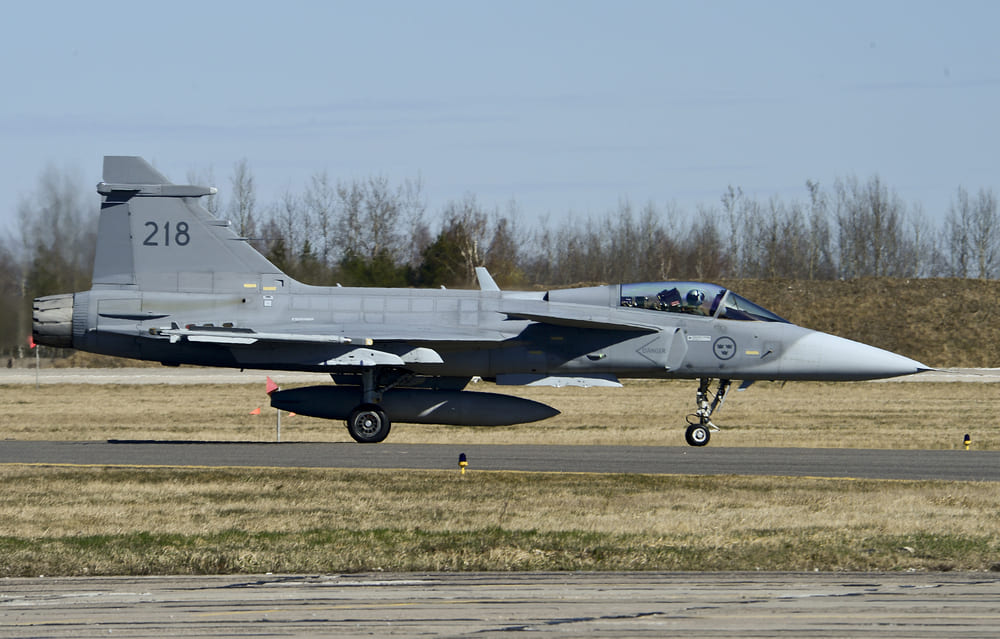
Prime Minister Ulf Kristersson and President Volodymyr Zelenskyy signed a letter of intent in Linköping on Oct 22 covering cooperation in airpower and a prospective export of JAS 39 Gripen E fighters to Ukraine.
The public range set by Stockholm is wide but explicit: 100 to 150 aircraft. “Today we have signed an important Letter of Intent… likely between 100 and 150 fighter jets,” Kristersson said at the factory event in Linköping. Zelenskyy called it “the first document… paving the way for… a substantial fleet of Swedish-made fighter jets.”
The LOI names areas of cooperation tied to fighter aviation and related capabilities and records both governments’ intent to work toward an export contract. It does not allocate money, schedule airframes, or bind either party to a firm purchase.
Quantity is only one part of what changed on Oct 22. Sweden put its newest variant on the table. The document and supporting remarks identify Gripen E, not second-hand C/Ds, as the platform Ukraine will plan around if the deal proceeds. Officials confirm the LOI’s focus on the E model and a broad cooperation track that spans knowledge exchange on air combat and the use of advanced capabilities, with fighter aircraft listed as an example. Kyiv’s readout points to “at least 100” aircraft as a working target in a future contract, which aligns with the Swedish floor and ceiling.
Public remarks around the event describe first deliveries in roughly three years from contract signature. Separate comments from Kyiv expressed hope for 2026 arrival of initial airframes, while air force spokespeople cautioned against near-term expectations. Taken together, the statements describe a staged induction that begins after contracting and financing, then ramps with production growth. Nothing in the LOI sets a date.
Both governments said they would explore financing mechanisms with partners. According to industry sources, options under discussion include export credits and European instruments, potentially with long amortization, to fit a triple-digit fighter program. No per-unit price was disclosed, and neither side published a total program value. The content of the package – training, spares, support, weapons, infrastructure – will drive the final figure more than airframe flyaway.
Pilot Familiarization and Production Facility
Swedish authorities acknowledged Ukrainian pilot familiarization in 2023, including flights, simulator time, and ground-crew orientation. That work gave Kyiv a first look at cockpit layout, mission systems, turnaround procedures, and operations from short or improvised surfaces. Officials confirm those events occurred under Swedish approval and supervision. The experience does not shortcut conversion on the E variant, yet it lowers risk when a syllabus starts.
The signing took place at Saab’s Linköping facility with a Gripen E present. The site is the center of Swedish final assembly, and any contract of this size will hinge on how fast that line – and partner lines – can scale. The Swedish Air Force accepted its first Gripen E into operational service at F 7 Skaraborg Wing on Oct 20-21. That milestone fixed a national training pipeline and operational conversion unit on type. Ukraine gains a live reference model for syllabus design, tooling, and instructor exchange once a contract converts intent into delivery work.
The LOI captures a few concrete points that now frame negotiations. The variant is Gripen E. The cooperation track extends beyond aircraft to operational knowledge and use of advanced airpower capabilities. The quantity range is “likely between 100 and 150,” a line the Swedish side put on record during the ceremony and Kyiv echoed in its own statement. The text stops short of a purchase agreement, which keeps all financial and delivery specifics for later documents.
Two short public quotes illustrate both sides’ intent without overselling. Kristersson described the LOI as a step toward a major export deal and stated the 100-150 range on the record. Zelenskyy called the LOI the first signed document that “pav[es] the way” to a substantial Gripen fleet and repeated Ukraine’s goal to receive at least 100 aircraft under a future contract. Those quotes now bound the conversation about scale and set expectations for the follow-on work between the capitals and industry.
Sweden paused a potential near-term Gripen transfer in 2024 to avoid complicating the stand-up of F-16s. That caution gave way in 2025 to a structured route for a new-build fleet. The LOI does not mention C/D transfer. Officials confirm no formal decision exists to pull C/D aircraft from Swedish service for immediate export. The working assumption is a new-build E fleet, with training and support built around Sweden’s current induction sequence.
Gripen E Capability for Dispersed Operations
The design logic behind Gripen favors Ukraine’s operating concept. Gripen E retains quick turnaround on small teams, road-base sortie generation, and short-strip operations. It adds range, payload, and a new suite of sensors and electronic warfare. The airframe’s architecture supports a broad family of weapons-European and U.S.-and the mission system is built for networked air combat under electronic attack. These traits map onto the dispersed basing and constant movement Ukraine already uses to complicate enemy targeting.
Sweden announced the transfer of ASC 890 airborne early warning and control aircraft in 2024. Erieye radar provides wide-area air and surface detection and serves as an airborne control node for fighter packages. Sweden developed tactics and procedures for Gripen with Erieye over decades; Ukraine can apply a similar model once more Western fighters arrive in numbers. Defense officials confirm the Erieye donation includes training and command-and-control support to help Ukraine absorb the capability.
Training will not start from zero. F 7 Skaraborg Wing serves as Sweden’s conversion unit on Gripen E. The first E accepted into Swedish service in October means the courseware, instructor bench, and maintenance training are now live inside the Swedish Air Force. That makes it easier to design a hand-off to Ukrainian crews and to structure a pipeline that moves pilots and ground staff from familiarization to combat readiness. The existence of a functioning national syllabus shortens the time from airframe arrival to frontline use.
Ukraine continues to operate Soviet-era fighters alongside arriving Western types, including F-16 and Mirage 2000. Gripen E would not replace those aircraft on day one. It would join them, then take on a growing share of air defense, counter-air, and strike as crews convert and weapons clear. The austere base model matters here; Ukraine runs many of its sorties from dispersed locations, often on short notice, often under threat of missile and drone attack. Gripen’s maintenance concept – fast refuel and rearm with small teams – fits that reality.
Gripen E’s AESA radar and electronic attack can help manage contested airspace and suppress threats. The aircraft’s data links and EW allow tactics that stretch beyond visual range when the ground picture is dirty or jammed. Paired with Erieye, the fighter can receive cues and target assignments across the region without exposing itself to unnecessary risk. It depends on a coherent package of aircraft, sensors, weapons, and trained crews.
Industrial Capacity and Local Assembly Options
Saab says it can lift annual output if a Ukrainian contract lands. According to industry sources and recent executive comments, the company is preparing options to expand throughput at home and at partner sites. The manufacturer has also stated it is prepared to support final assembly, testing, and potentially component production in Ukraine if security and industrial conditions permit. That would build sustainment know-how in country and cut shipping times for heavy parts. It would not replace initial deliveries from existing lines, but it would strengthen long-term support.
Brazil’s 36-jet program remains in delivery. Thailand added four E/F in 2025 with handovers scheduled through 2030. Colombia’s requirement remains active, and European interest in new-build aircraft and upgrades continues. Sweden’s own 60-jet E order only just reached first operational acceptance. All of this points to a queue that must grow in capacity to accommodate a three-digit Ukrainian order. According to industry sources, peak historical output for Gripen sat around the high teens per year across variants. Current production stands below that, which is why executives talk about doubling capacity if Ukraine signs.
A final-assembly footprint inside Ukraine requires secure space, power, tools, trained staff, and protected logistics. It also requires a flow of kits and parts from Sweden and partner sites and close oversight on quality. Early phases could start with component work and MRO tasks before any local final assembly. Even modest localization would help Ukraine control downtime and move airframes back into service faster after battle damage or heavy maintenance.
Weapons and support packages will be central to any contract. Gripen E’s value in Ukraine rises with the breadth of certified munitions, pods, and pylons available at signature. Follow-on certifications will continue as the fleet grows, but starting with a mature set of options accelerates combat utility. Training devices, spares, test equipment, and data rights also matter. They tend to dominate early-year spending and they determine how many aircraft a squadron can keep flying each day.
The three-year estimate to a first delivery only holds if the production plan aligns with a signed funding package and a clear sequence for training and basing. Defense officials confirm those workstreams are running in parallel now. If the line expands and the contract ties cash flow to deliveries, a first-block handover in that window is realistic. If financing drags or capacity growth slips, the handover slides to the right.
Ukrainian Air Force Integration and Force Structure
Ukraine’s air force will need a conversion pipeline, an austere-base playbook, and a networked command layer to make a fleet of Gripen E pay off. Pilots and maintainers will move in cohorts through training and squadron stand-ups, then seed new units as numbers rise. Runways and road segments must be surveyed, pre-positioned kits staged, and rapid refuel/rearm drills normalized across teams. Erieye controllers will connect sorties to the wider air picture and reduce surprise.
MiG-29 and Su-family jets will continue to fly alongside Western aircraft for years, covering tasks where they still add value during conversion. F-16 and Mirage 2000 already carry some of the load. Gripen E would take on a larger share of counter-air and deep strike as units spin up. According to officials, the LOI does not alter existing Western fighter deliveries; it adds a second Western lineage with a sustainment model designed around small teams and short strips.
The aircraft supports a wide set of European and U.S. stores. Some will be available at handover; others follow after test work. The EW suite and radar give options in heavily jammed sectors where legacy sensors struggle. The aircraft’s small logistic footprint helps sustain high sortie rates without giant base footprints that invite missile and drone barrages.
Erieye cues and directs, ground-based sensors fill gaps, and fighters use data links to share tracks and assignments. This has been standard practice in Sweden. Ukraine will adapt it to its geography, threat picture, and available weapons. The system is not exotic; it is about repeatable procedures and crews who train together often.
Our analysis shows the LOI gives Ukraine a defined route to a new-build Western fighter fleet and gives Sweden a clear framework to scale industry and training, but the schedule turns on three gates: contract signature, financing, and factory throughput. The first jets arrive only after those are solved in that order. Once airframes start to flow, the limiting factor shifts from politics to production rhythm and training capacity.
REFERENCE SOURCES
- https://www.government.se/press-releases/2025/10/sweden-and-ukraine-deepen-air-force-cooperation/
- https://www.president.gov.ua/en/news/volodimir-zelenskij-ta-ulf-kristersson-pidpisali-pershij-dok-100909
- https://www.reuters.com/business/aerospace-defense/sweden-talks-sell-gripen-fighter-jets-ukraine-2025-10-22/
- https://www.reuters.com/business/aerospace-defense/what-are-gripen-fighter-jets-ukraine-wants-buy-sweden-2025-10-22/
- https://www.defensenews.com/global/europe/2025/10/23/ukraine-gets-in-line-for-swedish-gripen-e-fighter-jets/
- https://www.euronews.com/2025/10/22/ukraine-and-sweden-sign-a-long-term-deal-for-up-to-150-gripen-fighter-jets-for-kyiv
- https://www.twz.com/air/huge-gripen-fighter-order-letter-of-intent-signed-by-ukraine
- https://breakingdefense.com/2025/10/ukraine-moves-to-buy-scores-of-saab-gripen-fighters-from-sweden/
- https://www.ft.com/content/9ab0fdf7-3524-4fb9-a0fa-656ce8209ffe
- https://www.government.se/press-releases/2024/05/military-support-package-16-to-ukraine–new-capability-to-strengthen-ukraines-air-defence-and-support-to-meet-its-prioritised-needs/
- https://euro-sd.com/2025/10/major-news/47338/swaf-accepts-first-gripen-e/
- https://theaviationist.com/2025/10/20/sweden-receives-first-gripen-e/
- https://www.saab.com/newsroom/press-releases/2025/saab-receives-gripen-ef-order-for-thailand
- https://www.reuters.com/world/europe/sweden-halts-plan-gripen-jets-ukraine-news-agency-tt-reports-2024-05-28/
- https://www.kyivindependent.com/media-ukrainian-pilots-successfully-test-swedish-gripen-jets/
- https://www.reuters.com/business/aerospace-defense/ukraines-zelenskiy-visit-sweden-wednesday-defence-talks-2025-10-22/