
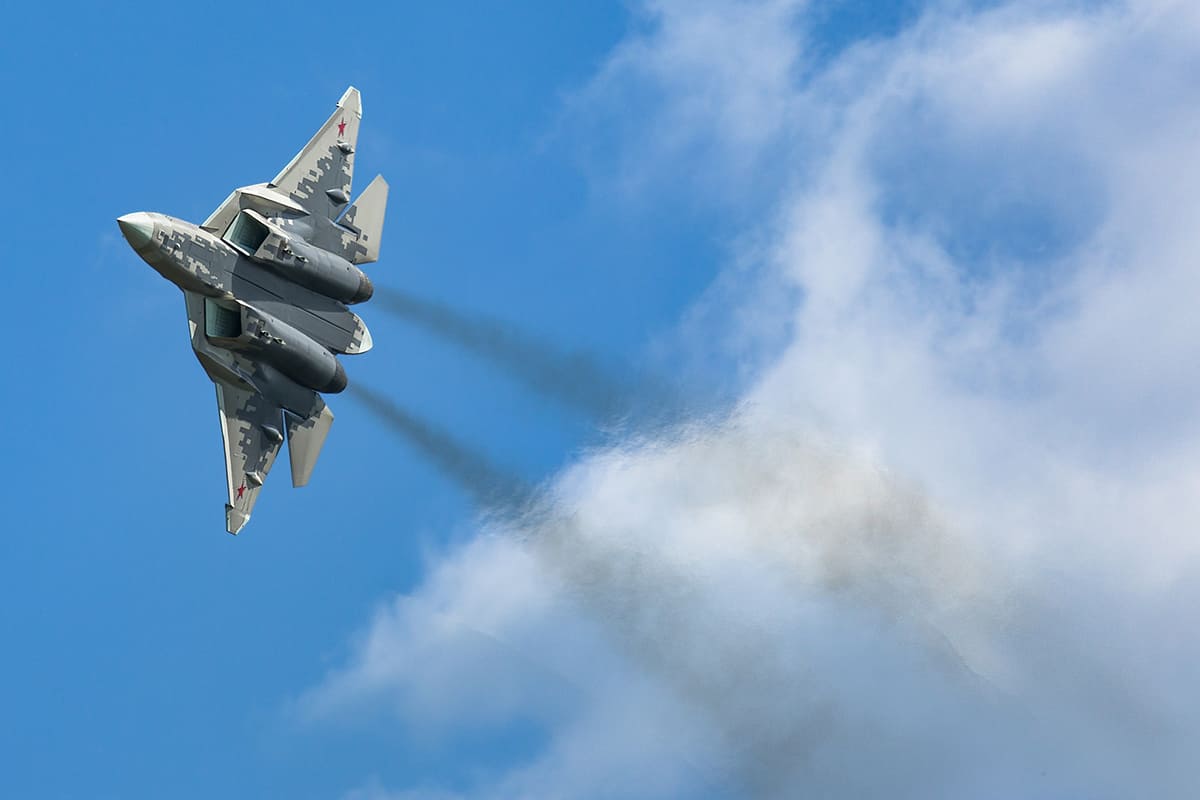
New footage released on 9 November ahead of Dubai Airshow 2025 shows a Su-57 Felon flying with its internal weapons bays open and fully loaded. The aircraft is the T-50-9 prototype, bort number “509,” and the images give a clear view of the forward main bay with two Kh-58UShK anti-radiation missiles mounted on ejector launchers. Side “quick-launch” bays under the wing roots cycle open as well, exposing R-74M2 short-range air-to-air missiles.
According to industry sources this is the first officially released material that shows an Su-57 carrying operational missiles inside both the main bay and the wing-root bays during routine flight rather than in a controlled weapons test. The configuration is consistent with a suppression-of-enemy-air-defenses role, pairing long-range anti-radiation missiles with internal short-range self-defense weapons on a near-series standard airframe.
Su-57 internal weapons bays at Dubai Airshow 2025
At Dubai Airshow 2025 the Su-57 took part in the flying display with T-50-9 performing aerobatic maneuvers and a dedicated pass with the forward weapons bay open. UAC’s promotional video from 9 November and photos taken during workups over the United Arab Emirates show the same aircraft, in dark camouflage, presenting its internal armament to cameras and show visitors.
Industry sources describe T-50-9 as equipped with the production-standard sensor and mission suite, including the 101KS Atoll electro-optical system and the full weapons-control package. The aircraft in the Dubai routine flies with two Kh-58UShK missiles in the forward bay and an R-74M2 in each quick-launch bay, illustrating how the Felon can present a clean external profile while carrying a meaningful combat load. Officials familiar with the program say the display used live-standard missiles rather than empty shapes.
The bay sequence follows earlier, more limited public views of the Su-57’s internal arrangement. Previous material had shown empty side bays and brief clips of weapons separation from the main bay without a clear look at loaded racks. The Dubai appearance goes further, keeping the bay doors open long enough for the missile bodies and their folding fins to be seen and confirming the tandem-bay layout now used on near-series aircraft.
Kh-58UShK and R-74M2 in Su-57 weapons bays
Kh-58UShK is a compact development of the older Kh-58 anti-radiation missile, redesigned for carriage inside weapons bays. Russian data puts its mass at about 650 kilograms, with a body roughly 24 centimeters shorter than the baseline weapon and folding control surfaces to meet bay limits. Range figures in open sources run from around 150 to more than 200 kilometers when launched at higher altitude. The missile homes on radar emissions from surface-to-air and fire-control systems.
The Su-57 carries Kh-58UShK in the forward main bay on UVKU-50-series ejectors that push the missile clear before motor ignition. This arrangement suits low-observable operations, since the aircraft avoids external pylons yet can still fire at air-defense radars from outside many engagement zones. According to officials involved with trials, internal integration of Kh-58UShK has been a major focus of recent weapons testing.
R-74M2 in the wing-root bays is the latest evolution of the R-73 short-range infrared missile family. The new variant retains high off-boresight capability and helmet-mounted sight cueing but uses a revised seeker and reduced-span fins so it can fit the Su-57’s quick-launch fairings. Each missile rides on a VPU-50 rail that extends from the bay into the airstream before firing, giving the seeker an unobstructed view of its target.
Standard internal air-to-air carriage on the Felon pairs those two R-74M2s with up to four medium or long-range missiles in the tandem bays. The R-77M active-radar missile and the very-long-range weapon known as izdeliye 810 are both sized for the UVKU-50 launchers and have been repeatedly linked to the Su-57 in Russian technical publications. For strike roles the fighter can take Kh-69 subsonic cruise missiles, Kh-38M family weapons, the Grom guided missile and guided bombs in the KAB-250 and KAB-500 classes, all tailored for internal or semi-internal carriage.
Gun armament remains conventional. A single GSh-30-1 30-millimeter cannon is installed in the starboard wing root with around 150 rounds available, giving the aircraft a close-range option alongside its missile and bomb load.
Su-57 weapons bays layout and engine upgrades
The Su-57’s main weapons section sits between the engines and consists of two large bays arranged in tandem, each sized for missiles up to roughly 4.4 meters long. Two smaller bays in the wing roots hold one short-range missile apiece. This layout has appeared in drawings for years, but only limited official imagery had shown it on a flying aircraft before the current UAC material and the Dubai display.
Internal weapons-separation tests began around 2016, several years after the first T-50 prototype flew. Russian reports from that period described releases of air-to-air missiles and precision weapons from modified prototypes, with later trials expanding to the full range of planned stores. Officials confirm that separation and guidance trials for Kh-58UShK, R-77M and R-74M2 have now moved from the dedicated test fleet onto near-series airframes.
When stealth is not a priority the Felon can also use six external hardpoints, four under the wings and two under the air intakes. Test photos have already shown the type carrying drop tanks and external weapons on those stations, though the Dubai routine stayed on an internal load for demonstration purposes.
Current production Su-57s use the AL-41F1 (izdeliye 117) turbofan, a development of the engine used in late-model Flankers. Work on the “second-stage” AL-51F1, or izdeliye 30, continues in parallel. Flight trials with the new engine started on a test airframe in 2017 and later expanded to configurations with a flat nozzle aimed at reducing radar and infrared signature. Russian officials say bench and flight development of AL-51F1 has finished and describe plans to equip the upgraded Su-57M variant, although open information on deliveries and fleet share still stays limited.
Su-57 exports Algeria order and production status
Algerian state media reported early in 2025 that the country would acquire Su-57E fighters and had already sent pilots to Russia for conversion training. Open-source assessments have for some time mentioned an Algerian requirement of roughly 14 aircraft, likely split into an initial batch of six and a follow-on group later in the decade. According to industry sources, Su-57E for Algeria will keep the core airframe and engine while adjusting some mission systems and communications equipment to local needs.
Russian defense officials say the first export Su-57s have now left the country. Two aircraft in export configuration have been delivered to a foreign customer and assigned to combat duty, although Moscow has not named the operator. UAC chief executive Vadim Badekha told Russian television that “they have begun combat duty and are demonstrating their best qualities,” and added that the receiving air force is satisfied with the aircraft. The timing and context of his remarks point strongly toward the same North African order.
On the domestic side Russia holds a contract for 76 Su-57s to be delivered to the Aerospace Forces by 2028. Open tallies suggest just over twenty serial aircraft have been completed so far. Deliveries started in small numbers in 2021–2022, increased to more than ten aircraft in 2023 and then slowed again during 2024 and 2025 as sanctions and industrial limits affected the broader aerospace sector.
India’s withdrawal from the earlier joint fighter arrangement removed a planned funding stream and delayed some development work. New Delhi had concerns over cost, schedule and technology transfer, and eventually chose to leave the project rather than commit to a large Su-57 order. Russian officials have since promoted the export Su-57E with offers of local assembly and industrial participation to India, the United Arab Emirates and other states, but no fresh agreements have moved into the public domain.
Russian statements have mentioned Su-57 participation in operations over Syria and the use of stand-off weapons against targets in Ukraine from well inside Russian airspace. Independent evidence for those claims remains thin. One widely discussed episode involved the reported downing of an S-70 Okhotnik-B unmanned combat air vehicle during trials, allegedly by a Su-57, although the circumstances and exact test objectives have not been fully described in official material.
Our analysis shows the Dubai weapons-bay display confirms that the Su-57 now carries integrated internal loads for suppression-of-air-defenses and precision strike on a near-series aircraft and gives UAC a concrete configuration to offer abroad, even while production volumes stay moderate and the transition to the new AL-51F1 engine progresses more slowly than originally advertised.
REFERENCE SOURCES
- https://www.twz.com/air/su-57-felon-brandishes-its-loaded-weapons-bays-for-the-first-time
- https://theaviationist.com/2025/11/11/russia-shows-off-su-57s-internal-weapons-bays/
- https://www.armyrecognition.com/news/aerospace-news/2025/russias-su-57-jet-displays-internal-bay-carrying-two-kh-58-missiles-for-stealth-strike-role
- https://en.wikipedia.org/wiki/Sukhoi_Su-57
- https://en.wikipedia.org/wiki/R-73_(missile)
- https://en.wikipedia.org/wiki/Kh-58
- https://en.wikipedia.org/wiki/Kh-69
- https://defencesecurityasia.com/en/russias-5th-generation-su-57-now-equipped-with-second-stage-al-51f1-izdeliye-30-engine-2/
- https://ruavia.su/the-su-57-has-received-the-al-51f1-second-stage-engine/
- https://dsm.forecastinternational.com/2025/02/14/russia-to-export-su-57e-in-2025/
- https://defencesecurityasia.com/en/russia-su57e-stealth-fighters-algeria-north-africa-air-superiority-balance/
- https://www.businessinsider.com/russia-delivering-su-57-sukhoi-fighter-fifth-generation-foreign-buyer-2025-11