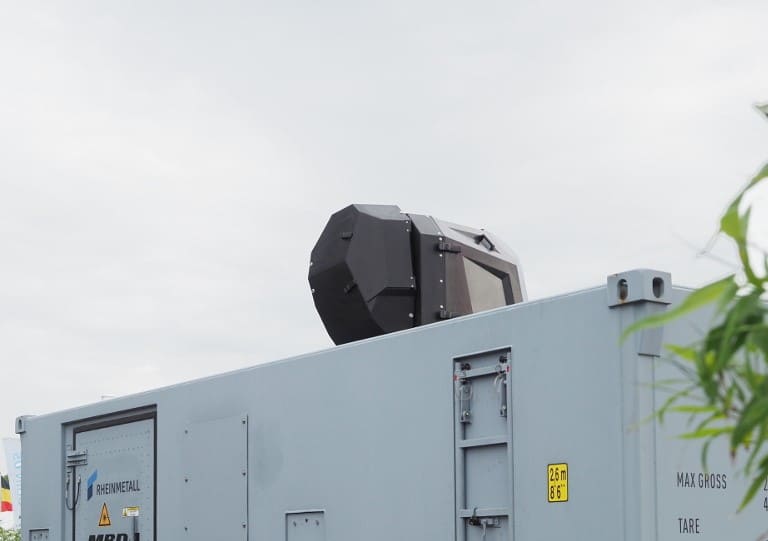
Berlin – Germany’s naval laser demonstrator has moved from sea to shore. The Rheinmetall–MBDA system transferred to the Bundeswehr’s Laser Competence Centre at WTD 91 in Meppen after a year of trials on the air-defense frigate Sachsen. Company materials note “fully operational weapon system possible from 2029.” The at-sea campaign recorded more than 100 live firings and a larger number of tracking runs against small, fast targets, including engagements “in front of blue sky” without terrain as a backstop.
Defense officials confirm WTD 91’s range covers roughly 200 square kilometers and includes instrumentation and safety arcs sized for directed-energy work. The containerized laser has been commissioned there for a land phase that focuses on counter-UAS tasks from fixed positions, using the same beam director, sensors, and operator console configured at sea.
According to industry sources, MBDA Germany integrates the sensors, target detection and tracking, the operator console, and the link to the ship’s command system. Rheinmetall provides the beam director, high-energy source, and the mechanical and electrical integration that let the 20-foot module attach to a frigate deck and draw ship services. The companies continue to present the laser as a complement to guns and short-range missiles for close-in defense against drones, swarms, small boats, and near-field guided threats.
A joint working group won the German contract to build and integrate the demonstrator on Sachsen during pier-side integration in 2022 and a firing campaign through 2023. During one sequence in August 2022, operators reported destroying approaching drones. The architecture stayed intact for the handover to Meppen in late October 2025 to allow a comparable test series on land under instrumented measurement.
Sachsen Sea Trials Validate Over 100 Live Firings
The Sachsen deployment treated the laser as a ship weapon. Crews embarked the container on the F124’s foredeck plus a topside director and sensor mast, routed services to ship power and cooling, and connected the console to the combat management system. Ship sensors cued the tracker, the director slewed to the target, and fire-control software executed the track-to-engage sequence. The campaign involved live shots and many dry runs in maritime air where spray, salt, and variable aerosols can scatter or absorb energy.
Engineering teams pointed to “in front of blue sky” shots as a regional first. Those runs put a premium on track quality, jitter control, and aim-point stability without the contrast of a terrain backstop. Data from the series informed stabilization settings, metrology checks, and dwell-time planning on small airframes crossing a low-contrast background.
Trial cards covered different drone types and profiles, along with small-craft tracks to stress scene tracking and discrimination. Lethality thresholds remain undisclosed. Officials confirm the current power class targets small unmanned aerial systems and light surface threats, and crews trained on the engagement routine inside the ship’s combat system so a future naval laser can operate in the same detect-track-engage chain used by guns and missiles.
WTD 91 Land-Based Testing for Drone Defense
The Meppen phase reuses the same container, beam director, and mission computer on a fixed stand. The goal is repeatable characterization under controlled conditions including instrumented telemetry, track-error budgets, jitter spectra, and dwell measurements. As the contractors put it, the container “has now been put into operation for further land-based drone defence testing,” and WTD 91 supporting acceptance and commissioning.
Power and cooling at Meppen permit longer duty cycles, which lets operators map how engagement schedules shift during aerosol load, humidity, and mirage effects near the surface layer. Those results will guide settings for automatic power on target, jitter filtering, and director drive profiles before any production return to sea.
The range’s size, about 200 square kilometers, supports multi-axis presentations and longer safety arcs for line-of-sight energy propagation. Wider baselines enable better trajectory reconstruction for small targets, which helps refine control algorithms that need milliradian-level stability at the aim point.
System Architecture and Scaling Beyond 20 Kilowatts
According to industry sources, the demonstrator uses a fiber-laser array offering a class-rated output near 20 kW in the current container. The package fits inside a standard 20-foot box and the beam director and sensors mounted on top. The container approach eases ship installation and gives a route for staged upgrades by swapping source modules or power electronics. A published breakdown cites “a dozen 2-kW fiber lasers” feeding a combiner in the present build.
Effective range depends more on beam quality, aim-point stability, and the target’s absorption than on headline power alone. Naval air adds spray, salt, and deck-level turbulence, so the architecture leans on fast steering mirrors, inertial sensing, and software that holds the spot on small cross-sections. Data from the sea campaign, followed by the Meppen runs, aims to quantify dwell time against different drone skins and geometries in those conditions. Company material continues to present the laser as a close-in adjunct to conventional interceptors rather than a replacement.
Scaling above 20 kW is on the roadmap. Briefings reference higher-power variants when ship power, thermal margins, and structure allow, including potential application against faster or more robust threats such as supersonic guided missiles, rockets, and certain mortar or artillery projectiles once control margins and fire-control logic mature. No specific ship installation for a higher-power class has been announced, and the division of responsibilities between the companies remains as described.
Integration Schedule and 2029 Service Target
The sea trial window ran from late 2022 into 2023, followed by the October 2025 handover to Meppen for a government-instrumented land phase. Using the same core hardware and software allows direct comparison of tracking error, director stability, and lethality logs from ship to shore.
One early data point still cited in official reporting comes from August 2022, when operators destroyed approaching drones during Sachsen trials. Later test cards added “blue sky” backgrounds and non-cooperative tracks to stress the tracker, director, and power-on-target control without terrain contrast.
The 2029 date remains a program target, not a binding commitment. Company language ties any fielding decision to government test outcomes and procurement steps, and positions the laser as a cost-effective addition to close-in defense. The Meppen phase will furnish the data needed for a go or no-go decision on serial kits and ship installations.
Program ancestry reaches back to awards in 2020 and 2021 that funded the laser source, beam-director work, and the shipboard demonstrator. Those releases set the containerized approach, deck integration, and a planned one-year sea trial. No new contract values accompany the Meppen move, beyond the previously reported low double-digit million-euro figure for the early laser-source effort and the teaming arrangement between MBDA Deutschland and Rheinmetall.
Operational impact centers on handling cheap small drones that erode magazine depth. A shipboard laser offering reliable track, predictable dwell, and clear safety arcs adds depth for close-in defense without expending missiles. Officials confirm the system operates inside the existing combat-system routine so crews detect using current sensors, hand off the track, and engage when arcs permit. The 2029 planning date gives ship program offices time to study power and cooling needs on candidate hulls.
Acquisition steps from here depend on government trials and qualification. Meppen data must validate effects against the target classes the Navy prioritizes, and ship integration studies need to lock power and thermal envelopes for hulls that might host a production unit. “With the support of WTD 91 in Meppen, the laser container has now been put into operation for further land-based drone defence testing,” the companies stated during repeating the 2029 availability note.
Our analysis shows the program’s structure – containerized hardware, clear split of roles, and sequenced sea and land testing – gives the Navy a way to retire key risks before any production-standard installation.
REFERENCE SOURCES
- https://www.rheinmetall.com/en/media/news-watch/news/2025/10/2025-10-28-rheinmetall-and-mbda-german-laser-weapon-system-close-to-market-readiness
- https://www.defensenews.com/global/europe/2025/10/28/rheinmetall-mbda-tout-german-shipborne-laser-gun-for-zapping-drones/
- https://www.navalnews.com/naval-news/2025/10/rheinmetall-and-mbda-german-laser-weapon-system-close-to-market-readiness/
- https://www.jedonline.com/2025/10/30/german-companies-hand-over-laser-weapon-system-to-bundeswehr/
- https://www.janes.com/osint-insights/defence-news/sea/rheinmetall-and-mbda-deliver-laser-demonstrator-to-bundeswehr
- https://www.bundeswehr.de/de/organisation/ausruestung-baainbw/organisation/wtd-91
- https://www.naval-technology.com/news/rheinmetall-mbda-laser-demonstrator/
- https://defence-industry.eu/rheinmetall-and-mbda-germany-advance-naval-laser-weapon-system-after-successful-sea-trials/
- https://www.welt.de/article6900a386c008edcf0c855f25
- https://www.rheinmetall.com/de/media/news-watch/news/2023/09/2023-09-22-laserwaffen-erprobung-auf-see-erfolgreich
- https://www.rheinmetall.com/en/media/news-watch/news/2021/2021-01-28_rheinmetall-and-mbda-win-contract-for-high-energy-laser-system