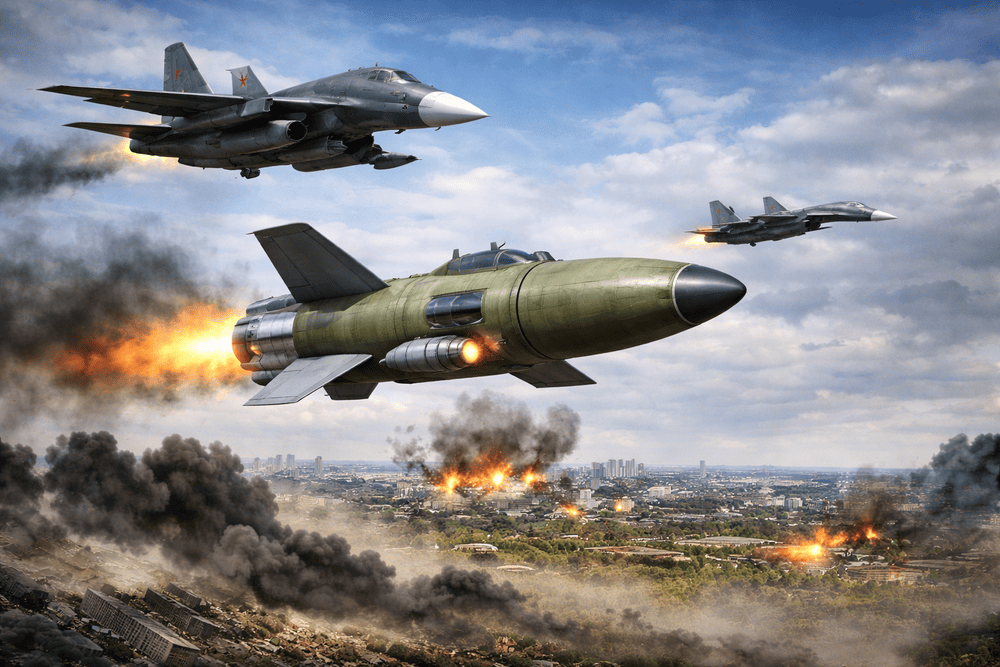
Russian strike aircraft are now dropping jet-powered glide bombs on Ukrainian targets at ranges approaching 200 kilometers, extending the reach of Soviet-era free-fall bombs with bolt-on wings, guidance units, and small turbojet engines. Ukrainian intelligence officers describe a new long-range variant entering series production, while field reports from several regions confirm the first combat use of these powered munitions in recent weeks.
Glide bombs had already become one of the most common Russian strike tools over the past year. Current Ukrainian estimates point to 200 to 250 glide bombs of all types released every day along the front, far more than air defenses can reliably intercept. Within this broader volume, a smaller batch of new powered bombs is emerging, with Ukrainian officers warning that at least 500 long-range units are planned by the end of 2025.
The powered family grows out of Russia’s UMPK concept, the “unified planning and correction module” that bolts onto conventional FAB-series bombs of 250, 500, 1,500, or 3,000 kilograms. Originally these kits provided wings, a guidance section, and a control unit, turning gravity bombs into precision weapons with glide ranges of roughly 40 to 90 kilometers, depending on bomb size and release conditions.
Russian engineers have now introduced a further development known as UMPK-PD, generally understood as an extended-range configuration, and a closely related powered bomb labeled UMPB-5R. Both have appeared in recent wreckage recovered in Ukraine. Open sources indicate that UMPK-PD is a modular kit that can work in a pure glide mode or accept a plug-in turbojet, while UMPB-5R is a complete powered guided bomb that uses similar components on a more aerodynamically refined body.
Technical features of Russia jet powered glide bombs and their range
Physical evidence obtained by Ukrainian investigators now confirms the presence of commercial turbojet engines on Russian glide bombs. In multiple cases, fragments of a Chinese-made SW800Pro-Y engine were found among wreckage, including serial markings and intact compressor sections. The engine was originally marketed for large model aircraft and unmanned systems and weighs around 9.5–10 kilograms while producing about 80 kilograms of thrust.
The powered kit identified on recent debris combines that engine with a new wing and tail assembly. Instead of a single central pop-out wing seen on early UMPK bombs, the UMPK-PD uses a larger pair of deployable wings mounted along the bomb body and a redesigned tail section. These changes increase lift and stability for longer powered flight and support the extra weight of the propulsion unit and fuel system.
Technical descriptions drawn from recovered fragments describe a compact turbojet attached under the bomb’s center or slightly aft, with fuel routed from an internal tank that replaces part of the original explosive filler. The SW800Pro-Y engine runs on aviation kerosene, turning at up to 65,000 rpm, with a rated exhaust temperature around 750 degrees Celsius and fuel consumption below 1.9 kilograms per minute. These parameters match the needs of a one-way strike munition that must fly for a few minutes at high subsonic speed.
The guidance section has evolved in parallel. According to a recent technical summary based on Ukrainian analysis of captured hardware, the newest UMPK-PD carries a Kometa-M24 navigation module with a 24-element controlled reception pattern antenna for satellite guidance, backed by a more capable inertial system. The antenna system adapts its pattern to suppress jamming signals and keep lock on navigation satellites, while the inertial unit maintains course if signals drop out for short periods.
Russian sources cited in that same analysis describe several baseline ranges. A conventional UMPK kit on FAB-250, FAB-500, or FAB-1500 bombs reaches about 40 to 72 kilometers, while heavier FAB-3000 bombs achieve roughly 50 to 60 kilometers. An aerodynamically improved glide-only variant can reach around 100 kilometers when dropped from 12 kilometers altitude at high subsonic speed. When engineers add the turbojet, Ukrainian intelligence now credits the powered bomb with a 150–200 kilometer reach.
Ukrainian officials report that the FAB-500T bomb plays a central role in the powered configuration. This 500-kilogram class weapon, developed in the Cold War for high-speed carriage on the MiG-25, uses a thermally stable casing and a slimmer body that suits long-range powered flight. Russian aircraft mount UMPK-PD or UMPB-5R kits on FAB-500T bodies, creating a weapon roughly comparable in concept to Western powered JDAM families but with a simpler layout and a smaller warhead after fuel space is taken into account.
Launch platforms remain the same Su-34, Su-35, and Su-30 tactical aircraft already used for glide-bomb missions. The powered bombs allow these aircraft to remain further from Ukrainian air defense envelopes. In some recent strikes, Ukrainian officials say the carriers launched from over Russian-controlled territory or over the Black Sea while the bombs flew in toward coastal and inland cities.
Recent jet powered glide bomb strikes and evidence from the front
Field evidence from Kharkiv, Poltava, Mykolaiv, and Odesa regions traces the initial combat employment of jet-powered glide bombs. A Ukrainian Air Force statement in October reported a strike on Lozova in Kharkiv oblast using a “jet type glide bomb” with an estimated range above 130 kilometers, launched from occupied territory. The same week, an Air Force spokesperson described another powered glide bomb routed through Kharkiv region toward Poltava oblast and called it the third documented attack with this class of weapon.
Photographs of debris from the Lozova attack showed twisted metal from a glide kit, control surfaces, and a mostly intact turbojet core. Ukrainian specialists and independent analysts matched the engine to the SW800Pro-Y type, while markings on a remaining section labeled the bomb as UMPB-5R. Reports from the site stated that the munition had flown over 130 kilometers before impact and caused injuries and structural damage in a residential area.
Another incident involved a bomb that landed in Poltava oblast on October 20 and apparently failed to detonate. Photographs published afterward showed a largely intact powered glide bomb, with the turbojet, folded wings, and bomb casing clearly visible. Analysts who reviewed the images assessed it as a powered version of the UMPK kit on a FAB-series bomb and noted close similarities with the earlier wreckage near Lozova.
Ukrainian intelligence also links the new bombs to attacks on Mykolaiv and Odesa regions. An interview with a senior official published in mid-November cited glide bomb strikes in those regions, along with Poltava, as evidence that Russian aircraft are now engaging targets far beyond the immediate front. The same official stated that a long-range bomb with a reach of up to 200 kilometers has entered mass production, with about 500 units planned.
Reports from Kharkiv prosecutors and local units suggest that the first tests of this powered configuration began slightly earlier along the southern front. A junior sergeant from a Ukrainian battalion described an attempted use near Mykolaiv on October 16, followed two days later by the strike on Lozova. In each case, Ukrainian officers noted unfamiliar debris compared with previous glide bomb attacks and highlighted the longer trajectory from launch areas deep in Russian-held territory.
Senior Ukrainian officials speaking to international media in late November drew a broader picture of the new jet-powered strike complex. They described a combination of powered Shahed-derived drones and powered glide bombs in recent large-scale raids, with both types used to probe defenses and test reaction times. One deputy minister for innovation stated that Russia appears to be “testing our defenses and our countermeasures against these new systems to assess whether mass production is worth pursuing.”
The same interviews stressed that powered weapons remain relatively rare inside the overall Russian arsenal. Ukrainian military representatives described only “isolated launches of guided glide bombs with an increased flight range” across the front and said the pattern does not yet qualify as mass employment. These statements align with the limited number of wreckage examples documented so far and with the separate indication that only a few hundred long-range bombs are planned within a much larger glide bomb program.
Production scale, foreign components and cost of Russia jet powered glide bombs
The powered glide bomb program sits inside a much larger Russian push to expand glide bomb production as a whole. A senior Ukrainian intelligence officer recently stated that Russia intends to manufacture up to 120,000 glide bombs in 2025, including both newly built weapons and older bombs upgraded with kits. Within that total, roughly 500 are expected to be the longer-range variant capable of hitting targets about 200 kilometers from the launch point.
Russian defense plants are assessed to run at high tempo for these munitions, with wartime priority and simplified designs reducing unit costs. Ukrainian analysts and military-linked commentators place the approximate cost of a FAB-500T fitted with an extended-range UMPK-PD kit at around 30,000 dollars, only slightly higher than some one-way attack drones already used by Russia. That figure is far below the cost of a modern cruise missile and well within the reach of sustained mass production.
Commercial turbojets from Chinese suppliers underpin that cost picture. The SW800Pro-Y engine used on UMPB-5R and UMPK-PD bombs is advertised on civilian sales platforms at a price in the tens of thousands of dollars per unit and is intended for hobby aircraft and unmanned systems. Earlier in the conflict, similar engines from the same manufacturer appeared on Russian improvised cruise missiles, indicating an established supply route and some level of technical familiarity on the Russian side.
Ukrainian and Western experts have questioned how far Russia can scale such imports. A senior Ukrainian minister responsible for digital transformation recently suggested that Russia faces difficulty securing large numbers of jet engines for drones and may face similar limits for bombs. One Ukrainian official involved in defense innovation described the powered drones and bombs as still “a small-enough number” and argued that Russian industry is iterating through early batches rather than already fielding a full-rate series.
Technical material compiled from captured UMPK-PD parts suggests a deliberate attempt to reduce dependence on foreign electronics inside the guidance unit. The Kometa-M24 navigation block described earlier reportedly relies on domestic Russian components in its radio-frequency front end and digital processing chain. The module can, in principle, transfer across UMPK-equipped munitions of different sizes, which supports industrial efficiency once production lines stabilize.
Within Russia’s wider strike inventory, the powered glide bomb occupies a position between mass glide munitions and more complex cruise missiles. Its range exceeds most unpowered bombs and many unguided rockets but falls short of Russia’s main land-attack cruise missiles. The warhead is smaller than that of a full-sized 500-kilogram bomb because of the fuel volume, yet still carries enough explosive to damage large buildings or infrastructure sites in a single strike.
Industry sources following Russian procurement contracts note that powered UMPK kits and UMPB-5R bombs have been discussed alongside other extended-range guided bombs such as the D-30SN family. Earlier reporting described D-30SN as a slimmer, purpose-built glide bomb with a maximum range around 120 kilometers even without a turbojet. In practice, Russian forces appear to field a mix of these systems, using glide-only weapons for nearer targets and powered kits when aircraft must remain further away from Ukrainian air defense rings.
Impact on Ukrainian air defenses and emerging countermeasures
Ukrainian air defense crews now face faster, longer-range profiles from powered glide bombs on top of the already heavy load of drones and missiles. The bombs present a small radar cross section, fly on non-ballistic paths, and arrive with relatively short warning time, especially when launched near the limit of their range. Ukrainian military statements describe successful intercepts in some cases using surface-to-air missiles, fighter aircraft, and helicopters, but acknowledge that interception rates against glide bombs remain low compared with those against ballistic or cruise missiles.
Range expansion changes the geometry of the air battle. Front-line cities that previously sat near the outer limit of glide-only UMPK strikes now fall well inside the reach of powered bombs. Ukrainian officials list October attacks on Mykolaiv, Odesa, and Poltava regions as examples of strikes at “dozens of kilometers” from the nearest front positions, with aircraft never crossing into zones where medium-range Ukrainian air defense systems could engage them.
Ukrainian defense planners have long argued that the most effective way to reduce glide bomb damage is to engage the carrier aircraft before weapon release. That logic grows stronger as bombs gain more range. Analyses in Ukrainian outlets point to the need for modern multirole fighters to patrol deeper and challenge Su-34 and other bombers over Russian-held airspace, along with denser networks of medium-range systems to threaten launch aircraft even when they remain behind the main front.
Electronic warfare offers another partial counter. The new Kometa-M24 navigation unit is designed to resist jamming, yet Ukrainian operators still report cases where glide bombs deviate or fall short after EW activity. The powered variants may benefit from the same resilience, but every additional kilometer of autonomous flight gives jammers more time to act. Ukrainian units continue to adjust their techniques, although detailed results remain classified.
Ukrainian officials are exploring jet-powered interceptor drones as a possible response to both powered drones and powered glide bombs. A senior official in charge of digital transformation confirmed ongoing research into fast unmanned interceptors intended to complement ground-based air defense and crewed aircraft. Public comments so far suggest that this effort remains in the development phase, with no evidence yet of operational deployment against powered bombs.
Our analysis shows that Russia’s jet-powered glide bomb effort has moved beyond isolated experiments into limited but real combat use, while still forming only a small share of the overall glide bomb inventory. The main risk for Ukraine lies not in the current number of powered bombs but in the combination of high daily glide-bomb usage and a production plan that includes several hundred long-range units. Tracking how fast powered variants leave the test phase and enter routine sorties will matter for both Ukrainian force planning and future assistance decisions by partner states.
REFERENCE SOURCES
- https://www.reuters.com/business/aerospace-defense/russia-plans-make-up-120000-glide-bombs-this-year-ukrainian-intelligence-says-2025-11-14/
- https://gwaramedia.com/en/russia-starts-to-use-of-jet-powered-glide-bombs-type-with-flight-range-of-over-60-80-miles-military-says/
- https://euromaidanpress.com/2025/11/15/russia-may-no-longer-need-expensive-missiles-chinese-sw800pro-y-are-modifying-existing-weapons-to-achieve-unprecedented-range/
- https://theaviationist.com/2025/10/25/russia-new-jet-powered-glide-bomb/
- https://defence-blog.com/russias-new-glide-bomb-uses-chinese-made-turbojet-engine/
- https://universemagazine.com/en/rocket-propelled-guided-bombs-russias-cheap-missiles-how-they-work-and-why-they-are-dangerous/
- https://www.twz.com/air/russia-is-now-launching-powered-glide-bombs-at-ukraine
- https://inf.news/en/military/7e153ab1180db3be68a8e71d52add08e.html
- https://militaeraktuell.at/en/russia-increases-glide-bomb-production-and-deployments/
- https://www.businessinsider.com/russia-new-jet-powered-strikes-test-ukraine-few-weapons-used-2025-11
- https://gwaramedia.com/en/russia-starts-to-use-of-jet-powered-glide-bombs-type-with-flight-range-of-over-60-80-miles-military-says/
- https://www.ft.com/content/b6d493dc-bd36-4140-bff8-c1bcdf992364