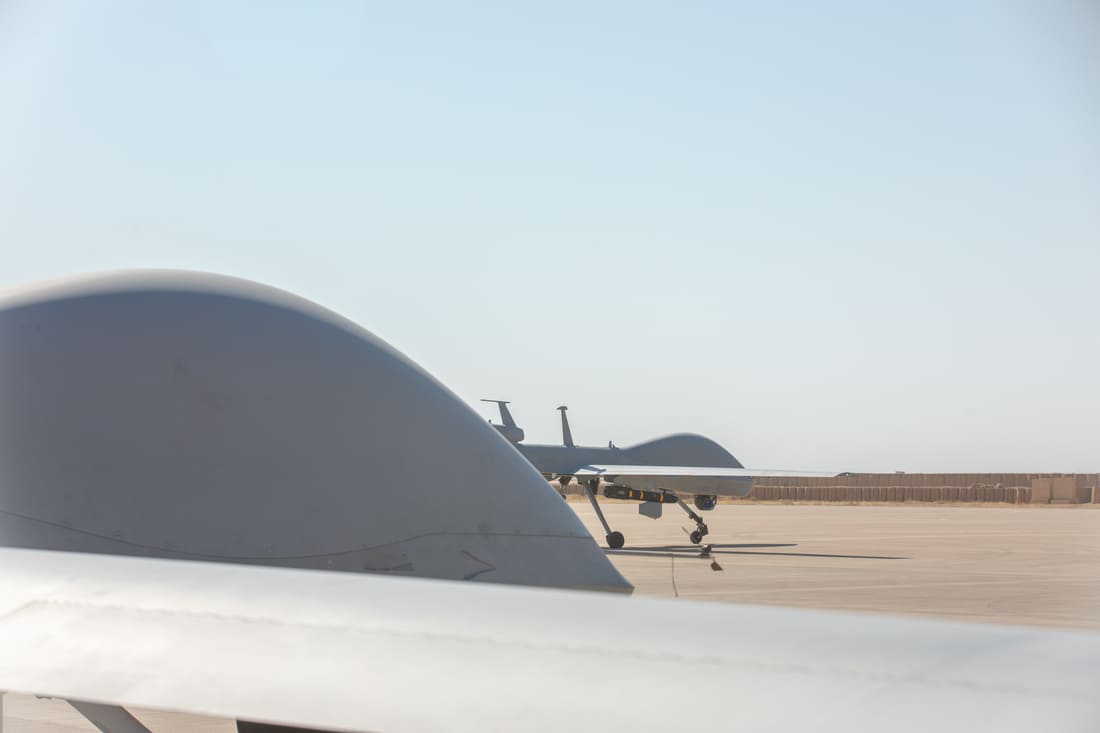
General Atomics Aeronautical Systems and Hanwha Aerospace signed a co-development and co-production agreement for a Short Takeoff and Landing version of Gray Eagle during AUSA 2025. The plan calls for a production-representative aircraft, first flight in 2027, and initial deliveries in 2028. The program builds on Mojave demonstrations and will be marketed as Gray Eagle STOL.
Partnership Structure and Production Timeline
The companies will stand up Gray Eagle STOL airframe manufacture and final assembly in South Korea. General Atomics will retain final system integration. Early builds will split work between California and Hanwha sites in Korea until the Korean line reaches full-rate output. A General Atomics spokesman said, “We are talking to a number of potential customers and anticipate new orders to arrive in parallel to standing up the production lines and building the first production representative aircraft.”
No end users were named at the signing. The partners will promote the aircraft to the U.S. military and South Korea’s Ministry of National Defense and expect interest from other export customers. According to industry sources, the sales case centers on austere-runway basing and modular payload options for maritime and land surveillance.
Program leaders on both sides pointed to new investment in Korea. “GA-ASI and Hanwha are committed to investing in this project and building development and production capabilities in South Korea,” said David R. Alexander, President of GA-ASI. “We’ll be leveraging the expertise of both companies to quickly bring the Gray Eagle STOL to global customers.” Hanwha Aerospace’s chief executive Jae-il Son stated, “Co-producing GE STOL in South Korea and the U.S. will create jobs and help Hanwha secure talent in related fields as well as foster our domestic (Korean) UAS industry ecosystem. Hanwha is poised to become a comprehensive UAS company capable of executing everything from design to production and maintenance based on our capabilities, which span from fighter jet engines to radar and avionics equipment.”
Hanwha Workshare on Engines and Avionics
Officials confirm General Atomics will keep system integration. Airframe production and final assembly will move to South Korea during line stand-up. Hanwha will supply engines, landing gear, fuel systems, avionics, and mission equipment for Gray Eagle STOL. According to people familiar with the deal, the cost-sharing split at co-development runs roughly 70:30 to fund design, tooling, and facilities for the production-representative aircraft and the Korean assembly line.
Hanwha outlined a larger capital plan for unmanned aviation that covers factory upgrades and R&D tied to Gray Eagle STOL and UAS engines. Company guidance points to spending in the hundreds of billions of won, including a paid-in capital increase to grow its unmanned systems business. The plan aligns to South Korea’s push to expand aerospace manufacturing around existing clusters.
Korean content targets guide parts planning for structures, landing gear, fuel systems, and avionics. The Gray Eagle STOL datasheet lists a 450-shaft-horsepower Rolls-Royce M250-series powerplant. Company officials have discussed local assembly or components over time to meet domestic content goals. General Atomics will keep final integration of sensors, weapons management, and datalinks to preserve configuration control inside the Gray Eagle family.
Production will ramp from the first production-representative build to low-rate output. Early aircraft will combine U.S. and Korean assemblies. The Korean line will qualify suppliers and processes in parallel. This plan holds the 2027 flight-test window and avoids reopening points already settled in the agreement.
Aircraft Specifications and Weapons Capacity
Gray Eagle STOL grows from the Mojave STOL demonstrator and the MQ-1C Gray Eagle lineage. The wing adds short-field high-lift devices and the landing gear is reinforced for rough surfaces. Company data indicates operations from very short strips with payloads the baseline Gray Eagle could not carry from unimproved sites.
Company figures indicate:
- Wingspan about 52 ft, length about 29 ft, and a 450 shp M250-series turboprop
- Maximum gross takeoff weight near 7,000 lb, useful load about 3,400 lb
- ISR takeoff runs around 400 ft. Armed loads need more runway yet still fit expeditionary strips
- Stores capacity up to 16 Hellfire-class missiles, subject to mission and runway length
The airframe adds leading-edge slats, double-slotted flaps, and drooped ailerons to boost lift at low speeds. Large low-pressure tires and long-travel shock struts handle rough-field loads. Operators familiar with Gray Eagle or Reaper ground stations will see common avionics and control architectures. The STOL wing and gear are the major changes. Payloads cover EO/IR, SAR/GMTI, and electronic surveillance within the Gray Eagle ecosystem, plus weapons on multiple hardpoints. Mojave testing also included gun pod work on a separate campaign.
The airframe reflects austere-site sustainment concepts. The aircraft can break down for transport inside a C-130-class cargo hold and reassemble quickly with a small team. Modular avionics and open interfaces support rapid payload swaps for maritime surveillance, counter-UAS, and reconnaissance.
The STOL wing trades some dash speed and certain endurance profiles for runway independence. Endurance in ISR profiles stays above a day at lighter gross weights. Armed endurance scales to weapons and short-strip requirements. Departures from 100-meter-class strips for sensor sorties, and a few hundred meters for armed loads, expand options near front lines or along coasts.
Navy Trials and Export Strategy
Mojave conducted at-sea trials with the Republic of Korea Navy in November 2024. The aircraft took off from the amphibious assault ship ROKS Dokdo during a steaming run off Pohang and then recovered ashore. Earlier trials included a British carrier deck and multiple rough-field sorties in the United States. The Dokdo trial covered deck handling, launch procedures, and control-link performance in local waters. Defense officials confirm Seoul continues to study embarked unmanned aviation on large-deck amphibs, and the Mojave-to-Gray Eagle STOL sequence fits that work.
Basing flexibility supports dispersed operations on land and at sea. Korean operators could stage from improvised strips on islands or coastal areas and cycle aircraft through nearby decks or airfields. That profile supports maritime chokepoint patrols, amphibious overwatch, and coastal counter-drone defense. Land forces can task the same aircraft for border surveillance or strike overwatch from temporary strips. The partners point to MUM-T with helicopters and ground units, using the aircraft as a remote sensor and weapons carrier under manned control.
The commercial argument leans on commonality inside the Gray Eagle family and a demonstrator that already flew rough-field and deck operations. A Korean final assembly line shortens lead times for regional buyers and meets domestic content goals. The signed agreement did not name a launch customer. The partners plan to market the production standard to the United States and South Korea first, then to export customers after the line is active.
Production Schedule and Korean Localization
Hanwha’s investment plan includes funds for Gray Eagle STOL work and UAS engines, a paid-in capital increase, and facility upgrades for serial manufacture and supplier onboarding. Program sources describe staged localization. Korean suppliers will take on more structure and subsystem content after initial low-rate production to stabilize spares and reduce cost for domestic users.
Our analysis shows the co-production model and the STOL configuration cut deployment risk for users who need persistent ISR and strike from short or improvised surfaces. Mojave flight records reduce uncertainty on dirt-strip and large-deck operations. Gray Eagle family ties shorten the route for training, control stations, and weapons integration. The 2027 first flight and 2028 deliveries keep a tight progression from demonstrator to product.
Officials in Seoul have discussed unmanned systems to extend patrol coverage without building new runways. The Dokdo takeoff validated local deck procedures, and the sea service keeps studying embarked UAV options for upgraded amphibious ships. Shared baselines could let air and sea components draw from common spares and training pipelines. Modular payloads and open interfaces should let Korea rotate sensors across maritime and land roles without separate fleets.
General Atomics plans to keep integration and certification aligned to existing Gray Eagle standards, which simplifies weapons clearance and datalink compatibility. Hanwha’s roles on engines, avionics, and mission equipment build supply depth in Korea and leave room for domestic mission kits. The cost-sharing structure puts both firms on the hook for development and for standing up the assembly line. Low-rate production will validate structural margins, wing-store behavior, and short-strip performance for ISR and armed loads.
Program materials present austere basing as the core advantage. ISR departures from very short surfaces at lighter weights, then recovery to the same site after refuel and rearm, keep the aircraft close to supported units. Armed overwatch from short expeditionary runways moves loiter time and magazine depth forward. Company cites 12-missile takeoffs around 1,000 ft. Sixteen-missile loads require longer strips or staged plans. Payload options include EO/IR and SAR/GMTI with provisions for electronic support and maritime sensors suited to peninsular and near-sea missions.
The production-representative configuration carries Mojave’s wing and gear concept into a series build. Access panels, structural joins, and wiring looms will be adapted for rate and maintenance access. The Korean line will qualify composite layup, machining, and landing-gear assembly with local vendors. General Atomics keeps final steps that bind sensors, weapons management, and datalinks to preserve software baselines across Gray Eagle blocks.
REFERENCE SOURCES
- https://breakingdefense.com/2025/10/general-atomics-hanwha-to-produce-gray-eagle-drone-in-south-korea/
- https://www.ga.com/ga-asi-and-hanwha-finalize-deal-to-produce-gray-eagle-stol-uas
- https://www.ga-asi.com/ga-asi-and-hanwha-finalize-deal-to-produce-gray-eagle-stol-uas
- https://www.hanwha.com/newsroom/news/press-releases/hanwha-aerospace-signs-contract-with-ga-asi-for-uas-co-development.do
- https://m.hanwhaaerospace.com/eng/media/newsroom/view.do?seq=565
- https://www.janes.com/osint-insights/defence-news/air/ausa-2025-hanwha-aerospace-ga-asi-plan-to-develop-gray-eagle-stol-uav
- https://www.navalnews.com/naval-news/2024/11/rok-navy-tests-mojave-drone-aboard-roks-dokdo/
- https://www.overtdefense.com/2024/11/14/general-atomics-mojave-makes-first-flight-from-south-korean-dokdo-amphibious-assault-ship/
- https://www.unmannedsystemstechnology.com/partner/general-atomics-aeronautical-systems/gray-eagle-stol/
- https://www.ga-asi.com/remotely-piloted-aircraft/pdf/2410_GRAY_EAGLE_STOL_E.pdf
- https://www.twz.com/air/general-atomics-gray-eagle-stol-drone-will-be-made-in-korea
- https://defensenews.com/air/2025/10/14/general-atomics-hanwha-to-work-on-short-takeoff-version-of-gray-eagle/