First Sea Lord General Sir Gwyn Jenkins told industry and allies at DSEI in London that the Royal Navy will follow a clear rule from now on: “uncrewed wherever possible; crewed only where necessary.” He set a four-year target to restore war-fighting readiness, outlined a plan to field uncrewed escort ships alongside frigates within two years, and said carrier aviation will shift to a hybrid air wing by the end of the decade. He kept nuclear deterrence at the top of the priorities list and noted the strain of an aging surface fleet kept in service twice as long as intended
Royal Navy Unmanned Rule and Near-Term Targets
Jenkins used his first public speech as First Sea Lord to tie plans to timelines. The principle – uncrewed when possible, crewed only when necessary – now guides choices across surface, subsurface, and carrier aviation. He paired it with a four-year readiness mandate and asked industry to speed deliveries so the fleet can add mass with a blend of platforms.
The plan includes a jet-powered carrier-capable drone as a concept demonstrator next year. It links to a “hybrid air wing” by the end of the 2020s, mixing crewed and uncrewed aircraft rather than treating drones as bolt-ons. He tied those changes to the next UK Carrier Strike Group deployment to the Indo-Pacific, where the air wing should look “almost unrecognisable” compared with today.
Uncrewed surface escorts are slated to work with frontline warships. Jenkins described a Type 26 frigate escorted by two uncrewed ships that add sensors, decoys, and weapon capacity and can maneuver in concert using AI. He aims to have the first of these escorts sailing with Royal Navy ships within two years, then scale across the fleet. Service communications after the speech repeated the same target and tied it to North Atlantic employment.
He set the context on fleet age. Type 23 frigates have been extended to roughly twice their planned life, which narrows maintenance headroom and forces careful sequencing of modernization work. That is why the Navy wants to add uncrewed mass quickly while it replaces frigates.
Defense officials confirm the next Indo-Pacific Carrier Strike Group deployment will feature uncrewed vessels in logistics, ISR, and force protection roles, consistent with the DSEI brief and follow-on statements.
Carrier Strike, Hybrid Air Wing and Drones Entering Service
Carrier aviation has moved past trials on paper. In 2023 the Royal Navy flew the Mojave short-takeoff drone from HMS Prince of Wales, a first for a system of that size from a British deck. The trial used shipboard control stations and needed no catapult or arresting gear, which lowered risk and sped up deck-crew learning. The service is now signaling a jet-powered collaborative platform demo at sea as early as next year to push the tempo.
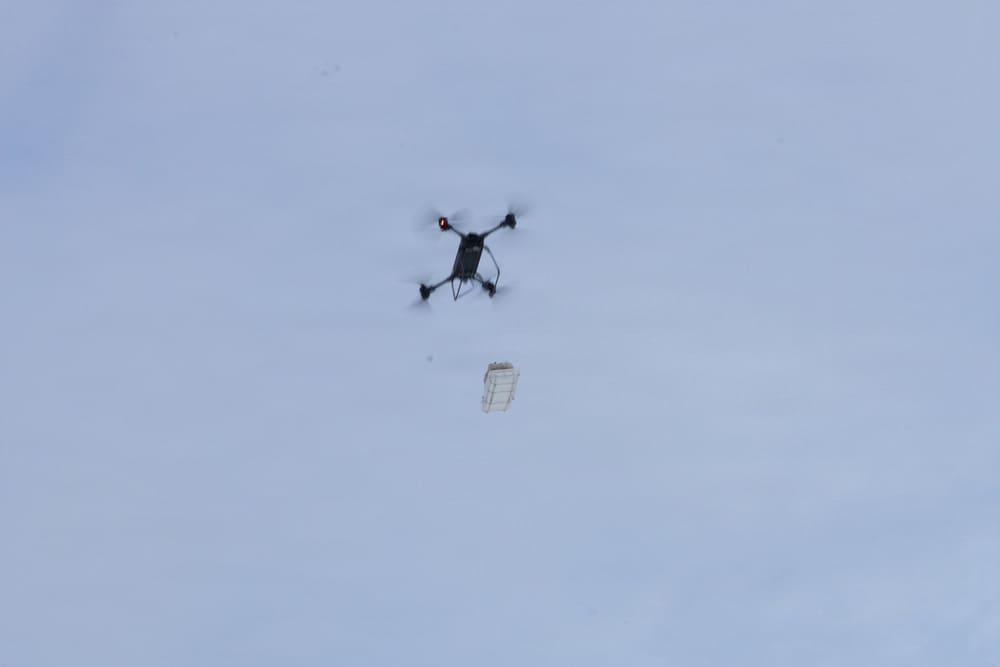
Two drone systems have been cleared for front-line use since DSEI week. The Malloy T-150 will carry ammunition, water, and medical supplies to Royal Marines in rough terrain and adverse weather, with release-to-service after Arctic and Indian Ocean evaluations. The Peregrine rotary-wing UAS – built around the Schiebel airframe with Thales iMaster radar – has entered service to extend shipborne surveillance beyond the horizon and has supported counter-narcotics patrols. Both now sit on the Navy’s books as deployable kit, not trials gear.
Logistics at sea also crossed a first. During the 2025 carrier strike deployment, T-150 conducted ship-to-ship resupply between HMS Prince of Wales and HMS Dauntless. That unmanned hop helps daily operations in dispersed groups, where a small quad-eight-rotor platform can move minor parts and medical items without tying up a helicopter.
Jenkins’s “hybrid air wing” goal blends F-35B, Merlin, Wildcat, and several uncrewed types by decade’s end. According to industry sources the near-term candidates include a jet drone for deck handling trials, continued logistics drones, and a rotary UAS for persistent maritime ISR, all sized to fit within existing hangar and mission bay constraints on the Queen Elizabeth class. The mix aims to cut surveillance gaps, free manned helicopters for ASW, and keep pilots focused on strike and complex missions.
Service messaging places part of the carrier plan in the Indo-Pacific. The next expeditionary CSG aims to sail with a package of uncrewed systems embarked across the group. Public material points to fusion of crewed and uncrewed platforms rather than one-off trials, with surface and subsurface autonomy augmenting the outer screen.
Atlantic Bastion, Subsurface Autonomy and Uncrewed Escorts
The North Atlantic anti-submarine fight sits at the heart of the plan. Jenkins introduced “Atlantic Bastion,” a layered construct from the Mid-Atlantic Ridge to the Norwegian Sea that networks crewed and uncrewed host platforms and places distributed sensors in the water. Initial Bastion sensors are planned for next year, with the aim of detecting, tracking and if required acting against threats.
The XLUUV developed under Project Cetus was formally unveiled and named Excalibur in May. At 12 meters long and about 19 tonnes displacement, Excalibur is the largest uncrewed underwater vessel the Navy has trialed. It is a testbed for long-endurance patrols, seabed warfare payloads, and remote operation concepts aligned with AUKUS Pillar II cooperation. Public releases show the Navy moving through shore-based integration and sea trials during 2025.
Uncrewed surface escorts sit on a parallel track. The First Sea Lord’s DSEI speech described a near-term configuration in which a Type 26 deploys with two uncrewed escorts that extend sensor reach and decoy options. The Navy’s follow-up note underlined the goal to have the first escort ships sailing with the fleet within two years.
The concept treats these craft as a force multiplier that can assume patrol arcs, screen duties and deception tasks without adding crew billets. Uncrewed escorts allow risk-forward behavior when ships need to probe contact lanes or sit inside a threat weapon ring. They also provide a way to add mass around a high-end frigate without building another frigate.
Defense officials confirm the early use cases will concentrate on ISR pickets, decoy carriage, and communications nodes with limited weapons trials to follow.
Nuclear deterrence remains priority one. Jenkins listed “nuclear, innovation, leadership, agility” as immediate focuses and tied the deterrent to a whole-force effort across SSBNs, infrastructure, and protection forces.
Type 23 Life Extension and Type 26 Replacement Path
Fleet age pressures now carry numbers. Many Type 23s have been kept on to about twice their intended life, a point Jenkins made explicitly. That strains maintenance cycles and availability and forces careful choreography to avoid gaps in escort numbers. The replacement arc relies on eight anti-submarine Type 26 frigates entering service across the 2020s and 2030s, with the last Type 23s planned to leave by the mid-2030s. The reported target inside industry coverage is 2035 for the final Type 26 takeover of that role.
The Type 26 industrial base sits in Glasgow with modules moving through Govan and Scotstoun. Export momentum adds workload and supply-chain stability after Norway selected the design for at least five ships in a package valued at around £10 billion, the UK’s largest warship export deal. Government messaging tied to the announcement says this does not alter Royal Navy hull deliveries, while it anchors a bigger user community across northern waters.
According to industry sources, the surface plan assumes a staged handover of tasks as the Type 26 class builds out and as uncrewed escorts begin basic duties. That approach follows the mine countermeasures shift from legacy ships to autonomous kits while retaining core crews and expertise.
The carrier force remains the shop window for the hybrid model. Trials on HMS Prince of Wales demonstrated deck handling, launch, and recovery for a medium-weight UAS, and the Navy is committing to a jet-powered demonstrator off a Queen Elizabeth-class deck next year. Defense officials confirm the goal is a repeatable process, not a one-off stunt, and to align the air wing with the next Indo-Pacific deployment cycle.
REFERENCE SOURCES
- https://www.gov.uk/government/speeches/first-sea-lord-general-sir-gwyn-jenkins-speech-at-dsei-2025
- https://www.royalnavy.mod.uk/news/2025/september/11/20250911-first-sea-lord-outlines-future-of-the-royal-navy-at-dsei
- https://www.defensenews.com/global/europe/2025/09/10/uk-navy-fleet-rebuild-will-prioritize-unmanned-systems-chief-says/
- https://www.royalnavy.mod.uk/news/2025/september/11/20250911-double-drone-announcement-royal-navy
- https://www.ga-asi.com/ga-asi-demonstrates-short-takeoff-landing-of-uas-on-uk-carrier
- https://www.navylookout.com/mojave-uncrewed-air-system-successfully-flown-from-hms-prince-of-wales/
- https://www.navalnews.com/event-news/dsei-uk-2025/2025/09/uk-royal-navy-chief-aims-at-autonomy-to-drive-warfighting-scale-and-readiness/
- https://news.usni.org/2025/09/09/next-u-k-pacific-carrier-deployment-will-feature-unmanned-ships-in-strike-group-says-first-sea-lord
- https://ukdefencejournal.org.uk/royal-navy-to-launch-jet-powered-carrier-drone-next-year/
- https://www.royalnavy.mod.uk/news/2025/may/15/20250515-uncrewed-submarine-naming-ceremony
- https://www.navalnews.com/naval-news/2025/05/royal-navy-names-cetus-xluuv-after-excalibur/
- https://www.naval-technology.com/news/royal-navy-name-project-cetus-xluuv-excalibur/
- https://www.ft.com/content/23160153-fc98-46ab-8d7b-8ed3fa85952c
- https://www.theguardian.com/business/2025/aug/31/norway-signs-10bn-deal-for-anti-submarine-warships-built-in-uk