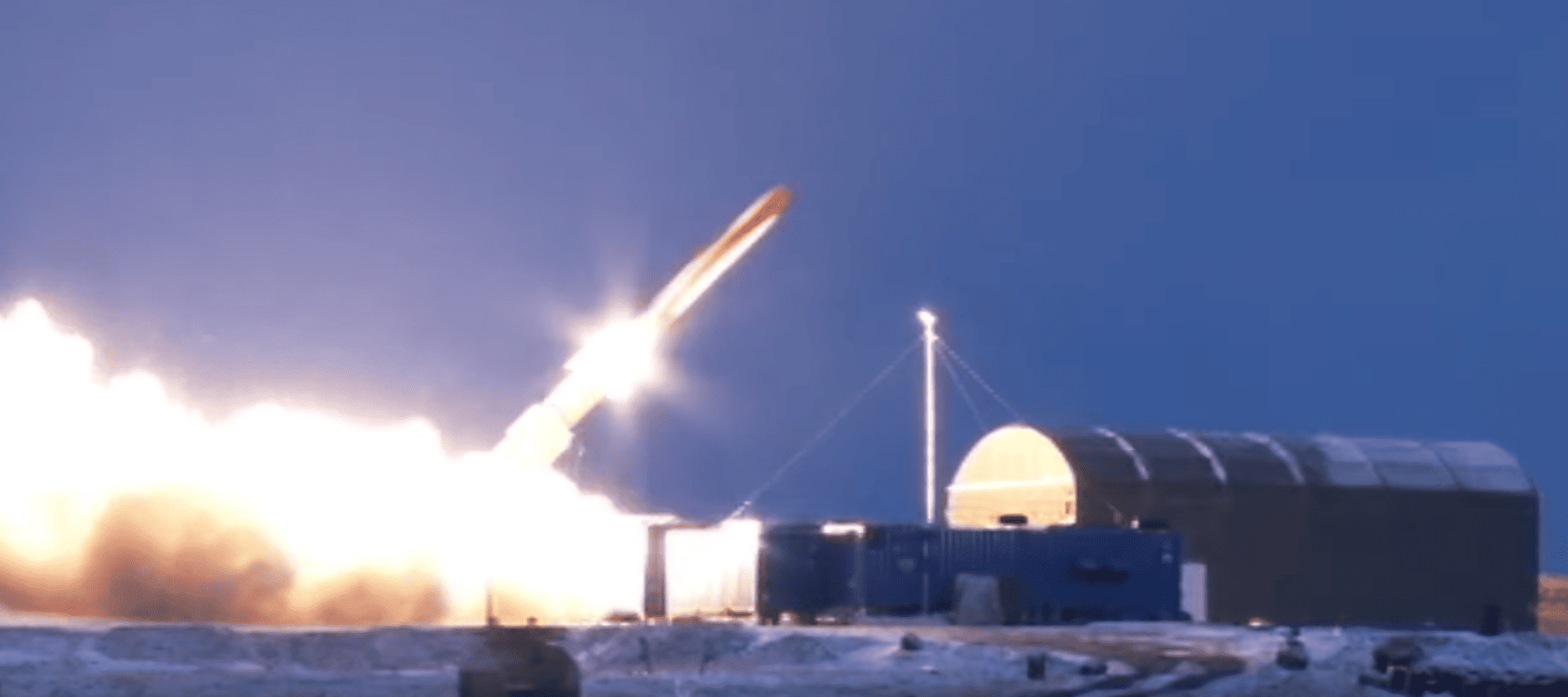
Russia’s leadership announced a new long-range flight for the 9M730 Burevestnik (Skyfall) on Oct 21, describing a subsonic cruise of about 14,000 kilometers in roughly 15 hours. The briefing ran on camera and signaled a push toward preparation for service. No telemetry, downrange imagery, or independent tracking data accompanied the claim.
Russia Claims 14,000-km, 15-hour Burevestnik flight on Oct 21, 2025
Valery Gerasimov briefed Vladimir Putin on a flight he called successful. He said the missile “was in the air for about 15 hours,” and added, “this is not the limit.” He also described vertical and horizontal maneuvers, arguing the vehicle can route around air and missile defenses. The numbers-14,000 kilometers, 15 hours-match the range and endurance Russia has advertised for years when describing this project.
Putin tied the update to promises first made in 2018, when the Kremlin introduced several strategic systems together. “The decisive tests are now complete,” he said in the filmed exchange. The line implies the design has reached a performance goal that earlier critics inside Russia thought impractical in the near term. Moscow again cast the concept as a counter to layered missile defense, emphasizing unpredictable routing and endurance rather than speed.
Public reaction from Washington focused on timing and purpose. The U.S. President called the test “not appropriate” and urged an end to the war in Ukraine “instead of testing missiles,” pointing to U.S. submarines as a constant deterrent. The response did not contest the launch window but avoided crediting the distance or duration. Russian officials answered that decisions would follow national interests. Officials confirm the announcement landed during a week of strategic drills, which helped amplify the message at home and abroad without committing to a production schedule.
Russia claims a nuclear powerplant sustained subsonic cruise for about 15 hours. Russia claims the vehicle maneuvered vertically and horizontally. Russia claims distance near 14,000 kilometers. No independent radar track, downrange imagery, or debris field has been presented to verify those points. According to industry sources who monitor Arctic range activity, the way Moscow staged the briefing suggests it wanted the flight to be seen as a threshold event even if formal acceptance trials still lie ahead.
Novaya Zemlya Launch and Radiation Monitoring
Norway’s intelligence chief, Vice Admiral Nils Andreas Stensønes, told press that Russia launched the missile from Novaya Zemlya in the Arctic. His office did not publish telemetry but offered the first public Western confirmation of the range. That statement helped settle the location question after Moscow left the site unnamed in its initial remarks.
Radiation monitoring posts in Norway reported no abnormal readings in the days after the claimed flight. The country expanded its northern monitoring network this autumn, which improved coverage over the Barents and Kara Sea approaches. Officials confirm there were no spikes at fixed stations during the window of interest. The absence of a signal does not speak to range or accuracy. It does suggest either controlled handling, a reactor configuration that did not vent detectable by-products along Norwegian corridors, or wind conditions that kept any release away from the network.
Air and sea safety notices pointed to live-fire risk areas around Novaya Zemlya on Oct 21. Aviation and maritime warnings mapped wide boxes on both the Barents and Kara sides of Yuzhny Island. Those boxes matched previous seasons when the same archipelago supported long-range tests. According to industry sources who track polar shipping, several familiar support vessels worked the region before and after the window, including ships built to carry radioactive materials. That traffic picture aligns with a launch from a shore site, a circuit contained over Arctic waters, and a recovery or termination plan close to the archipelago.
Allied aircraft operated in the high north earlier in the season. WC-135 missions in August and September helped establish background baselines. No public lab reports tied to the Oct 21 window have been released. Regional authorities repeated the standard caveat that atmospheric transport can delay detection or push any trace away from existing stations, yet their open statements still read as “no anomaly observed.”
Program History and Safety Record
The nuclear cruise idea is not new. The United States explored a similar approach in the 1960s under Project Pluto, building nuclear ramjet reactors for a concept called SLAM. Ground tests proved a compact reactor could heat incoming air and generate thrust. The program stalled because a flight test would have spewed radioactive exhaust over any flight route and because safer and simpler strategic options took the lead. Engineers also wrestled with shielding. Full shielding adds mass and erodes performance. Minimal shielding reduces mass but increases risk to crews on the ground and, in war, to any region under the flight route.
Russia has its own safety record in this space. In 2019, an explosion near Nyonoksa on the White Sea killed Rosatom specialists and caused a brief radiation uptick in Severodvinsk. Moscow acknowledged a nuclear-related accident without naming the device. Open reporting tied the work to recovery or handling of a test article for this class of system. The episode hardened the way Norway, Finland, and others read activity out of Novaya Zemlya and the White Sea, and it continues to drive how local agencies prepare for future tests.
The current claim of a 15-hour nuclear-powered flight raises practical questions that matter even in a successful test. A test article without a live warhead still carries a reactor. At the end of a mission, the team must either recover the vehicle at sea using ships built for radioactive cargo or manage a land impact under strict controls. The Arctic complicates both options. Ice, daylight cycles, and weather narrow the days that crews can work safely. Russia has added equipment and specialized vessels to shorten the recovery schedule. A faster handoff reduces the chance of loss and gives the program a cleaner data loop between flights.
Accuracy remains the blind spot. Gerasimov spoke of “guaranteed accuracy against highly protected targets at any distance,” then described maneuvers intended to bypass defenses. No public evidence has shown an end-game profile, seeker behavior, or a representative terminal shot against a defended aim point. The American SLAM concept used multiple nuclear warheads and relied on sheer destructive power rather than precision. It is not clear whether Skyfall will pursue a single heavy payload, a modular package, or a smaller nuclear device. Russian media carried claims that a warhead surrogate flew in the latest test, which would be consistent with checking fuzing and mass properties, yet official briefings did not show recovered hardware, downrange impact footage, or detailed telemetry.
Command and control raises its own questions. A missile that can stay aloft for many hours needs a reliable two-way link and a clear set of rules for aborts, retargeting, and end-of-flight choices under stress. The longer the flight, the more chances for link interruptions and confusion over who holds release authority. No open material lays out those procedures, and none should, but the unanswered questions explain why outside observers keep asking for more than range and endurance claims.
Strategic Assessment and Detection Challenges
Public indicators around Pankovo on Yuzhny Island lined up for a launch window in late summer and early autumn. Rail-type launchers under retractable covers have appeared in earlier imagery from this site. Temporary structures and traffic into Rogachevo airfield signaled preparations similar to previous cycles. Maritime data showed repeat appearances by nuclear logistics vessels on both sides of the Matochkin Strait. Notice windows for aviation and shipping were broad, which fits either a racetrack pattern over the archipelago or a set of contingency boxes for a longer swing. Officials confirm the Oct 21 date and the Novaya Zemlya location; they have not put forward confirmation of the claimed 14,000-kilometer distance.
The Russian sequence paired the Skyfall update during strategic nuclear drills the same week. The government has done this before, pressing new system news and triad activity into the same news cycle. The approach increases attention at low cost. It also places the story inside a deterrence narrative without tying it to treaty numbers or counting rules. Moscow has described Skyfall as one answer to expanding missile defense networks. Endurance and circuitous routing support that story. A slow, low cruise profile can slip around some ground radars, especially across sparsely covered arcs, but it also spends a long time inside the defender’s sensor volume. In that time, airborne and space-based sensors can search for a low, persistent heat source and for long, thin motion tracks over water or ice.
Detection and engagement challenges cut both ways. A nuclear-powered cruise missile does not need fuel stops, yet it must manage navigation across magnetic anomalies and over sea ice where scene matching and terrain references get tricky. It must keep a clean data link over the pole, or carry rules for autonomous re-route and termination. Defenders gain chances to spot it as hours go by, but they must cover wide arcs to avoid gaps. The balance today favors the country that can keep a stable track from multiple sensors and hand that track to shooters. According to officials in allied capitals, investment into wide-area, low-altitude tracking from space and from long-endurance aircraft continues against this exact problem set.
The industrial side inside Russia shows more muscle than in earlier cycles. The Novaya Zemlya complex has improved in three areas this year-lift into Rogachevo, on-site handling at Pankovo, and maritime recovery capacity. The result looks like shorter gaps between events. That kind of cadence matters for a program that has to collect real flight hours to prove reliability, to map out reactor behavior under varied weather, and to validate guidance over featureless ice. None of those points confirm the headline range claim, but they do point to a program that now has the scaffolding to run repeated flights without improvised workarounds.
Quotations from principals remain direct. Putin said, “The decisive tests are now complete.” Gerasimov told him, “The missile was in the air for about 15 hours… this is not the limit.” The U.S. President addressed Putin in remarks carried by U.S. media: “You ought to get the war ended … instead of testing missiles.” Norway’s intelligence chief said: “We can confirm that Russia has conducted a new test launch of the long-range cruise missile Skyfall Burevestnik on Novaya Zemlya.” Those lines capture the positions on each side without extra gloss.
The strategic picture will hinge on whether Russia can prove repeatable flights under varied conditions and whether it can publish or leak convincing evidence of guidance performance. Work on space-based layers meant to spot low-flying aircraft and cruise missiles continues, including testbeds already returning useful data in polar latitudes. If those layers reach operational readiness, the value of endurance and clever routing drops, though it does not disappear. If those layers lag, a nuclear-powered cruise missile that can wait in the air and come from an unexpected vector forces planners to keep more assets on alert, from maritime patrol aircraft to distributed radars.
Russia’s domestic signals point to preparation for deployment infrastructure rather than immediate fielding. Putin said, “We need to determine the possible uses and begin preparing the infrastructure for deploying this weapon in our armed forces.” That choice of words fits a project moving toward a basing and training concept, not a weapon already in units. The most likely near-term option is a limited series of articles for continued trials out of Novaya Zemlya, plus a small logistics fleet staged in the north and a training syllabus built around long-range navigation and recovery.
The unanswered environmental questions will not fade. A reactor that flies through open air and then crashes or even splashes under control still demands procedures that protect recovery crews and coastal populations. Norway’s network did not see a spike after Oct 21. That single result is reassuring only for that single event. Regional agencies will keep their sampling cadence up as long as Russia runs shots out of the archipelago, because a one-off clean reading cannot carry over to the next flight.
The policy debate outside Russia circles back to simple tradeoffs. If endurance and route flexibility are the core advantages, defenders will invest in persistence and coverage. If Moscow seeks to complicate defense planning through a unique threat vector, allied staffs will aim to fold Skyfall into existing cruise missile defense playbooks rather than build bespoke systems. The most effective answer is a sensor arrangement that watches the surface layer over the seas north of Norway and north of Alaska, paired with aircraft that can hold a contact until ground-based shooters can take the handoff.
Russia has the political incentive to keep Skyfall in the headlines. It is a prestige project, and it helps argue Moscow’s case that missile defense can be outflanked by endurance and clever routing rather than sheer speed. Our analysis shows the technical work ahead looks straightforward but hard: fly more, recover cleanly, prove guidance, and publish enough evidence to move outside audiences from suspicion to acceptance. Until then, the story rests on official claims, a confirmed range, a quiet radiation network, and a thicker support footprint in the Arctic.
REFERENCE SOURCES
- https://www.reuters.com/world/china/russia-tested-new-nuclear-powered-cruise-missile-top-general-says-2025-10-26/
- https://www.reuters.com/business/aerospace-defense/what-is-russias-burevestnik-missile-2025-10-26/
- https://apnews.com/article/dd6a424d6c545ad42848416b77e93619
- https://www.pbs.org/newshour/world/putin-says-russia-has-tested-a-new-long-range-nuclear-capable-missile-that-can-evade-defenses
- https://news.sky.com/story/vladimir-putin-tests-new-invincible-nuclear-powered-missile-13457838
- https://www.themoscowtimes.com/2025/10/26/putin-says-russia-successfully-tested-burevestnik-nuclear-powered-missile-a90932
- https://www.reuters.com/business/aerospace-defense/trump-says-putin-should-end-ukraine-war-not-test-missiles-2025-10-27/
- https://www.reuters.com/business/aerospace-defense/kremlin-trump-criticism-missile-test-russia-is-guided-by-its-own-interests-2025-10-27/
- https://www.theguardian.com/world/2025/oct/27/russia-cruise-missile-test-trump-putin
- https://www.twz.com/nuclear/skyfall-nuclear-powered-cruise-missile-long-range-test-claimed-by-russia
- https://www.reuters.com/world/europe/norway-says-russias-burevestnik-missile-was-launched-novaya-zemlya-2025-10-27/
- https://www.dagbladet.no/nyheter/bekrefter-russisk-missiltest/83776232
- https://thebarentsobserver.com/security/no-radiation-measured-in-norway-after-putins-burevestnik-missile-allegedly-flew-14000-km/439340
- https://www.arctictoday.com/norway-opens-worlds-northernmost-permanent-radiation-monitoring/
- https://en.wikipedia.org/wiki/Project_Pluto
- https://en.wikipedia.org/wiki/Nyonoksa_radiation_accident
- https://www.reuters.com/world/europe/putin-appears-ready-test-new-missile-he-prepares-trump-talks-researchers-say-2025-08-13/
- https://www.newsweek.com/us-nuclear-weapons-russia-wc135r-air-force-murmansk-novaya-zemlya-burevestnik-2109490