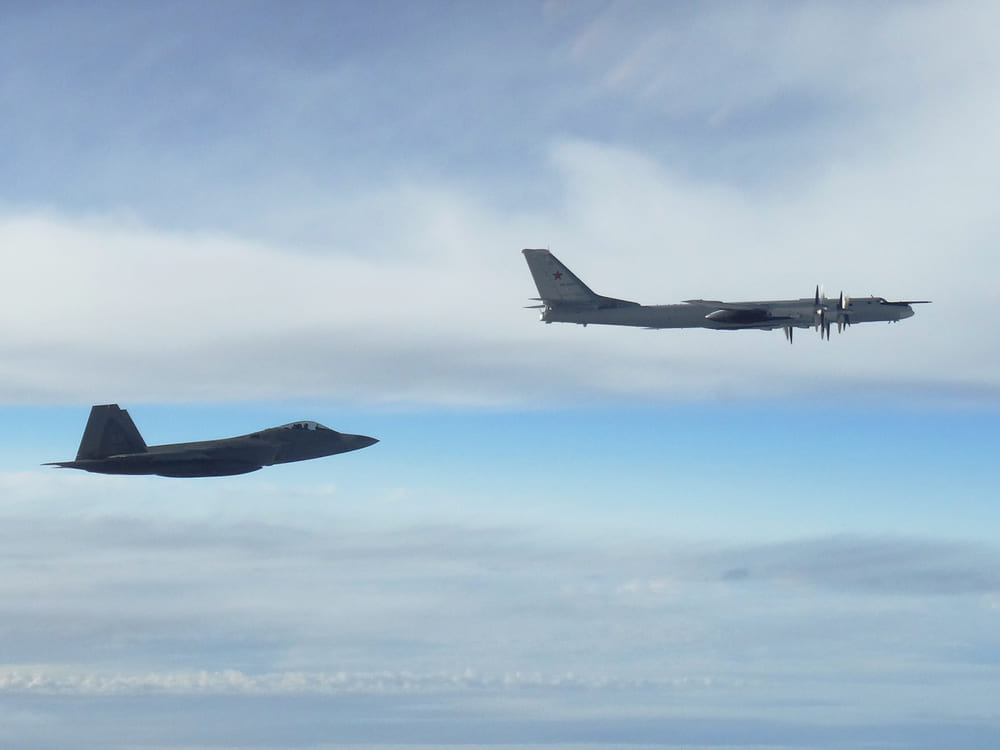
Japan and South Korea launched fighter jets Tuesday after Chinese and Russian military aircraft flew a coordinated patrol over international waters. Japan’s defense authorities tracked Russian Tu-95 bombers moving from the Sea of Japan into the East China Sea. The aircraft linked up with Chinese H-6 bombers and continued into the Pacific off Shikoku. South Korea’s military reported entries into its Air Defense Identification Zone, or KADIZ, and said it sent fighters up as a precaution.
Japan reports Tu-95 and H-6 joint flight off Shikoku
Japan’s Joint Staff Office said two Russian Tu-95 bombers flew from the Sea of Japan into the East China Sea, merged with two Chinese H-6 bombers, then continued on what it called a “long-distance joint flight” into the Pacific Ocean off the coast of Shikoku.
Japanese air defense units scrambled fighter aircraft, the ministry said. Japan reported no entry into its territorial airspace in its initial release.
Japanese Defense Minister Shinjiro Koizumi later wrote that the joint operations were “clearly intended as a show of force against our nation, which is a serious concern for our national security.” He added Japan’s fighter jets “strictly implemented air defense identification measures.”
The Joint Staff map placed the main bomber track along a route that moved south through the island chain and then eastward into the Pacific. The report described the activity as running from morning into the afternoon.
Japan reports J-16 escorts near Okinawa and Miyako
Japan’s Joint Staff said four Chinese J-16 fighters joined the bomber formation when it flew back and forth between Okinawa Island and Miyako Island. The Miyako Strait lies between Okinawa and Miyako and serves as a corridor between the East China Sea and the Pacific. The ministry did not say how close the combined formation came to Japan’s airspace limits during those passes.
Japan’s report also listed Russian aircraft operating farther north at the same time. Japan said it observed one Russian A-50 airborne early warning and control aircraft and two Russian Su-30 fighters in the Sea of Japan. The report treated that activity as separate from the bomber route to the south.
According to industry sources familiar with regional routing and standard intercept practices, the Okinawa to Miyako corridor draws close monitoring because it sits near a main passage from the East China Sea to the open Pacific. Those sources said escort fighters often attract added scrutiny there, since the corridor sits near busy civilian and military routes. Japan’s public notice spelled out the fighter count and tied it to a specific leg of the patrol.
Russian state outlets, citing the Russian defense ministry, said the joint patrol lasted about eight hours. The Russian side did not publish a flight path. It also did not detail aircraft counts in its brief public summaries.
South Korea reports nine aircraft entered KADIZ
South Korea’s Joint Chiefs of Staff said Tuesday that two Chinese military aircraft and seven Russian aircraft “successively entered the KADIZ at around 10 a.m.” The JCS said it dispatched Air Force fighters in preparation for “a possible accidental situation.” The aircraft did not violate South Korean airspace, the JCS said.
South Korean officials said the aircraft moved in and out of the KADIZ for about an hour before leaving the zone. One JCS official said the aircraft included bombers and fighters and entered intermittently during that period.
KADIZ is an identification zone, not sovereign airspace, and South Korea expects approaching aircraft to identify themselves when entering it. Russia has disputed the concept in the past and argues the zone lacks a basis under international law. South Korean authorities continue to apply it as part of routine air defense procedures.
South Korean reporting tied parts of the track to waters east and south of the peninsula. One account said Russian aircraft entered near Ulleung Island and Dokdo, while Chinese aircraft entered near Ieodo. Ieodo, a submerged rock south of Jeju Island, sits under overlapping air defense zones claimed by Seoul and Beijing. South Korean officials said the two sides regrouped near Tsushima Island before departing.
Defense officials confirm South Korea detected the aircraft before they entered the identification zone. They said fighters launched to cover contingencies, not because any aircraft crossed into sovereign airspace.
The next day, Seoul delivered what the defense ministry called a “stern protest” to Chinese and Russian defense attaches in Seoul. Lee Kwang-suk, director general of the ministry’s international policy bureau, delivered the protest. The ministry quoted Lee as saying, “Our military will actively respond to aircraft activities from neighboring countries in the KADIZ in compliance with international law.”
China calls the mission the 10th joint strategic air patrol since 2019
China’s defense ministry issued its own statement Tuesday and described the mission as the 10th joint strategic air patrol with Russia since 2019. The ministry said the patrol took place over the East China Sea and the western Pacific and followed an annual cooperation plan between the two militaries. China did not address Japan’s flight-path description or the escort details cited by Tokyo.
The patrol came days after a separate dispute between Japan and China over reported radar targeting near Okinawa. Japan said Chinese carrier-based fighters from the aircraft carrier Liaoning locked radar on Japanese aircraft during a weekend encounter over international waters. China rejected Japan’s account and said Japanese aircraft interfered with Chinese training.
Japanese authorities said they monitored Liaoning’s movements and observed frequent takeoffs and landings during the carrier’s recent activity near Japan’s southwestern islands. Chinese authorities maintained the carrier group operated in line with its training plan. Japan said China did not answer a deconfliction hotline at one stage during the exchange. China later released audio it said showed its side issued warnings.
Japanese officials recently described plans to deploy an electronic warfare air-defense unit on Yonaguni Island in Okinawa prefecture. Local reporting said the system could disrupt aircraft communications. Yonaguni sits about 70 miles from Taiwan. Japanese officials have not linked the Yonaguni move to Tuesday’s bomber patrol, but they have described the regional air picture as increasingly busy.
Joint China-Russia patrols in this region have occurred repeatedly since 2019. South Korea has said the two countries sent aircraft into the KADIZ once or twice a year during joint exercises, often without prior notice. Japan’s Joint Staff has released similar maps and aircraft counts in earlier cases, though the aircraft mix and escort details shift from year to year.
Our analysis shows Tuesday’s patrol combined three activity sets that appeared in Japan’s notice: a bomber route from the East China Sea to the Pacific off Shikoku, escorted legs between Okinawa and Miyako, and separate Russian support aircraft activity in the Sea of Japan.
REFERENCE SOURCES
- https://www.mod.go.jp/js/pdf/2025/p20251209_05.pdf
- https://www.reuters.com/business/aerospace-defense/russian-bombers-join-chinese-air-patrol-near-japan-tokyo-beijing-tie-strains-2025-12-10/
- https://www.reuters.com/world/china/china-says-it-conducted-air-patrol-with-russia-east-china-sea-western-pacific-2025-12-09/
- https://www.koreatimes.co.kr/southkorea/defense/20251209/9-chinese-russian-military-aircraft-briefly-enter-koreas-air-defense-zone-jcs
- https://www.koreatimes.co.kr/southkorea/defense/20251210/korea-lodges-protest-with-china-russia-over-military-jets-kadiz-entry
- https://www.stripes.com/theaters/asia_pacific/2025-12-09/east-china-sea-adiz-south-korea-fighters-20041831.html
- https://english.news.cn/20251209/4309294e72114e26be12b386104be5d2/c.html
- https://news.usni.org/2025/12/09/russian-chinese-bombers-fly-joint-patrol-near-japan-south-korea
- https://apnews.com/article/25017ddbec3afd6bf9e6da4b8516b90a
- https://www.mod.go.jp/j/press/kisha/2025/1216a.html