
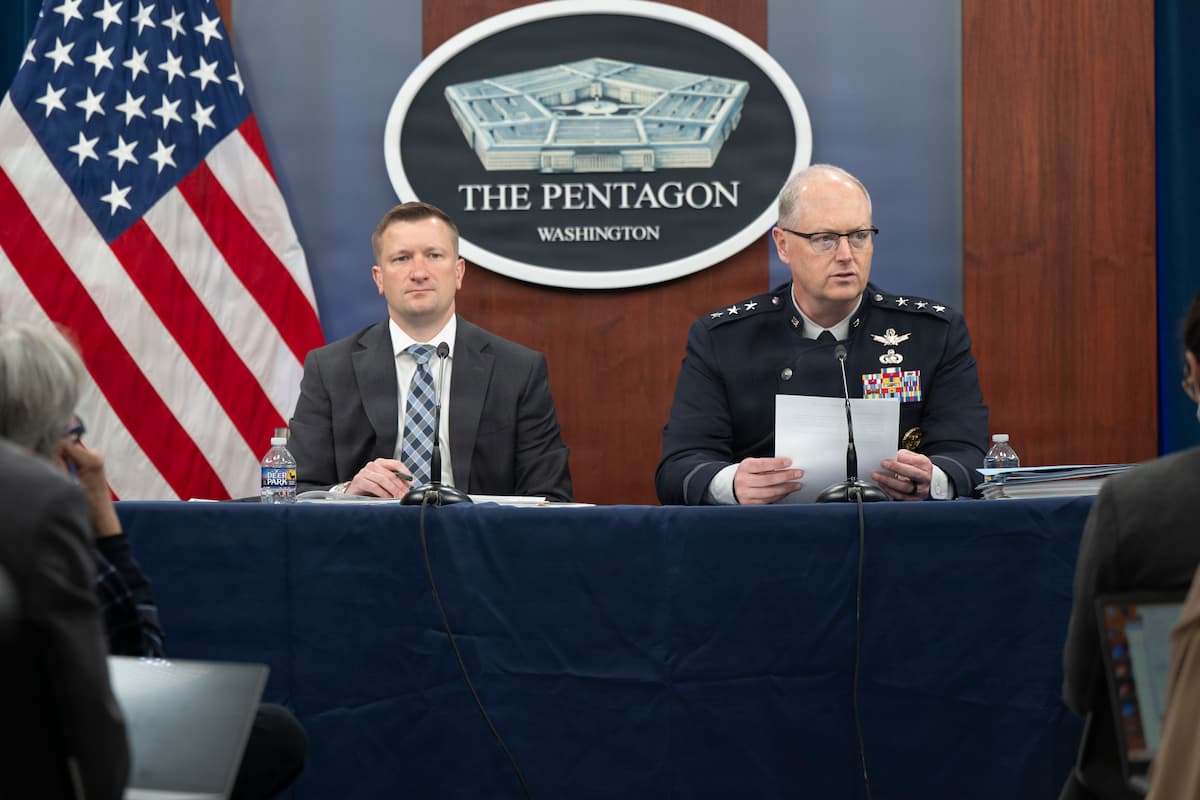
The FY2027 request was released by OMB on 3 April 2026, with the detailed Department of War rollout on 21 April. Figures below reflect the request as of that rollout. Congressional markup was ongoing at the time of writing — verify against enacted appropriations.
A data breakdown of the largest single-year US defense request since the Second World War — how the topline is structured, where the money flows by service and account, and the programs driving a 42 percent surge.
Numbers this large stop meaning much on their own. A trillion and a half dollars is not a figure anyone pictures — it is a headline. So it helps to start with the one comparison that does land: not since the United States was fighting a two-front world war has any single year’s defense request been this big, once you strip out inflation. That is the frame worth holding onto as the account lines pile up below.
A wartime-scale request built on a two-track funding structure
On 3 April 2026 the White House released a $1.5 trillion national-defense budget request for FY2027, the highest single-year figure since the Second World War and roughly 42 percent above the prior year. Measured against the inflation-adjusted wartime peak of about $1.2 trillion in FY1945 outlays, the request would set a new all-time high.
The topline splits into $1.15 trillion in discretionary budget authority that Congress must pass through regular appropriations and $350 billion in mandatory funding the administration wants routed through a separate reconciliation bill. Of the discretionary share, $1.1 trillion goes to the Department of Defense, about $42 billion to Department of Energy atomic-energy and nuclear-security work, and $12 billion to other defense-related activities.
The surge is concentrated in hardware. The procurement and RDT&E modernization account reaches roughly $760 billion once reconciliation is included — close to the size of the entire FY2026 defense budget on its own. The Navy receives the largest service topline at $324 billion, while the Space Force grows fastest at 77 percent.
The plan is front-loaded rather than sustained: national-defense funding is projected to fall about 16 percent in real terms from FY2027 to FY2028, then stay roughly flat with inflation. Its prospects hinge on a reconciliation package that competes with immigration-enforcement priorities, and on a discretionary increase needing 60 Senate votes.
How this report was built
Figures are drawn from the Office of Management and Budget’s FY2027 request, Department of War comptroller materials released on 3 and 21 April 2026, and independent analyses by CSIS, the Congressional Research Service and specialist defense trade press. Every figure post-dates the April 2026 request. Historical comparison points — wartime outlays, FY2026 enacted levels — are dated where they appear. Where sources give different values for the same line, both are shown and the discrepancy is flagged rather than resolved silently.
The administration renamed the Department of Defense the Department of War in 2025; both names appear across cited sources. Reconciliation funding is classified as mandatory spending and is not yet law — it depends on Congress passing a bill that does not currently exist. All service-branch toplines include pass-through and reconciliation funding unless noted.
Two funding tracks, one headline number
The $1.5 trillion figure is not a single appropriation. It is a discretionary base that Congress passes annually, stacked on top of a one-time mandatory injection that requires a partisan reconciliation vote.
Here is where the headline number gets slippery, and where it pays to slow down. When most people read “$1.5 trillion defense budget,” they picture a single check the Pentagon gets to cash. It is not that. Roughly three-quarters of it — the $1.15 trillion discretionary piece — moves through the ordinary appropriations grind, the same annual process that produces continuing resolutions and shutdown standoffs. The other quarter rides on a separate vehicle entirely. Treating the two as one round number flattens a real distinction: one part is how Washington usually funds defense, and the other is a bet that a specific, still-unwritten bill will clear a narrowly divided Congress.
Why route $350 billion through reconciliation at all? The short answer is arithmetic on the Senate floor. A discretionary increase of this size needs 60 votes, which means Democrats. Reconciliation needs 51, which means it can pass on Republican votes alone. The administration has been candid about the logic, describing the move as a way to fund its priorities without the spending ratchet that historically paired every defense increase with a matching domestic one. Whatever one makes of that framing, the mechanical consequence is the same: a large slice of the most eye-catching programs in this budget — Golden Dome chief among them — lives or dies on a bill that carries its own political baggage.
| Component | Mechanism | Amount ($B) |
|---|---|---|
| Department of Defense / War | Discretionary base | 1,100 |
| DoE atomic energy (incl. NNSA) | Discretionary base | 42 |
| Other defense-related activities | Discretionary base | 12 |
| DoD priorities (Golden Dome, munitions, drones) | Reconciliation (mandatory) | 350 |
| Total national defense (function 050) | 1,504 |
The reconciliation mechanism matters strategically. By moving $350 billion into a bill that needs only a simple Senate majority, the administration frames the increase as decoupling funding for its own priorities from spending it opposes. The trade-off is fragility: unlike enacted appropriations, this tranche does not exist until a specific reconciliation bill passes, and only one such bill can move per fiscal year.
The largest defense increase since the Korean War
Adjusted for inflation, the request surpasses the previous all-time peak of US defense spending, the wartime high of roughly $1.2 trillion in FY1945 outlays. The year-over-year jump is the steepest since 1945, exceeding even the Reagan-era buildup of the 1980s.
The Reagan comparison deserves a second look, because it is the one defense-budget veterans reach for instinctively. The 1980s buildup is the reference point for “big” in modern American military spending — the era of the 600-ship Navy and a defense budget that reshaped the late Cold War. This request is bigger in real dollars and steeper in its one-year jump. That does not make it a rerun of the eighties. The Reagan increase was spread across several years and became a sustained plateau; this one, by the administration’s own projections, is a single spike that recedes almost as fast as it arrives. The scale rhymes with history. The shape does not.
A reader glancing only at “3.6 percent of GDP” might conclude this is a modest budget by historical standards — after all, it sat near 14 percent in the early 1950s. That reading is a trap. Defense’s share of GDP fell for seventy years mainly because the American economy grew enormously, not because the military got cheaper. Real spending rose across most of that stretch. So the move from 3.0 to 3.6 percent is a bigger deal than the two decimal points suggest, and the comparison measured in actual dollars is the more honest yardstick.
| Fiscal year | Context | % of GDP |
|---|---|---|
| FY1953 | Korean War postwar peak | ~13.8 |
| FY1999–2001 | Post-Cold-War low | 2.9 |
| FY2026 | Prior year (enacted) | 3.0 |
| FY2027 | Request (outlays) | 3.6 |
| FY2028 | Projection | 3.7 |
The Navy takes the largest share; the Space Force grows fastest
Each branch took a distinct approach. The Navy and Army planned buying sprees, the Air Force leaned into operations and R&D, and Defense-Wide agencies more than doubled.
If you want to read a defense budget’s real priorities, ignore the press release and watch which accounts grow fastest. The Navy takes the biggest single slice, which surprises no one given the shipbuilding ambitions. But the story hiding in the growth rates is the Space Force. A 77 percent jump in one year is the kind of number that does not happen to a mature organization; it happens to one the leadership has decided to build out in a hurry. At roughly $75 billion the Space Force is now crowding the Marine Corps, a branch with a century of history and a global expeditionary mission. That two services of such different vintage now sit within striking distance of each other tells you something about where the Pentagon thinks the next fight is contested.
The line that should raise eyebrows, though, is not a service at all. Defense-Wide — the catch-all for agencies and programs that do not belong to any single branch — more than doubled, a 121 percent increase. That is where the marquee cross-cutting bets live: Golden Dome, autonomy, artificial intelligence, the industrial-base money. By its nature it is also the least legible part of the budget, the hardest for outside analysts to track program by program. When the fastest-growing category in a trillion-dollar request is also the murkiest, congressional oversight has its work cut out.
| Service | FY2027 topline ($B) | YoY growth |
|---|---|---|
| Navy | 324 | +21–23% |
| Air Force (after pass-through) | 264 | +21–23% |
| Army | 252 | +21–23% |
| Space Force | 75 | +77% |
| Marine Corps | 53 | +~35% |
That Defense-Wide surge is why the modernization account, not any single service, is the real story of this budget — so much of the increase is managed centrally rather than pushed through one branch. The Space Force’s ascent is equally notable, though the growth rate depends on the baseline: it rises from roughly $40 billion the year before on the comptroller’s topline, or about $31.6 billion on the narrower base. The 77 percent figure is measured off the former.
A modernization budget, not a sustainment budget
Pentagon officials described the overall theme as shifting from a sustainment-based force to one investing in industrial-base expansion and new capability. The numbers bear it out: procurement and RDT&E together dominate the discretionary increase.
The account math
In the base budget alone, the department requested about $260 billion for procurement and $220 billion for RDT&E. Reconciliation would layer roughly $280 billion more onto those weapons accounts, lifting the combined modernization total to about $760 billion — a figure close to the entire FY2026 defense budget.
Not every account rises. Basic research, the main channel for department-funded university science, is cut 9.9 percent, from $2.47 billion to $2.14 billion, and applied research is cut harder still. The surge favors buying and fielding over fundamental discovery.
| Account area | Total request ($B) | Mandatory share |
|---|---|---|
| Aircraft & related systems | 102.2 | — |
| Missiles & munitions | 95.0 | — |
| Base procurement (all) | ~260 | — |
| Base RDT&E (all) | ~220 | — |
| Modernization account (proc. + RDT&E) | ~760 | ~280 |
The programs driving the surge
Four buckets absorb most of the new money: homeland missile defense, shipbuilding, next-generation aircraft and drones, and the nuclear triad.
This is the section most readers actually came for. One and a half trillion dollars is abstract; a battleship is not. And the naming tells its own story — Golden Dome, Golden Fleet, a Trump-class battleship. Budgets are usually written in the grey prose of program-element numbers and line items. This one reaches for brand names, and brand names are a political instrument as much as a procurement one. They make a program easy to champion and hard to quietly cut, which is precisely the point when so much of the funding has to survive a contested vote.
Notice, too, what shares the page with the new toys: retirements. The same request that stands up sixth-generation fighters and battleships also moves to end the E-7A Wedgetail early-warning aircraft and trim the Army’s Black Hawk and Chinook helicopter buys. This is the unglamorous half of modernization — divesting legacy platforms to free money and attention for what comes next. It also happens to be where budgets get bloody in Congress, because every retired program has a district behind it, a supplier who builds it, and a member who will fight for it. The buying spree and the cull are two sides of the same strategy.
| Program | Category | FY2027 request ($B) |
|---|---|---|
| Nuclear triad modernization | Strategic deterrent | 71.4 |
| Navy shipbuilding (34 ships) | Maritime | 65.8 |
| Navy aircraft procurement | Aviation | 34.4 |
| Navy weapons procurement | Munitions | 22.6 |
| Golden Dome missile shield | Homeland defense | 17.5–17.9 |
| Space Force missile warning and tracking | Space | 6.8 |
| B-21 Raider bomber | Strategic deterrent | 6.1 |
| F-47 next-gen fighter (NGAD) | Aviation | 5.0 |
| Army MV-75 Cheyenne II tiltrotor | Aviation | 2.2 |
| CCA collaborative combat drones | Autonomy | 1.0 |
Golden Dome and homeland missile defense
The signature new initiative is Golden Dome for America, a homeland missile-defense shield authorized under Executive Order 14186. The FY2027 ask is $17.5 to $17.9 billion, but almost all of it — all but about $400 million — sits in the reconciliation request rather than the base budget. That makes the program’s near-term funding unusually dependent on a bill Congress has not yet written. The request also funds 506 new civilian hires to accelerate the effort.
Sit with that split for a moment. No single line captures the whole request’s central gamble better. If reconciliation stalls — over Golden Dome itself, over an unrelated fight about immigration funding riding the same vehicle, over intra-party disputes about deficits — the administration’s signature homeland-defense initiative arrives at the fiscal year with a rounding error for a budget. The program’s fate is tied less to its own merits than to legislative traffic it does not control.
The Golden Fleet
Shipbuilding jumps to $65.8 billion to procure 34 ships — 18 battle-force vessels and 16 support ships — more than double the $27.2 billion enacted in FY2026. The administration brands this the Golden Fleet, with initial money for a Trump-class battleship and next-generation frigates, plus a Columbia-class ballistic-missile submarine and two Virginia-class attack submarines.
Aircraft, drones and the nuclear triad
The nuclear triad draws $71.4 billion across submarines, bombers and ICBMs, including $6.1 billion for the B-21 bomber. The F-47 sixth-generation fighter advances with about $5 billion, while collaborative combat aircraft appear in procurement for the first time at roughly $1 billion.
Front-loaded spending and an uncertain path through Congress
The administration’s own projections show the spike is not meant to last. National-defense funding falls about 16 percent in real terms from FY2027 to FY2028, and total departmental resources drop nearly 17 percent, before flattening. This is a one-time reconstitution surge, not a permanent new baseline.
There is a genuine strategic tension buried in that decline, and it is worth naming plainly. Pentagon officials framed this budget as a pivot from sustainment toward productive expansion of the industrial base — the factories, the supply chains, the skilled workforce that turns out ships and munitions and drones. But industrial base is a long game. You cannot ask a shipyard to add capacity, or a munitions supplier to hire and tool up, on the promise of a single boom year followed by a 16 percent cut. One official put the supplier problem directly: large primes can absorb the swing between fat years and lean ones, but the small and mid-size firms beneath them cannot. A surge that recedes this fast risks sending exactly the wrong signal to the very suppliers the budget says it wants to grow. The proposed fix — multi-year procurement authorities that smooth the demand signal — is a real answer, but it too needs Congress.
Passage is the larger question. The discretionary increase of more than $250 billion needs 60 Senate votes and collides with proposed nondefense cuts, inviting opposition. The $350 billion reconciliation tranche needs only a Republican majority but competes with demands to fund immigration enforcement in the same once-per-year bill, and November midterms could delay full-year appropriations regardless. Notably, the request did not include a supplemental for the recent military operations against Iran; reporting suggested a separate $80 to $100 billion war supplemental might follow.
So where does that leave the $1.5 trillion headline? Closer to a statement of intent than a settled fact. This is the largest defense request since the Second World War, real in its ambitions, and contingent at almost every turn — on 60 Senate votes for the discretionary half, on a party-line reconciliation bill for the other, on midterm-year politics not derailing appropriations, and on suppliers reading a one-year spike as a durable commitment rather than a head-fake. The number will change before anything is built. Watching how it changes — which programs survive the markup, whether reconciliation carries Golden Dome or sheds it, how much of the modernization account clears both chambers — will tell the real story of what this budget buys. The request is the opening bid, not the receipt.
Caveat on figures: this is a budget request, not enacted law. About $350 billion depends on a reconciliation bill that did not exist at the time of the sources cited, and the discretionary increase requires bipartisan Senate agreement. Individual program totals vary slightly across sources — Golden Dome at $17.5B versus $17.9B, the Space Force base at roughly $31.6B versus $40B — depending on whether reconciliation and pass-through funds are included. Where sources disagreed, both figures are shown. Congressional authorization and appropriations action was ongoing as of mid-2026 and may have altered these numbers.
Sources
- CSIS — Unpacking the $1.5 Trillion FY2027 Defense Budget Topline
- US Department of War — DoW leaders brief the FY2027 budget request, 21 April 2026 (video)
- Congressional Research Service — FY2027 Defense Budget: Funding for Selected Weapon Systems (R49023)
- US Department of War — $1.5 Trillion Budget Request Prioritizes Service Members, Modernization
- Greenberg Traurig — Understanding the President’s FY2027 Budget Request for the Department of War
- Breaking Defense — Trump proposes $1.5 trillion defense budget, banking on $350 billion from reconciliation
- Breaking Defense — Golden Dome, out-years and lots of missiles: details of the request
- Air & Space Forces Magazine — How USAF and USSF compare to other services in the 2027 budget
- Aerospace America (AIAA) — Pentagon fiscal ’27 budget aims to operationalize Golden Dome
- Inside Defense — Historic FY-27 defense budget fueled by industrial-base investment
- Computing Research Association — Historic budget will not include basic research
- defence-industry.eu — Pentagon details $1.5 trillion FY2027 budget request
- GovCon Wire — President’s FY27 budget request includes $1.5T for the Pentagon
- Foundation for Defense of Democracies — Administration requests extraordinary $1.5 trillion defense budget
- StartupDoD — FY2027 Defense Budget Playbook
- The Hill — Pentagon officials lay out the $1.5 trillion request for 2027
- Center for Arms Control and Non-Proliferation — FY2027 Defense Budget Request Briefing Book
- Forecast International — Inside the Pentagon’s historic $1.5 trillion FY27 budget request
- National Guard Association of the United States — President proposes $1.5 trillion defense budget