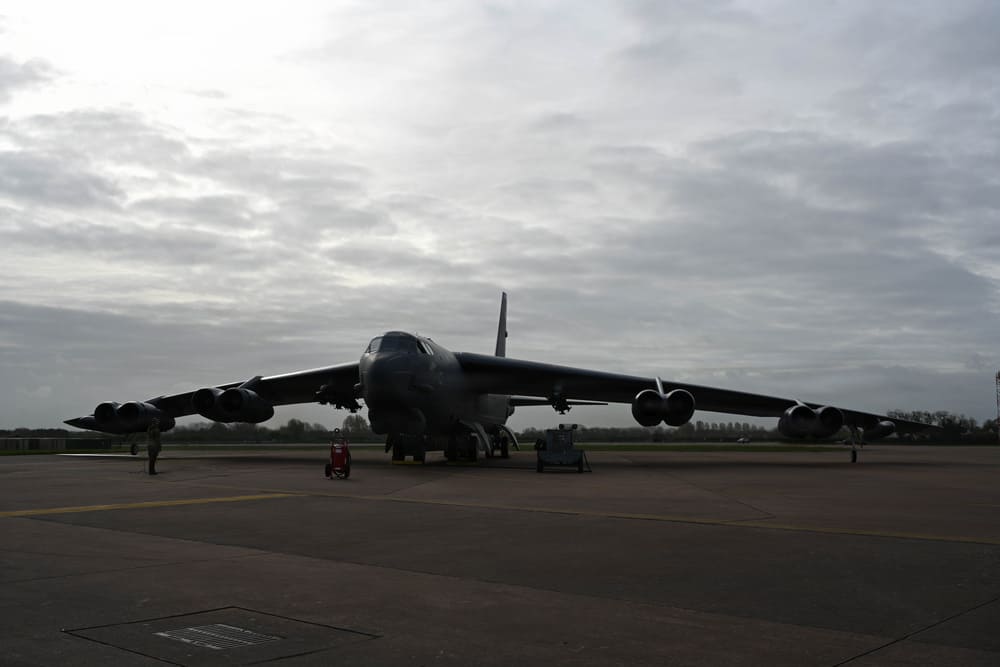
The first B-52 fitted with an AESA radar reached Edwards Air Force Base this week after a ferry flight from San Antonio. The aircraft completed the Dec. 8 move under the B-52 Radar Modernization Program, and the test team at Edwards now holds the jet for ground work and flight trials through 2026.
First B-52 with AN APQ-188 AESA radar reaches Edwards for 2026 testing
Air Force photos from Edwards show the bomber arriving with the same broad nose profile the fleet has carried for decades. The new hardware sits inside the radome, and it replaces the legacy AN/APQ-166 set that crews used for navigation and targeting.
The Dec. 8 ferry flight used a combined crew drawn from Barksdale’s 49th Test Evaluation Squadron and Edwards’ 419th Flight Test Squadron. The service said the team will run functional checks on the ground, then move into flight work across 2026 before a production decision later next year.
“The ferry flight of this upgraded B-52 marks an important moment in our efforts to modernize the bomber force,” Secretary of the Air Force Troy Meink said. “This radar modernization ensures that the B-52 will continue to serve as a cornerstone of American airpower well into the future. We are committed to extending the life of this vital platform, allowing it to operate alongside next-generation fighter and bomber aircraft.”
The Air Force statement framed the radar replacement as a maintainability fix as much as a capability change. It described the old radar as failing and hard to sustain, a problem that shows up most often in parts availability and repair cycles.
Edwards matters here because the program needs a disciplined test run with instrumentation, repeatable sorties, and a stable engineering baseline. Defense officials confirm the flight test aircraft now at Edwards will support both radar trials and integration checks tied to the wider B-52 update set.
AN APQ-188 Bomber Modernized Radar System draws on AN APG-79 fighter AESA line
The new radar is designated AN/APQ-188. The set traces back to the AN/APG-79 family fielded across F/A-18E/F and EA-18G fleets, and it also shares technology roots with the AN/APG-82 line in Air Force F-15 variants. The Air Force described the bomber radar as a derivative intended to bring a comparable maintenance burden and modern modes into a much older airframe.
San Antonio handled the installation and early checks. The contractor said the Edwards handoff followed ground integration and initial functional checks at that facility. The same statement identified the jet as the first flight test aircraft under the radar program.
One of the few “looks like” details the public can take from official material comes from imagery of the radar itself under the opened nose cone. A flat AESA array sits on a mount within the large radome volume, and the installation looks more like a fighter’s array on a structural cradle than the older dish-style arrangement it replaces. Public photos also show the radar centered low within that nose space, not up near the cockpit line.
The shift to AESA brings practical benefits for a bomber crew. The radar can support higher-resolution mapping and more flexible mode selection than the old set, and it should reduce downtime tied to moving parts. The Air Force has stayed focused on navigation and targeting improvements in its public language, not niche features that would invite guesswork about tactics.
AESA also tends to simplify software growth, at least compared with older mechanically scanned designs where hardware limits can force awkward workarounds. That matters for a bomber expected to stay in service through 2050, where incremental software drops often carry more value than one-time hardware swaps.
According to industry sources familiar with the radar effort, the most sensitive part of the APQ-188 work has not been the array itself. The hard part has been making the bomber’s nose and radome cooperate with a modern radar’s cooling needs, power demands, and performance expectations, without major exterior redesign.
B-52 nose radome integration and the downward radar angle now visible in photos
The bomber’s nose looks broadly unchanged in external profile in published images from Edwards. A narrow seam line appears between the radome area and the cockpit section, with a slightly different tone than surrounding paint. It reads like a fit-and-finish signature of new work, not a new nose shape.
Integration has driven program risk for years, and official reporting puts radome design at the center of it. The Pentagon’s test office flagged that the Air Force continued to refine the radome design to address aircraft integration problems, and it warned performance could shift depending on the final radome configuration. “Depending on final radome design, radar performance may be impacted,” the report stated. “The program office should fully characterize performance with the final radome design to inform operational employment tactics.”
The physical placement of the array adds another constraint. Imagery and observer analysis suggest the array sits canted downward within the radome volume. A fighter can mount a radar close to the jet’s centerline and manage look angles by design. The B-52’s nose gives room, but internal structure and layout still influence where the array can sit and how it points.
A downward cant fits a bomber’s main work. The B-52 spends most of its combat planning time on surface targets, navigation, and long-range weapons employment. The array does not need to prioritize high elevation search in the same way a defensive counter-air fighter radar does. Still, the cant and the surrounding structure can limit upper look angles, and the program has to map that reality into tested performance rather than assumptions.
The Air Force has stayed careful on public detail for the final radome and array configuration. That makes sense. A precise discussion of blind zones or look angle limits turns into a targeting aid in the wrong hands, and the radar remains early in test work.
Engineers also have to manage heat and electrical margins. The B-52 airframe was built around older electronics with very different demands. New digital systems can pull more power and dump more heat, and the bomber’s nose is not an easy place to add capacity without ripple effects. Those are the kinds of problems that can chew up schedule, even when the radar design itself is mature.
B-52J upgrade path links radar testing schedule to production decision and fleet fielding
The Dec. 10 service release set expectations for 2026 test work and a production decision later next year. That sequencing fits the public story around the radar program’s earlier delays and cost growth, including the “Nunn-McCurdy breach” described in recent reporting.
A cost breach does not kill a program on its own. It forces reporting and revalidation. The radar effort has lived with that pressure while the Air Force keeps the bomber recap plan moving.
The Edwards test jet now becomes the practical gate. If the radar behaves in flight the way it did in labs and ground runs, the program can push into production modifications across the fleet. If the radome or integration work still shifts, the test plan has to catch it early.
Industry statements tied to the Dec. 11 delivery describe the aircraft as the first flight test jet, not a final production configuration for the fleet. That distinction matters. Flight test aircraft often carry extra instrumentation and early software loads, and crews treat them as engineering assets first.
Troy Dawson, a Boeing bombers executive, tied the near-term focus to getting the opening phase right. “This phase of the program is dedicated to getting it right at the start so that we can execute the full radar modernization program,” he said.
The radar swap is one visible part of a larger redesign that will eventually re-designate the aircraft as the B-52J. The service has said the 76-jet fleet will also get new engines, updated communications for conventional and nuclear tasking, cockpit and crew station changes, plus other avionics and mission system work.
New engines sit at the center of the B-52J plan, and they stay on a different timeline than the radar. Public reporting and official messaging place full operational capability for the re-engining effort in the early 2030s, not the late 2020s. The radar program aims for earlier fielding, with service statements and recent reporting pointing toward initial operational capability in the 2028 to 2030 window.
The Air Force also has to keep the bomber useful during the transition. The B-52 remains a stand-off weapons truck for many missions, and it supports both conventional strike planning and nuclear tasking. A better radar supports navigation accuracy, weather avoidance, surface mapping, and target location work, all without forcing a new airframe design.
One risk sits in the handoff between a single test aircraft and fleet-wide modification. The bomber inventory is not large. Depot time, parts flow, and training for maintainers all start to bite once modifications scale beyond a test cell. That is where schedule optimism tends to break.
Our analysis shows the first Edwards test jet answers two questions at once. It shows the APQ-188 can live inside the B-52’s nose with a workable radome design, and it sets the baseline for whether the program can move from one-off integration to repeatable fleet installs.
REFERENCE SOURCES
- https://www.af.mil/News/Article-Display/Article/4356905/b-52-stratofortress-completes-ferry-flight-after-radar-modification/
- https://boeing.mediaroom.com/news-releases-statements?item=131626
- https://www.defensenews.com/air/2025/12/15/b-52-with-key-radar-upgrade-flies-to-edwards-for-testing/
- https://www.airandspaceforces.com/air-force-b-52-completes-first-test-flight-of-radar-modernization-program/
- https://www.dote.osd.mil/Portals/97/pub/reports/FY2024/af/2024b-52rmp.pdf
- https://theaviationist.com/2025/12/11/b-52-aesa-radar-arrives-edwards-afb/
- https://www.twz.com/air/this-is-what-the-b-52s-new-radar-looks-like