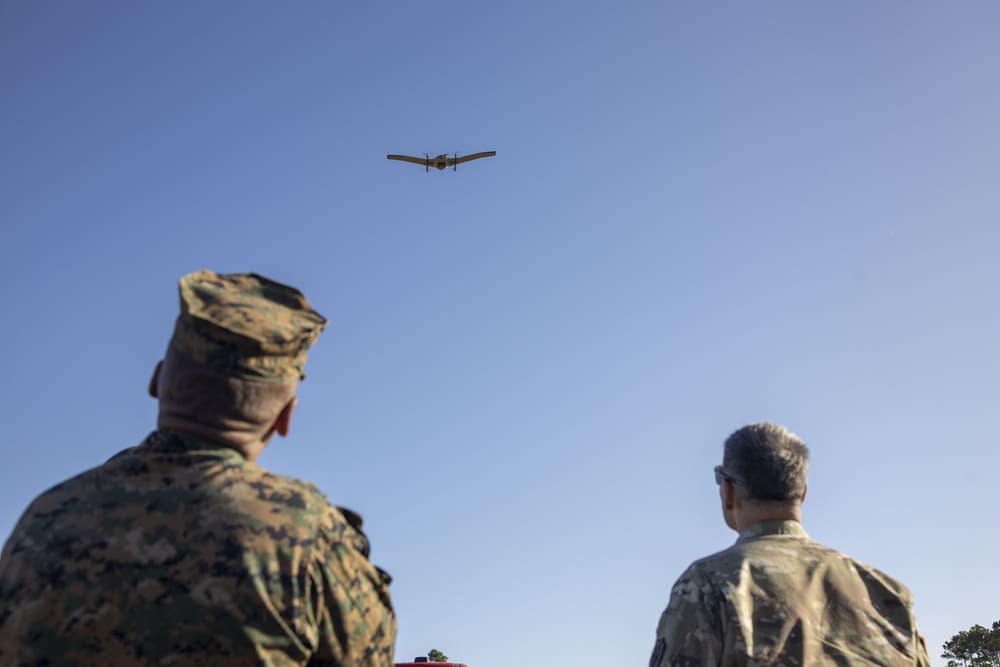
U.S. Navy officials confirmed a first at-sea launch of a LUCAS one-way attack drone from the Independence-class littoral combat ship USS Santa Barbara in the Arabian Gulf. The test used a rocket-assisted launch from the ship’s flight deck. The flight took place on Dec. 16.
USS Santa Barbara tests LUCAS one-way attack drone launch in the Arabian Gulf
Personnel assigned to U.S. Naval Forces Central Command and U.S. Fifth Fleet carried out the launch from USS Santa Barbara, according to an official Navy release. The ship was operating in the Arabian Gulf when the drone left the deck. Public imagery shows the drone lifting off from the aft portion of the flight deck, with smoke from the assist rocket trailing behind it.
The Navy described the event as the first time the LUCAS system launched from a U.S. ship at sea. Officials did not publish the distance flown, the route, or the end point. No target details were released. No note was made about a live warhead, and no impact footage has been issued.
The Navy release also avoided technical specifics on control and guidance. It did not say whether the drone was pre-programmed for the test, guided by an operator, or supported by relay equipment. It also did not describe whether the flight tested communications in a contested spectrum environment.
A separate photo caption distributed through defense imagery channels placed Task Force 59 at the center of the launch. The caption identified the drone as a Low-cost Unmanned Combat Attack System. It also tied the aircraft to Task Force Scorpion Strike, the new one-way attack drone squadron deployed to the region.
Vice Adm. Curt Renshaw linked the launch to a larger regional mission set. “This platform will undoubtedly enhance regional maritime security and deterrence,” he said. The Navy did not describe how the force intends to assign mission tasking, or how it would integrate the drones into routine maritime patrol patterns.
The ship itself offers a clear reason it was selected for the first event. USS Santa Barbara has a large flight deck relative to its displacement and crew size. The platform was built to support helicopter operations and unmanned aircraft, with mission spaces that can accept modular equipment. Those traits fit a test that needs deck clearance, handling gear, and safe separation for a rocket-assisted departure.
The launch also adds another data point for the Navy’s surface force in the Gulf. The region has seen frequent air defense alerts tied to drones and missiles, plus persistent maritime security missions near major sea lines of communication. Officials did not connect the test to a specific threat report. They kept the announcement within the lane of field experimentation.
Task Force 59 and Task Force Scorpion Strike connect ship launch to CENTCOM drone squadron
U.S. Central Command announced Task Force Scorpion Strike on Dec. 3 and described it as the military’s first one-way attack drone squadron based in the Middle East. The command said the squadron is already formed and operating with LUCAS drones inside the theater. The CENTCOM release linked the task force to U.S. Special Operations Command Central.
CENTCOM also said the drones were deployed under a push to accelerate acquisition and fielding of low-cost systems. The press release described a timeline that moved from directive to operational unit in a matter of months. It did not publish unit basing locations, inventory figures, or sortie rates.
The Navy release placed Task Force 59 as the unit that executed the ship launch. Task Force 59 sits under NAVCENT and U.S. Fifth Fleet for unmanned and autonomous operations in the region. Its role has included hands-on testing with new maritime systems, plus work on tactics and integration for unmanned platforms in fleet operations.
That division of labor matters for how this capability is likely managed. Task Force Scorpion Strike brings the drone force, along with its operators and support personnel. Task Force 59 provides the naval integration lane and the ship interface. The Dec. 16 event appears to sit where those lanes meet.
CENTCOM’s public wording on the drones stays broad on purpose. The command said LUCAS has an extensive range and can operate autonomously. It also said the system can launch through several methods. Those include catapults, rocket-assisted takeoff, and mobile ground and vehicle systems. The Navy repeated the same set of launch modes in its own release.
The ship launch used the rocket-assisted method, based on the official description and the photos. That approach reduces dependence on deck run length and wind over deck. It also reduces the amount of ship-specific launch equipment needed, since the rocket provides the initial acceleration. The Navy did not say if the drone’s launch kit uses a reusable rail, a disposable cradle, or a ship-mounted fixture.
Public photos show a clean flight deck with limited extra equipment visible near the launch point. That suggests the setup did not require major deck modification for the demonstration. The Navy did not publish details on what was bolted down, what was strapped, or what was removed for safety.
CENTCOM also placed the task force inside a broader rapid fielding effort. The command said it stood up a Rapid Employment Joint Task Force earlier in the fall to speed processes for outfitting deployed forces with emerging systems. It described focus areas that include software and capability. Those details align with how low-cost drones tend to evolve, since software updates can change mission profiles faster than hardware swaps.
No official statement addressed how Task Force Scorpion Strike will coordinate airspace control with maritime forces when the drones fly. The Gulf area has dense civil aviation routes and routine coalition activity. Deconfliction rules and mission clearances sit at the heart of any recurring launch plan. The Navy release stayed away from that discussion.
SpektreWorks LUCAS design draws from Shahed-136 and uses low-cost modular variants
SpektreWorks built the LUCAS system for U.S. forces, according to multiple public reports and the contractor references included in open coverage. The drone is widely described as derived from Iran’s Shahed-136 design, which has been used across multiple conflict zones in recent years. Russia has employed Shahed-family drones against Ukraine in large numbers, and Iranian-backed groups have also used similar designs in the Middle East.
Defense officials confirm CENTCOM has set LUCAS unit cost at about 35,000 dollars per platform. The command presented that figure as part of the rationale for fielding the system at scale. It did not list the cost for launch gear, support equipment, or training packages.
Public reporting has placed LUCAS dimensions near the Shahed class, with an airframe around 10 feet long and a wingspan near eight feet. Those numbers appear in open descriptions tied to the U.S. effort. The Pentagon has not issued a formal spec sheet for the deployed version, and the Navy release did not provide measurements.
SpektreWorks has marketed a related airframe under the FLM 136 name for threat emulation work. According to industry sources, company material lists a range of 350 nautical miles for the FLM 136 under unrestricted command and control conditions, plus endurance of about six hours and a maximum payload weight of 40 pounds. That same material lists a maximum takeoff weight of 180 pounds. Those figures describe a target and training baseline, not a confirmed deployed configuration.
The key point in the official releases is flexibility of launch and employment, not maximum range. CENTCOM and the Navy emphasized the ability to launch from catapults, rocket-assisted takeoff, and mobile platforms. That approach allows operators to match launch method to site conditions, then adjust basing without waiting for fixed infrastructure.
The Navy did not describe the LUCAS control chain for the sea event. Open imagery released earlier for the program has shown more than one external fit. Some airframes appear set up for strike only. Others show additional hardware that suggests reconnaissance or relay functions. The Navy did not confirm any sensor payload for the Dec. 16 flight.
The command also did not say whether the flight tested navigation updates in flight, or a midcourse retask process. One-way attack drones can operate through preplanned routes and coordinates, yet some newer designs can accept updates over longer distances. The public releases did not address that question, and no terminal footage was provided.
Iran’s own employment of Shahed-family drones has shown how low-cost systems can saturate defenses and complicate attribution in the early minutes of an attack. Russia’s use has shown how massed, cheap threats can drain interceptor stocks and radar attention. U.S. officials have framed LUCAS as a response that uses the same cost logic, with U.S.-controlled production and theater basing.
Sea launch adds a new employment path for low-cost drones and changes how LCS decks are used
The Dec. 16 launch matters because it ties a land-based drone force to a mobile sea platform. A ship can move the launch point without host-nation runway access, and without a long setup footprint ashore. That mobility also changes the geometry of a strike route, since the drone can start closer to the edge of a defended area.
The Navy’s own announcement did not claim the system is ready for routine use from ships. It described a first launch and kept technical details limited. Even so, the test confirms that the deck and handling system on a Littoral Combat Ship can support this class of drone with a rocket-assisted departure.
USS Santa Barbara is an Independence-class ship, and the class has faced years of debate over mission packages and long-term roles. The Navy has looked for more ways to use the large flight deck and mission spaces across both LCS variants. A drone launch test fits that search, since it uses existing deck area rather than demanding major weapon system redesign.
The Navy has also explored containerized firepower on smaller surface combatants in other programs. Container launchers can be installed on deck, then removed or swapped as mission needs change. A one-way attack drone that can launch with minimal ship changes sits in that same concept lane, even if the Navy has not said it plans a permanent LCS loadout.
The ship launch also hints at a wider class of platforms that could support similar trials. Any vessel with a flight deck and safe launch procedures could become a test site. Amphibious ships, auxiliaries, and even some Coast Guard cutters have decks that can support unmanned aircraft operations. Officials have not said which hulls might follow. The Navy also did not say whether the next tests will focus on control, recovery of sensor data, or coordination with other fleet assets.
The operational environment around the Arabian Gulf adds a second layer of relevance. The region includes tight choke points, dense maritime traffic, and frequent surveillance activity. NAVCENT’s area includes the Strait of Hormuz, Bab al-Mandeb, and the Suez Canal. A low-cost drone that can launch from sea and travel long distance can cover sea lanes, then threaten targets deeper inland if tasked for strike.
Rules of engagement and target selection remain outside the public record for this system. Officials did not describe use cases beyond general language on security and deterrence. They also did not publish any concept for how a ship-launched LUCAS would interact with manned aircraft, surface fires, or electronic warfare assets. Those details tend to remain internal.
The launch also arrives during a period when U.S. forces have pushed hard on lower-cost systems across domains. The drive comes from how fast drones have changed battlefield costs, and how quickly drone software evolves. The Navy and CENTCOM releases on LUCAS emphasized speed of fielding and flexibility of launch more than any single performance metric.
One constraint sits in logistics, not aerodynamics. A sea-based drone program needs safe storage, handling procedures, and quality assurance at the deck level. It also needs reliable spares for launch kits and control equipment. The Navy did not address any of that in its public release.
Another constraint sits in communications. Over-water operations can simplify line-of-sight links, yet interference and deconfliction still matter. Satellite support can extend control distance, but it adds bandwidth demands and security needs. The Navy did not say what link types were used for the Dec. 16 event.
The Defense-Aerospace editorial team reviewed the official releases, imagery, and public reporting tied to the launch. Our analysis shows the USS Santa Barbara test adds a new path for one-way attack drones at sea, with few disclosed details on range, control, or payload. The Navy’s next public statements will likely focus on repeatability, not publicity.
REFERENCE SOURCES
- https://www.navy.mil/Press-Office/News-Stories/display-news/Article/4363707/us-navy-in-middle-east-employs-attack-drone-at-sea-for-first-time/
- https://www.centcom.mil/MEDIA/PRESS-RELEASES/Press-Release-View/Article/4347030/us-launches-one-way-attack-drone-force-in-the-middle-east/
- https://www.centcom.mil/MEDIA/VIDEO-AND-IMAGERY/VIDEOS/?dvpmoduleid=37619&dvpsearch=5&videoid=990918
- https://www.army.mil/article/289326/low_cost_combat_attack_system_tested_at_u_s_army_yuma_proving_ground
- https://spektreworks.com/counter-uas/
- https://spektreworks.com/dev/wp-content/uploads/2024/11/Info-Flyer-FLM136.pdf
- https://www.griffonaerospace.com/products/arrowhead-aerial-target/
- https://www.navy.mil/Press-Office/Speeches/display-speech/Article/3677940/secnav-del-toro-delivers-keynote-address-at-west-2024/
- https://news.usni.org/2024/12/11/lcs-is-back-with-firepower-upgrades-including-new-missile-launchers-says-secnav-del-toro
- https://www.cusnc.navy.mil/Media/News/Display/Article/4281475/task-force-59-holds-change-of-command-ceremony/