
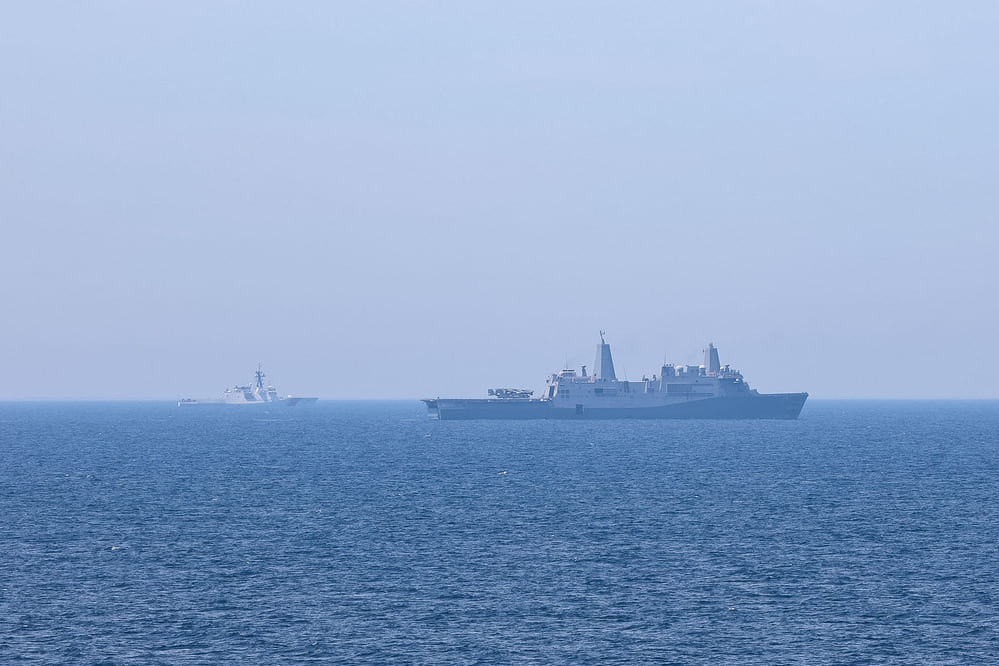
Navy leadership says the service will move ahead with a new frigate program built on an existing U.S. design and try to get the first ship in the water by 2028. Huntington Ingalls Industries will serve as the lead for the design effort, with follow-on construction planned as a competitive process across multiple shipyards. Navy Secretary John C. Phelan described the plan as “built on a proven American design, in American shipyards, with an American supply chain.”
The announcement lands after the Navy halted work on the Constellation-class frigate line, a program meant to deliver a lower-cost surface combatant by adapting a mature foreign design. Instead, the design effort expanded, schedules slipped, and the cost profile moved closer to larger combatants. The Navy now wants to avoid another long redesign cycle and get to a stable configuration faster, with tighter control over changes once construction starts.
New FF(X) frigate timeline targets 2028 and a Legend-class cutter baseline
The Navy’s plan centers on a new frigate designation, FF(X), with an acquisition approach that begins with a lead design yard and then shifts to broader production. Phelan said the Navy will front-load requirements work, then clamp down on late changes. That posture reflects lessons from recent shipbuilding programs where design growth arrived after contracts were signed and after yards were already committed to long-lead buys.
Adm. Daryl Caudle, who oversees Fleet Forces Command, framed the strategy as risk control. “By leveraging a mature platform and focusing on early design stability, we can reduce cost, schedule, and technical risk while delivering critical capability faster,” he said in the Navy’s announcement.
Huntington Ingalls will take the lead role in shaping the FF(X) design and managing early integration work. Navy officials have pointed to an existing Coast Guard hull as the baseline. The Legend-class National Security Cutter fits that description and sits inside an established U.S. production history, with known performance margins in open-ocean operations and a supply chain that already supports a fleet of large cutters.
According to industry sources, the Navy’s choice to start from a Coast Guard hull aims to cut down the unknowns that come from adapting a foreign frigate design to U.S. standards. The Navy still faces the same hard trade: any “existing design” becomes a new ship once combat systems, power and cooling, shock and survivability measures, and weapons layouts start to drive changes. The service’s stated target, though, is to keep those changes disciplined and early.
The 2028 “in the water” goal does not mean the frigate will be combat-ready on launch day. It sets a marker for hull delivery and basic ship completion. Combat system integration, testing, and acceptance trials usually run beyond that point, especially when a platform’s mission equipment differs from its baseline. The Navy’s choice to publish a date this early signals a schedule-driven program, with requirements expected to stay inside what the chosen hull can carry without major redesign.
Phelan tied the frigate reset to a broader shipbuilding effort the Navy has described as the “Golden Fleet.” The label matters less than the structure behind it: a push to field more hulls, keep designs stable, and treat change orders as an exception rather than a routine feature of ship construction. That approach will be tested quickly on a frigate, where costs climb fast when the ship’s weight, power, and cooling budgets get tight.
Constellation-class cancellation and why the Navy walked away
The Constellation-class frigate effort began as a corrective move. The Navy wanted a surface combatant smaller than an Arleigh Burke destroyer, with credible air defense, anti-submarine warfare capability, and modern sensors, but at a cost and build tempo closer to a commercial-style yard rhythm. The idea depended on “parent design” commonality. The Navy selected a proven European frigate design and planned to adapt it with limited changes.
Those “limited changes” did not stay limited. Over time, engineering and survivability requirements, U.S. Navy combat system integration, and a long list of technical and regulatory standards pushed the design away from its starting point. The more the ship moved, the less the parent design helped. That shift showed up in schedule pressure, rework, and cost growth. The Navy ended up with a frigate that was no longer a straightforward adaptation and no longer promised the original price and delivery benefits.
Public reporting over the past month described the Navy’s decision as a termination of planned Constellation-class orders, not a simple slowdown. That included canceling additional ships and pausing the path toward a class of at least 10 frigates, the minimum fleet the Navy had once framed as its starting buy. The service had already committed to early construction steps, but the delivery profile slipped into the end of the decade.
A core problem was design maturity at contract award. The program moved ahead before key details were frozen. That is not unique in Navy shipbuilding, but it carries extra penalty on a ship that is supposed to be cost-controlled. A destroyer program can absorb some growth because the hull is larger and budgets are larger. A frigate program loses its reason to exist when it starts to resemble a destroyer in price and complexity while staying smaller in capacity.
The Navy’s shift to FF(X) does not erase the operational need Constellation was meant to fill. The fleet still needs surface combatants that can escort high-value units, contribute to anti-submarine screens, and add missile capacity outside the destroyer force. The Navy also faces the retirement curve of older cruisers and the strain on destroyer schedules caused by high deployment tempo and long maintenance lines.
The Constellation reset also lands in the shadow of the Littoral Combat Ship era. The LCS program delivered hulls in quantity, but mission-package delays, mechanical failures, and uneven survivability confidence undercut the Navy’s original concept. Constellation was supposed to restore confidence by returning to a frigate with built-in combat systems and a more traditional escort role. The failure of that plan created a second gap: not just missing hulls, but missing credibility in the Navy’s ability to buy a “simple” surface combatant without turning it into a custom ship.
The Navy’s new message is that it wants the benefits of an existing design, but it wants that design to be American and already embedded in U.S. yard practices. That is a practical response to the political and industrial reality of shipbuilding. It also reflects a belief inside the Navy that the next attempt will face less resistance if the baseline ship is already familiar to U.S. regulators, U.S. supply lines, and U.S. workforce training pipelines.
Legend-class National Security Cutter and what must change for a Navy frigate
The Legend-class National Security Cutter is the Coast Guard’s largest modern cutter and is built for sustained operations in demanding seas. The Coast Guard describes the class as 418 feet long with a displacement around 4,500 long tons, a maximum speed near 28 knots, and a range of about 12,000 nautical miles. Endurance is measured in 60- to 90-day cycles, with a crew listed at roughly 148.
Those numbers matter for a Navy frigate because they set the baseline margins. A frigate’s combat systems add weight high in the ship, increase electrical load, and drive heat rejection needs. If the Navy wants a frigate that carries a vertical launch system, a modern air-search radar, electronic warfare equipment, and anti-submarine sensors, the ship’s growth margins become the controlling issue. It is the point where “existing design” either holds or breaks.
The Coast Guard’s mission set differs from the Navy’s escort and combat roles. The National Security Cutter is built for law enforcement, patrol, and defense support missions. It operates helicopters and unmanned aircraft from a large flight deck. It launches and recovers small boats from astern, a feature that supports boarding teams and patrol work. The class also carries robust command-and-control equipment for multi-agency operations.
A Navy frigate built from that hull would have to prioritize different things. Air defense becomes central. Anti-submarine sensors and quieting become more prominent. The ship needs a combat system built for rapid targeting and engagement, not just surveillance and coordination. Those requirements affect layout and internal volume as much as they affect topside equipment.
The Constellation design shows what the Navy was aiming for in weapons and sensors on a frigate. Public descriptions of that program included a 32-cell vertical launch system, a modern radar tied to a Navy combat system architecture, an embarked helicopter, and deck-launched anti-ship missiles. A new FF(X) frigate may not copy that exact loadout, but the Navy’s escort mission does not work without some mix of area surveillance, point defense, and offensive reach.
The hardest changes usually come from three areas.
Weapons integration drives structural reinforcement, magazine arrangements, blast paths, and safety zones. A vertical launch system is not just a box on deck. It forces deep hull cuts, routes for exhaust and uptake management, and weight distribution planning. Adding deck-launched anti-ship missiles introduces fewer hull changes, but it still affects stability and topside signatures.
Sensors and combat systems drive mast design, electromagnetic interference control, cooling, and redundancy. A radar suite sized for fleet escort demands stable power and cooling margins. It also demands disciplined topside layout to avoid blind arcs and to keep maintenance access workable. Electronic warfare gear adds more antennas, more cabling, and more classification rules for compartment layouts.
Survivability standards separate a Navy combatant from a Coast Guard cutter. The Navy expects a warship to take damage and keep fighting. That drives compartmentation, firefighting system capacity, shock hardening of equipment, redundancy of power runs, and protection of vital systems. The Coast Guard builds for resilience and safety, but Navy standards are different in intent and often stricter in how they are verified.
None of those changes are optional if the Navy wants a frigate that can operate in high-threat environments without a destroyer attached. The ship does not have to be a destroyer. It does need to survive long enough to matter and to keep its sensors and weapons operating under stress.
The Navy’s new plan tries to solve that problem by choosing a hull where the basic seakeeping, endurance, and operations profile are already proven, then adding combat power inside a controlled design process. That is a reasonable theory. The risk sits in the details of integration. A hull can be proven and still become unstable in cost and schedule once the combat system package starts to demand changes in structure and power.
Lead-yard approach, multi-yard production, and shipbuilding limits
The Navy says it wants to compete follow-on construction across shipyards once the design is stable. That is not a small statement. The Navy’s surface combatant industrial base is already stressed by destroyer production, amphibs, and the long maintenance tail of existing fleets. Adding a frigate line means yards must either expand capacity or trade work across programs.
A lead-yard model can work if the design is truly frozen and the follow-on yards receive complete, controlled technical data packages. That is how the Navy has tried to run aircraft procurement for decades. Shipbuilding is harder. Every yard has different tooling and different work practices. A design that is “frozen” still needs adaptation to yard-specific construction sequences. That adaptation becomes another path for change unless the Navy enforces strict configuration control.
According to industry sources, Navy leaders want a frigate program that behaves more like an industrial product line and less like a series of unique prototypes. That requires contract structures that penalize late changes and reward predictable delivery. It also requires program offices that accept tradeoffs early, then live with them rather than re-litigate requirements after steel is cut.
The Navy’s push for an American baseline also reflects workforce reality. A foreign-based design adds friction in standards alignment, supply chain sourcing, and design authority. It can be done, but it often adds time at the stage where time is hardest to recover. A Coast Guard baseline removes some of that friction. The hull is already built to U.S. expectations in key areas. Workers and suppliers already exist. Training pipelines already feed the yards. Those are the quiet benefits that do not show up on a weapons list but show up in delivery schedules.
The choice of Huntington Ingalls as lead is also a signal about industrial planning. The company already builds large surface ships for the Navy and has long experience with Coast Guard work. It can serve as a design authority and an integrator, not just a fabricator. A lead yard needs that combination if the Navy expects follow-on yards to pick up production without rewriting core parts of the ship.
The Navy still has to face the simple constraint: shipbuilding capacity does not appear overnight. Skilled welders, pipefitters, and electricians take time to train. Supervisors take longer. Supply chains for shipboard combat systems, power equipment, and specialized steel do not scale instantly. A frigate program that targets 2028 will collide with those limits unless the Navy keeps the first ship’s configuration tightly bounded.
The Navy’s internal discipline will matter as much as the baseline hull. A frigate gains cost and time quickly when leadership asks for “just one more” capability after the design is set. That habit can be seen across decades of ship programs. Phelan’s emphasis on controlling changes reflects that history and the Navy’s awareness that another runaway frigate design would be hard to defend in Congress and hard to execute in the yards.
Our analysis shows the Navy’s decision to anchor FF(X) on the National Security Cutter hull is less about copying a Coast Guard ship and more about forcing early stability into a program the Navy cannot afford to let drift again.
REFERENCE SOURCES
- https://news.usni.org/2025/11/18/new-navy-unmanned-aqusition-office-could-oversee-up-to-66-programs-consolidate-6-peos
- https://breakingdefense.com/2025/09/secnav-moves-to-consolidate-navys-unmanned-offices-pauses-all-robotic-contracting-activities/
- https://www.navy.mil/Press-Office/Press-Releases/display-pressreleases/Article/4017734/navy-to-acquire-new-frigate-based-on-american-design/
- https://www.dcms.uscg.mil/Our-Organization/Assistant-Commandant-for-Acquisitions-CG-9/Programs/Surface-Programs/National-Security-Cutter/
- https://www.businessinsider.com/us-navy-wants-frigate-coast-guard-cutter-constellation-canceled-2025-12
- https://www.axios.com/2025/12/09/navy-shipos-ships-trump-golden-fleet
- https://www.usni.org/press-releases/2025/12/navy-to-acquire-new-frigate-based-on-american-design
- https://crsreports.congress.gov/product/pdf/R/R44972