
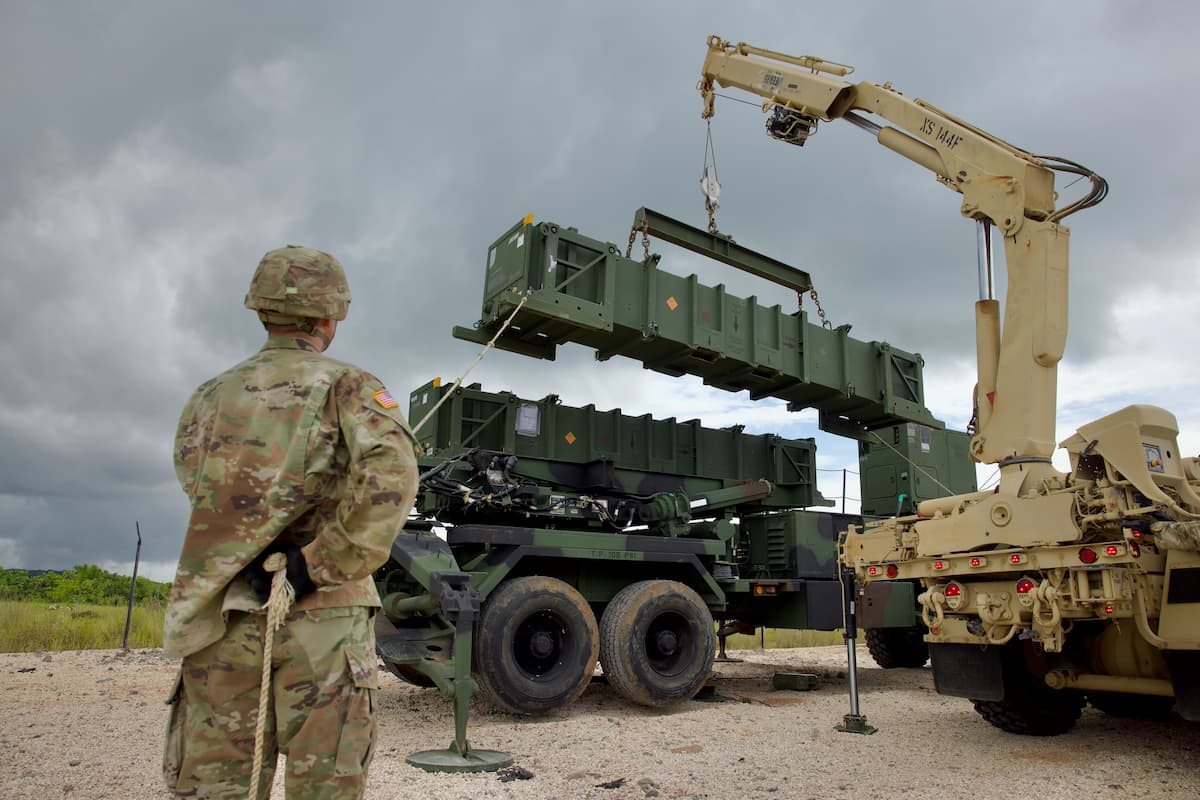
Air & Missile Defense Systems · Analysis · August 2026. Primary source: US Department of War daily contracts bulletin. Inventory figures are think-tank estimates, not disclosed stockpile numbers.
The Army’s first PAC-2 buy in thirty years was fully obligated on day one with a September 30 end date. That date is a fiscal-year artefact, not a delivery promise, and the gap between the two is the story.
- Awarded
- 30 April 2026
- Value
- $441,600,000
- Contractor
- Raytheon RTX, Andover, MA
- Place of performance
- Chambersburg, PA
- Funds
- FY26 special funds, 100% obligated at award
- Est. completion
- 30 September 2026 ← fiscal year end
- Contracting activity
- ACC Aviation Logistics, Redstone Arsenal, AL
The number that matters is not $441.6 million
On 30 April 2026, Army Contracting Command at Redstone Arsenal awarded Raytheon a $441.6 million modification for PATRIOT GEM-T interceptors in support of Operation Epic Fury. The award appeared in the Pentagon’s 1 May contracts bulletin and drew almost no attention at the time.
Do the arithmetic the announcement does not do for you. GEM-T unit pricing has become opaque because the United States stopped buying the missile, but reported figures put it at $2 million per round at minimum and plausibly higher. At that range, $441.6 million buys somewhere between roughly 110 and 220 interceptors. Call it 150 as a working midpoint.
Now set that against consumption. CSIS estimates US forces expended between 1,060 and 1,430 Patriot interceptors during operations tied to Iran this year, and tracked the inventory itself: roughly 2,300 rounds before Epic Fury, about 1,030 by the ceasefire, and between 759 and 827 as of 27 July.
This is not a replenishment contract. It is a partial payment. The first US order for new-build PAC-2 interceptors in more than three decades replaces, at best, something like one round in seven of what was fired. Reading it as anything else produces the wrong conclusion about where American magazine depth actually stands in the autumn of 2026.
What is genuinely new here, and what is not
The “first GEM-T order in 30 years” framing is accurate but has been thoroughly worked over since RTX chief executive Christopher Calio surfaced it on the 23 July earnings call, where he noted over $5 billion in GEM-T bookings driven by international customers plus the first domestic production order in more than three decades.
Three details in the primary document are more informative and have been largely passed over. The announcement is four sentences long. Here is what each field is actually telling you.
| Field | What it says | Why it matters |
|---|---|---|
| Action type | Modification P00026 to contract W31P4Q-23-C-0036 | A modification to an existing 2023 vehicle, not a new competed award — the fastest legal route to product |
| Cumulative face value | $441.6M, equal to this single action | Unusual on a 26th modification; consistent with a previously undefinitized or zero-value ordering agreement |
| Appropriation | FY2026 special funds, fully obligated at award | Not the Army’s programmed interceptor line; supplemental-type money that does not create a programme of record |
| Place of performance | Chambersburg, Pennsylvania | Existing Raytheon production, not new capacity |
| Est. completion | 30 September 2026 | The last day of the fiscal year — a funding boundary, almost certainly not a delivery date |
| Contracting activity | ACC Aviation Logistics, Redstone Arsenal | Aviation and missile channel, consistent with an off-the-line buy |
The money was appropriated as special funds, not standard missile procurement. That phrasing does not point to the Army’s programmed Patriot interceptor line — the line that, per the House Armed Services Committee’s own June commentary on the FY2027 NDAA, had been running exclusively to PAC-3 MSE and not to GEM-T. It points to contingency or supplemental money moving outside the normal budget cycle, and money arriving through a supplemental channel does not automatically create a programme of record.
The entire sum was obligated on day one. Complex guided-munitions buys normally release funding in tranches across fiscal years as milestones are met. Full same-day obligation is what happens when a buyer is taking product off an existing production line rather than starting one.
The completion date is the detail most likely to be misread. It is tempting to treat 30 September as a delivery promise. It is almost certainly not one — it is the last day of the fiscal year, and the boundary on which the funds must be closed out. Patriot-family interceptors are long-lead items; deliveries typically arrive years after award, not months. If you see that date cited anywhere as missiles in hand by the end of September, treat that source as unreliable on this topic.
There is a fourth oddity worth flagging rather than explaining away. This is modification P00026 — the twenty-sixth action against a contract dating to 2023 — yet the announcement states it brings the contract’s total cumulative face value to $441.6 million, the exact value of this single action. That is unusual phrasing for a mature vehicle, and it is most consistent with a previously undefinitized or zero-value ordering agreement being used as a fast-award mechanism. It is not proof of anything, but it is the kind of structure a service reaches for when it wants to compress the contracting timeline.
The oversight gap is the real story
Line up the dates.
| Date | Event | Channel |
|---|---|---|
| 30 Apr 2026 | Army awards the $441.6M GEM-T modification | Contract action |
| 1 May 2026 | Award appears in the daily contracts bulletin | Routine publication, four sentences |
| Jun 2026 | HASC notes the Army has been buying PAC-3 MSE and not GEM-T, asks whether more PAC-2 should be procured, and directs an inventory briefing | FY2027 NDAA report |
| 23 Jul 2026 | RTX chief executive cites the first domestic GEM-T order in 30+ years | Quarterly earnings call |
| 11 Aug 2026 | Army AMD commander gives engagement totals; CSIS inventory estimates circulate | Space & Missile Defense Symposium |
| 1 Mar 2027 | Congress due a consolidated Patriot inventory picture | Directed briefing |
The committee was asking, in June, whether the Army ought to consider doing a thing the Army had already done in April. Whether members were aware of the contract is unclear from the public record. Either way, the sequence describes a procurement moving faster than the reporting channels built to track it, and a Congress that will not receive a consolidated picture of Patriot inventories until March 2027, roughly eleven months after the award.
For a reader trying to judge US air defence readiness, this is the operative limitation. The authoritative inventory numbers are not public, the best available figures are think-tank estimates, and the mechanism designed to produce official ones is scheduled to report after the window in which another round of fighting could plausibly occur.
Why GEM-T at all, when PAC-3 MSE is the better missile
The straightforward answer is that PAC-3 MSE is better and GEM-T is available. GEM-T is a semi-active radar-guided PAC-2 derivative with a blast-fragmentation warhead, an older architecture than PAC-3’s hit-to-kill approach and a physically larger round. Current trailer-mounted Patriot launchers accept mixed PAC-2 and PAC-3 loadouts, so adding GEM-T requires no new launchers and no separate fire unit.
| PAC-2 GEM-T | PAC-3 MSE | PAC-3 ACE | |
|---|---|---|---|
| Prime | Raytheon | Lockheed Martin | Lockheed Martin |
| Guidance | Semi-active radar homing | Active radar, hit-to-kill | PAC-3 architecture, hit-to-kill |
| Kill mechanism | Blast-fragmentation warhead | Kinetic impact | Kinetic impact |
| Rounds per launcher | Fewer — larger round | More — smaller round | Smaller-round family |
| Status | Only PAC-2 variant still in production | Current high-end production round | Unveiled Jul 2026; explicitly less capable than MSE |
| Best against | Tactical ballistic and air-breathing threats at range | The most demanding ballistic threats | Aircraft, cruise missiles, shorter-range ballistic |
The economics are the argument. A PAC-3 MSE runs $5.3 million per round according to the Army’s FY2027 budget request. GEM-T, at a reported floor around $2 million, is cheaper per shot against targets that do not require hit-to-kill precision — and a meaningful share of what the 32nd Army Air and Missile Defense Command engaged over the past year was not high-end ballistic.
Lt. Gen. John Rafferty told the Space and Missile Defense Symposium in August that the command engaged 125 ballistic missiles during the twelve-day Israel–Iran war and neutralised over 1,200 ballistic, cruise and drone threats during Epic Fury. Spending $5.3 million to kill a one-way attack drone is a losing exchange, and everyone involved knows it.
That same logic is why the Army has floated a requirement for a Patriot-compatible interceptor at under $1 million a round, and why Lockheed Martin unveiled the PAC-3 Adapted Capability Effector in July as a deliberately less capable, cheaper, higher-volume option. Read together, the GEM-T buy and the ACE announcement are the same admission from two directions: the interceptor inventory has to get cheaper per shot or it cannot be sustained.
What this contract does not fix
Timeline. Money obligated in April 2026 does not become rounds on launchers in 2026. If deterrence depends on magazine depth over the next twelve months, this contract is not part of the answer.
Volume. Roughly 150 rounds against a stockpile that fell by more than 1,400 does not restore the pre-Epic-Fury baseline, and does not come close.
Competing claims on the same production line. Raytheon’s GEM-T backlog is dominated by international orders — over $5 billion of them in a single quarter, including Ukraine replenishment and European buys, some routed through the COMLOG joint venture facility in Germany. US rounds are not being drawn from a dedicated national queue. They compete with allied deliveries that carry their own political deadlines. Switzerland’s Patriot order has already been deferred once, and Swiss authorities raised the possibility of cancellation in April.
Interceptors are not the whole problem. Rafferty’s own framing at the August symposium was that magazine depth cannot be solved by buying more interceptors alone, and that electronic warfare, directed energy and faster targeting decisions have to carry part of the load. That is an unusual thing for an air and missile defence commander to emphasise in public, and it is the most honest signal in the record.
What to watch next
Three things will tell you whether April’s award was a one-off or the start of a line.
Sources
- US Department of War — Contracts for May 1, 2026, Army section (award dated 30 April 2026)
- House Armed Services Committee — report accompanying the FY2027 NDAA, June 2026
- US Army — FY2027 budget request materials, ASA(FM&C)
- Center for Strategic and International Studies — interceptor inventory assessments, May and July 2026
- The War Zone — US Army is buying older PAC-2 Patriot missiles for the first time in decades
- The War Zone — Army downed more than 1,400 Iranian missiles and drones during Epic Fury and the 12-day war
- The War Zone — Severity of America’s depleted advanced weapons stockpiles detailed in new report
- RTX — Raytheon to deliver Patriot interceptors to Ukraine
- Tech Times — Lockheed debuts PAC-3 ACE, a half-price Patriot interceptor