
The Army’s first request to buy XM30s, rather than just develop them, ran into an “early to need” cut. The amount that survived matches a single line in the Army’s own cost exhibit.
The FY2027 budget request, released in April, asked for $547 million to buy 19 XM30 Mechanized Infantry Combat Vehicles, the program’s first step out of research accounts and into procurement. Congress has since started to answer.
The House Appropriations Committee approved its defense bill on June 24, 2026, and the committee report (H.Rept. 119-715), filed June 26, sets the XM30 procurement line at $33.067 million, down from $546.990 million. The report mentions XM30 once, in a table on p. 92, with a single note: “Program decrease—early to need.” The development line, $290.069 million for the Manned Ground Vehicle program element, passed untouched (p. 149).
The surviving $33.067 million is not a round-number trim. It equals, to the thousand dollars, the government-furnished equipment entry in the Army’s own P-5 cost analysis for the line. On paper, the House bill keeps the equipment the government would supply and drops the vehicles, hulls, turrets, training devices and program management. The committee report does not say whether that match was deliberate.
What the $547 million was meant to buy
The Pentagon’s Program Acquisition Cost by Weapon System book lists $837.1 million for the XM30 in FY2027: $290.1 million in research and development and $547.0 million in procurement for “up to 19 vehicles, hulls and turrets.” It says FY2027 funding “represents the final increment for the Phase 4 efforts associated with the XM30 design maturation, development activities, and prototype build.” The Army’s justification book for Procurement of Weapons and Tracked Combat Vehicles breaks the procurement figure down.
| FY2027 cost element (P-5) | Unit cost | Total | House Appropriations |
|---|---|---|---|
| Vehicle end item (turret-to-chassis integration) | $4.536M | $86.175M | Not funded |
| Hull/chassis | $15.117M | $287.231M | Not funded |
| Turret | $6.538M | $124.226M | Not funded |
| Government-furnished equipment | — | $33.067M | $33.067M |
| Training devices | — | $5.843M | Not funded |
| Program management | — | $10.448M | Not funded |
| Total | $28.789M | $546.990M | $33.067M |
The P-5 remarks note that the vehicle end item covers only integration of the turret onto the chassis, so the hardware cost of one XM30 is the sum of three lines, about $26.2 million. With equipment, training and management included, the Army’s gross unit cost for FY2027 is $28.789 million.
The same exhibit set gives the dates and the buyer. The procurement history (P-5a) lists the contractor as “TBD,” with contract award in September 2027 and first delivery in July 2029. The production schedule (P-21) spreads the 19 deliveries from July 2029 to June 2030 at one to two vehicles a month, with a 22-month manufacturing lead time. The Army calls these “LRIP vehicles” bound for production qualification testing, initial operational test and evaluation, and a first unit equipped in an active-component armored brigade. The Congressional Research Service describes the same 19 as “prototype vehicles for evaluation.”
A 326-vehicle plan
The procurement plan in the P-40 runs five years and ramps toward about 100 vehicles a year. The FY2031 quantity of 108 is a single year’s buy; the five-year total is 326 vehicles and $6.93 billion.
| Fiscal year | Quantity | Procurement ($M) | Unit cost ($M) |
|---|---|---|---|
| FY2027 | 19 | 546.990 | 28.789 |
| FY2028 | 48 | 995.047 | 20.730 |
| FY2029 | 65 | 1,463.575 | 22.517 |
| FY2030 | 86 | 1,774.080 | 20.629 |
| FY2031 | 108 | 2,151.128 | 19.918 |
| Total | 326 | 6,930.820 | 21.260 |
Two budget books, two stories
The two documents behind the FY2027 request do not agree on where the program stands. The Pentagon’s Program Acquisition Cost book, generated April 21, 2026, still says “Milestone B was approved in June 2025, and Milestone C is targeted for first quarter FY 2028,” and names General Dynamics Land Systems and American Rheinmetall as prime contractors (p. 3-10). The Army’s own justification for the same line says “the prime contractor(s) has not yet been identified,” with awards to depend on performance during the rapid prototyping phase, preproduction prove-out testing and soldier feedback.
The Army book is consistent with what Breaking Defense reported in February 2026: officials had agreed the previous June to move XM30 into engineering and manufacturing development, but Army Chief of Staff Gen. Randy George and Army Secretary Dan Driscoll halted it by not signing the document that finalized the decision. The report did not say when they made that choice. Army spokesperson Maj. Pete Nguyen told the outlet: “We are actively assessing multiple, competing designs for the XM30 to foster a truly competitive environment.”
The Army also went to industry. Solicitation W912CH-26-RFI-1234, a request for information posted to SAM.gov on February 18, 2026, by Army Contracting Command–Detroit Arsenal for Capability Program Executive Ground, never mentions the XM30 or the Bradley. Its RFI document, attached to a February 19 update of the notice, lists these assumptions: “40 to 80-ton tracked combat vehicles,” “approximately 10 prototype vehicles, beginning in FY27,” a prototype lead time “no greater than 24 months” and “continuous production of up to 2,500 vehicles per year.” Responses were due March 19, 2026.
| RFI, February 2026 | XM30 budget exhibits, April 2026 | |
|---|---|---|
| Path to first vehicles | About 10 prototypes beginning in FY27; lead time of 24 months or less | Award September 2027; 22-month build; first delivery July 2029 |
| Annual output | Up to 2,500 vehicles a year | 108 in FY2031, the peak year in the plan |
| Producer | Open to nontraditional firms; Army arsenals and depots offered as partners | Contractor TBD |
The RFI covers a class of vehicle, not a program of record, and its numbers are planning assumptions. Still, two months after asking industry about thousands of vehicles a year, the Army submitted a budget in which the first production Bradley replacement arrives in mid-2029 and output peaks at 108 a year.
What Congress has done so far
| Action | Date | XM30 procurement | Manned Ground Vehicle RDT&E |
|---|---|---|---|
| President’s budget request | April 2026 | 19 / $546.990M | $290.069M |
| Senate Armed Services (S.Rept. 119-127) | Voted June 10, 2026; report filed June 15 | 19 / $546.990M | $310.069M (+$20M for unmanned ground vehicle development) |
| House Appropriations (H.Rept. 119-715) | Approved June 24, 2026; report filed June 26 | $33.067M | $290.069M |
| House-passed NDAA (H.R. 8800) | July 22, 2026 | 19 / $546.990M | $290.069M |
| Continuing resolution (P.L. 119-103) | Signed September 2, 2026 | FY2026 rates through December 11, 2026 | |
The authorizers did not object to the buy. The House-passed defense authorization bill matched the request line by line, with $546.990 million for XM30 procurement and $290.069 million for the Manned Ground Vehicle program element in its funding tables. The Senate Armed Services Committee approved all 19 vehicles and added $20 million to the development line for unmanned ground vehicles. The Senate committee also directed the Army to brief the House and Senate armed services committees by April 1, 2027, on thermal and electro-optical/infrared signature modeling for new ground platforms, naming the XM30 and warning about “passive infrared-guided anti-tank missiles” and “drone-mounted thermal cameras” (pp. 38–39).
The House appropriators were the outlier, though their cut barely moved the account as a whole. In the same Procurement of Weapons and Tracked Combat Vehicles table, the committee added $577 million to the Paladin Integrated Management self-propelled howitzer line, from $84.193 million to $661.193 million, and the account total fell by only $20.65 million. The report links the two changes only by putting them in the same table.
When the stopgap was enacted on September 2, the Senate Appropriations Committee had not reported any of its FY2027 bills, according to CRS, so there was no Senate number to set against the House figure.
Why the stopgap matters less than it looks
Fiscal 2027 began under a continuing resolution, the Continuing Appropriations and Extensions Act, 2027, signed September 2, 2026, which funds the government through December 11, 2026. Section 102(a)(1) of the law bars the Defense Department from funding “new production of items not funded for production in fiscal year 2026 or prior years.” The Army’s P-40 shows no XM30 procurement funding in FY2025, FY2026 or prior years, so the line falls into that category. None of the Defense Department exceptions in the law (sections 126, 127 and 146, on shipbuilding cost increases, national security systems and one Army and Navy construction project) covers it. The same clause applies to other first-year programs, including Golden Dome.
The current stopgap costs the program little, because the Army does not plan to award the production contract until September 2027. The exposure lies in the full-year outcome. A full-year continuing resolution that kept the same new-production restriction would rest on an FY2026 baseline with no XM30 procurement, and a final bill closer to the House version would leave about $33 million on the line. Either outcome would put the September 2027 award date in the Army’s schedule at risk.
Hardware is on the ground
None of this has stopped the prototypes. At the 17th Michigan Defense Expo in Detroit, the May 13 panel for Capability Program Executive Ground and Army Contracting Command–Detroit Arsenal listed “PM XM30 COL Novak” among its participants, according to the event program.
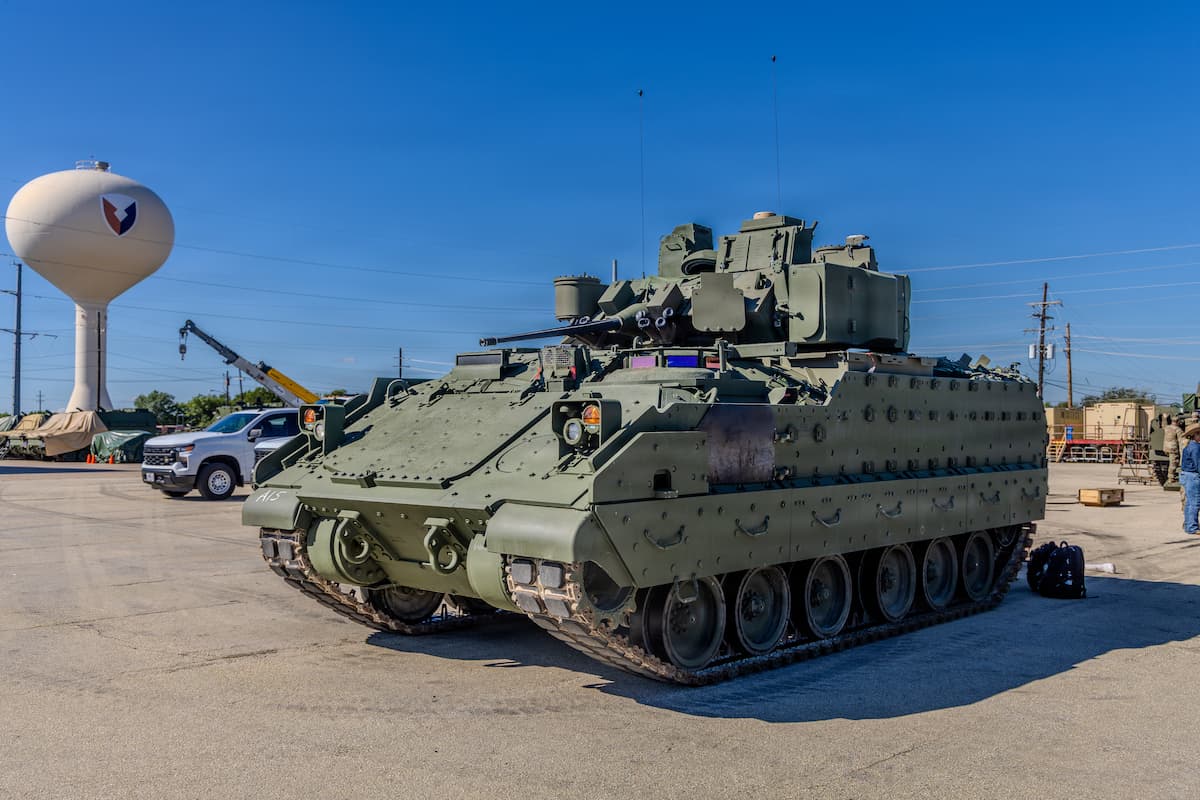
American Rheinmetall announced on September 1, 2026, that it had delivered the first of eight Lynx XM30 prototypes under a Phase 3/4 contract valued at about $764 million, and that the remaining seven would follow later this year for operational unit training. CRS, citing Inside Defense, puts that delivery on September 1 and says General Dynamics Land Systems delivered its first Wolf at the end of August. According to the same reporting, the 1st Cavalry Division at Fort Hood, Texas, is to receive two XM30 platoons and train with them at the National Training Center through March 2027. The same division’s 3rd Armored Brigade Combat Team began fielding upgraded M2A4E1 Bradleys on October 5, 2026.
Who decides next
The two officials who declined to sign Milestone B have left or are leaving. CRS describes Gen. George’s departure in April 2026 as a retirement; CNN reported that Defense Secretary Pete Hegseth fired him. CNN reported on August 31, 2026, that Driscoll had submitted his resignation and said it was unclear when he would leave the post. As of September 8, CRS wrote that the Army was “presently without Senate-confirmed senior leadership.”
The dates to watch line up: the continuing resolution expires December 11, 2026; the National Training Center rotation runs through March 2027; and the Army’s own schedule puts the production award in September 2027. CRS reports that the Army has moved XM30 to a Middle Tier of Acquisition rapid prototyping path and expects to pick a single vendor in late spring or June 2027. Until a final bill settles it, the only appropriations figure on the line is the House committee’s: $33 million against a five-year plan of $6.93 billion.
Sources
Primary and official documents
- House Appropriations Committee — Department of Defense Appropriations Act, 2027, H. Rept. 119-715, June 26, 2026: Procurement of W&TCV, Army, line 5; RDT&E, Army, line 172
- U.S. Army — Army FY2027 Budget Estimates, Procurement of Weapons and Tracked Combat Vehicles, Army, Vol. 1 (PDF), April 2026: line 7241G86000, Exhibits P-40, P-5, P-5a and P-21
- Department of War — FY 2027 Program Acquisition Cost by Weapon System (PDF), April 2026: XM30 Combat Vehicle
- Senate Armed Services Committee — National Defense Authorization Act for Fiscal Year 2027, S. Rept. 119-127, June 15, 2026: Report on ground vehicle signature management simulation capability; sec. 4101 and sec. 4201 funding tables
- U.S. House of Representatives — H.R. 8800, National Defense Authorization Act for Fiscal Year 2027, engrossed in House (PDF), July 22, 2026: sec. 4101 and sec. 4201 funding tables
- U.S. Congress — Continuing Appropriations and Extensions Act, 2027, Public Law 119-103 (PDF), September 2, 2026: Division A, sec. 102, 106, 126, 127 and 146
- Army Contracting Command–Detroit Arsenal — Request for Information (RFI) for Ground Combat Vehicle Production, W912CH-26-RFI-1234, February 18, 2026
- Army Contracting Command–Detroit Arsenal — Request for Information (RFI) for Ground Combat Vehicle Production, W912CH-26-RFI-1234, RFI document, February 19, 2026
- Congressional Research Service — The Army’s XM-30 Mechanized Infantry Combat Vehicle, IF12094, September 8, 2026
- Congressional Research Service — Overview of Continuing Appropriations for FY2027 (Division A of P.L. 119-103), R49353, September 17, 2026
- Congressional Research Service — Appropriations Status Table: FY2027, updated October 9, 2026
Trade press and analysis
- Breaking Defense — Is the Army about to shake up its Bradley replacement, XM30? Sources see major signs, February 2026, updated February 27, 2026
- American Rheinmetall — American Rheinmetall delivers first Lynx XM30 combat vehicle prototype to U.S. Army, September 1, 2026
- NDIA Michigan Chapter — 17th Annual Michigan Defense Expo (MDEX) 2026 Program (PDF), May 12–14, 2026
- Haley Britzky and Natasha Bertrand — Hegseth ousts US Army chief of staff and two other generals amid Iran war, CNN, April 2, 2026
- Haley Britzky, Kristen Holmes and Kevin Liptak — Army Secretary Dan Driscoll submits resignation after tension with Hegseth, CNN, August 31, 2026
Related coverage
- Defense-Aerospace — Golden Dome: $17.5B Requested, $400M Written Down, September 16, 2026