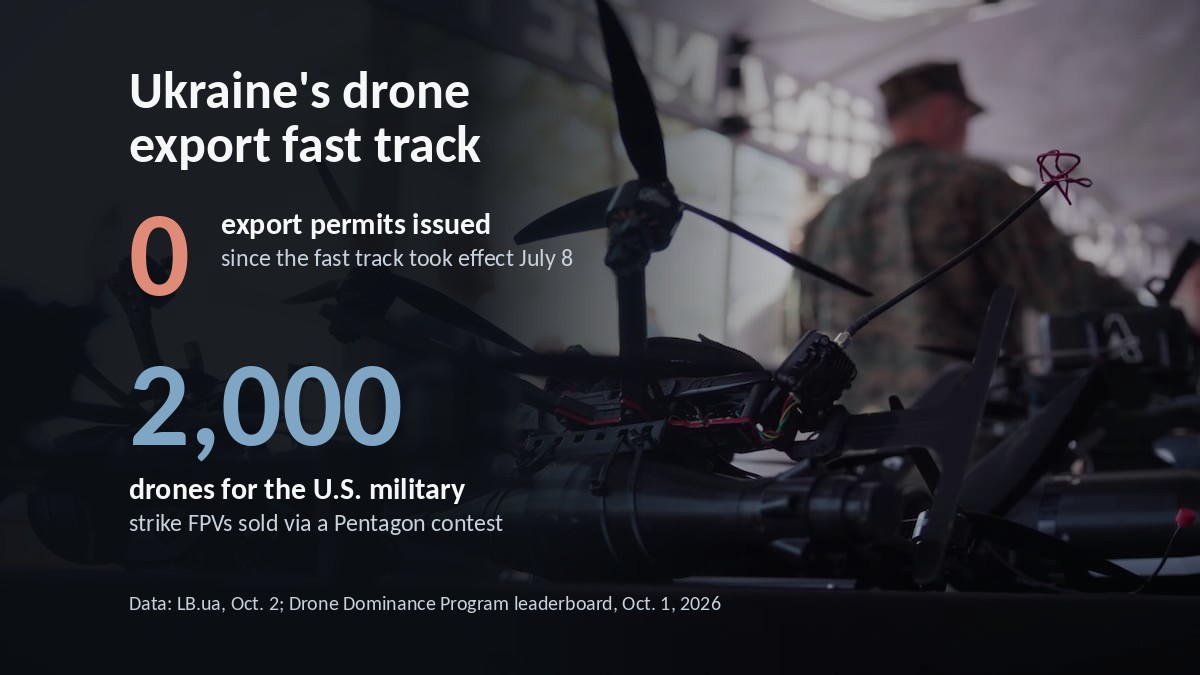
Kyiv’s special export channel for Drone Deal partners had not issued a single permit as of October 2, almost three months after it took effect on July 8. The one documented sale of finished Ukrainian strike drones to a NATO military went around it, through a Pentagon competition that moves final assembly to the United States from its next phase.
Ukraine’s Cabinet adopted a fast track for arms exports on July 1, 2026, and pitched it as the opening of a market. Three months later, no permit had been issued under it, LB.ua reported on October 2, and the head of the commission that clears Ukrainian arms exports said the procedure had not started working. The lists that switch it on were not in place, and the government had received proposals to rewrite it.
On the same July 1, Ukraine’s export control service cleared a batch of F10 strike drones from manufacturer F-Drones for the U.S. military, which had ordered 2,000. That permit came through the old procedure. The Pentagon’s Drone Dominance Program now lists all 2,000 as shipped and accepted, plus a 1,320-unit bonus order not yet shipped. The program’s own rules require U.S. final assembly from Phase 3, which opened on September 28.
For NATO buyers reading “Ukraine opens exports” as “Ukrainian drones are for sale,” those two facts set the terms. As of October 8, 2026, the legal route to buy finished drones from Ukraine exists on paper. The preconditions sit with Kyiv’s ministries, with the manufacturer and with the buyer’s own government. The only buyer on record that has taken delivery is steering the supplier toward production on its own soil.
What the fast track actually requires
Cabinet Resolution No. 875 was adopted on July 1, published in the government gazette Uryadovyi Kurier on July 8 and took effect that day. It runs for the duration of martial law plus six months. Its promise is a 30-day decision without a hearing before the Interagency Commission on Military-Technical Cooperation and Export Control. If the Defense Ministry or the security services stay silent past their deadlines, the transfer counts as cleared by that agency.
The procedure covers only countries that have signed a “Drone Deal” with Ukraine. The resolution defines that broadly: any bilateral treaty, memorandum or agreement on drones or other defense technology, “regardless of the specific name of such documents.” The commission still steps in for countries without such a document or under partial embargo, for items on a critical list or restricted by Ukraine’s international obligations, and where the security services raise objections.
Read as a checklist, the text puts preconditions on three parties.
| Precondition | Where in Resolution No. 875 | Who has to act |
|---|---|---|
| Buyer country appears on a quarterly list of eligible states | Procedure, clause 5 | Ukraine’s Foreign Ministry, then the commission |
| Item is absent from a quarterly list of critical goods | Clauses 5 and 19(6) | Ukraine’s Defense Ministry, then the commission |
| Contract of at least UAH 15 million for goods and technology; components exempt | Clause 4 | Exporter and buyer |
| Permit fee paid with the application: 20% of value for finished goods and technology, 30% for components | Clause 13(5); amendments to Resolution No. 746 | Exporter |
| A guarantee document from the importing state; its listed terms cover transferred technology and goods made with it | Clauses 11(1) and 19(4) | Buyer’s government |
| No Defense Ministry intent to buy the same item, or a written supply guarantee from the exporter | Clauses 19(5) and 20 | Defense Ministry or exporter |
Three details matter most to a foreign buyer. The first is the fee. It is a charge for issuing the permit, added to the export control service’s list of paid services. Proof of payment goes in with the application, and the text contains no refund provision.
The second is the valuation behind that fee. The application must carry documents setting the value under clause 12: a Ukrainian state defense contract or an expert valuation. Clause 12 values goods produced under a technology license at what Ukraine’s state customers pay, or by expert valuation if they have not bought the item in the past six months. The amendment spells out that formula explicitly only for technology transfers, so its application to finished goods is open to reading.
The third is the guarantee. Every transfer under the procedure needs a document carrying state guarantees from the importing country, and its absence is grounds for refusal. The guarantees the text lists concern transferred technology: a right to use it without acquiring the intellectual property, re-export of goods made with it only with Kyiv’s prior written permission, production only in the licensed quantity, and information on modifications passed back to Ukraine. The text does not say what the document must contain when only finished goods are sold. Read literally, the text would still require a NATO buyer of finished drones to obtain one from its government.
The Defense Ministry keeps first call on output. An “intent” to buy the same item is grounds for refusal, and for suspending an issued permit for up to 30 days. A refusal on that ground obliges the state customer to take steps toward a contract within 30 days. If no contract is signed in that time, the exporter may reapply and the same ground cannot be used again. Exported services are limited to “instruction” to the minimum needed to use the goods.
One promise from launch day is not in the text. Then-Prime Minister Yulia Svyrydenko wrote on July 1 that 20% of proceeds from finished goods and 30% from components would go to a special budget fund for the defense industry. The resolution sets those percentages as permit fees and says nothing about a special fund. National Security and Defense Council (NSDC) Secretary Rustem Umerov said the same day that the review period would fall from 90 days to 30. On September 15, the Verkhovna Rada declined to pass bill No. 15400, which would route the permit fees to defense spending, and returned it to its sponsors for revision. A revised version filed on September 24 won the budget committee’s recommendation on October 9 for adoption at first reading and as a whole: half of the fees for buying and repairing weapons, half for military pay.
Why nothing has moved
The official explanation is short. LB.ua, introducing its interview with Davyd Aloian published on October 2, reported that the fast track had produced no permit in three months. Aloian, deputy NSDC secretary and chair of the export control commission since a September 15 decree, did not dispute it: since July, he said, the resolution “as such has not started working.” To run, it needs at least two lists: one of countries, compiled by the Foreign Ministry, and one of critical weapons, compiled by the Defense Ministry. The critical list was still being formed. He named a second gap as well: the Cabinet has yet to set up how the fee would flow into a special fund for the armed forces, which needs further changes. And he doubted the procedure would work until it gives partners a reason to buy Ukrainian. LB.ua’s Defense Tech section, which ran the interview, names F-Drones as its general partner.
The resolution’s timetable put the first quarterly cycle after the third quarter at the start of this month. Both lists are due for approval by October 1 and for submission to the commission by October 5; the text puts the approval deadline before the submission deadline. As of October 8, the official legislation portal lists Resolution No. 875 as in force, in its original text.
Aloian’s account of demand is less flattering to the market narrative. From February to June, he said, no new company applied to export finished products; most applications concerned services, repair and components. Across all procedures, he counted “more than 18” permits for finished goods, including for participants in the Drone Dominance Program.
A summer of acting officials
The leadership of the Defense Ministry, which owns the critical list, and of the NSDC, which hosts the commission that must approve both lists, changed within weeks of the resolution’s adoption. LB.ua’s introduction to the interview says the commission stopped working again in the summer: when the NSDC secretary changed, so did his team, including the first deputy secretary who chairs the commission ex officio, and the pause lasted a little over a month. The chronology:
- July 14: the Verkhovna Rada accepted the resignation of Prime Minister Yulia Svyrydenko, whose government adopted the resolution, according to LIGA.net.
- July 16: Serhiy Koretskyi was confirmed as prime minister.
- July 20 to August 19: Yevhenii Khmara ran the Defense Ministry, which owns the critical list, as acting minister until the Rada confirmed him, per his ministry biography.
- August 3: presidential decrees No. 694 and No. 695 of that date made Igor Klymenko NSDC secretary in place of Rustem Umerov.
- September 15: Aloian was appointed to chair the commission.
- October 5: a presidential decree approved the commission’s new membership, the body that must clear both lists.
Industry’s version
Manufacturers say the rules themselves are part of the problem, alongside the missing lists. On August 25, Ihor Fedirko, executive director of the Ukrainian Council of Gunsmiths, published a joint position with four other industry bodies: Technological Forces of Ukraine (TSU), NAUDI, FRU and UADUT. By his count, the whole private market had received “up to 10 small export contracts” since the government announced the resumption of controlled exports last October. Only one joint venture abroad was actually working. Under Resolution No. 875, not one permit had been issued.
The five objections track the text. A flat 20% or 30% fee, paid before review with no refund, prices armored vehicles and dual-use components out of foreign markets. The UAH 15 million floor excludes the small test batches that foreign buyers order first. An unsupported ministry “intent” to buy can block a sale that a buyer will not wait 30 days for. And services such as maintenance, operator training and demining expertise stay outside the special procedure, which creates no route for exporting them on their own. Industry had been promised changes in early September, Fedirko wrote.
Those changes have not appeared. Instead, as LB.ua reported on October 2, the NSDC has already sent the Cabinet its own proposals, built on more than a month of meetings with industry associations. The aim, it said, is to simplify permits and to route the fee into a special fund for the armed forces. The associations have asked for a zero rate until scenarios are modeled. Aloian wants “a percentage that will be useful to both the market and the front.” He floated a single rate for finished goods and components, possibly lower for Drone Deal signatories.
The one sale went around the fast track
The documented exception came from the buyer’s side of the table. F-Drones’ U.S. arm, Ukrainian Defense Drones (UDD Tech Corp), entered the F10 FPV strike drone in Gauntlet I, the first phase of the Pentagon’s Drone Dominance Program. The program dates the event to February 17, 2026. On July 1, Ukraine’s State Export Control Service issued a permit for a batch of F10s “for the needs of the U.S. Armed Forces,” the company told Interfax-Ukraine. The permit rested on a decision of the interagency commission under the existing procedure, before Resolution No. 875 took effect.
The buyer’s records match the company’s account. The Gauntlet I leaderboard, as of October 1, ranks UDD sixth of 11 winners with 72.9 points and an order for 2,000 drones. All 2,000 are listed as shipped and accepted. Only four of the 11 vendors show their base order fully shipped and accepted: Neros, UDD, Griffon Aerospace and Farage Precision. UDD also holds a 1,320-unit bonus order, shown as not yet shipped. With bonuses, Gauntlet I orders total 30,000 drones.
The relationship then moved toward the United States. On June 29, Rep. Marcy Kaptur’s office announced that UDD had chosen the Village of Holland, Ohio, for its first U.S. assembly and manufacturing center. “The next step is to share the technology to produce these drones on American soil,” F-Drones CEO Stas Khutor said. The Ohio Tax Credit Authority approved a nine-year, 1.642% tax credit for the project the same day, according to its scope of work. The document says UDD expects to create 300 full-time-equivalent jobs and $18.4 million in new annual payroll by December 31, 2029, and it requires the company to keep operating at the site for at least 12 years. It describes itself as a general description that will not be used to determine compliance. Kaptur’s release describes the $18.4 million as an investment; the authority’s document describes it as payroll. The document also notes that Ohio competed with Texas for the project.
The second phase did not repeat the first. UDD competed in Deep Strike at Gauntlet II, held in August at Fort Carson, Colorado, but did not finish in the top five, according to the Gauntlet II leaderboard. The program selected the top five in each mission for orders, and only those 10 winners are fast-tracked into Phase 3, under the Phase 3 request for solutions.
The assembly clock
The program’s rules explain why the Ohio plant matters. Version 2 of the DDP Supply Chain Framework, dated July 23, 2026, adds a final-assembly requirement. For Phase 2 (August 2026), final assembly in any non-covered country is the minimum, and U.S. final assembly is preferred. For Phase 3, the minimum becomes U.S. final assembly. The framework states that each phase’s preferred standard becomes the next phase’s floor, and that missing the floor is disqualifying.
Ukraine clears the first test and not the second. “Covered countries” are China, North Korea, Russia and Iran, so a Ukrainian-made drone qualifies as non-covered. “Nearshored” sourcing, preferred in Phase 4, means the Western Hemisphere. The framework also closes the kit route: if a product is disassembled and reassembled, “the place of reassembly is not the place of manufacture.”
The framework applies to Phases 2 through 4. UDD’s bonus order belongs to Phase 1. F-Drones said on October 8 that the order is due by the end of November and that it is completing the export procedures and expects a Ukrainian permit in time, AIN.ua reported. The company did not say which procedure the permit will go through.
The Phase 3 request for solutions, released September 28, sets the next bar:
- $450 million for about 60,000 drones with their payloads and safe-and-arm devices, plus the pre-event production orders. The 60,000 split evenly between Deep Strike at $5,000 a drone and Close-Quarters Battle at $3,000; munitions are priced at $3,000 and $2,750. An option covers up to 40,000 more.
- Pitch decks due October 12. Gauntlet II winners are invited directly by October 15. About eight new vendors go to a Pitch & Fly event in early November, and at most four of them advance.
- A 400-drone production order before the event, with awards expected by mid-December 2026. Gauntlet III is estimated for March 2027; the framework labels Phase 3 as February 2027.
- Eligibility for companies “based in the U.S. or U.S. Allied Nations” that “have ability to manufacture in the U.S.” Applicants must show they can build 8,000 drones in five months and file a foreign ownership, control or influence (FOCI) data sheet.
Where the United States sits under Kyiv’s rules
The one documented delivery of finished Ukrainian strike drones to a NATO military came through a funded competition. The fast track played no part in it. Whether a second U.S. sale could use the fast track is undecided. RFE/RL reported on July 22, citing two unnamed sources, that the two countries had signed a bilateral statement of intent on drone cooperation. It would create a framework for exporting Ukrainian drones to the United States for military testing. Its text has not been published. In his October 2 interview, Aloian said the talks with Washington had started in a different format and that a Drone Deal document was ready if the U.S. side moved; as of that date, no Drone Deal with the United States had been signed.
Under clause 5 of Resolution No. 875, a document of any name can qualify a country. The decision rests with the Foreign Ministry’s list of eligible states, which, as of Aloian’s October 2 interview, still had to be compiled.
Where allied money goes instead
The larger flow runs the other way: European money buying Ukrainian drones for Ukraine’s own forces. On October 7, the Defense Ministry reported a further €1.24 billion under the EU’s Ukraine Support Loan. It is earmarked for drones, interceptor drones, drone munitions and missiles made in Ukraine. That brings defense financing received under the loan to almost €13 billion, with €15.4 billion of defense-industrial support still available through the end of 2026. The European Commission paid €1 billion on July 15 as the second payment under the first €6 billion tranche dedicated to drone procurement, after €3.9 billion on June 30.
Ukraine’s own buying has grown with it. The Defense Procurement Agency contracted UAH 333.6 billion of drones in the first half of 2026, twice the year-earlier figure. The figure measures contracted value; it says nothing about units delivered. As our analysis of the Ankara summit pledges found, NATO’s pledge of €70 billion for Ukraine in 2026 adds up only if it counts Ukrainian procurement financed by EU credit.
What allies seek for their own forces is mostly the know-how. Aloian put it bluntly: for any partner, buying a Ukrainian product is an import, and the priority is technology, not the drone. Describing how the Drone Deal took shape, he recalled a “small recession” in partner funding for Ukrainian producers under the Danish model, when partners shifted toward sending output from their own industries. He also warned buyers against benchmarking on Ukrainian prices. The price Ukraine pays is “preferential, not market,” set with profitability capped at 25%, and export prices “will be different.”
The signed frameworks point the same way. The EU’s own Drone Deal, launched on July 15, is built around joint ventures between Ukrainian and European companies, alongside a defense industrial partnership that targets joint production of drones and counter-drone systems by the end of 2026. Estonia signed its Drone Deal at the Ankara summit on July 7; its text is not public. Prime Minister Kristen Michal said it gives Estonian companies access to Ukrainian know-how and the option to produce in Estonia, according to European Pravda, citing ERR. The agreement leaves room for Estonia to buy Ukrainian products in the future, but “we have not yet agreed on specifics,” he said.
Put together, the flows look like this. Credit flows in to buy Ukrainian drones for the front. Designs and know-how flow out through licenses and joint ventures. On the public record, finished drones flow out to a single NATO buyer, through its own competition and on terms that end with U.S. assembly; the destinations of the other permits Aloian counts have not been disclosed. Aloian says about five countries have formed Drone Deal requests and are at the final stage. Whether any of them becomes a contract for finished drones is the test of the fast track.
What to watch
The next three months should show whether the fast track was blocked by its rulebook or by a lack of buyers for finished drones. If the lists are approved and finished-drone permits still do not follow, the constraint is demand. If permits follow within weeks, it was the rules.
| When | What happens | What it would show |
|---|---|---|
| October 12, 2026 | Pitch decks due for DDP Phase 3 | Whether UDD re-enters through the normal track, now that U.S. final assembly is the Phase 3 floor |
| By October 15, 2026 | DDP invites the 10 Gauntlet II winners to Phase 3 | The field of fast-tracked vendors; UDD is not among them |
| Fourth quarter, cycle due October 1–5 | Foreign Ministry list of eligible states; Defense Ministry critical list; the commission’s membership was approved on October 5 | Whether the fast track becomes usable, and whether the United States is on the list |
| Not scheduled | Cabinet decision on the NSDC amendments | Fee level, a single rate, any Drone Deal discount, and whether the fee goes to a special fund |
| End of November 2026 | Deadline for UDD’s 1,320-unit bonus order, which F-Drones says needs a Ukrainian permit | Whether that permit comes through Resolution No. 875 or the commission |
| Not scheduled | Requests from about five Drone Deal countries | Whether any becomes a contract for finished drones rather than licensing or a joint venture |
| Mid-December 2026 to March 2027 | Phase 3 production orders, DCMA inspection deliveries on January 8, Gauntlet III | Which vendors meet the U.S. final-assembly floor, and whether any of them builds a Ukrainian design |
| Plenary date not set | Rada vote on the revised bill No. 15400 | Whether the permit fees are earmarked for defense, as the launch day promised |
The first test already has a date. F-Drones expects a Ukrainian permit for the bonus drones by the end of November. If it comes through Resolution No. 875, the fast track will have issued its first permit for the same buyer that went around it in July. If it comes through the commission again, the fast track’s record stays at zero.
Sources
Quotations from Ukrainian-language sources are our translations. DDP leaderboard figures are as of October 1, 2026, and the program notes they are subject to change. LB.ua’s Defense Tech section lists F-Drones as its general partner.
Primary and official documents
- Cabinet of Ministers of Ukraine — Resolution No. 875 of July 1, 2026, with the Procedure and the amendments to Resolutions No. 838 and No. 746; published in Uryadovyi Kurier No. 142, July 8, 2026. Also on the Government Portal.
- Drone Dominance Program — Supply Chain Framework, Version 2, July 23, 2026.
- Drone Dominance Program — Phase 3 Request for Solutions, Rev. 3.
- Drone Dominance Program — Gauntlet I and Gauntlet II leaderboards and program homepage.
- Drone Dominance Program — announcements: “DDP Announces Gauntlet II Results”, September 15, 2026; “DDP RFS 3 is Open”, September 28, 2026.
- Ohio Tax Credit Authority — Exhibit I, Scope of Work: UDD Tech Corporation, June 29, 2026 (hosted by Gongwer).
- Office of Rep. Marcy Kaptur — UDD selects Northwest Ohio, June 29, 2026.
- Ministry of Defense of Ukraine — H1 2026 drone contracts, July 17, 2026; €1.24 billion EU tranche, October 7, 2026; Minister Yevhenii Khmara biography.
- European Commission — EU launches Ukraine defence industrial partnership, Drone Deal and disburses €1 billion for drones, press release IP/26/1624, July 15, 2026.
- Yulia Svyrydenko — Telegram post, July 1, 2026; Rustem Umerov, Telegram post, July 1, 2026.
- President of Ukraine — Decree No. 919/2026 on the Interagency Commission, September 15, 2026; Decree No. 1030/2026 on its membership, October 5, 2026 (NSDC site).
- Verkhovna Rada — Bill No. 15400 on crediting export control fees to the special fund of the state budget, bill card; Budget committee backs the revised bill, October 9, 2026.
Trade press and analysis
- LB.ua — interview with Davyd Aloian, October 2, 2026; NSDC sends proposals on Resolution No. 875, October 2, 2026.
- Ihor Fedirko — joint industry position on Resolution No. 875, Facebook, August 25, 2026.
- LB.ua (English) — Five flaws in Ukraine’s arms export decree, August 26, 2026.
- Interfax-Ukraine — F10 drones first to receive export permit to the U.S., July 3, 2026.
- RFE/RL — US, Ukraine reach breakthrough agreement on drone cooperation, July 22, 2026.
- LIGA.net — Koretskyi appointed prime minister, July 16, 2026.
- Ukrainian News — Zelenskyy appoints Klymenko NSDC secretary, Umerov head of foreign intelligence, August 3, 2026.
- Kyiv Post — Umerov to head foreign intelligence, Klymenko named NSDC secretary, August 3, 2026.
- European Pravda — Ukraine and Estonia sign drone agreement, July 7, 2026.
- AIN.ua — The US ordered an additional batch of over 1,300 Ukrainian FPV drones from F-Drones, October 8, 2026.
Related coverage
- defense-aerospace.com — Ankara’s €70bn Ukraine pledge vs a €2bn-a-month run rate, August 27, 2026.