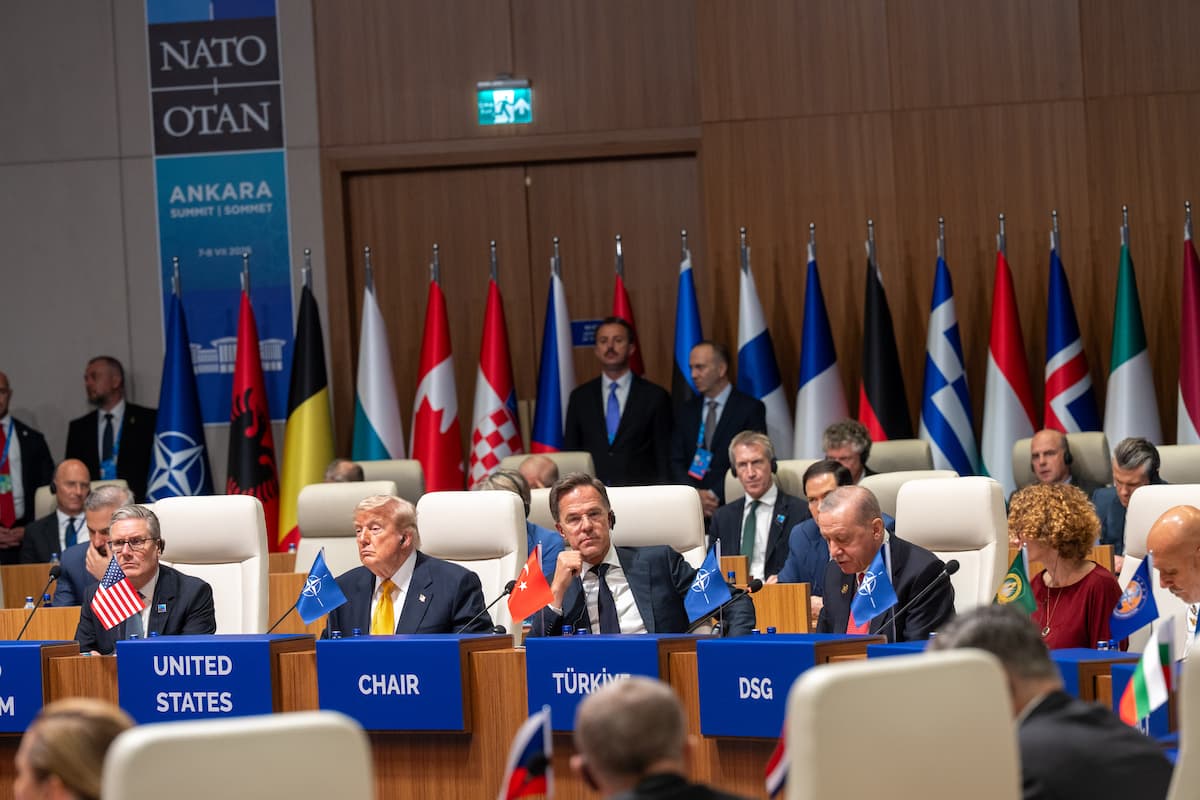
The Ankara Summit Declaration runs to six paragraphs and carries two large figures. It carries no methodology for either one. Reconstructing the denominators from allied and third-party data gives a materially different picture of how much new money left Ankara — and on the procurement side NATO never publishes a total at all, only a floor, stated in one currency on one of its pages and in another currency on the next.
- Issued
- 8 July 2026
- Issued by
- Heads of State and Government, 32 Allies
- Venue
- Beştepe Presidential Compound, Ankara
- Length
- 6 numbered paragraphs
- Procurement figure
- >$50bn, paragraph 2
- Ukraine figure
- €70bn for 2026, paragraph 4
- Supporting annexes
- None published
Summit communiqués are political documents, and treating them as financial disclosure is a category error. But procurement planners, suppliers and analysts do exactly that, because for several years the summit figure has been the only consolidated number available before national budget documents catch up. So the question worth asking about Ankara is narrow and answerable: of the money announced, how much is spending that did not already exist somewhere else?
A floor in two currencies, never a total
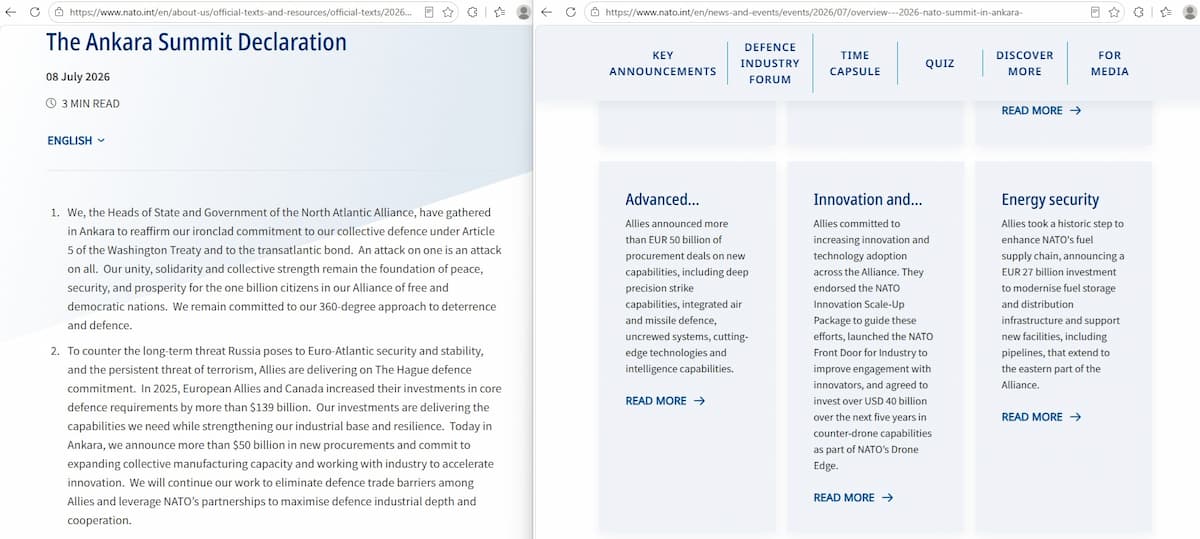
Paragraph 2 of the declaration commits Allies to announcing more than $50 billion in new procurements. The same figure, in the same currency, appears on NATO’s summits topic page and in Secretary General Mark Rutte’s closing press conference, where he described over 50 billion dollars in deals concluded in a single day.
Two other NATO pages published the same week give the figure in euros. The summit overview page records more than €50 billion of procurement deals on new capabilities, and the Alliance’s own summit wrap-up article uses the same euro wording.
These two statements do not contradict each other, and that is the point. Both are phrased as more than. More than $50 billion sets a floor of roughly €43 billion; more than €50 billion sets one of roughly $58 billion. A real total of, say, €52 billion satisfies both at once. What NATO has published is not a procurement total in two currencies but a lower bound expressed against two different scales, with the actual figure absent from every document. Downstream coverage inherited whichever page it read, and the 15% gap between the two floors passes unnoticed because both round to about half a hundred billion. Anyone building a demand model on the Ankara figure is modelling a threshold, not a sum.
What the procurement total is made of
The declaration gives no list. The composition has to be assembled from what governments and companies said in Ankara during the Defence Industry Forum, and those announcements sit at very different stages of maturity. Reuters, surveying the same forum, noted that some announcements were firm contracts and procurement plans while others remained subject to further negotiation, approval or future development.
| Announcement | Stage as stated | Why the distinction matters |
|---|---|---|
| 10th Airbus A330 MRTT tanker | Scheduled delivery | Delivery under an existing 12-aircraft order, due in September. No new money committed in Ankara. |
| Multinational A400M initiative | Letter of intent | Belgium, Croatia, France, Poland, Spain, Türkiye and the UK signed on. Fleet size, ownership, basing and cost shares all remain open. |
| Saab GlobalEye AEW&C, up to 10 aircraft | NATO: joint procurement announced. Saab: no contract signed | Eleven Allies behind it, reported at about $4.5bn. Talks with the NATO Support and Procurement Agency are only beginning. |
| Northrop Grumman Triton, up to 5 aircraft | Procurement announced by four Allies | Denmark, Finland, Germany and Norway. The quantity is an upper bound, and NATO’s own headline calls it a purchase. |
| Accenture and Leonardo, secure NATO communications network | Contract signed | Seven-year deal worth roughly €200m. One of the few unambiguously executed items. |
| Isar Aerospace and Maritime Launch Services, launch pad at Spaceport Nova Scotia | Contract signed | Industrial rather than platform procurement. Value not disclosed in the announcement. |
| 12-nation critical raw materials initiative | Initiative launched | Supply-chain framework. No procurement value attaches to it directly. |
The pattern is consistent: the Ankara figure aggregates deliveries under prior contracts, letters of intent, opened negotiations, supplier selections and a smaller number of signed contracts, without disclosing the weight of each category. Vozpopuli’s stage-by-stage review of the air package concluded that what emerged in Ankara was closer to a roadmap for shared allied airpower than a stack of finished contracts. That review covered aircraft only. No comparable audit exists for the space, counter-drone or munitions elements, which means the share of the total that is contractually binding is not currently knowable from open sources.
NATO’s own vocabulary is worth reading closely here, because it does not track the stages. The Alliance reports that eleven Allies announced the joint procurement of Saab GlobalEye as its new airborne early warning aircraft, and that four more announced the procurement of up to five Triton uncrewed aircraft, a headline NATO itself frames as a purchase. The A400M item is described in different terms: seven Allies launched a multinational project. So two of the three carry procurement language. Yet in both of those two the quantity is capped by an upper bound rather than fixed, and in the GlobalEye case the supplier says the transaction does not yet exist — Saab has confirmed there is no signed contract and no firm order, with agency-level negotiations only starting. Rutte put it from the stage as “the joint procurement of up to 10 Saab GlobalEyes” on the same day.
There is a precedent for reading an allied surveillance announcement slowly, and it belongs to NATO. In November 2023 the Alliance selected six Boeing E-7A Wedgetail aircraft to succeed the E-3 fleet, presented at the time as one of its largest capability purchases, with the first jet due on operational duty by 2031. Two years later the participating nations walked away: the Dutch defence ministry said the American exit from the programme had removed its strategic and financial basis. What Ankara announced is therefore the second AWACS procurement announcement in under three years, replacing a first one that produced no aircraft. The point is not that the GlobalEye will go the same way — it is that an announcement of this exact kind has already failed to become hardware once, which is the reason a headline total assembled from such announcements needs its stages disclosed.
The Drone Edge overlap
Alongside the procurement figure, Allies launched Drone Edge, described on NATO’s overview page as over $40 billion of investment in counter-drone capability across the next five years, with Rutte putting the participating group at 20 nations. Whether that envelope sits inside the $50 billion or beside it is not stated anywhere.
$50bn − $40bn = ~$10bn in everything else
Reading B — Drone Edge alongside the total
$50bn + $40bn = ~$90bn announced in total Under Reading A, 80% of the headline is a five-year programme rather than a day’s contracting. Under Reading B, a point-in-time figure is added to a multi-year envelope. Rutte’s transcript lists the two in consecutive sentences without subordinating one to the other. The summit overview page leans towards B: it carries the procurement figure under advanced capabilities and the counter-drone envelope under innovation and technology, as separate items in separate currencies. That is presentation rather than accounting, and NATO states the relationship nowhere.
The €27 billion fuel storage, distribution and pipeline programme announced at the same summit sits in the same fog. It is infrastructure investment on NATO’s own account rather than allied platform procurement, but nothing published says whether it was counted.
€70 billion for Ukraine, against a €2 billion-a-month run rate
Paragraph 4 of the declaration pledges €70 billion in military equipment, assistance and training for Ukraine in 2026, with sovereign commitments to sustain at least equivalent levels in 2027. It is the most concrete-looking sentence in the document and the one most in need of a denominator.
The Ukraine Support Tracker maintained by the Kiel Institute for the World Economy measures allocations rather than pledges. Its April 2026 update put European military allocations at an average of about €2 billion a month in real terms over January to April, below the 2025 average of roughly €2.4 billion a month. The June update showed European institutions allocating close to €11 billion across May and June, of which €4.3 billion was military and €6.7 billion financial and humanitarian, most of it flowing through the EU’s new €90 billion Ukraine Support Loan for 2026 and 2027.
The gap closes only if the €70 billion counts loan-financed budget support that Ukraine borrows and spends on its own procurement, rather than equipment transferred by Allies. The Kyiv Post reached the same conclusion from summit sources, reporting that the pledge folds in existing bilateral programmes and funding tied to the EU loan facility, that current EU and bilateral programmes do not fully cover the two-year total, and that the declaration does not set out how the burden divides among Allies.
Military equipment, assistance and training is a broader category than the one the Kiel tracker labels military aid. Loan proceeds spent by Kyiv on domestic and foreign weapons purchases are defence spending by any reasonable definition — but they are Ukrainian procurement financed by European credit, not allied donation. The declaration’s phrasing accommodates both without distinguishing them, and the difference determines whether the €70 billion represents new demand on European industry or a change in who signs the contract.
What the summit did establish
Two figures in the declaration are firmer than the headline pair, because they describe the past rather than the future. Paragraph 2 records that European Allies and Canada raised investment in core defence requirements by more than $139 billion during 2025 — a retrospective measure against national budget data rather than a forward pledge. Rutte separately put total defence and security spending at around 4% of GDP one year into the ten-year path to 5%.
Against that, Al Jazeera reported from NATO data that only five of 32 members are projected to hit the 3.5% core defence share in 2026. The Hague target is being approached in aggregate and missed almost everywhere individually, which is the more useful context for reading Ankara’s procurement announcements: the demand signal is real, the contracting behind it is uneven, and the summit total does not separate the two.
What to watch
Reading the figure honestly
Nothing in the declaration is false. Allies did announce a large volume of procurement activity in Ankara, and they did commit to a Ukraine support level well above what Europe delivered in 2025. What the document does not do — and what no accompanying NATO publication does either — is state what was counted, over what period, at what stage of contractual maturity, and in which currency. A six-paragraph text is not the place for that. The absence of any separate publication that does provide it is the more notable fact.
For anyone forecasting European defence demand, the practical consequence is that the Ankara figures are best treated as an upper bound on intent rather than a floor on spending, and that the five triggers above will settle within roughly twelve months how much of the announcement was contracting and how much was framing.
Sources
- NATO — The Ankara Summit Declaration
- Internet Archive — Ankara Summit Declaration, archived 25 August 2026
- Internet Archive — Overview, 2026 NATO Summit in Ankara, archived 25 August 2026
- NATO — Press conference by the Secretary General following the Ankara Summit
- NATO — Overview, 2026 NATO Summit in Ankara
- NATO — Secretary General on the Ankara Summit, NATO delivers
- NATO — NATO summits
- NATO — NATO’s new Airborne Warning and Control System is announced
- NATO — NATO expands its ISR Fleet with the purchase of Triton aircraft
- NATO — NATO Allies expand strategic airlift capacity
- Kiel Institute for the World Economy — Ukraine Support Tracker, Europe leads on aid and US weapons remain key
- Kiel Institute for the World Economy — Ukraine Support Tracker, military aid holds steady as focus shifts to drones
- Breaking Defense — NATO to acquire up to 10 Saab GlobalEyes for E-3 replacement, says Secretary General
- FlightGlobal — NATO abandons Boeing E-7 Wedgetail buy after US withdrawal
- Kyiv Post — What came out of NATO’s Ankara summit
- Vozpopuli — The A400M deal is still only a letter of intent
- Reuters, via Devdiscourse — NATO touts $50 billion in arms deals as leaders meet in Ankara
- Defence24 — NATO summit in Ankara, defence deals worth $50 billion
- Al Jazeera — Five key takeaways from the NATO summit in Ankara