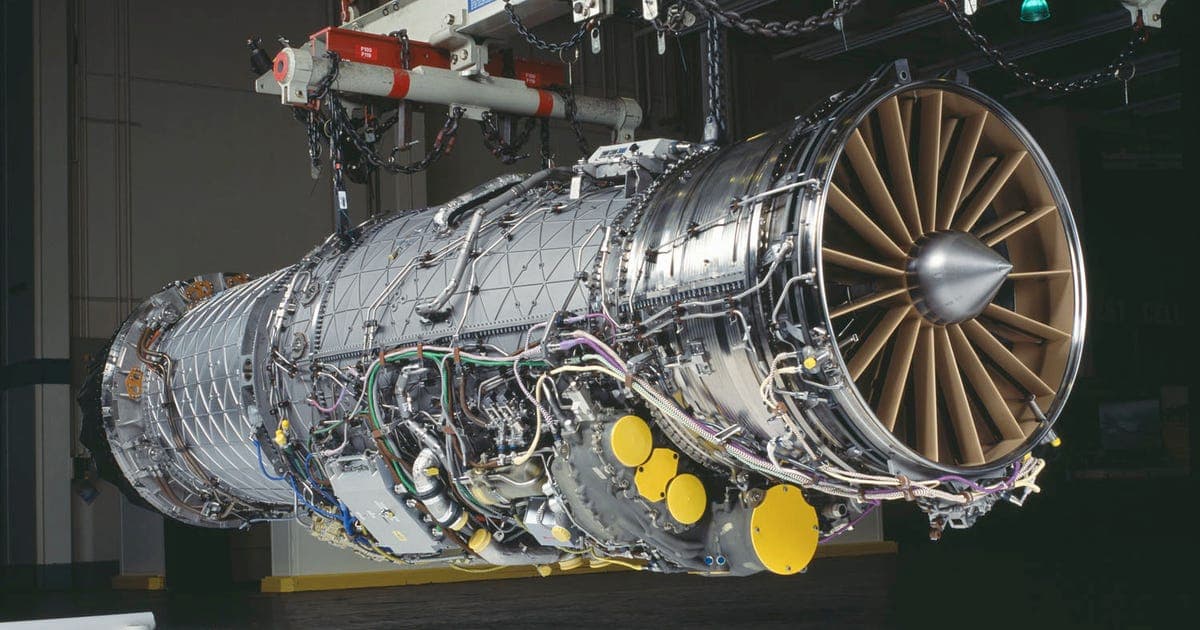
House appropriators and Senate authorizers backed the Air Force’s full $513.7 million fiscal 2027 request for next-generation fighter engines; House authorizers recommended cutting it by $51.4 million. A continuing resolution now holds the program to its fiscal 2026 level just as prototype assembly is due to begin. The reductions behind the 2025 and 2026 delays were made inside the Pentagon.
The Air Force’s Next Generation Adaptive Propulsion (NGAP) program is late again. Its fiscal 2027 budget justification, released in April, stretches prototype fabrication and engine assessments to the fourth quarter of fiscal 2031 and requests $513.7 million to keep GE Aerospace’s XA102 and Pratt & Whitney’s XA103 in competition. The document explains the $187.7 million increase over fiscal 2026 in one line: it is needed “to maintain competitive prototyping.”
Congress has not settled on that number. The House Appropriations Committee approved a bill on June 24 that funds the full request, and the Senate Armed Services Committee recommended authorizing it without change. The House Armed Services Committee recommended $462.3 million, a cut of $51.4 million. None of these bills has been enacted. Fiscal 2027 instead begins Oct. 1 under a continuing resolution that funds the Pentagon at fiscal 2026 rates through Dec. 11. NGAP received $326.0 million in fiscal 2026, and the Air Force planned to award $246.1 million to each engine maker in October.
The squeeze fits a longer pattern. In fiscal 2025 and 2026, the largest reductions against the Air Force’s own plans for NGAP were made in the Pentagon’s funding baseline and in the Air Force’s requests, not by Congress.
NGAP at a glance
- Managed by
- Air Force Life Cycle Management Center propulsion directorate, Wright-Patterson AFB, Ohio
- Competitors
- GE Aerospace XA102 (Evendale, Ohio); Pratt & Whitney XA103 (East Hartford, Conn.)
- Current phase
- Prototype fabrication and engine assessments, 2Q FY2025 to 4Q FY2031
- FY2027 request
- $513.681M: $246.112M each to GE and Pratt, $21.457M program management
- Planned funding
- $905.7M FY2028, $865.0M FY2029, $303.3M FY2030, $304.9M FY2031, continuing
- Contract ceilings
- $3.5B each, announced Jan. 27, 2025, no funds obligated; work to July 2032
- Airframers
- Boeing, Lockheed Martin and Northrop Grumman hold FY2022 integration contracts; only Boeing funded in FY2026
- Congress, FY2027
- House Appropriations $513.681M; Senate Armed Services $513.681M; House Armed Services $462.313M, a $51.368M cut. None enacted
What $514 million buys
Almost all of the fiscal 2027 request goes to the two engine makers in equal shares. The cost exhibit in the budget justification lists $246.112 million for GE and the same amount for Pratt & Whitney, 95.8% of the total, with the remaining $21.457 million for program management. The split was nearly even in earlier years as well: $237.2 million for GE and $233.9 million for Pratt in fiscal 2025, and $150 million each in fiscal 2026. Across fiscal 2025 through 2027, that comes to about $633 million for GE and $630 million for Pratt.
Those sums sit far below the contract ceilings. In January 2025 the Pentagon raised both companies’ contracts to a ceiling of $3.5 billion each for the prototype phase. Pratt’s ceiling rose from $975 million. No money was obligated when the modifications were announced, and work is scheduled to run through July 11, 2032, for GE and July 13, 2032, for Pratt. The ceiling is the most the Air Force can spend under each contract. The budget line is what it has actually planned.
The budget justification does not commit money to either company after fiscal 2027. Both named engine lines show no cost to complete; later prototype build-and-test funding sits in a separate line with the performer listed as “TBD.” The acquisition strategy says delivery orders for each phase are competed and that performance in the current phase determines progression to the next. That does not by itself signal a downselect, although Air Force officials have said they expect eventually to carry one contender forward, Breaking Defense reported. It does mean the budget does not guarantee two engines beyond next year.
Both companies say they are ready. GE announced on May 11 that its assembly readiness review showed the XA102 on schedule to be awarded the next phase later this year. Pratt & Whitney announced its review on May 8 and said testing of the XA103 is expected in the late 2020s. Jill Albertelli, president of Pratt’s military engines business, called for “stable investment” in propulsion.
Follow the money
The public explanation for NGAP’s delays has been budget pressure. The budget documents show where that pressure came from.
| Fiscal year | What happened | Source |
|---|---|---|
| FY2023 | The Air Force’s request included $67.6 million for NGAP. Congress created a separate NGAP line and added $152.8 million, for a total of $220.4 million | FY2024 RDT&E justification |
| FY2025 | The Air Force’s FY2024 budget planned $579.8 million. The FY2025 request was $562.3 million, and the full-year continuing appropriation provided $562.3 million. The Pentagon’s baseline then set the line at $507.3 million, and actual spending was $489.7 million after a $17.6 million small-business research transfer | FY2024 RDT&E justification; FY2025 and FY2026 R-1; House Report 119-162; FY2027 RDT&E justification |
| FY2026 | The FY2024 budget planned $456.9 million. House appropriators recommended $439.9 million in June 2025, before they had the detailed request. The Air Force then requested $330.3 million. Congress enacted $326.0 million. The $4.3 million difference is NGAP’s share of a $1 billion reduction to research accounts that the fiscal 2026 appropriations law made because small-business research authorities had expired (Sec. 8151 of P.L. 119-75) | FY2024 RDT&E justification; House Report 119-162; FY2026 R-1; FY2027 RDT&E justification; P.L. 119-75 |
| FY2027 | The Air Force requested $513.7 million. House appropriators recommended $513.7 million, and the Senate Armed Services Committee recommended authorizing $513.7 million. The House Armed Services Committee recommended $462.3 million, a $51.4 million cut. None has been enacted | FY2027 R-1; House Reports 119-715 and 119-698; Senate Report 119-127 |
Two reductions stand out. In fiscal 2025, the Pentagon’s baseline put NGAP $55.0 million below the amount Congress provided. The House committee report notes that its enacted figure does not reflect changes the department later made in its baseline for reprogramming. The budget documents do not say why the $55 million came off NGAP.
In fiscal 2026, the Air Force asked for $126.6 million less than its own fiscal 2024 plan, and $109.6 million less than House appropriators had been prepared to provide. The fiscal 2027 justification also notes that the fiscal 2026 budget submission “did not reflect FY 2027 through FY 2030 funding.”
Congress’s record is mixed. In fiscal 2023 it more than tripled the Air Force’s request. In fiscal 2025 it provided the full request, and in fiscal 2026 it enacted the request less NGAP’s share of a statutory, research-wide reduction. Congress has cut before: the Air Force’s fiscal 2021 justification records a $207 million congressional reduction in fiscal 2020, “for funding excess to need,” to the program element that then held both NGAP and its predecessor, the Adaptive Engine Transition Program; the document does not say how much of it fell on NGAP. For fiscal 2027, Congress is split.
The price of two
The Air Force has been open about why it accepted the delay. John Sneden, the service’s portfolio acquisition executive for propulsion, told reporters in July that the program slipped because it wanted to keep two viable engine suppliers and, with a fixed budget, had to split resources between them, Air & Space Forces Magazine reported. “Competition is the gateway that enhances producibility, drives innovation [and] keeps costs down,” he said, according to DefenseScoop. In May, an Air Force spokesperson told Breaking Defense that the new timeline “reflects expanded test and evaluation of NGAP prototypes and allows investigation of test findings.”
The budget documents put numbers on that choice. When the Air Force submitted its fiscal 2024 budget in March 2023, the justification said funding through fiscal 2028 would enable “competitive prototyping through prototype testing” and showed nothing for NGAP after fiscal 2027.
| Fiscal year | FY2024 budget plan, March 2023 | Actuals and plan in FY2027 budget, April 2026 |
|---|---|---|
| FY2024 | 595.4 | 573.8 actual |
| FY2025 | 579.8 | 489.7 actual |
| FY2026 | 456.9 | 326.0 enacted |
| FY2027 | 291.1 | 513.7 request |
| FY2028 | 0 | 905.7 |
| FY2029 | — | 865.0 |
| FY2030 | — | 303.3 |
| FY2031 | — | 304.9, continuing after that |
| Total | about 1,923 | about 4,282 |
| Phase ends | 3Q FY2027 | 4Q FY2031 |
By these budget plans, the phase that was to finish in mid-2027 for about $1.9 billion now runs to the end of fiscal 2031 and about $4.3 billion, with funding continuing after that. The end date has moved before. The Air Force’s fiscal 2021 budget placed the end of detailed design, fabrication and assessments in the second quarter of fiscal 2025.
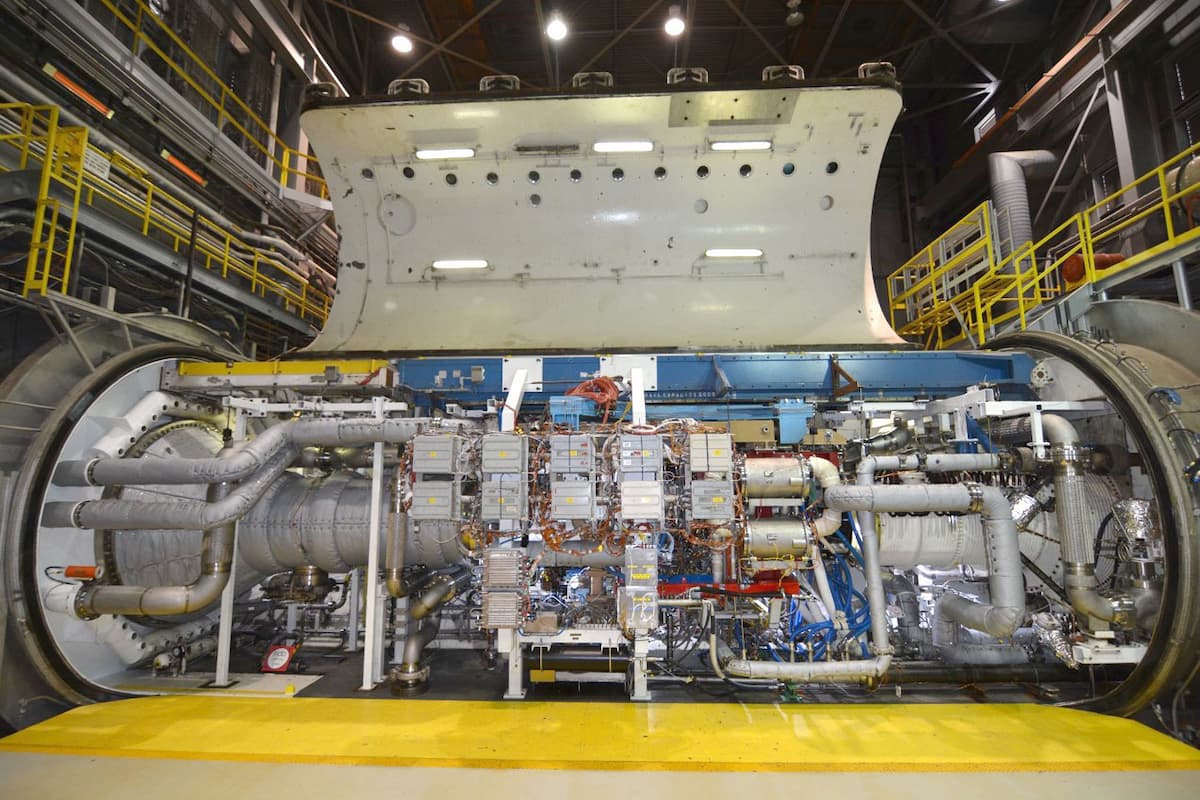
Testing two engines also needs more test capacity. In its fiscal 2025 budget justification, the Pentagon’s central test investment program listed among its fiscal 2024 plans new ground-test power and thermal-load capability for advanced engines, including a threshold requirement of two altitude test cells for competing engine programs. Its fiscal 2025 plans cite NGAP by name as the source of higher thermal loads and power extraction that test facilities must handle. The document does not say where the cells would be or when they would be ready.
FY2027: a split Congress and a stopgap
On paper, fiscal 2027 is the year NGAP’s funding recovers, but Congress has not agreed on how far. The House Appropriations Committee approved its fiscal 2027 defense bill on June 24, and its report, filed June 26, recommends $513.681 million, the full request. The Senate Armed Services Committee voted June 10 and, in its report of June 15, recommended authorizing the same amount. Neither report adds direction on NGAP.
The House Armed Services Committee went the other way. In the funding tables of its report, filed June 15 after a June 4 markup, it recommended $462.313 million, a $51.368 million “program decrease,” and listed the reduction in its savings table for the bill. The report gives no reason. The House passed its version of the authorization bill on July 22 after floor amendments, and the Senate has not taken up its own, according to CRS. No fiscal 2027 defense authorization or appropriations act has been enacted.
In practice, the Pentagon starts the year on a stopgap. The president signed the Continuing Appropriations and Extensions Act, 2027, on Sept. 2. According to the Congressional Research Service, the law funds most programs at a rate based on fiscal 2026 appropriations from Oct. 1 through Dec. 11, a 72-day period. It bars the Defense Department from new starts and from raising production rates above fiscal 2026 levels, and it directs agencies to take only the most limited funding action needed to continue existing activities.
The law’s defense-related anomalies cover Navy shipbuilding cost increases, national security systems in Procurement, Defense-Wide, Navy advances to the Maritime Administration and new-start authority for a military medical training complex in Texas. None covers NGAP or Air Force research and development. Because NGAP was funded in fiscal 2026, it is not a new start.
The fiscal 2027 cost exhibit shows October 2026 award dates for the $246.1 million planned for each engine maker. Whether the Air Force can issue those delivery orders in full, in part or on schedule under the CR is not public. The stopgap may also not be the last. Byron Callan of Capital Alpha Partners has suggested the fiscal 2027 base budget may not clear Congress until spring 2027, Air & Space Forces Magazine reported.
The F-47 will fly first on something else
NGAP was conceived to power the Next Generation Air Dominance fighter. The Air Force awarded the F-47 contract to Boeing in March 2025, the House Appropriations Committee noted. The F-47 is on track for a first flight in 2028, DefenseScoop reported, while Sneden has said NGAP engines should be ready “for potential integration activities in the 2030 timeframe,” Air & Space Forces Magazine reported. The first F-47s will therefore fly with a different engine. Sneden has also stressed that NGAP was built as a platform-agnostic system and that no integration decision has been made.
The budget’s airframer lines point the same way. In the fourth quarter of fiscal 2022, the Air Force awarded NGAP integration contracts to Boeing, Lockheed Martin and Northrop Grumman as well as the two engine makers. In fiscal 2024 each airframer was budgeted $5 million. By fiscal 2026, only Boeing was funded, at $5 million; Lockheed Martin was budgeted $0.6 million in fiscal 2025 and nothing in fiscal 2026, and Northrop Grumman nothing in either year.
What to watch
There is little outside scrutiny to rely on in the meantime. NGAP is not among the programs assessed in the Government Accountability Office’s 2026 annual weapon systems assessment, which leaves the budget documents as the fullest public record of the program’s cost and schedule.
Sources
Primary and official documents
- Department of War — FY2027 Budget Estimates, Air Force Justification Book Volume 2, RDT&E (PDF), April 2026: PE 0604010F, Next Generation Adaptive Propulsion; PE 0604004F, Aerospace Propulsion and Power Technology
- Department of Defense — FY2024 Budget Estimates, Air Force Justification Book Volume 2 of 4, RDT&E (PDF), March 2023: PE 0604004F
- Department of the Air Force — FY2021 RDT&E Justification, PE 0604004F, Stratvocate mirror
- Office of the Under Secretary of Defense (Comptroller) — RDT&E Programs (R-1), FY2027 (PDF), April 2026
- Office of the Under Secretary of Defense (Comptroller) — RDT&E Programs (R-1), FY2026 (PDF), June 2025
- Office of the Under Secretary of Defense (Comptroller) — RDT&E Programs (R-1), FY2025 (PDF), March 2024
- Office of the Secretary of Defense — FY2025 Budget Estimates, RDT&E Defense-Wide, Volume 3 of 5 (PDF), March 2024: PE 0604940D8Z, Central Test and Evaluation Investment Program
- U.S. Department of Defense — Contracts for Jan. 27, 2025, for the $3.5 billion ceilings on both prototype contracts
- House Committee on Appropriations — Department of Defense Appropriations Act, 2026, H. Rept. 119-162 (PDF), June 16, 2025
- House Committee on Appropriations — Department of Defense Appropriations Act, 2027, H. Rept. 119-715 (PDF), June 26, 2026
- House Committee on Appropriations — Committee Approves FY27 Defense Appropriations Act, June 24, 2026
- House Committee on Armed Services — National Defense Authorization Act for FY2027, H. Rept. 119-698 (PDF), June 15, 2026: sec. 4201 funding table and the committee’s savings table
- Senate Committee on Armed Services — National Defense Authorization Act for FY2027, S. Rept. 119-127 (PDF), June 15, 2026
- U.S. Congress — Consolidated Appropriations Act, 2026, P.L. 119-75 (PDF), Feb. 3, 2026: Division A, sec. 8151
- Congressional Research Service — FY2027 NDAA: Status of Legislative Activity (IN12704), updated Sept. 1, 2026
- Congressional Research Service — Overview of Continuing Appropriations for FY2027, Division A of P.L. 119-103 (R49353), Sept. 17, 2026
- The White House — Congressional Bill H.R. 6500 Signed into Law, Sept. 2, 2026
- Government Accountability Office — Weapon Systems Annual Assessment, GAO-26-108457, July 2, 2026
Trade press and analysis
- GE Aerospace — GE Aerospace Clears Assembly Readiness Review of Adaptive Cycle Engine for U.S. Air Force, May 11, 2026
- RTX — RTX’s Pratt & Whitney completes fully digital assembly readiness review for NGAP engine, May 8, 2026
- Breaking Defense — Air Force sees another year delay for next-gen engines, May 2026
- Air & Space Forces Magazine — USAF Preps Next-Gen Engine Testing Ahead of 2030 Integration onto Aircraft, July 28, 2026
- Mikayla Easley — Air Force aims to have next-gen engine ready for aircraft integration by 2030, DefenseScoop, July 30, 2026
- Greg Hadley — Congress Passes Short-Term Funding Bill, Putting DOD’s $1.5T Budget Ask on Hold, Air & Space Forces Magazine, Sept. 1, 2026