Berlin signed for a Poseidon simulator in 2023 and hoped to have it in 2027. The U.S. Navy put the contract on Boeing in 2026, with work running to 2031. Two weeks after that contract, Congress was told the fleet it serves may grow from eight aircraft to 12.
On May 19, 2026, the Pentagon announced a $251,063,227 firm-fixed-price and cost-plus-fixed-fee award to Boeing in St. Louis for P-8A Poseidon training systems for the government of Germany. The contract covers procurement, software development, integration, installation and acceptance, and the devices it names are operational and weapons tactics trainers, maintenance trainers, electronic classrooms, briefing and debriefing stations, and mission systems trainers. Logistics, engineering and technical support to field the capability are also included.
Ninety percent of the work is in St. Louis and 10% at the German naval air station in Nordholz. It is expected to be complete by August 2031. The contract was not competed. The contracting activity is Naval Air Warfare Center Training Systems Division in Orlando.
Read on its own, this is a routine Foreign Military Sales award. Placed on Germany’s P-8A timeline, it shows how far behind the aircraft the ground-based training system trails, and why this contract is unlikely to be the last.
Signed in 2023, contracted in 2026
Germany’s decision chain on the simulator runs four years ahead of the Navy’s contract. The Bundestag’s budget committee approved the purchase on July 6, 2022, at €181.4 million, for a simulator with a virtual classroom and ancillary services for aircrew and maintenance personnel. On May 25, 2023, Annette Lehnigk-Emden, president of Germany’s defense procurement office, BAAINBw, signed an FMS agreement for a P-8A “Weapon System Trainer.” The office said the signature authorized the U.S. Navy to contract with Boeing on Germany’s behalf. The agreement also covered other training aids, software and support. The office said the simulator was to be available to Naval Air Wing 3 in Nordholz in 2027, and it put the value at about €180 million.
The Navy’s May 2026 contract fits that description: a German training system delivered by Boeing through an FMS case. Neither government has publicly tied the two documents together, however. The euro figure and the dollar figure are not directly comparable, since the scope may have changed and the U.S. contract includes a share of work for Canada.
The August 2031 completion date is also not the same thing as the 2027 target. The contract covers support as well as devices, and delivery dates for individual trainers have not been published. Whether the simulator will reach Nordholz in 2027 is a question only the Bundeswehr can answer. The comparison the German side itself invites is instructive: BAAINBw called the aircraft buy a record for an acquisition of its size, four years from contract to first delivery. Four years after the budget committee cleared the simulator, the contract to build it had only just been signed.
The aircraft got there first
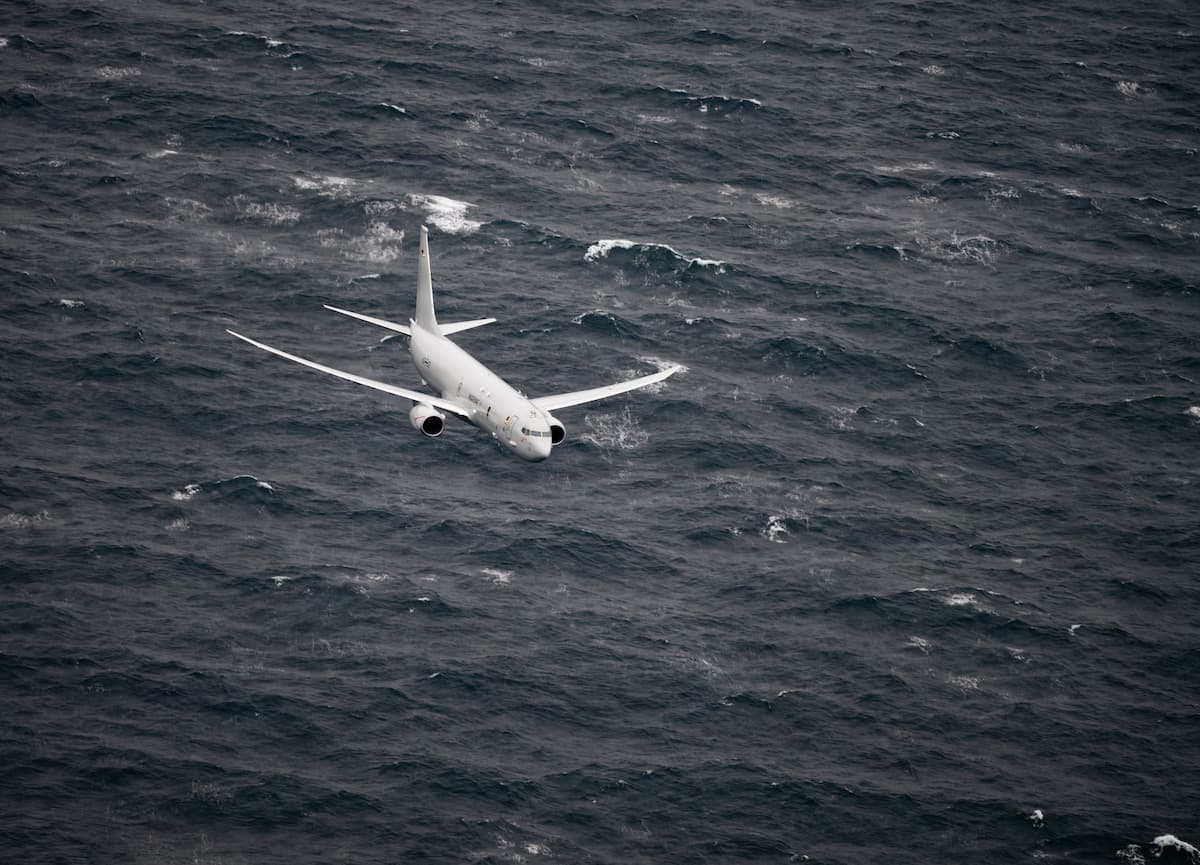
The first German P-8A landed at Berlin Brandenburg Airport on November 7, 2025. Crews of Naval Air Wing 3 flew it over from the United States by way of Iceland. The Bundeswehr said the other seven are to follow by 2029, and it put the investment in the eight aircraft at more than €3 billion. A German procurement tracker puts the same eight at about €2.4 billion, a figure that totals what the budget committee approved for purchase rather than what the fleet costs to run. By the Berlin air show in June 2026, three of the eight were at Nordholz, with the fourth and fifth due by September, completing the lot of five ordered in June 2021.
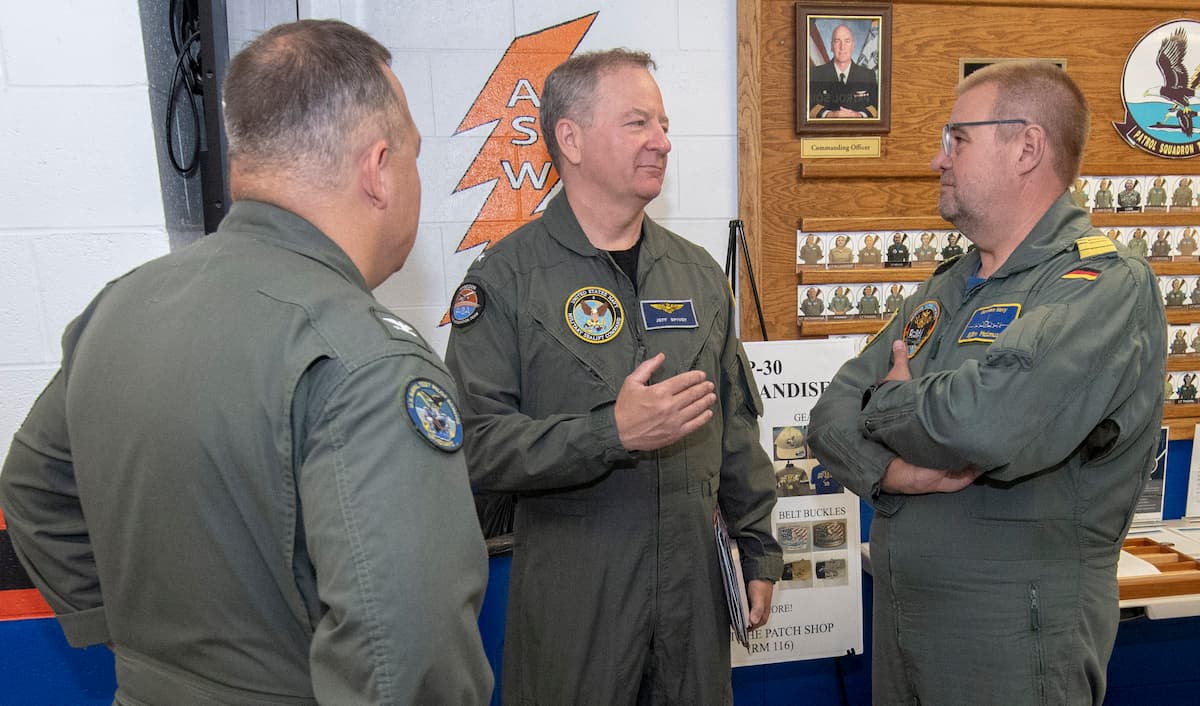
Training therefore began outside Germany, and it is still split between two locations. German crews have been doing six-month conversion training with the U.S. Navy in Jacksonville, Florida, and the Bundeswehr expected the last crews to finish there by mid-2026. On November 18, 2025, pilot training began at Lufthansa Aviation Training in Berlin-Schönefeld, which runs a six-week Boeing 737 type rating in cooperation with ASEC, a U.S. training partner of the Navy. Lufthansa Aviation Training says future German P-8A pilots are trained both in the United States by ASEC and at its Berlin center, which runs the type rating itself. Trade reporting at the time of the first delivery said instruction in the United States would continue through mid-2026, after which Germany would stand up its own training programme.
That arrangement may explain a gap in the May contract. The Pentagon’s list of devices does not include an operational flight trainer, the cockpit simulator used for pilot training. Canada’s P-8A training order does list operational flight trainers. Two caveats apply: the wording “to include” is not necessarily a complete inventory, and no official source has said that the Lufthansa arrangement replaces a German flight simulator.
| Device named | Germany, May 2026 | Canada, July 2025 |
|---|---|---|
| Operational flight trainer | — | yes |
| Weapons tactics trainer | yes | yes |
| Mission systems trainer | yes | — |
| Maintenance trainer | yes | virtual maintenance trainer |
| Part task trainer | — | yes |
| Training systems support center | — | yes |
| Electronic classrooms | yes | yes |
The fleet grew after the contract
The aircraft are arriving on schedule while the training system is not, and the fleet the system was sized for is already changing. Germany’s P-8A case began with one notification and has been amended three times. The original, delivered to Congress on March 12, 2021, covered five aircraft with training devices and maintenance trainers and classrooms, at an estimated $1.77 billion, of which major defense equipment was $1.10 billion. On April 1, 2022, infrared countermeasures equipment and other items were added, worth $13.5 million, and the case total stayed at $1.77 billion because the pricing had been factored into the original. On July 31, 2023, three aircraft were added, again with training devices; major defense equipment rose by $800 million to $1.9 billion and the case total rose to $3.2 billion.
The German parliament’s budget committee approved those three aircraft on November 16, 2023. The defense ministry noted then that the simulator had already been approved for the crews of all eight.
Then, on June 2, 2026, just 14 days after the Boeing award was announced, Congress received Transmittal 26-0Y. It reports four more P-8As for Germany, with “training and training devices” among the added items. The new items are estimated at $3.7 billion, the case value rises to $6.9 billion, and major defense equipment accounts for $4.3 billion of that total.
| Notification | Delivered to Congress | Aircraft | Case value after |
|---|---|---|---|
| 21-24, original | Mar 12, 2021 | 5 | $1.77B |
| 0D-22 | Apr 1, 2022 | — | $1.77B |
| 23-0M | Jul 31, 2023 | +3 | $3.2B |
| 26-0Y | Jun 2, 2026 | +4 | $6.9B |
A U.S. notification is not a German order. In April 2026, the head of the German Navy, Vice Adm. Jan Christian Kaack, was reported as saying the purchase of four more aircraft was imminent, which would take the fleet to 12, the figure the Navy’s own “Kurs Marine” planning document sets as its requirement. Parliamentary approval does not appear to have followed. A running list of German naval procurement projects still described the four aircraft in July 2026 as something the Navy was about to order, and the agenda of 12 items for the budget committee’s September 23, 2026 session does not include them.
If Berlin does buy the four aircraft, the notification already carries training devices for them, inside a non-MDE component that the transmittal says rises by $1.3 billion to $2.6 billion. That points to further training work on top of the $251 million.
A Canadian line in a German contract
One sentence in the award goes beyond Germany. The contract incorporates cost-sharing for common software development supporting Canada’s future P-8A training system procurement, which the announcement says reduces overall development costs through shared investment.
Canada’s hardware is already on order. On July 29, 2025, the Pentagon announced a $37,909,683 order to Boeing for simulator integration kits and long-lead items for P-8A Canada Training Systems, to be completed in November 2029, supporting operational flight trainers, weapons tactics trainers, part task trainers, virtual maintenance trainers and other devices. That order was funded in full at award and, like the German contract, was not competed.
How much of the German contract pays for common software is not disclosed. Part of the $251 million is therefore shared development whose size is unknown, and the figure should not be read as the price of German trainers alone.
Money up front, and a second vehicle
At award, $228,783,604 in FMS customer funds was obligated against the German contract. That is 91.1% of its value, none of it expiring at the end of the fiscal year. Canada’s smaller order was obligated at 100%.
Canada, July 2025 $37.91M of $37.91M = 100%
IDIQ, June 2026 $0 of $880M ceiling = 0% Funds obligated at award. The two FMS contracts are funded with customer money up front; the indefinite-delivery vehicle is funded order by order, which is why its ceiling and the other two figures are not comparable quantities.
That third line is the one worth reading closely. On June 18, 2026, the Navy awarded Boeing an $880 million P-8A training systems IDIQ, also without competition, covering procurement, modernization and sustainment of aircrew and maintenance trainers. The announcement frames it as supporting U.S. Navy fleet readiness and evolving aircraft configurations. Its work locations tell a wider story.
- Edinburgh, South Australia
- 2% · RAAF Edinburgh
- Lossiemouth, United Kingdom
- 1% · RAF Lossiemouth
- Ohakea, New Zealand
- 1% · RNZAF Ohakea
- Gyeonsangnam-Do, South Korea
- 1%
- Wurster Nordseeküste, Germany
- 1% · contains Nordholz
- Greenwood and Comox, Canada
- 1% each
- Singapore · Trondheim, Norway
- 1% each
The announcement names no ordering customers. But a vehicle whose stated purpose is U.S. Navy readiness, and whose work is placed at the home bases of Australia, Britain, New Zealand, South Korea, Germany, Canada, Singapore and Norway, is built to serve more than one navy. It runs to June 2031, the same horizon as the German contract, and it is a plausible channel for later German trainer work.
What to watch
Sources
Primary and official documents
- Department of War — Contracts for May 19, 2026, for the German award: value, contract type, device list, Canada cost-sharing, work split, completion date, $228,783,604 obligated, not competed, N6134026C1006
- Department of War — Contracts for June 18, 2026, for the $880 million IDIQ: scope, stated purpose, all twelve work locations, completion June 2031, no funds obligated at award, not competed, N6134026D1006
- Department of War — Contracts for July 29, 2025, for the $37,909,683 Canada order, N6134025F8000, its device types and November 2029 completion
- Federal Register — Arms Sales Notification, Transmittal 21-24, 86 FR 57650, October 18, 2021, for the original five aircraft, training devices, $1.77 billion and the March 12, 2021 delivery date
- Federal Register — Arms Sales Notification, Transmittal 26-0Y, 91 FR 36576, June 17, 2026, for the case history, the four added aircraft with training and training devices, and the revised case values
- BAAINBw, via presseportal.de — BAAINBw beschafft Simulator für P-8A Poseidon, May 26, 2023, for the May 25 signature, the Weapon System Trainer, the 2027 availability target and the €180 million figure
- German Federal Ministry of Defence — Beschaffung neuer Dingos und Seefernaufklärer gebilligt, November 17, 2023, for the budget committee’s approval and the note that the simulator covered crews of all eight aircraft
- Bundeswehr — Erster neuer Seefernaufklärer in Deutschland gelandet, November 7, 2025, for the landing, the routing via Iceland, the seven remaining aircraft by 2029 and the €3.1 billion figure
- Bundeswehr — Training for German naval aviators in the USA, July 31, 2025, for the six-month Jacksonville course and the mid-2026 completion expectation
Trade press and analysis
- Lufthansa Aviation Training — Lufthansa Aviation Training launches pilot training for the German Navy’s P-8A, November 19, 2025
- Sicherheit & Verteidigung — Beschaffungsvorhaben der Marine, procurement timeline, for the budget committee’s July 6, 2022 approval of the simulator at €181.4 million and the November 16, 2023 approval of three more aircraft
- Sicherheit & Verteidigung — Beschaffung vier weiterer P-8A Poseidon steht kurz bevor, April 23, 2026, for Vice Adm. Kaack’s reported statement. The date of the statement itself is not given
- Sicherheit & Verteidigung — Nächste Woche im Haushaltsausschuss, September 18, 2026, listing all 12 items on the budget committee’s September 23 agenda, none of them the P-8A
Editor’s note: euro and dollar figures in this article are not directly comparable, because the scope of the German case may have changed between 2023 and 2026 and because the U.S. contract carries an undisclosed share of Canadian software development. Case values in the arms-sales notifications are U.S. estimates, not contract amounts. Vice Adm. Kaack’s remark is dated to its publication, not to when it was made.