Ukrainian authorities, open-source analysts, and defense officials describe the first operational use in mid to late October. Debris and near-intact examples recovered in Kharkiv and Poltava regions show production has moved beyond trials.
Powered Variants Claim 150 to 200 km Range
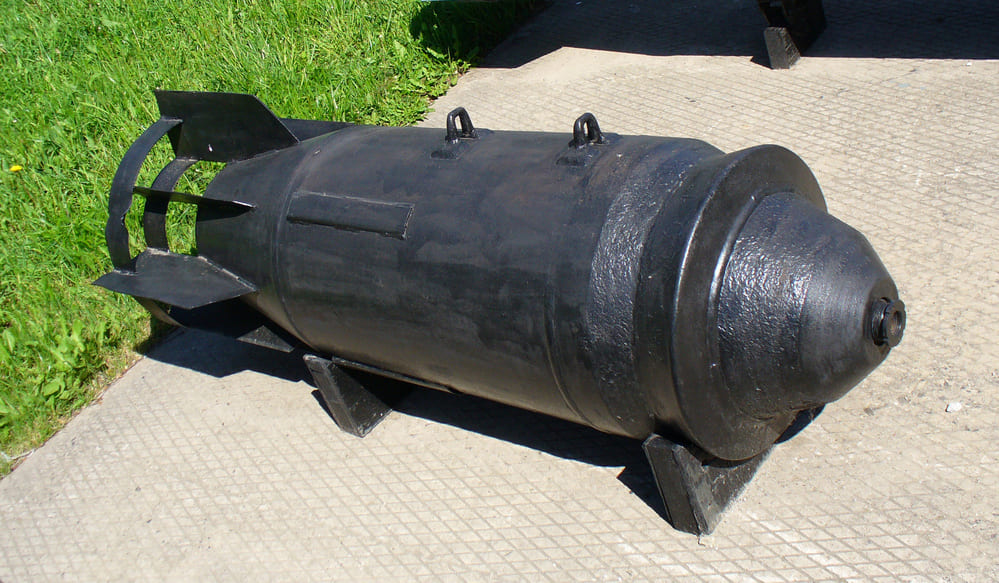
Visual evidence from October shows a powered evolution of Russia’s clamp-on wing kits paired to 500-kg class bombs. Two labels appear in official and semi-official channels. One is a powered version of the long-wing UMPK kit, referred to as UMPK-PD. The other is a heavier guided bomb line, UMPB-5R, which Ukrainian authorities and analysts tied to October strikes. Both families aim to push release distances well beyond the front by bolting guidance, wings, a power source, and now a small turbojet onto standard bombs.
Ukrainian military intelligence described tests in September and October, followed by an industrial ramp. Maj. Gen. Vadym Skibitskyi said the new guided bomb completed trials with a range “up to 193 km” and is entering mass production. He also pointed to improved guidance modules that hold lock under electronic warfare better than early kits. Defense officials confirm those trials concluded before the first documented field uses.
Aerodynamic changes separate the latest kits from the first UMPK frames. Early clamp-on modules used a single pop-out wing. Current powered sets show extended fixed wings and a revised three-fin tail, with longer chord and cleaner joints to the bomb body. The geometry supports higher lift in thin air and steadier control at release speeds typical for Su-34 sorties. Russian sources around the aviation community claim the unpowered long-wing kit can pass 100 km in favorable profiles and that the turbojet variant pushes the envelope toward 150-200 km when released at altitude. Ranges vary with altitude, speed, and air temperature, so figures should be read as profile-dependent rather than absolute.
The UMPB line exists alongside UMPK rather than replacing it. UMPB D-30SN, introduced earlier, resembles a lighter, cleaner glide munition with its own guidance body. UMPB-5R scales up mass and uses a full tail unit rather than a clamp. Ukrainian statements and imagery link the powered sub-variant to strikes in the third week of October, which fits a short transition from testing to combat use.
Lozova and Poltava Debris Match SW800Pro-Y Turbojet
The Kharkiv Regional Prosecutor’s Office reported the first use in Lozova on October 18, identifying “a guided aerial bomb of a new modification – UMPB-5R (jet type)” and estimating a launch distance near 130 km from occupied territory. Several wounded and residential damage were recorded. The statement presented the “first use” note specific to Lozova and put a preliminary range figure on the record. Two days later, a powered glide bomb failed to detonate in Poltava oblast; responders documented a largely intact body with a long rear fairing, redesigned tail, and a guidance section consistent with the newer kits.
Hardware from those finds and from separate debris photos lines up with a commercial off-the-shelf model-turbine form factor. Markings, compressor face, and mounting lugs match the Chinese Swiwin SW800Pro-Y family widely sold for large radio-controlled jets. The same engine class already appears in hobby markets with published thrust ratings around 180 pounds, which suits a role where the wing carries most of the lift and the motor extends time aloft rather than driving high speed. According to industry sources, Russian shops can adapt such turbines with straightforward fixtures, fuel pumps, and a compact ECU without deep redesign.
Imagery of Su-34s during the same period shows FAB-500-series bombs mated to longer wings, with the powered fairing not always visible from the common angles used in ramp and taxi photos. That mismatch now makes sense after ground photos exposed the rear fairing and intake hardware. A powered kit can share airframes, pylons, and most of the tail unit with the unpowered long-wing set, letting squadrons mix loads and crews and armorers keep familiar procedures.
Ukrainian media and OSINT groups tracked several powered-bomb incidents that week in deeper-rear areas than typical for the first-generation UMPK strikes. Reports place additional cases in Poltava and Dnipropetrovsk regions after Lozova. The pattern hints at limited prototype batches fielded on selected sorties rather than wide issue across all bomber regiments. Officials confirm only isolated uses so far and describe a “check of air defense reactions” rather than a flood of new munitions.
FAB-500T Payload and Air Defense Impact
Payload choice matters because the tail section on older FAB bodies complicates a full guidance unit swap. The FAB-500T variant uses a heat-resistant body and a bolted tail, which simplifies removal of the original section and installation of a purpose-built tail with actuators and a power source. The “T” model traces back to MiG-25RB carriage, where thermal resistance at very high speed and altitude served reconnaissance-bomber profiles. A stockpile question remains, yet the T-variant’s structure makes it attractive for the powered kit even if other FAB bodies also see use.
Launch profiles seen in Russian training footage and inferred from attack geometry center on high-altitude releases by Su-34s. Crews can orbit inside Russian air defense coverage, accelerate, climb, and release without crossing into the engagement baskets of many Ukrainian medium-range systems. Earlier unpowered UMPK drops already showed 60-70 km reach from altitude. The powered kit opens arcs that extend well past 100 km, which pushes weapons footprints onto cities and junctions deeper behind the line.
During the glide phase, radar cross-section is modest and the thermal signature is small. The turbojet adds exhaust heat when it runs, but thrust is limited, so plume intensity does not approach a cruise missile’s signature. Local air defense units that focus on drones and cruise missiles must now assign sensors and interceptors to low-contrast objects approaching at transonic speeds on shallow descent angles. Radar siting and cueing become more sensitive to terrain and multipath effects, especially around built-up areas.
Navigation hardening shows up in the antenna layouts captured in late-October images. Some guidance sections carry 12-element controlled-reception arrays instead of earlier eight-element discs that featured through the spring and summer. Ukrainian electronic warfare degraded many UMPK drops earlier this year by cutting satellite reception or forcing larger circular error probable. Extra elements and better filtering improve resistance to those tactics. Officials confirm upgrades to the guidance modules across recent production blocks, which aligns with the antenna changes visible on debris.
Damage profiles recorded after the October cases match the expected effects from a 500-kg class body with a thick-cased charge rather than a large blast-fragmentation filling. Concrete damage and spalling, collapsed interior walls, and shrapnel fields limited to immediate surroundings show up in police and emergency photos from Lozova. UMPB-style bodies appear built for penetration and structure demolition in a single hit rather than area fragmentation over large radii. That choice fits typical Russian employment near rail or industrial nodes and around defensive works, but the power against residential blocks remains severe at short slant ranges.
Terminal intercepts against glide bombs can work when the approach vector crosses defended corridors tied to fixed sites. Points with layered systems and short-range missiles or guns can attrit some inbound weapons near the endgame. Navigation denial remains a lever if jamming teams can maintain power and geometry against the improved receivers. The problem rests in coverage density and cost per defended site, not in any magic immunity of the bombs to interception.
Production Outlook and Electronic Warfare Upgrades
Procurement signals suggest steady but limited output in the near term. Defense officials confirm series production started after the September-October trials, yet field accounts still count powered-bomb uses in the single digits across late October. Workshop time per kit rises once a turbine, fairing, fuel feed, and ECU enter the bill, so volumes will lag the simple clamp-on UMPK that Russian bomber units drop in high numbers each day. According to industry sources, factories can speed wing-kit assembly more easily than they can scale the powered sub-assemblies, which adds a natural brake on rollout.
The SW800Pro-Y class of model turbines sells widely through civilian distributors. The units offer enough thrust to stretch time aloft on a 500-kg body once the bomb has initial speed and lift from the wings. A powered glide bomb with this architecture uses the engine to extend range more than to add speed. Hobby-market turbines do not solve every constraint, but they arrive quickly and mount with modest adaptation. Field maintenance should stay within the skill set of aviation technicians used to handling UAV powerplants, fuel lines, and simple controls.
Reliability looks mixed, which is normal in a first deployment. One Poltava example survived impact with the body largely intact, which points to either a fuse fault, a control-law lapse, or a motor problem. Earlier UMPK wings sometimes failed to lock after release. The powered kits show redesigned wing locks and a pyrotechnic assist referenced by Russian sources; those changes likely target the chronic deployment failures from the first wave of clamp-on modules. Crews will still face duds as tolerances settle in production and as guidance code hardens against jamming.
Accuracy depends on the guidance blend and on how the kit rides turbulence and crosswinds over long glides. Satellite-aided inertial guidance offers acceptable precision against large fixed targets when receivers stay locked. Electronic warfare degrades that picture. Ukrainian units demonstrated earlier this year that well-placed jamming complexes can push CEP wider than a typical city block. The improved multi-element antennas narrow that advantage but do not erase it. Officials confirm better resistance to electronic warfare than spring-summer baselines, and that matches the antenna and receiver changes visible on recent tail units.
Economics favor continued use even at limited scale. A powered kit costs more than a bare UMPK set but remains far cheaper than a cruise missile. Russian planners can conserve high-end stocks by assigning powered bombs to targets inside the 120-180 km band and saving cruise missiles for very long-range strikes or heavily defended hubs. Ukrainian planners must assume that band remains at risk on days when bomber orbits operate under strong Russian air defense coverage.
Naming will likely stay messy for some time. UMPK-PD and UMPB-5R both appear in official and semi-official phrasing, sometimes applied to similar hardware with minor differences in tails, wings, or the way the kit attaches to the bomb body. Field photos show enough common parts to suggest a shared supply chain across sub-variants. Western readers can treat them as a powered wing-kit family sized for 500-kg class bodies until more definitive factory documentation surfaces in public.
Operational summaries from the week of October 18 list glide-bomb strikes in locations that earlier sat outside typical UMPK rings. Lozova in Kharkiv region is the first public case for a jet type UMPB-5R near 130 km launch distance. A Poltava case soon followed with a failed detonation that gave investigators a close look at the powered tail and fairing. Officials confirm additional incidents in Dnipropetrovsk region in the same window. The spread of locations suggests deliberate testing of defended zones and reactions rather than broad fielding.
Production scale will decide pressure over the winter. Russian bomber regiments already run heavy daily use of unpowered UMPK. Powered kits draw from the same bombs, wings, and guidance stock and add a turbine and fuel system that take extra time and parts. According to industry sources, shops that build UAV engines and small cruise devices can support the turbine side, but supply will trail demand for months. That gap keeps powered-bomb usage selective and focused on targets where extra standoff matters most.
The impact on Ukrainian air-defense posture shows up in sensor tasking and crew workload. Radar crews must search for small returns at longer ranges and shallow altitudes and still track drones and cruise missiles. Dispatchers will juggle alerts over wider arcs when bomber racetracks shift, which complicates manning for point defenses. Our analysis shows the powered kit tightens detection to intercept timelines and forces defenders to cover approach sectors that previously carried lower risk.
REFERENCE SOURCES
- https://www.twz.com/air/russia-is-now-launching-powered-glide-bombs-at-ukraine
- https://theaviationist.com/2025/10/25/russia-new-jet-powered-glide-bomb/
- https://www.longwarjournal.org/archives/2025/10/russia-deploys-new-longer-range-bombs-in-war-against-ukraine.php
- https://kyivindependent.com/russia-hits-kharkiv-oblast-with-new-rocket-powered-guided-bomb-for-first-time/
- https://gwaramedia.com/en/russia-starts-to-use-of-jet-powered-glide-bombs-type-with-flight-range-of-over-60-80-miles-military-says/
- https://gwaramedia.com/en/russia-launches-rocket-powered-glide-bomb-on-poltava-oblast-from-belgorod-region/
- https://understandingwar.org/research/russia-ukraine/russian-offensive-campaign-assessment-october-24-2025/
- https://eadaily.com/en/news/2025/10/18/the-aerial-bomb-from-the-umpk-for-the-first-time-flew-to-lozovoy-kharkiv-prosecutors-office
- https://militarnyi.com/en/news/prosecutor-s-office-russia-uses-newly-modified-bomb-on-kharkiv-region-for-the-first-time/
- https://www.kyivpost.com/post/62530
- https://x.com/JohnH105/status/1980335059887616353
- https://x.com/OSINTWarfare/status/1981401818438549685