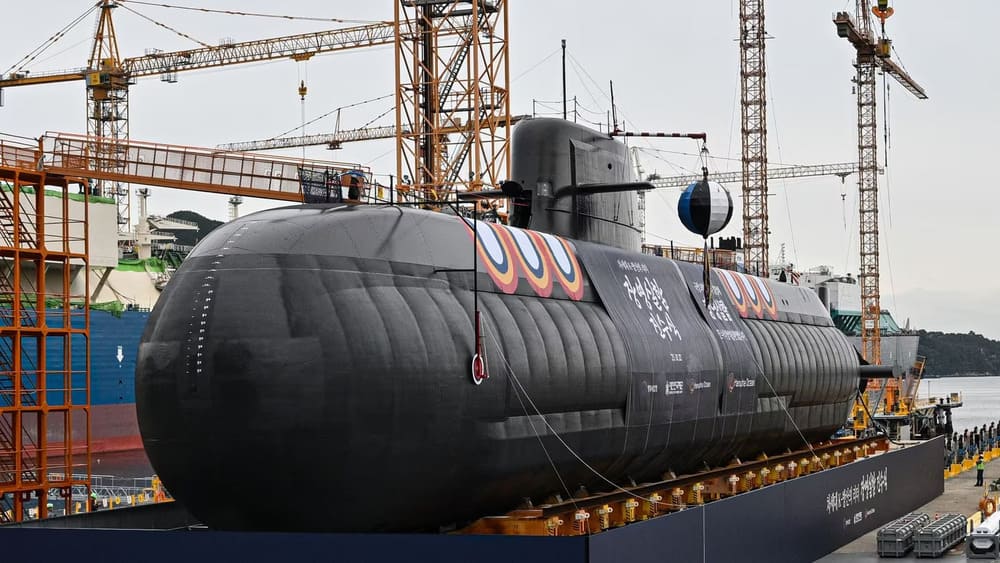
South Korea launched ROKS Jang Yeong-sil (SS-087) on Oct 22 at Hanwha Ocean’s Geoje yard. It is the first KSS-III Batch II boat, a domestically built 3,600-ton class. The Navy and Defense Procurement Agency led the ceremony and set delivery for late 2027 after trials.
Officials placed the boat on an acceptance track that runs through a long system test phase and sea trials before handover.
“I believe the Jang Yeongsil, built with our own technology, will mark a new leap toward a smart and powerful military and fulfill its role as the main force in ensuring maritime security,” Adm. Kang Dong-gil, the Navy’s chief of staff, said at the launch.
Batch II Upgrades Include 10-Cell VLS and Extended Hull
Batch II stretches the KSS-III hull to roughly 89 meters and adds displacement over the Batch I Dosan Ahn Chang-ho class. The bigger hull houses new combat and sonar suites and more automation to cut crew workload and tighten reaction times.
The most visible change sits behind the sail. Batch I mounted six Korean vertical launch system cells for land-attack cruise missiles and the conventionally armed K-SLBM. Batch II grows that battery to ten cells, a 66 percent bump that widens salvo options and payload arrangements. Industry reporting after the launch highlighted the ten-cell module as the center of the strike upgrade.
A larger internal volume also supports upgraded processing for the integrated mast and sonar arrays. The Navy points to improved passive detection and classification in shallow, noisy waters, a tough environment in the region. According to industry sources, Batch II pushes more of the combat system hardware and software to local suppliers than earlier boats, part of a steady indigenization trend in the program.
The launcher itself preserves cold-launch ejection for ballistic missiles and supports cruise missile canisters. That flexibility keeps the torpedo room free for torpedoes, decoys, and mines rather than forcing a trade. Reporting before and after the ceremony consistently lists ten K-VLS cells as the Batch II standard.
Lithium-Ion Batteries and Air-Independent Propulsion Integration
The Jang Yeong-sil is South Korea’s first submarine to carry lithium-ion batteries alongside an air-independent propulsion unit. That pairing raised submerged endurance and gives the boat higher sustained speeds on battery during low acoustic output. Press accounts from the launch week confirmed the new battery pack and dual-power approach.
Lithium-ion cells offer faster charge cycles and deeper discharge without the efficiency penalties seen on lead-acid banks. The Navy frames the change as a way to stay underwater longer and maneuver during sensitive phases of a mission. Reporting on the class notes added quieting on Batch II, including coatings and isolation to trim machinery vibration.
Lithium-ion propulsion changes daily operations under the waterline. Crews can hold higher batteries for longer and recover charge faster, which cuts snorkeling windows. The Navy’s statements in local media highlighted longer submerged operation and higher-speed maneuvers made possible by the new pack. The AIP unit on board supplements that during hotel power and low-speed propulsion without air, extending time on task.
South Korean industry has pursued maritime fuel-cell work for several years, which dovetails with the auxiliary AIP fit on KSS-III. Recent approvals in principle for marine hydrogen fuel-cell systems signal a maturing supply base in country, though officials did not release internal module specs for this boat. Public tech notes and industry news from the last year show steady progress on maritime fuel-cell systems in South Korea. Acoustic measures noted in open reporting include anechoic coatings and vibration isolation to lower radiated noise.
K-SLBM, Hyunmoo Cruise Missiles and Torpedo Armament
The ten-cell vertical launcher is sized for the K-SLBM commonly referred to as Hyunmoo 4-4. South Korea conducted SLBM tests from a KSS-III in 2021, and officials and press noted a roughly 500 kilometer class missile derived from the Hyunmoo-2B. Batch II is built to carry more of them and to fire on short notice after a quiet transit.
Beyond ballistic missiles, the KSS-III architecture supports land-attack cruise missiles from the same launcher family. Open sources have long tied the program to Hyunmoo-3 variants for standoff strike. Those sit alongside heavyweight Tiger Shark torpedoes fired from six 533 mm tubes. The arrangement lets the boat hit fixed targets ashore, warships at sea, submarines, or seed a minefield as needed.
The torpedo battery remains six 533 mm tubes compatible with Tiger Shark heavyweights and mobile mines, providing the core anti-ship and anti-submarine punch. Those tube-fired options combine with the vertical battery to let commanders set the boat up for strike, sea denial, or layered deterrence assignments as the theater demands.
Development of a hypersonic cruise missile named Hycore has advanced through test flights since last year. Public material indicates the concept spans ship, air, ground and potentially submarine launch in time. Seoul has not declared a submarine integration plan or schedule, but the ten-cell module preserves future options if requirements and engineering line up.
Trials Schedule and Canadian Submarine Export Campaign
Defense officials confirm the Jang Yeong-sil now moves into harbor tests, builder trials, and Navy trials before commissioning near the end of 2027. Two additional Batch II hulls are in build, running into the late decade. The production line at Geoje remains the central site for outfitting and test.
The launch arrives as South Korea positions KSS-III for export. Canada has shortlisted two foreign yards for its Canadian Patrol Submarine Project, and South Korea’s bidder has been active during partners and outreach. Public briefings in Canada and Korea over the past two months describe a proposal that adapts KSS-III for under-ice patrols and promises early deliveries from an active line.
On Oct 30, Canada’s prime minister and defense leaders toured the Hanwha Ocean yard at Geoje during an Asia trip and viewed the submarine now afloat. The visit underscores how far the boat had progressed toward trials and how visible the program has become in export circles.
Program officials in Seoul emphasize the domestic content percentage, localized combat system elements, and the new powertrain as selling points. According to industry sources, the Batch II variant pitched abroad keeps the ten-cell launcher and battery-AIP pairing, then adjusts sensors and mission systems to national requirements.
Export activity followed the launch. Canada narrowed its submarine search to two qualified suppliers and sent senior leaders to Geoje on Oct 30. The visit occurred just days after Jang Yeong-sil entered the water. Canadian think-tank and industry updates describe proposals based on KSS-III for Arctic operations during deliveries in the mid-2030s if selected.
“As the Navy’s first 3,600-ton-class submarine, the ROKS Jang Yeong-sil is a world-class diesel-electric submarine and a core strategic asset with enhanced capabilities to respond to various maritime threats,” the Navy and procurement agency said.
Our analysis shows the step from six to ten vertical cells matters more than raw tonnage growth. The extra cells give planners the margin to combine ballistic and cruise weapons without stripping torpedo room inventory, a practical gain for continuous at-sea deterrence missions and for conventional strike packages that demand multi-axis saturation. The lithium-ion bank does similar work on the endurance side, lifting on-battery dash time and reducing the number of snorkeling windows a patrol must schedule.
REFERENCE SOURCES
- https://www.navalnews.com/naval-news/2025/10/hanwha-ocean-launches-first-kss-iii-batch-ii-submarine/
- https://www.koreatimes.co.kr/southkorea/defense/20251022/s-korea-launches-1st-3600-ton-naval-attack-submarine
- https://www.asianmilitaryreview.com/2025/10/south-korea-launches-first-kss-iii-batch-2-submarine-foc/
- https://www.twz.com/air/south-korea-has-launched-its-most-advanced-submarine-ever
- https://defence-industry.eu/south-korea-launches-most-advanced-home-built-submarine-to-date-marking-key-defence-milestone/
- https://www.stripes.com/theaters/asia_pacific/2025-10-23/south-korea-diesel-electric-submarine-19515711.html
- https://www.koreaherald.com/article/10598746
- https://www.reuters.com/world/asia-pacific/skorea-tests-first-submarine-launched-ballistic-missile-yonhap-2021-09-07/
- https://www.reuters.com/business/aerospace-defense/skorea-successfully-tests-submarine-launched-ballistic-missile-blue-house-2021-09-15/
- https://www.navalnews.com/naval-news/2021/07/south-korea-conducts-submarine-launched-ballistic-missile-test/
- https://aviationweek.com/defense/missile-defense-weapons/south-korea-conducts-secret-hypersonic-test-flight
- https://www.twz.com/air/south-koreas-hypersonic-cruise-missile-emerges-in-new-test-photos
- https://cdainstitute.ca/canada-narrows-choice-for-new-submarines/
- https://montreal.citynews.ca/2025/10/30/carney-tours-korean-shipyard-thats-vying-to-build-canadas-next-submarine-fleet/
- https://ukdefencejournal.org.uk/babcock-and-hanwha-team-up-for-canadian-submarine-project/
- https://en.wikipedia.org/wiki/KSS-III_submarine