The S2AS contract drew a single bid and caps orders at $350 million. The Army’s own budget programs 147 systems through FY2031, worth at most about $156 million.
On May 29, 2026, the Pentagon announced that 3dB Labs, a small business in West Chester, Ohio, had won a $350 million firm-fixed-price contract to produce, test, validate, deliver and support the Army’s Spectrum Situational Awareness System. Only one bid came in. The announcement lists no funds obligated at award; funding and work locations will be set order by order, and the estimated completion date is May 28, 2031. The Army’s own release, published June 1, describes a single-award indefinite-delivery/indefinite-quantity vehicle with a five-year ordering period.
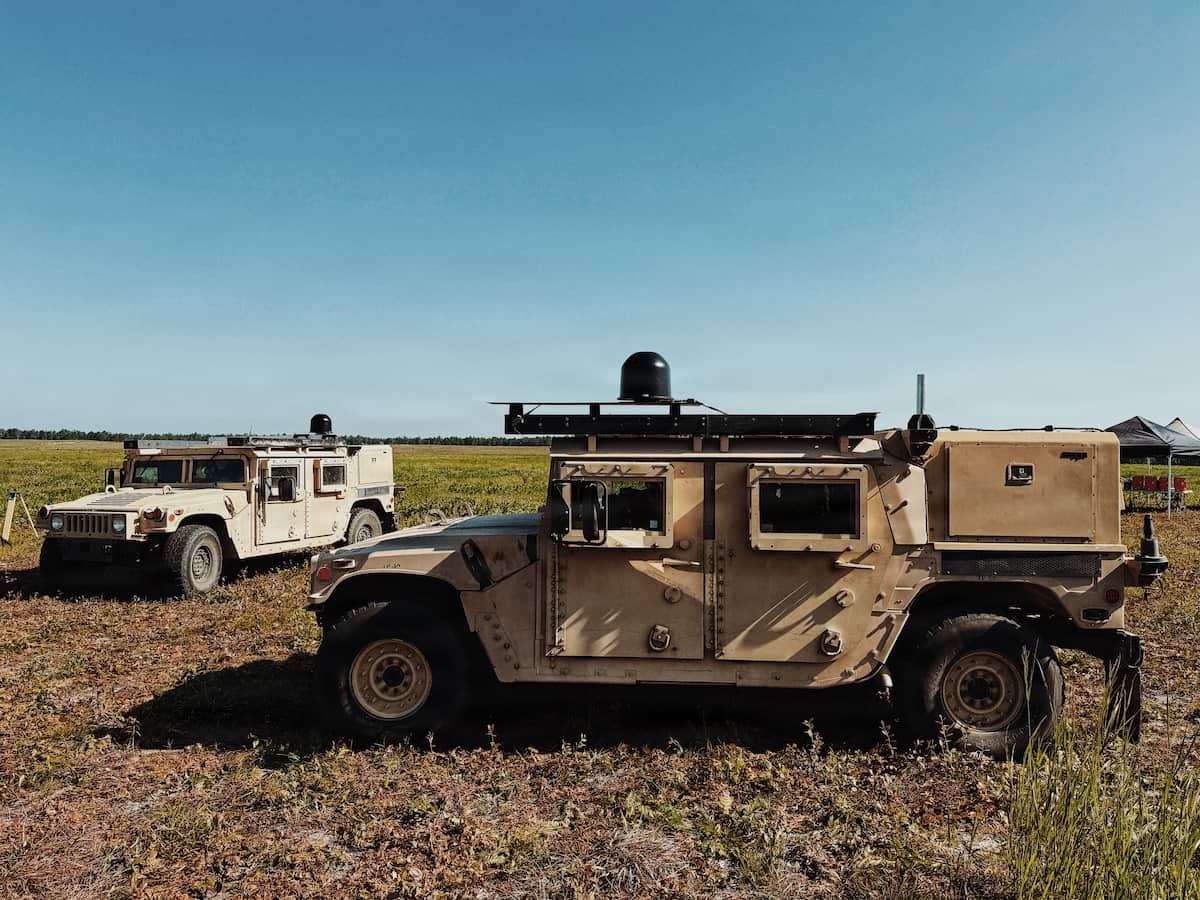
S2AS lets a unit see its own command post the way an enemy direction-finding team would. It senses and reports the post’s electromagnetic signature and nearby interference in near real time. Commanders use that picture for emissions-control decisions, and operations centers get warnings of intentional or unauthorized interference.
Most coverage of the award repeated the headline figure. That figure is a ceiling. The Army’s fiscal 2027 budget justification spells out what the service actually plans to buy under it, and the plan is much smaller.
What the budget actually buys
S2AS sits inside a consolidated procurement line, P-1 line 52, “Electronic Warfare Planning & Mgmt Tools,” which is part of the Department of War’s Capability Based Funding Pilot. That line programs 147 S2AS systems from FY2026 through FY2031.
Two details matter for reading those figures. The FY2026 figures are enacted appropriations: the book’s P-1 exhibit lists $24.547 million for line 52 as FY2026 discretionary enacted, and the line’s P-5 cost analysis allocates $17.637 million of it to S2AS. And dollars for FY2028 onward are not broken out for S2AS. They appear only as totals for the whole line, which also funds the EWPMT software.
That still bounds the program. The line’s six-year total is $175.229 million. Subtracting the EWPMT money shown for FY2026 and FY2027, $6.910 million and $12.362 million, leaves at most $155.96 million for S2AS, or about 45% of the contract ceiling.
A tighter estimate uses the FY2027 cost per system, all-in: $34.208 million for 37 systems, or $924,541 each, covering production and fielding support. At that rate, 147 systems come to about $136 million, roughly 39% of the ceiling. The same price would let the $350 million ceiling cover about 379 systems. The budget book’s own unit-cost row reads higher, $1.26 million for FY2027, because it divides the whole line, EWPMT software included, by the S2AS quantity alone.
The comparison works because the two horizons roughly line up. The IDIQ has a five-year ordering period, and its estimated completion date, May 28, 2031, falls within FY2031. The FY2026 justification material was released without out-year figures for FY2027–FY2030, so among the documents reviewed here, the FY2027 book is the first to show S2AS procurement quantities for FY2028–FY2031. The fiscal 2025 submission had projected development funding through FY2029 and a procurement and fielding schedule through FY2028.
The gap does not mean the extra capacity will go unused; the budget can change. What it shows is that, on current plans, the $350 million figure measures Army flexibility, not Army commitment.
37 systems, not 60
The FY2027 quantity has circulated in two versions. Breaking Defense, citing documents the Army provided, reported $34.2 million to buy up to 60 systems in FY2027, and ExecutiveGov repeated that figure in two articles. The formal justification book ties the same $34.208 million to 37 systems, covering procurement, delivery, training and initial spares.
The Army may have circulated a different planning figure. For anyone tracking deliveries against the budget, 37 is the number Congress was asked to fund.
The FY2026 figure does match across sources. DefenseScoop reported a $17.6 million request for 20 systems in July 2025, and the FY2027 book shows $17.637 million for 20 systems out of the line’s FY2026 enacted amount.
A joint industry day, then one bid
S2AS began with a 2023 request for information from Aberdeen Proving Ground, W56KGY-23-R-G143. It sought mature commercial and non-developmental hardware and software, and it called for a modular open systems approach. It also required data feeds into the Army’s EWPMT planning tool and said the government intended to prototype through the C5 other transaction consortium.
An industry day followed, though not a dedicated one. The government’s answers to questions on the request said none was scheduled at that point; the event that did take place was a joint S2AS-SNTRE industry day, covering S2AS and a separate program. Its attendee list names 20 companies, among them Rohde & Schwarz USA, CRFS, Viavi Solutions, General Dynamics Mission Systems, Leidos, CACI, Leonardo DRS and Peraton. 3dB Labs is not on the list. Because the day covered two programs, the list shows interest in the pair of them, not in S2AS alone.
In its fiscal 2025 budget submission, dated March 2024, the Army said S2AS would follow a “tailored competitive acquisition approach.” On April 2, 2025, the Army announced that 3dB Labs had received a $6,114,381.17 other transaction agreement through the C5 consortium to develop and demonstrate the system over 14 months. The same budget submission had planned that award at $5.075 million, so the agreement came in about a fifth above plan.
The production award then drew a single bid. There is a noncompetitive route from prototype to production, and the same day’s contract announcements show it in use: a Navy fuze contract to L3Harris states it was not competitively procured under 10 U.S.C. §4022, as a follow-on production requirement for prototypes completed under an other transaction agreement. The S2AS announcement makes no such citation. It says bids were solicited online.
A single bid on a large indefinite-delivery vehicle is not unusual in itself. The same day, Gentex received a $44.8 million contract for Apache helmet assemblies with identical wording, one bid, work and funding set by order, completion on May 28, 2031, and Lockheed Martin’s Trident II modification recorded one proposal. On paper, the Army opened the door for S2AS. Only the prototype holder came through it.
The public record does not explain why. An industry-day list shows interest in 2023, not bids in 2026, and the production solicitation itself could not be located for this analysis.
The practical consequence is clearer. Every S2AS task order under this contract will be priced by a firm-fixed-price vehicle that never faced a rival offer. The Army’s budget already shows the production cost per system, before fielding support, rising from $829,000 in FY2026 to $881,000 in FY2027. Those are budget estimates, not contract prices.
Behind its own schedule
The fiscal 2025 budget submission laid out a timeline: prototyping from the first quarter of FY2025 through the first quarter of FY2026; a contract award in the third quarter of FY2025, with its cost exhibit planning the development award for April 2025; procurement starting in the first quarter of FY2026; and the first unit integrated in the second quarter of FY2026, which is January through March 2026.
Later statements kept roughly to that plan. In April 2025, DefenseScoop reported an operational demonstration planned for the first quarter of FY2026, supporting a possible rapid-fielding decision in the second quarter. In a SIGNAL article published August 1, 2025, Lt. Col. John Cross, then product manager for tactical spectrum warfare, said he expected the first 10 to 15 systems to reach Transformation in Contact units by the end of calendar 2025. He described a goal of 40 to 60 systems across FY2026 and FY2027.
| Milestone | Plan | What happened |
|---|---|---|
| Development contract award | Q3 FY2025; cost exhibit April 2025 | Announced April 2, 2025 |
| Soldier user assessment | Q4 FY2025 exercise | Army reported it August 20, 2025 |
| First systems to units | Q2 FY2026; 10–15 by end of 2025 | Nine promised on August 27, 2026, “in three weeks” |
| Production contract | Procurement from Q1 FY2026 | Announced May 29, 2026 |
| Fielding window | Q2 FY2026–Q2 FY2028 | Buys programmed through FY2031 |
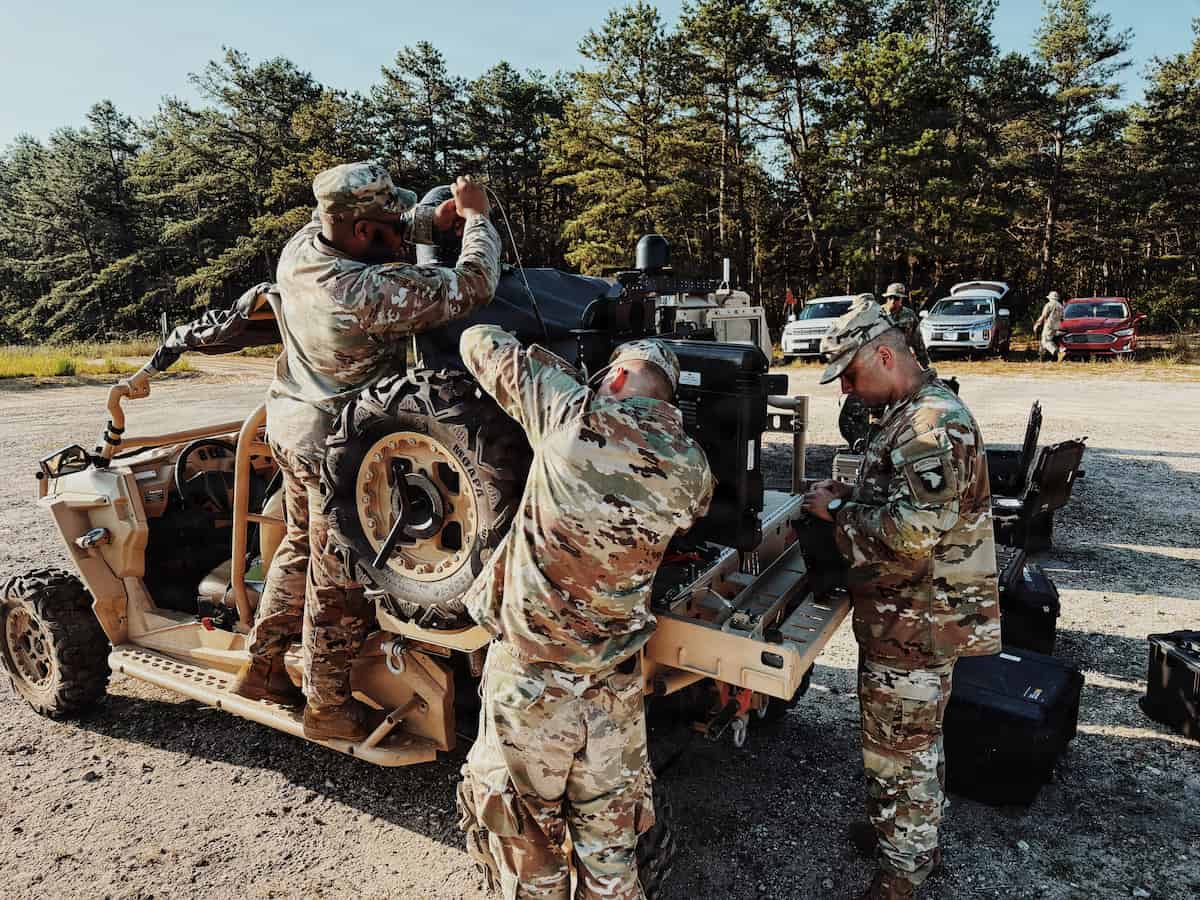
At an Aberdeen Proving Ground briefing on August 27, 2026, officials said nine systems would reach “prioritized Army units” in three weeks. They expect 46 delivered by July 2027.
That puts the first fielding in about the fourth quarter of FY2026, at least two quarters behind the fiscal 2025 plan. The total, however, is still inside the 40-to-60 range Cross described. The start slipped; the planned size did not. Whether the nine systems have been handed over had not been publicly confirmed as of this writing.
The budget calendar is one likely part of the story, though not a proven cause. S2AS has no procurement money in FY2025; its first buy is in FY2026. The Pentagon ran under a continuing resolution from November 12, 2025, to January 30, 2026. That resolution barred the Pentagon from starting production of items not funded for production in FY2025 or earlier, and from raising production rates. It was bracketed by two lapses in appropriations. Full-year FY2026 appropriations became law on February 3, 2026, and the production award was announced almost four months later.
No Army document reviewed here attributes the delay to the continuing resolution. The dates line up, and that is all the record shows.
Development funding followed a similar path. The FY2025 submission sought $9.330 million for S2AS development in FY2025 and projected $5.007 million for FY2026. The FY2026 R-1 exhibit shows $4.665 million enacted for FY2025 in that program element and no FY2026 request there. The FY2027 R-1 shows $4.495 million in FY2025 actuals and nothing enacted for FY2026 in that element.
What the ceiling is for
The headroom does match an ambition the program office has stated. Cross said in the same SIGNAL article that he expected S2AS to move into rapid fielding in FY2027. He compared it to the Terrestrial Layer System Manpack, fielded at a pace of one brigade per month and possibly two or three if needed.
The out-year plan does not fund that pace. After 39 systems in FY2028, procurement drops to 15–18 a year.
Where the systems go matters too. Each S2AS comes with two nodes. It is meant to watch brigade and division command post nodes, which the current product manager, Lt. Col. David Picard, called high-payoff targets. If the Army decides every such node needs one, the ceiling is ready and the budget is not.
What to watch
Sources
Primary and official documents
- Department of War — Contracts for May 29, 2026, for the S2AS award, the L3Harris §4022 citation and the Gentex and Lockheed Martin single-offer awards
- Department of the Army — FY2027 Budget Estimates, Other Procurement, Army, BA2 Communications and Electronics, Volume 2 (PDF), April 2026: line 52, pp. 270–276; Exhibit P-1, p. xx
- Department of the Army — PB2025 RDT&E exhibits, PE 0605247A Spectrum Situational Awareness System (PDF), March 2024
- Office of the Under Secretary of Defense (Comptroller) — RDT&E Programs (R-1), FY2026 (PDF), June 2025, line 161
- Office of the Under Secretary of War (Comptroller) — RDT&E Programs (R-1), FY2027 (PDF), April 2026, line 160
- CPE Intelligence and Spectrum Warfare — Army Awards Production Contract for the Spectrum Situational Awareness System, June 1, 2026
- CPE Intelligence and Spectrum Warfare — Army Announces Selection of 3dB Labs to Develop the S2AS Prototype, April 2, 2025
- Army Contracting Command, Aberdeen Proving Ground — Sources Sought / RFI W56KGY-23-R-G143, 2023, with attachments including the S2AS-SNTRE industry day attendee list and the questions and answers
- Army.mil — Transformation in Contact units test Spectrum Situational Awareness System, August 20, 2025
- Congressional Research Service — FY2026 Department of Defense Appropriations: In Brief (R48891), April 2, 2026
- U.S. Congress — H.R. 5371, Continuing Appropriations Act, 2026, Division A, Sec. 102; enacted as P.L. 119-37 on November 12, 2025
Trade press and analysis
- AFCEA SIGNAL — New Army Technology Enhances Electromagnetic Spectrum Comprehension, August 1, 2025
- DefenseScoop — Army awards prototype for spectrum sensing and visualization tool, April 2, 2025
- DefenseScoop — Army’s new budget proposal invests in electromagnetic force protection capabilities, July 1, 2025
- DefenseScoop — Army will soon deliver first batch of detection tools to help command posts identify their own signal emissions, August 28, 2026
- Breaking Defense — Army requests funds to speed development, production of EW systems, April 2026
- ExecutiveGov — Army Requests Increased Funding for EW, SIGINT Technologies in Fiscal 2027, May 1, 2026
- ExecutiveGov — A Comprehensive Guide to the Army’s FY 2027 Budget Request, May 12, 2026
- ClearanceJobs — ITC Defense Wins $47M Missile Defense Agency Support Contract, May 30, 2026, republishing the May 29 announcements