President Volodymyr Zelensky said Ukraine has begun using the Sapsan ballistic missile in combat. He spoke to journalists on Dec. 9 and declined to discuss targets or the number of shots fired. “Ukraine is already using the Neptune, the long-range Neptune, the Palyanytsya, the Flamingo. And also, the Sapsan, I’ll be honest — we’ve begun using it,” Zelensky said. “Because for now we don’t want the enemy to know all the precedents and all the details,” he added.
He also described how Kyiv wants uncertainty around attribution. “There are many cases when our enemy believes a strike was carried out with a Neptune… And let them continue thinking that,” Zelensky said. Ukraine has used mixed strike packages in recent raids. Drones, cruise missiles, and other systems can arrive in the same window. That makes attribution harder from the outside, even after the fact.
Zelensky claims Sapsan combat use and withholds targeting details
The Sapsan claim still lacks clear, independent proof. Public confirmation usually comes from debris at impact sites. It can also come from a launcher image, or fragments that match a known missile airframe. Analysts also watch for consistent crater patterns and identifiable guidance sections. None of those markers have surfaced in a way that settles the question.
Russia’s Ministry of Defense has previously claimed it shot down Ukrainian ballistic missiles over Crimea. Those claims have not produced the kind of wreckage trail that would let outsiders confirm the type. Kyiv also keeps strike forensics close. It releases selective photos and video, often days later, and often without full location detail.
If Sapsan is in use, Kyiv gains a strike option it does not need permission to fire. Officials confirm limits still apply to many foreign-supplied longer-range weapons. Those limits vary by munition and donor. Ukraine has worked around them with drones and domestic cruise missiles, but a ballistic missile fills a different slot.
Ukraine’s need for a longer-range ballistic weapon predates the full-scale invasion. Its Soviet-era Tochka family remains the only ballistic missile type it has used in large numbers. Tochka-U has a maximum range of 43 miles, or 70 kilometers. Older Tochka variants reach about 75 miles, or 120 kilometers. Those ranges pushed Ukraine to pursue a replacement long before 2022.
Zelensky’s statement also fits the pattern of Kyiv talking up domestic strike output. Ukraine has expanded long-range drone production and rolled out new cruise missile designs. A ballistic missile has stood out as the missing piece in that domestic portfolio.
What is known about Sapsan and the Hrim-2 program
According to industry sources, Sapsan is closely tied to the Hrim-2 program. Hrim-2 also appears as Grim-2 in some material, and the English meaning is Thunder-2. Hrim-2 emerged as an export version of the original Sapsan concept, which aimed at Ukrainian service.
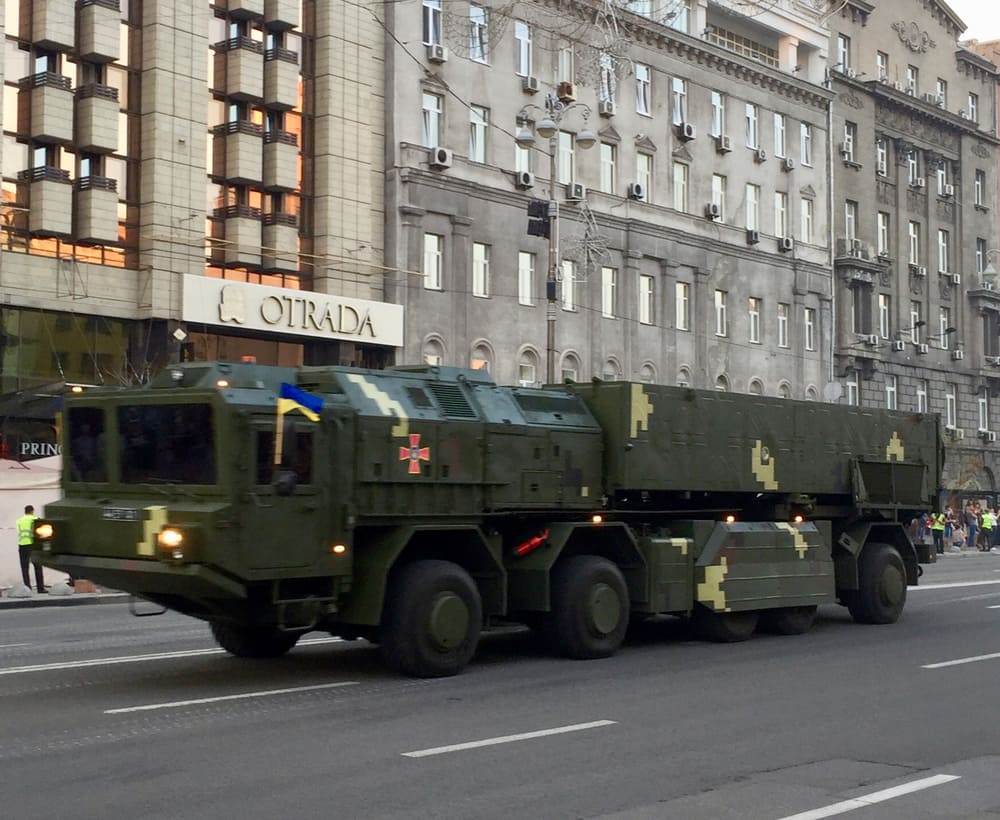
Work on the Hrim-2 line traces back to the late 2000s. Reporting has linked the pace of development to the period after Russia seized Crimea in 2014. A rocket motor test tied to the design occurred in 2018. That same year, a two-round, 10-wheeled transporter-erector-launcher appeared publicly, or at least a mock-up of it, during a parade.
Ukraine has not shown an official Sapsan missile body in recent months. The public imagery that exists around the family comes mostly from Hrim-2 concepts and test articles. Those designs resemble Russia’s Iskander-M in general layout. Both sit in the short-range, road-mobile ballistic class and use solid rocket propulsion.
Zelensky said in August 2024 that Ukraine had completed the first successful test of a new domestically developed ballistic missile. He did not name the missile then. Later reporting and defense watchers tied that announcement to Sapsan.
Performance details remain thin, but repeated figures appear across open reporting. Hrim-2 has been described with a minimum range of about 174 miles, or 280 kilometers. Other accounts place it as high as 310 miles, or 500 kilometers. Those numbers could apply to Sapsan as well, since the programs track closely in most descriptions.
Ukraine’s officials have also talked about longer reach in general terms. In 2023, then-Defense Minister Oleksii Reznikov said Ukraine had a long-range missile in development that could reach 620 miles, or 1,000 kilometers. He did not name the system in that remark. A 1,000-kilometer figure would still sit inside the standard short-range ballistic missile category, which runs up to 1,000 kilometers.
Some Ukrainian reporting has described a successful combat test at roughly 300 kilometers. The same accounts cited a warhead in the 480-kilogram range and said the test struck a Russian military target. A payload in that class pushes Sapsan into hardened-target territory, not just light infrastructure.
Open reporting has also mentioned top speed figures, including around Mach 5.2. Speed varies across the trajectory and by profile, so a single number has limits. The operational effect remains straightforward. A ballistic missile arrives fast in its terminal phase, and defenders get less time.
Domestic strike weapons list and limits on foreign munitions
Zelensky bundled Sapsan with four other systems that Ukraine says it has used operationally. He named Neptune in land-attack form, the longer-range Neptune variant, the Palianytsya jet-powered missile drone, and the Flamingo cruise missile. Ukraine has also used a wide set of long-range one-way attack drones and other hybrid designs, including the Peklo “missile drone.”
The Neptune story shows why Zelensky talked about misattribution. Neptune entered service as an anti-ship cruise missile before the full-scale invasion. Ukraine later adapted the design for land attack. Zelensky has described an extended-range version, often called Long Neptune. Ukraine has used Neptunes in combat before, so Russia can plausibly blame Neptune for strikes that used something else.
Palianytsya sits in a separate category. Zelensky first spoke publicly about it in August 2024 and said it had already seen combat use. Reporting has described it as a turbojet-powered strike weapon that blurs the line between a drone and a missile. Kyiv has not published full specifications.
Flamingo, which Zelensky called out by name, is described by Ukrainian officials as a long-range cruise missile. Zelensky has said it can reach 3,000 kilometers and should enter mass production by the end of 2025. Ukraine has not released reliable public imagery of the weapon’s airframe, and it has not disclosed production quantities.
Peklo appears as another hybrid strike design. Ukrainian government messaging has described it as a domestically produced system with deliveries to the armed forces. Many details remain guarded.
A domestic ballistic missile would sit above these systems in speed and flight profile. It does not replace drones or cruise missiles. It offers a different way to hit targets deeper inside Russia and in occupied territory, with less time for defenders to react.
Ukraine has used U.S.-supplied ATACMS ballistic missiles in limited numbers. Those strikes have caused visible changes in Russian operating behavior at airfields within range. Even with restrictions, ATACMS forced Russia to move assets and spread defenses. It also pushed Russian planners to allocate more air defense coverage to certain bases, rather than concentrating it near the front.
Ukraine’s problem has never been access alone. It has been constraints and quantity. Donated munitions arrive in batches, and policies around their use shift. A domestic ballistic missile avoids foreign release rules and helps stabilize supply over time, if production grows.
Ballistic missile effects on Russian air defenses and strike planning
Ballistic missiles stress defenses in ways drones and cruise missiles do not. Interceptors often need different kinematics to hit a fast, steep target. Radar coverage also matters, since the engagement window can be short. Defenders must decide early which interceptors to commit, and that decision competes with other threats in the same raid.
Russia’s layered defenses in and around Crimea add more context. Ukraine and outside analysts have long described those defenses as a mix of longer-range and shorter-range surface-to-air missile systems. The precise readiness and integration level varies by unit and location. Russian forces also move systems as threats change.
Ukraine has already tried to complicate that defensive picture. It has fired drones and cruise missiles in large mixed raids. Russia has responded with more interceptors, more radar coverage, and more dispersion. Open reporting has also described Russia moving advanced systems into the theater, including the S-500, to bolster coverage in sensitive areas.
If Sapsan is in combat use, Russia faces another ballistic track to manage. Even small numbers matter when a defender must treat each inbound as high consequence. A ballistic missile can also force Russia to keep higher-end interceptors and radar crews on alert deeper in the rear, not only near the front.
None of this settles whether Sapsan has already struck a target. Zelensky has offered a direct statement, but he also said he wants to keep details from Russia. Independent confirmation still depends on physical evidence, or a consistent set of strike signatures that cannot be explained by other weapons.
Our analysis shows a working Sapsan capability would push Russia to allocate more air and missile defenses to rear areas within range, especially around Crimea and southern military infrastructure.
REFERENCE SOURCES
- https://www.ukrinform.net/rubric-ato/4067902-zelensky-confirms-use-of-sapsan-ballistic-missile.html
- https://newsukraine.rbc.ua/news/zelenskyy-reveals-missiles-used-in-strikes-1765310891.html
- https://www.reuters.com/business/aerospace-defense/long-range-weapons-ukraine-has-developed-since-russias-2022-invasion-2025-11-17/
- https://kyivindependent.com/ukraine-strikes-russia-with-atacms-for-the-first-time/
- https://kyivindependent.com/ukraines-sapsan-ballistic-missile-to-enter-serial-production-following-successful-combat-testing/
- https://www.kas.de/en/web/ukraine/blickpunkt-ukraine/detail/-/content/ukraine-air-war-monitor-vol-x
- https://cepa.org/article/flight-of-the-flamingo-spells-trouble-for-russia/
- https://www.reuters.com/world/europe/ukraine-hits-targets-russia-with-atacms-military-says-2025-11-18/
- https://www.ft.com/content/078b8e70-a58c-47cc-b573-598850dd5685
- https://missilethreat.csis.org/missile/ss-21/
- https://www.kmu.gov.ua/en/news/minstratehprom-syly-oborony-ukrainy-otrymaly-pershu-partiiu-ukrainskykh-droniv-raket-peklo
- https://militarnyi.com/en/news/zelensky-ukraine-successfully-tests-first-ballistic-missile/