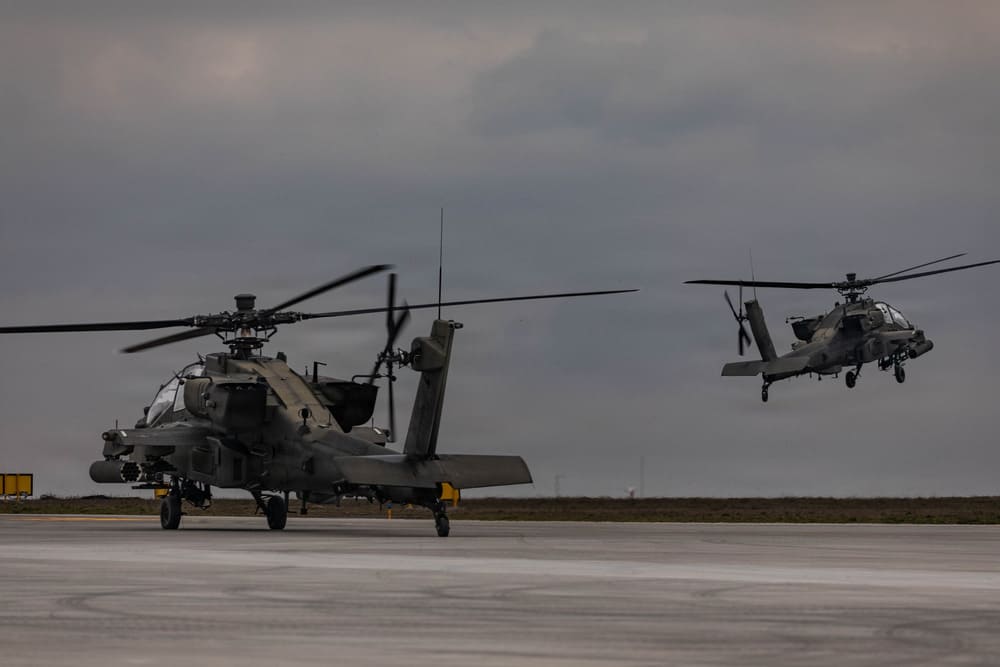
On 8 November, Antonov An-124 heavy transport UR-82008 returned to Phoenix-Mesa Gateway Airport in Arizona carrying three AH-64E Apache Guardian helicopters for the Indian Army. The aircraft had left the same airfield a week earlier for India and was due to make a technical stop at East Midlands Airport in the United Kingdom. It spent eight days on the ground there, then crossed the Atlantic again instead of continuing to India.
The three helicopters are the second and final batch from the Indian Army’s six-aircraft Apache order. Flight-tracking accounts first picked up the return leg. Interest in India rose after Boeing said “logistical issues caused by external factors” had disrupted the delivery and delayed arrival of the last three aircraft.
Three AH-64E Apaches Went Back to Mesa After the UK Stop
Flight data and enthusiast photographs show UR-82008 arriving at Mesa from Leipzig on 30 October. Ground crews then moved three sand-colored AH-64Es from Boeing’s nearby Mesa facility and loaded them nose-to-tail through the An-124’s raised nose. One helicopter carried Indian Army serial IA-7105. All three wore the desert camouflage already seen on the first batch.
UR-82008 departed Arizona on 1 November and flew to East Midlands, a regular fuel and crew-rest stop for Antonov commercial flights. The aircraft remained parked there for more than a week. On 8 November, it flew back to Mesa. Later photos showed the three Apaches unloaded. Their rotors had been removed and ground crews towed them across the apron behind service vehicles.
The return to Arizona interrupted a delivery already running late. The first three Army Apaches reached Hindon Air Force Station only in late July 2025 aboard another An-124 charter. That arrival came more than a year after the original target window.
Turkey Overflight Issue Emerged After the East Midlands Delay
Indian and foreign defense outlets have quoted officials who say Turkish authorities did not grant overflight clearance for the mission. Under that account, the An-124 stayed at East Midlands while Antonov and Boeing waited for approval to use the usual corridor across Turkish airspace toward the Gulf. The crew then dropped the attempt and returned to the United States.
The reported issue drew attention because the first Army Apache batch earlier this year appears to have used a similar corridor without trouble. An An-124 carried those helicopters to India in July. The difference between that movement and the failed November run has led Indian officials to examine several possible causes. They include a bilateral clearance problem, tighter treatment of Ukrainian-registered cargo aircraft after the war in Ukraine, or commercial friction involving the charter operator and regional aviation authorities.
Turkish media reports have pushed back against claims of a deliberate move aimed at India. Some reports there say alternate routes around Turkish airspace remained available and argue that Ankara’s position reflects broader policy toward certain cargo operators since the Ukraine conflict. Turkish ministries have not given a clear public explanation, so the issue still rests largely on background briefings and press reporting.
Boeing has stayed with the phrase “logistical issues” and external factors. Indian officials have referred in public to an overflight-related delay but have avoided naming specific countries. Defense officials confirm in private that diplomatic channels are working on an alternate route and a revised delivery date inside the current financial year.
Overflight approval for oversized military cargo involves civil aviation agencies, defense ministries, and foreign ministries in each state on the route. Any one of them can block access without much public detail. Since the war in Ukraine began, the An-124 fleet has faced tighter routing options, sudden changes, and a smaller set of staging points. UR-82008 now operates inside that narrower network.
Indian Army Still Waits for the Final Three Apache Helicopters
India’s Army Aviation Corps ordered six AH-64E Apaches in a package worth about $796 million, approved in February 2020 during the visit of then U.S. President Donald Trump to New Delhi. The package moved ahead alongside a separate deal for MH-60R naval helicopters. Those six Army aircraft came on top of an earlier order for 22 AH-64Es for the Indian Air Force, which operates Apache squadrons from Pathankot and Jorhat.
At the July induction ceremony for the first batch, Defense Minister Rajnath Singh said the helicopters would strengthen the Army Aviation wing in “challenging terrains.” Those aircraft later moved to the Army Aviation Training School at Nashik in Maharashtra. Pilots and technicians there work on a syllabus built around the Apache’s mast-mounted radar, electro-optical sights, and digital maintenance systems.
Planning papers point to the eventual basing of the full six-aircraft Army unit near Jodhpur. The mission set centers on anti-armor strikes, support for air assault units, and high-altitude backing along India’s western and northern fronts. Until the second batch arrives, the Army cannot field the full Apache element under its own command.
Army leaders have long pushed for direct control of an Apache unit instead of relying on Indian Air Force assets for attack helicopter support. The six-aircraft formation is intended to work alongside strike corps in western India, support tanks and mechanized infantry, suppress strongpoints, and escort transport helicopters in contested airspace during exercises and any future operations.
The Army’s attack helicopter fleet also includes the indigenous Light Combat Helicopter Prachand and the armed Rudra version of the Dhruv utility helicopter. Apache crews bring mast radar, long-range electro-optical sensors, and networked mission systems for stand-off engagement and target sharing with other aircraft and ground posts. Prachand remains more focused on very high-altitude work. Rudra covers armed escort and lighter strike tasks.
Training material for the new Army Apache unit places heavy emphasis on simulators, mission rehearsal systems, and crew-coordination drills. Many pilots come from Cheetah, Dhruv, Mi-25, or Mi-35 backgrounds. Instructors describe a demanding move into the Apache’s glass cockpit, helmet-mounted sights, and the close division of work between the front and rear crew seats.
Heavy-Lift Cargo Limits Hit the Second Apache Shipment
UR-82008 is one of a small number of Antonov An-124 heavy transports still used worldwide for outsized cargo, including modern combat helicopters. Its nose-loading layout and payload capacity let crews move attack helicopters with landing gear and major assemblies still fitted. That cuts the amount of teardown and rebuild work at each end.
The first Indian Air Force Apaches reached India inside Indian Air Force C-17 Globemaster III aircraft. Later consignments, including the Army helicopters, moved or were meant to move on commercial An-124 charters. Those charters offer more internal volume, but they also require more complex routing and coordination with a foreign operator.
According to industry sources, route planning for a load of this size has to account for runway length, pavement strength, fuel support, insurance terms, overflight fees, and diplomatic clearance. That narrows the realistic corridors between North America, Europe, West Asia, and India. Once the overflight problem emerged, the operator had two basic options. It could unload the helicopters in the United Kingdom and hold them for a later charter. Or it could return them to the United States so UR-82008 could move on to its next booked mission. The second option was chosen.
Since 2022, sanctions and war-related airspace closures have removed several Russian-operated An-124s from regular Western charter work and pushed Antonov Airlines to run its remaining fleet from hubs such as Leipzig instead of Ukraine. Airspace over Russia and Ukraine remains closed or heavily restricted for many operators. Heavy freighters such as UR-82008 therefore depend on fewer main corridors, and those corridors already carry dense commercial traffic.
The delayed Apache shipment also fits into India’s broader flow of U.S.-built aircraft and defense equipment over the past decade. That list includes C-130J and C-17 transports, CH-47F Chinook helicopters, P-8I maritime patrol aircraft, and Apache helicopters for both the Air Force and the Army. Sea lift and Indian Air Force transports can carry much of that hardware. Very large or urgent cargo still depends on specialist freighters such as the An-124.
What can be confirmed here is narrower and firmer than much of the public speculation. UR-82008 flew from Arizona to the United Kingdom, remained there for eight days, then returned to Arizona carrying all three Indian Army Apaches. Boeing acknowledged that external logistical factors disrupted the delivery. Our analysis shows the episode says less about the helicopters themselves than about how exposed long-range defense cargo flights have become to airspace politics and a thinner heavy-lift charter fleet.
REFERENCE SOURCES
- https://www.twz.com/air/ah-64-apaches-make-mysterious-return-to-u-s-on-their-delivery-flight-to-india
- https://www.business-standard.com/blueprint-defence-magazine/news/logistical-issues-delay-delivery-of-3-apache-helicopters-en-route-to-india-125111201668_1.html
- https://theprint.in/defence/turkey-blocks-transport-of-apache-choppers-to-india-through-its-airspace-new-route-being-worked-out/2783335/
- https://shop.ssbcrack.com/blogs/blog/turkey-denies-overflight-clearance-for-an-124-with-indian-army-apaches-forcing-return-to-u-s
- https://en.wikipedia.org/wiki/Boeing_AH-64_Apache
- https://en.wikipedia.org/wiki/Antonov_Airlines
- https://timesofindia.indiatimes.com/india/army-finally-gets-the-first-3-of-the-6-apache-attack-helicopters-ordered-from-the-us/articleshow/122836752.cms
- https://thediplomat.com/2020/02/us-india-sign-contract-for-6-more-ah-64e-attack-helicopters/
- https://spsnavalforces.com/features/?h=Ahead-of-Trump-visit-CCS-clears-%242.9-B-deals-for-30-American-choppers&id=164