
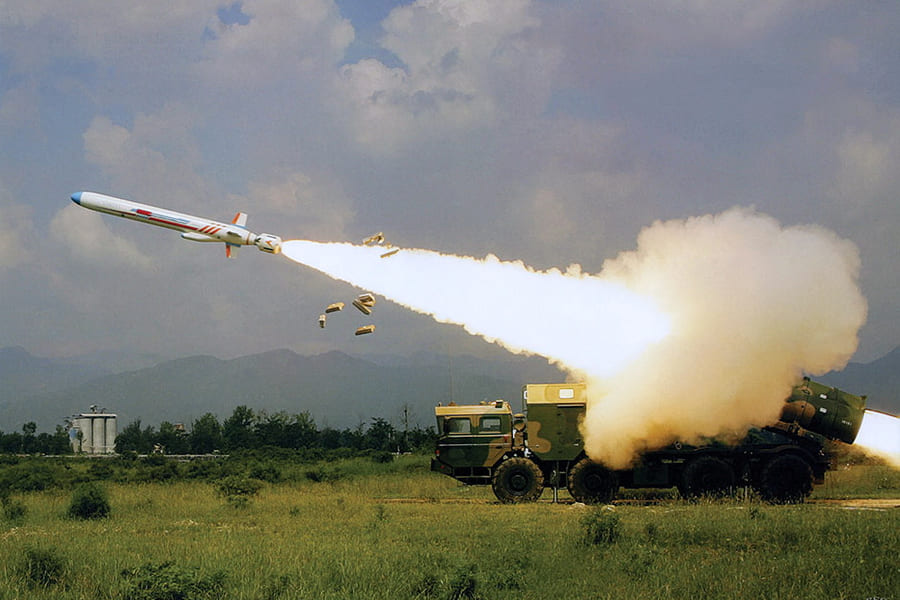
Chinese forces sent new missiles, drones, and aircraft past Tiananmen Square, with all three legs of the nuclear force on display. Hypersonic anti-ship weapons, new families of intercontinental missiles, submarine drones, laser air-defense systems, and seven types of uncrewed aircraft appeared in public for the first time, according to industry sources who reviewed the footage and order of battle.
The missile blocks included DF-61 road-mobile intercontinental systems, an updated DF-31 family, DF-5C silo-based missiles, submarine-launched JL-3 missiles, and an air-launched Jinglei-1.
Yingji-series anti-ship missiles followed in close ranks. The YJ-19 and YJ-20 variants were presented as long-range ship killers able to reach carrier groups far from China’s coast. Observers also noted land-attack cruise missiles and updated DF-17 and DF-26 launchers that outside analysts assess as dual-capable.
In the air segment, nine manned types flew overhead. J-35A stealth fighters, at least one naval J-35 in carrier colors, and a twin-seat J-20S flew with Y-20B transports and the KJ-600 airborne early warning aircraft. The KJ-600’s presence matched long-standing expectations for a carrier-borne radar platform tied to the new generation of Chinese carriers.
Seven new uncrewed aircraft drew close study from foreign specialists. Open-source analysis linked four collaborative combat aircraft with low-observable shaping and internal bays to a UAV brigade at Hotan in Xinjiang. Two medium-size tailless designs carried diverterless intakes and electro-optical targeting systems under the nose. Two smaller types resembled loyal wingman drones already trialed by Western air forces, giving the impression of a move toward mixed manned-unmanned packages.
China’s State Council Information Office described the formations as built from domestically produced, active main battle systems. The defense ministry spokesman called them the newest phase of modern warfare development. Taken at face value, those statements suggest that most of what rolled through Beijing sits at or near operational status rather than prototype stage.
Fujian, China’s first catapult carrier, connects directly to this picture. The ship began sea trials in 2024. Footage from autumn 2025 shows J-35 fighters, J-15T strike aircraft, and KJ-600 aircraft launching from electromagnetic catapults and trapping aboard. According to industry sources who track shipyard throughput, China now fields more than 370 warships and submarines in total, against fewer than 300 for the U.S. Navy, with hull numbers on the Chinese side still rising.
China’s nuclear expansion and strategic forces
Chinese nuclear forces have grown at a pace that surprised many long-time observers. U.S. defense reporting from 2024 and 2025 states that China has passed 600 operational nuclear warheads and could pass 1,000 by 2030. Independent inventories from nuclear specialists point to yearly growth of roughly 100 warheads since 2020 and a move away from the older “minimum deterrence” posture toward a larger and more flexible force.
Commercial satellites revealed three large missile-silo complexes under construction between 2021 and 2022. Follow-on analysis linked these fields to new missile types shown in the 2025 parade and to expansion of associated command, control, and support facilities. Each new ICBM family, such as the DF-61, raises separate questions on throw-weight, multiple warhead options, penetration aids, and readiness of launch crews.
The sea-based leg is undergoing its own upgrade. Improved Jin-class submarines and reports of additional boats under construction point to higher patrol capacity. The JL-3 missile, when fired from bastions near China’s coast, can reach targets across much of North America. Long-range aviation adds another layer. H-6 bombers have tested new air-launched systems with nuclear potential, and development work on the long-promised H-20 stealth bomber continues, with Chinese sources describing global-range missions and heavy payloads.
For U.S. intelligence, the nuclear track is not just a counting exercise. Analysts need to understand how the new arsenal fits into doctrine, alert levels, and command arrangements, and whether Beijing intends to keep most forces in a low-readiness posture or move toward higher peacetime availability. That debate runs in parallel with the growth of China’s conventional strike capacity.
U.S. intelligence capacity and workload
The U.S. intelligence community brings significant resources to this problem. Eighteen agencies feed the system, including the CIA, NSA, service intelligence branches, and organizations responsible for space and geospatial support. Public figures for fiscal year 2025 show about 73.3 billion dollars for the National Intelligence Program and 27.8 billion dollars for the Military Intelligence Program, a combined total a bit above 101 billion dollars.
Open-source workforce estimates suggest that 100,000 to 120,000 people work directly inside those 18 agencies, backed by roughly 1.25 million private contractors on defense and intelligence tasks. If cleared military and civilian personnel in the wider national security system are counted, the number runs into the low millions. That scale gives the United States reach across domains and regions.
The portfolio against which those people work has widened rather than narrowed. Analysts who focus on Chinese nuclear silos, hypersonic missiles, and carrier aviation also follow Russia’s war in Ukraine, Iranian missile and nuclear programs, North Korean launches, tensions in the Middle East, large cyber campaigns, and terrorism networks. Congressional research notes that the intelligence share of the defense budget has stayed broadly flat for a decade while the range of assigned tasks kept expanding.
At the same time, the structure itself is under reform. Since early 2025, the current administration has run a downsizing drive across the main intelligence agencies. Buyout packages and hiring freezes at the CIA, NSA, the National Reconnaissance Office, and the National Geospatial-Intelligence Agency have targeted many thousands of billets over several years, according to officials familiar with the planning.
ODNI 2.0, the main reorganization at the Office of the Director of National Intelligence, aims to cut headquarters staff by about 40 percent, from roughly 1,800 to around 1,300 posts, while closing or merging centers created after 2001. Public statements from the director argue that this will strip out politicized or duplicative offices, save hundreds of millions of dollars, and push authority back to line agencies. Former officials quoted in open sources warn that cross-cutting issues such as foreign influence and cyber operations may get less coherent attention if coordination nodes shrink.
Annual threat reports sent to Congress now place China at the top of the list, describing the People’s Liberation Army as the only competitor designed to challenge the United States across military, technological, and economic dimensions at once. Intelligence managers must keep the China problem at the front of the queue without dropping fast-moving crises elsewhere, with no major increase in overall share of the defense budget to ease the trade.
Open source intelligence AI tools and China focus
Open-source intelligence plays a larger role on both sides of this contest. Chinese research institutes, universities, private firms, and state-owned enterprises run their own open-source programs, mining foreign publications, commercial databases, satellite imagery, and social media. A recent review of PLA materials concludes that Chinese organizations treat these sources as an efficient way to track foreign weapons and exploit the openness of Western societies.
Western governments and independent analysts use similar tools. Commercial satellite constellations were first to reveal the new Chinese missile-silo fields. Public ship-tracking feeds and dockside images allowed specialists to follow Fujian from fitting out to sea trials and then to the first visible carrier-borne J-35 launches. Open nuclear inventories from non-government groups provide a baseline that matches, within limits, the growth pattern described in recent U.S. defense reports.
Inside U.S. agencies, AI-supported systems have started to take over routine parts of this work. Computer vision models scan imagery for new silos, transporter garages, UAV shelters, and changes at test ranges. Language models filter Chinese-language press, provincial budget documents, and technical papers for signals of emerging projects. Officials confirm that some of these tools already run on classified networks and feed straight into daily analytic production, with human staff checking and refining the output.
Chinese military writers publicly discuss similar methods. Commentary after the 2025 parade praised uncrewed systems with AI support and described future swarms using wide-area sensing and fast data links to help commanders. If those concepts move into service, U.S. and allied analysts will have to judge not only the performance of individual drones or missiles but also how groups behave under electronic attack, how commands are passed in contested airspace, and how much initiative sits in the software.
Our analysis shows the United States still holds strong advantages in global collection, commercial data access, and long experience dissecting foreign weapons programs, but the surge in Chinese systems, the pace of testing, and domestic restructuring put sustained pressure on analytic depth and continuity, especially on the narrow cadre of specialists who follow Chinese forces year after year.
REFERENCE SOURCES
- https://www.janes.com/osint-insights/defence-and-national-security-analysis/china-accelerates-air-combat-modernisation
- https://apnews.com/article/efd398d9b3198bb63b505151162312cf
- https://fas.org/publication/nuclear-weapons-at-chinas-2025-victory-day-parade
- https://www.armscontrol.org/act/2025-01/news/pentagon-says-chinese-nuclear-arsenal-still-growing
- https://thebulletin.org/premium/2025-03/chinese-nuclear-weapons-2025
- https://media.defense.gov/2024/Dec/18/2003615520/-1/-1/0/MILITARY-AND-SECURITY-DEVELOPMENTS-INVOLVING-THE-PEOPLES-REPUBLIC-OF-CHINA-2024.PDF
- https://www.dni.gov/index.php/newsroom/press-releases/press-releases-2025/4121-pr-39-25
- https://irp.fas.org/budget/index.html
- https://crsreports.congress.gov/product/pdf/R/R44381
- https://www.clearancejobs.com/news/11770/the-true-scale-of-u-s-national-security-inside-the-defense-and-intelligence-community
- https://www.recordedfuture.com/research/private-eyes-chinas-embrace-open-source-military-intelligence
- https://euro-sd.com/2025/09/major-news/46838/chinese-carrier-fujian
- https://www.space.com/technology/china-shows-off-advanced-hypersonic-missiles-icbms-and-drones-in-military-parade-photos
- https://economictimes.indiatimes.com/news/international/us/chinas-j-35-fighter-beats-f-35c-becomes-first-stealth-jet-to-be-launched-from-an-aircraft-carrier-using-emals-fujian-breaks-us-navys-monopoly-watch-video/articleshow/124060309.cms
- https://www.congress.gov/crs/product/IF10524
- https://www.uscc.gov/annual-report/2025-annual-report-congress
- https://flyajetfighter.com/us-intelligence-faces-a-deluge-of-chinese-weapons
Launching_ceremony_2025-07-02-1-150x150.jpg)