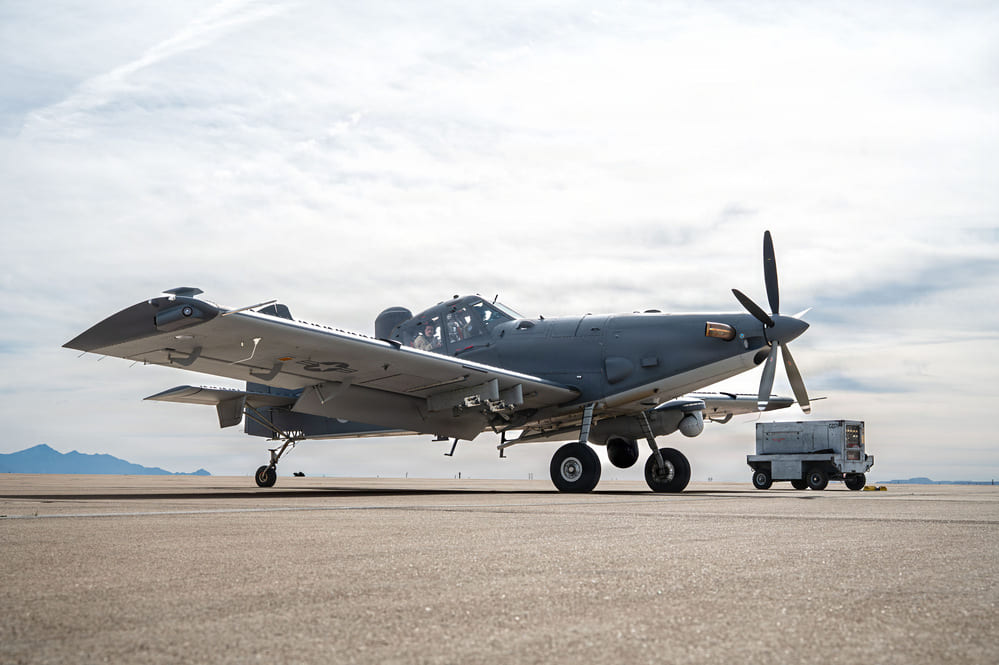
An OA-1K Skyraider II assigned to Air Force Special Operations training at Will Rogers Air National Guard Base made a forced landing in a field southeast of Oklahoma City on Oct 23. The two-person crew – one active-duty airman and one contractor – exited without injuries. The aircraft clipped two utility poles and sparked a small grass fire that city crews extinguished within minutes. Defense officials confirm the sortie was a training mission launched that afternoon from Will Rogers.
Witnesses near Southeast 119th Street and Sooner Road recorded the turboprop descending low across traffic toward an open tract. Power lines sagged across the roadway and smoke rose beyond the tree line. Responders closed access around the field, isolated the downed lines, and reported both occupants clear before they staged firefighting foam. “Two people onboard walked away safely after the plane hit two power poles and sparked a small grass fire,” a city fire spokesperson said. According to industry sources, the landing path left a shallow furrow and light under-fuselage scraping, consistent with a low-energy arrival on uneven ground.
Dispatch traffic referenced engine trouble reported around mid-afternoon. The aircraft stopped upright in cropped grass showing visible underbody scuffs and localized deformation. No secondary explosions or rolling fire showed up in the early videos. Base officials coordinated with utility crews to restore power to nearby homes. Law enforcement kept a perimeter until safety investigators and recovery teams could secure the airframe.
The Oklahoma Air National Guard described the mission as routine training over local airspace. The aircraft belonged to the training enterprise associated with the 492nd Special Operations Wing at Will Rogers, paired with the Oklahoma Air National Guard’s 137th Special Operations Wing. That pairing supports initial qualification and instructor upgrades on the OA-1K. Officials confirm an Air Force safety investigation board is now in charge of the inquiry.
Crash Site Details and Emergency Response
The mishap area lies a short glide from the base traffic pattern and includes several open parcels that aircrews know as emergency options. The approach line toward the field ran across a corridor with multiple wire spans. Photos from the scene show the propeller at rest and the tailwheel stance intact, along with the fuselage resting near wheel ruts cut into the soft ground. Tire marks drag toward the final stop, and one wingtip appears to have clipped roadside debris.
First responders reached the field quickly from city stations that cover the southeast quadrant. They knocked down a patch fire started by arcing lines and kept bystanders back from the wires. Power workers isolated the damaged segment and restored service in phases. County medical units confirmed no injuries on the ground.
The crew’s quick egress fits the OA-1K’s cockpit design: high seating, wide visibility over the nose, and armored cell features inherited from the militarized build. The taildragger geometry places the main gear forward and the tail low, which can help absorb rough touchdowns when ground is uneven. Air Tractor’s base airframe was built for agricultural strips and hard field work; the missionized aircraft adds reinforced gear attach points, protected plumbing, and survivability features suited to austere operations. According to industry sources, the training syllabus at Will Rogers includes rough-field procedures, wire-strike avoidance techniques, and off-airport decision making, which will all come under review once the board publishes initial notes.
Traffic camera and dashcam clips show the aircraft crossing the roadway at only a small height margin. Engines at low power-or spooling down-tend to leave less fuel available to atomize and ignite, which mirrors the limited fire at the site. The lack of injuries owes much to a low arrival speed, an open landing area inside glide distance, and prompt fire service access along Sooner Road. Officials confirm the airframe remains at a secured location for evidence preservation and planned recovery.
OA-1K Capabilities and Mission Profile
The OA-1K Skyraider II is the armed overwatch variant of the Air Tractor AT-802, missionized for Special Operations by L3Harris. The two-seat aircraft carries roughly 6,000 pounds across eight underwing pylons. Typical kits include an electro-optical/infrared turret, a laser designator, and secure radios for line-of-sight and beyond-line-of-sight links. The platform can loiter near six hours and hold a reserve to recover at a forward strip. Crews can fit precision weapons-such as laser-guided rockets and AGM-114 class missiles-depending on tasking and certification, plus pods for sensors and datalinks that extend coverage for ground teams.
The airplane’s appeal to Special Operations Command comes from endurance and basing flexibility. Units can operate from short, semi-prepared surfaces and move closer to partner forces than jet aircraft usually can. Payload and dwell let a small detachment cover many hours of surveillance and immediate strike options. The cockpit pairs traditional analog cues with modern avionics and mission management systems. That arrangement keeps training time reasonable for pilots stepping in from other turboprops and helps crews maintain situational awareness at low altitude over complex terrain.
The tailwheel configuration is unusual in current U.S. military tactical aviation. It helps on rough strips where prop clearance and angle of attack at touchdown matter. It also demands precise footwork near the ground. Training emphasizes directional control during rollout, crosswind corrections, and energy management close to obstacles. The Oklahoma mishap area shows the kind of narrow margins tailwheel crews face around wire corridors. Wire-strike kits, visual scanning techniques, and tactical pattern work all address those hazards, but no mitigation removes them entirely at the speeds and heights involved in a forced landing.
Acceptance of the first missionized OA-1K took place in early April. The unit at Will Rogers stood up as the formal training organization for basic qualification and instructor conversion. Aircraft at the base carry the full missionized standard, not the earlier training-only configuration. Instruction covers weapons employment in permissive environments, armed ISR procedures, and communications relay for ground elements. According to industry sources, the syllabus includes scenario work over paved and unprepared surfaces around central Oklahoma to replicate the forward locations where the type is intended to serve.
Training Enterprise and Safety Investigation
The training enterprise pairs the 17th Special Operations Squadron with the 137th Special Operations Wing at Will Rogers. Aircrews practice pattern work, low-level navigation, and sensor employment under strict altitude and obstacle rules in designated areas. The base’s proximity to open tracts gives crews emergency landing options inside glide distance during climbout and recovery. That geography appeared to matter on Oct 23, as the crew reached an open parcel within minutes of departure.
An Air Force safety investigation board now holds the airframe and related evidence. The board will review engine condition, propeller and governor function, fuel quality and delivery, control continuity, and possible complications from mission equipment. Investigators compare teardown findings with maintenance logs, recent software loads, and any available data from onboard recording or engine control modules. They also review radio calls, radar traces when available, and witness statements to reconstruct altitude, speed, and track. None of those steps point to a cause on their own; the board publishes a public summary after technical work concludes.
Officials confirm the training pipeline continues at Will Rogers under standard safety precautions. Instructors brief obstacle corridors near suburban edges and adjust profiles when winds, sun angle, or traffic could compress margins. Units coordinate with local agencies on emergency access routes and communications. The Oklahoma City Fire Department’s quick access from multiple stations reduced risk to the public and the crew; that coordination piece forms a standing part of base-community planning.
If the board identifies a single hardware fault, maintainers can inspect the fleet and address it through service bulletins. If integration or software contributed, the program office can issue interim restrictions until a fix arrives. According to industry sources, the unit will fold lessons into the syllabus once the board releases enough technical detail to back changes in training or checklist flow. Crew interviews often drive small but useful updates-like refined cues for wire-rich corridors, or a change in where the eye lands on the primary display during an engine-out descent.
The OA-1K operates inside Special Operations Command’s Armed Overwatch portfolio, sized for long dwell over permissive or lightly contested areas. Early planning called for 75 aircraft, then budget cycles and oversight trimmed the objective to about 62. The mission set stays the same: persistent surveillance, immediate precision fires when cleared, and communications support for ground teams that operate far from large bases. Will Rogers is the training hub that feeds crews to operational units as aircraft deliver.
Procurement pacing eased earlier this year as the training organization absorbed the first missionized jets and stood up courseware. The Oklahoma field landing did not injure the crew and did not cause a major fire, so broad program halts look unlikely absent a systemic technical finding. Units often impose targeted inspections or checks when a new aircraft has its first mishap. Officials confirm nothing beyond the standard safety hold around the single airframe as of this publication.
Tail numbers in a modest fleet matter, so any write-off would sting. Recovery teams will evaluate structural condition and decide whether repair makes sense. Insurance and contractual mechanics differ for government-owned, contractor-operated elements versus unit-owned aircraft, but the training enterprise aims to avoid schedule gaps by staggering course starts and holding a small buffer. According to industry sources, the unit can slide a handful of events without long-term disruption if the aircraft count dips temporarily.
Wire stands out as the dominant hazard for any off-airport arrival at low height. Crews carry wire-strike kits, but avoidance works better than contact. Instructors already map emergency fields inside safe glide footprints around the base. A refined map that marks wire corridors more aggressively near Sooner Road and similar tracts would support split-second choices when power fades low to the ground.
The OA-1K’s reinforced gear, protected fuel runs, and sturdy cockpit helped the crew walk away. Engine instruments and any available control-position data will tell investigators how much drag and thrust remained during the approach. If engine control logic or power management played a role, the fix could be as simple as a software update or as direct as a component swap. If fuel contamination shows up, the answer will live in sampling and supply chain checks. Our analysis shows this mishap will likely push refinements to emergency field maps and also tighten the brief for sun-angle effects late in the day, when wires blend into background clutter.
REFERENCE SOURCES
- https://www.flightglobal.com/fixed-wing/us-air-force-oa-1k-skyraider-crashes-during-oklahoma-training-mission/165032.article
- https://www.airandspaceforces.com/oa-1k-skyraider-crash-oklahoma-crew-uninjured/
- https://www.stripes.com/branches/air_force/2025-10-24/air-force-plane-crash-oklahoma-19529374.html
- https://okcfox.com/news/local/national-guard-aircraft-accident-reported-near-se-119th-and-sooner-road-crews-on-scene-crash-collision-fire-police-officer-law-enforcement-emergency-thursday-field
- https://www.af.mil/News/Article-Display/Article/4146325/air-force-special-operations-command-accepts-the-first-missionized-oa-1k-skyrai/
- https://www.afsoc.af.mil/About-Us/Fact-Sheets/Display/Article/4201500/oa-1k-skyraider-ii/
- https://www.twz.com/air/air-forces-crop-duster-converted-into-attack-plane-crash-lands-in-field
- https://theaviationist.com/2025/10/24/oa-1k-crash-lands-oklahoma-crew-safe/
- https://www.businessinsider.com/oklahoma-crash-crop-duster-converted-special-ops-aircraft-2025-10
- https://www.492sow.af.mil/News/Article/3967510/wrangb-home-to-oa-1k-formal-training-unit/
- https://www.flightglobal.com/fixed-wing/us-air-force-dubs-new-oa-1k-armed-crop-duster-skyraider-ii-ahead-of-first-delivery/162009.article