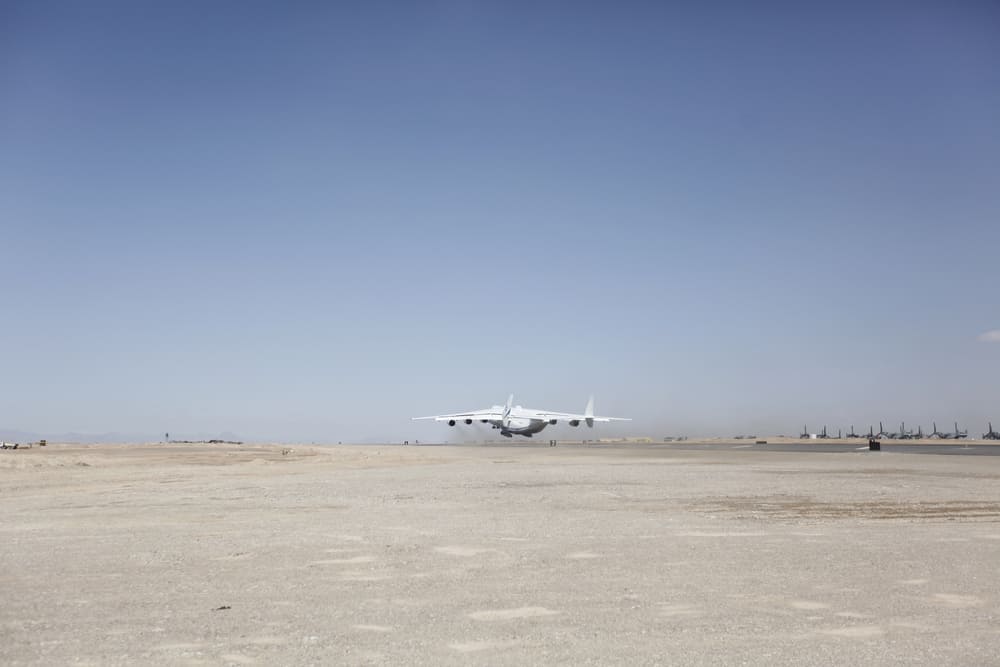
A Russian Air Force Antonov An-22 heavy transport crashed in the Ivanovo region on December 9, 2025. Russian investigators said everyone on board died. The loss likely removes the last flying An-22 from Russian service. The type already flew rarely and recent reports pointed to retirement.
Russia’s Investigative Committee said the aircraft went down near the village of Ivankovo, northeast of Moscow. Investigators opened a case into possible violations of flight safety rules. Officials did not publish a passenger or crew total in the first statement.
Local emergency services told state media that seven people were on board. Later incident records and some regional reporting listed eight. Officials did not reconcile the totals that day. The defense ministry did not release a crew manifest or unit roster.
The defense ministry said the aircraft was on a test flight after maintenance. “Today, in Ivanovo region, the military transport aircraft An-22 crashed during a test flight after undergoing maintenance. The aircraft fell in an uninhabited area,” the ministry said in a statement. The ministry said rescuers and an Aerospace Forces commission were heading to the scene.
Early evidence points to in-flight breakup and structural failure
Video posted online showed the aircraft breaking up in flight. Parts fell toward the Uvodskoye Reservoir. Witnesses described a mid-air breakup. Authorities have not released a technical sequence from the flight. No cockpit audio or flight data summary was public on the day.
Public incident records list the aircraft as an An-22A built in 1975. The same records list it as operated by the Russian Air Force. They describe a structural failure during initial climb after takeoff from Ivanovo-Severny Air Base. The records say the aircraft fell into the Uvodskoye Reservoir.
Those records also say investigators opened a criminal case under Article 351 of the criminal code. Article 351 covers violations of rules for flights and training flights.
A Russian repair firm issued a statement on recent work. “The last time the specified aircraft underwent restoration work with the participation of plant specialists was in 2007. In 2022-23, the aircraft was serviced under the program of the branch of PJSC Il – named after V.M. Myasishchev,” the statement said.
According to industry sources, investigators first looked at a technical failure. They focused on the aircraft’s systems and the airframe’s condition after maintenance. Officials did not name a failed component in initial comments. No preliminary report appeared in the first days.
RF-09309 retirement reports and the shrinking An-22 fleet
Russia’s An-22 fleet had already shrunk to a handful of aircraft. Flights became infrequent. Remaining airframes were tied to Military Transport Aviation units at Migalovo in the Tver region. Open reporting described only a small number that could fly, and fewer that could take regular tasking.
In August 2024, Russian reporting said an An-22 registered RF-09309 flew from Migalovo toward Yekaterinburg. The plan called for permanent display at a military museum in Verkhnyaya Pyshma. Later open-source checks did not clearly show an An-22 added to that collection. Officials did not publish a follow-up explanation.
Russian reporting in mid-2024 said several other An-22 airframes remained on paper with a transport regiment. Their status stayed unclear. Lt. Gen. Vladimir Venediktov, commander of Military Transport Aviation, told a state broadcaster the An-22 would retire before the end of 2024. The December 2025 test flight shows at least one aircraft stayed in a repair-and-acceptance cycle beyond that point.
Plans to modernize surviving An-22s did not move forward, according to earlier Russian reporting. The fleet stayed tied to legacy avionics and aging wiring. Parts became harder to source each year. Russia kept a few An-22s because it cost less to operate than an An-124 on some routes. It also carried cargo that did not fit well inside an Il-76.
Long gaps between flights raise risk during acceptance sorties. Ground checks cannot reveal every fatigue issue. Climb loads arrive fast after takeoff.
One other An-22 survived outside Russian military service into the 2020s. A civil An-22 registered in Ukraine suffered damage during the opening phase of the 2022 fighting around Hostomel. Aviation incident records describe projectile damage to sections of the fuselage on February 24, 2022. The aircraft did not return to flight.
An-22 Antei payload, troop capacity, and NK-12 engines
Antonov developed the An-22 in Kyiv, then part of the Ukrainian Soviet Socialist Republic. The prototype first flew on February 27, 1965. The aircraft entered Soviet military service in January 1969. It was built for bulky loads that earlier transports could not carry across long distances.
A total of 68 aircraft were completed between 1966 and 1976, including two prototypes. Soviet planners valued the rear ramp and the ability to load vehicles and large systems. Internal volume often mattered more than maximum payload.
Four Kuznetsov NK-12 turboprop engines powered the aircraft. Each engine drove an eight-blade contra-rotating propeller. The same engine family powered the Tu-95 bomber. The arrangement delivered endurance and strong low-speed performance. It also demanded specialized maintenance and a narrow support chain.
Published figures credit the An-22 with carrying more than 132,000 pounds of cargo. Troop figures often cited include 151 paratroopers or 292 troops on two decks. The main cargo area lacked pressurization apart from a forward cabin section. That pushed the aircraft toward freight missions.
The An-22 filled the space between two better-known fleets. The Il-76 became the backbone of transport aviation. Some loads still fit better inside the An-22’s wide hold. The An-124 lifted far more, yet it cost more to operate and existed in smaller numbers.
Russian heavy airlift after An-22: Il-76 and An-124 constraints
Russia’s heavy lift now depends on Il-76 variants and the remaining An-124 fleet. Smaller transports cover lighter routes. The An-22’s exit removes an option for oversize cargo that exceeded Il-76 volume and did not always justify an An-124 sortie.
The An-124 fleet faces engine and support limits. The aircraft uses the Ivchenko-Progress D-18T engine. Long-running reporting has tied overhaul capacity and parts supply to Ukrainian industry. Russia has discussed domestic repair work and replacement efforts. Availability still depends on engines and deep maintenance throughput.
The repair firm’s statement added friction around responsibility for recent work. It placed its last restoration involvement in 2007 and pointed to servicing in 2022 and 2023 under a separate program. Fragmented sustainment chains hit harder when only one or two aircraft remain.
Russia asked the International Civil Aviation Organization in September 2025 to ease restrictions on spare parts and overflights. Officials argued parts access had become a safety concern. Russian officials and industry representatives said not all components can be obtained through indirect import routes. That increases the chance of more aircraft staying grounded.
Recent civil accidents also kept attention on aging Soviet-era fleets. An Angara Airlines An-24 crashed near Tynda on July 24, 2025, killing all 48 people on board, Russian officials said at the time. Russian reporting in October 2025 also described a fatal An-2 crash in the Krasnodar region. Those aircraft were not part of the Air Force transport fleet.
A Russian Il-76 crashed during takeoff in the Ivanovo region in March 2024 after an engine fire, according to the defense ministry and investigators. The aircraft type anchors the transport force. Losses reduce availability even if production continues.
Defense officials confirm the An-22 investigation is under way, and the fleet outcome looks settled. Our analysis shows the type faces a hard stop because Russia has no visible reserve of airworthy aircraft, no clear depot program that can return more airframes, and a small crew base that logged few recent flights on the type.
REFERENCE SOURCES
- https://www.reuters.com/world/crew-killed-crash-russian-an-22-military-plane-2025-12-09/
- https://www.reuters.com/world/russian-military-transport-plane-crashes-northeast-moscow-with-seven-board-state-2025-12-09/
- https://english.news.cn/europe/20251209/6f96243a3798489b87ce1894655f6479/c.html
- https://www.aerotime.aero/articles/russian-military-an-22-transport-aircraft-crashes
- https://aviation-safety.net/wikibase/563155
- https://www.themoscowtimes.com/2025/12/09/russian-military-cargo-plane-crashes-east-of-moscow-a91377
- https://militarnyi.com/en/news/an-22-military-transport-plane-crashes-in-russia-after-repairs/
- https://militarnyi.com/en/news/russian-an-22-military-transport-breaks-apart-mid-flight-crash-footage/
- https://www.twz.com/air/theres-likely-no-way-back-for-russias-an-22-turboprop-heavy-transports-after-fatal-crash
- https://en.wikipedia.org/wiki/Antonov_An-22
- https://airlive.net/incident/2025/09/03/a-russian-ilyushin-il-76-aircraft-skidded-off-runway-after-emergency-landing/