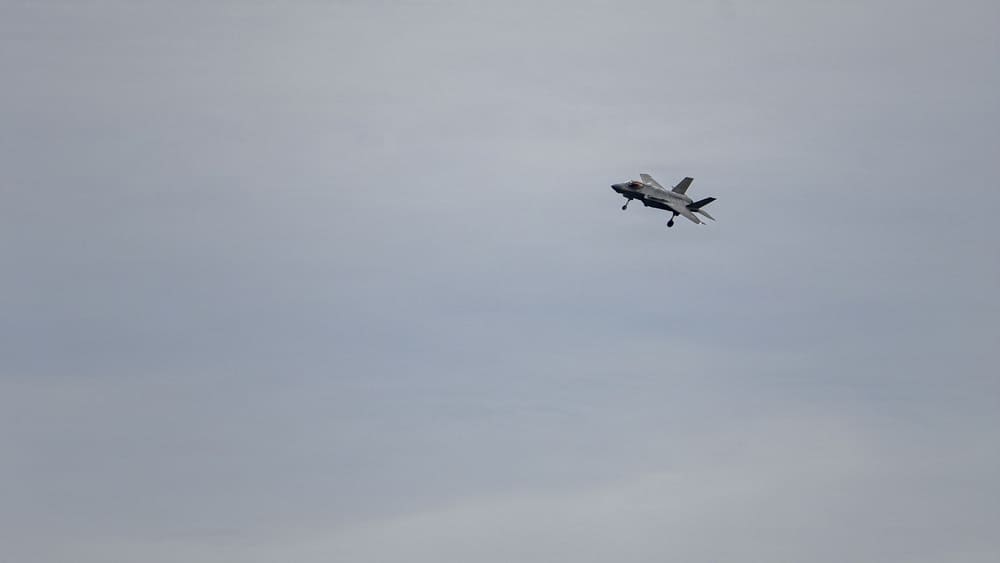
Switzerland has told its defense ministry to stay inside the six billion Swiss franc cap for its new fighter purchase, even if that means buying fewer than the planned 36 F-35A Lightning II jets. The Federal Council said it wants the highest possible number of aircraft within the previously approved budget.
“Due to foreseeable cost overruns, maintaining the originally planned number of 36 F-35As is not financially feasible,” the government said in a statement. Officials did not publish a revised quantity today, and they did not change the retirement dates that are driving the program schedule.
Swiss budget cap forces a smaller F-35A buy than the planned 36 jets
The six billion franc limit comes from a narrow public vote in 2020 that approved funding for a new fighter, before the aircraft type was chosen. That vote set a ceiling, not a price per jet. The government later selected the F-35A as the winner of the Air2030 competition and moved to contract for 36 aircraft.
The Federal Council’s direction today keeps the cap intact and shifts the problem to the order size. The defense ministry must now structure the purchase so it fits the original figure, even if the unit price, support package, or schedule looks different from what planners expected in 2021.
The immediate friction sits in the gap between the cap and more recent cost estimates shared with Bern. Swiss officials have cited added costs in the hundreds of millions of dollars, with some estimates rising above a billion, tied to inflation and other price pressures.
The government has argued in the past that Switzerland understood the deal as fixed-price. U.S. authorities have disputed that interpretation and said the total could move. The result has been a slow public drift away from the earlier “36 within six billion” picture.
Fixed-price dispute, audit pressure, and why the cost estimate changed
Parliamentary oversight has tightened since late summer. Swiss lawmakers asked for deeper scrutiny after new figures appeared, including a reported rise of roughly $650 million to $1.3 billion beyond earlier expectations. The numbers were tied to market conditions and program cost growth rather than a change in Switzerland’s stated requirements.
Defense officials confirm the Swiss defense department has been pressing U.S. counterparts for clarity on what elements can be held stable and what elements cannot. That effort matters because Switzerland’s domestic process treats the spending cap as a political constraint, not a target.
The U.S. side has pointed to factors that tend to sit outside a customer’s control, including changes in raw materials, energy costs, and inflation. Swiss officials have also raised the risk of additional costs driven by U.S. trade measures and related policy choices. Bern has publicly acknowledged it cannot guarantee a final fixed price under the current contract structure.
The audit pressure is not just about headlines. Switzerland’s procurement system moves slowly once big contracts lock. Today’s instruction keeps options open, but it also forces the defense ministry to decide what gets cut first if the gap remains.
What Switzerland’s F-35 budget has to cover beyond the airframes
The six billion franc ceiling is often discussed as “the jet budget,” but the total package goes beyond aircraft bodies. Large fighter buys normally include pieces that can swing the final figure by a lot: spares, ground equipment, training systems, simulators, weapons integration work, and base upgrades.
Public cost comparisons between countries can mislead for that reason. One government may put weapons and infrastructure inside the same pot. Another may fund those items through separate lines. Switzerland’s cap came first, then the aircraft choice, and the support costs have had to fit into that box.
According to industry sources familiar with European fighter purchases, buyers often discover that the easiest savings come from aircraft count, not from support items that protect readiness. Cutting spares or training too far creates second-order problems that show up later as aircraft availability drops.
Switzerland also has a schedule problem. The Swiss Air Force plans to retire its F-5 Tiger II fleet before the end of the decade, and its F/A-18C/D Hornets are expected to leave service around 2030. Those timelines limit how long Switzerland can delay decisions without risking a thinner air-policing posture.
The Air2030 selection in 2021 paired a fighter choice with a ground-based air defense plan that included Patriot. The government said then that “these two systems offer the highest overall benefit at the lowest overall cost.” That claim now sits under more pressure, since the F-35 portion is no longer fitting neatly inside the cap that helped sell the program to voters.
Sustainment and Block 4 upgrades shape the true cost of Swiss F-35 operations
The purchase debate has also shifted toward operating cost. Unit price gets attention, but long-term sustainment often decides whether fleets stay healthy over decades. The F-35’s maintenance and software model is complex, and it requires steady funding for parts, depot work, and periodic upgrades.
Delays to the Block 4 modernization package remain a separate concern for several F-35 customers. Block 4 is tied to new sensors, expanded weapons options, and broader electronic warfare updates. Customers also track how much they will pay for the retrofit path, and how long jets might fly with interim configurations.
Switzerland’s timeline matters because it plans to keep the new fighter as its main combat aircraft for decades. If early deliveries arrive before the full upgrade baseline is widely available, Switzerland could face a period of mixed configurations, with added training and sustainment friction.
None of this guarantees a collapse of the buy. Switzerland has already passed the biggest political hurdle by selecting the aircraft type and moving toward contract execution. Still, its history shows that fighter programs can be derailed even after a winner is chosen. A previous plan to buy Saab Gripen E/F fighters was rejected by a public vote in 2014 after the aircraft had already been selected.
Today’s move does not call for a new referendum or a new competition. It sets a financial constraint and pushes the defense ministry to adjust the package to match it. The simplest adjustment is quantity.
Our analysis shows the six billion franc ceiling now functions as a hard limiter on fleet size unless Switzerland secures a clear way to hold the total program price down across aircraft, support, and upgrade costs.
REFERENCE SOURCES
- https://www.reuters.com/world/europe/switzerland-seeks-talks-with-us-after-cost-increase-f-35-fighters-2025-06-25/
- https://www.reuters.com/business/aerospace-defense/switzerland-f-35-purchase-could-cost-more-government-says-2025-08-13/
- https://www.lemonde.fr/en/international/article/2025/07/01/switzerland-demands-clarification-from-us-on-f-35-fighter-price_6740241_4.html
- https://www.swissinfo.ch/eng/switzerland-s-f-35s-could-cost-more-than-expected–govt–/89551287
- https://www.diepresse.com/19738750/schweiz-will-wegen-kosten-stealth-jets-f-35-ueberdenken
- https://www.twz.com/air/swiss-poised-to-slash-f-35-order-as-costs-mount
- https://www.ar.admin.ch/en/home/ar/mitteilungen/medienmitteilungen.msg-id-106335.html
- https://www.dsca.mil/press-media/major-arms-sales/switzerland-f-35a-lightning-ii-joint-strike-fighter-aircraft